
Design Development and Delivery of Safety Management System

- Slides: 30
Design, Development and Delivery of Safety Management System Training to Transport Canada: Six Years and Counting David Wilson, Stantec (formerly Jacques Whitford) Roger Barker, ISR
Outline • The Mandate • The Plan • Course Design and Development – Transport Canada’s Start Point – Inclusion of International and Audit Content • Course Delivery – Institutional Challenges – Regional Challenges • Internal vs. External Reaction 2
The Mandate “The broad objectives of the SMS course are: • For Delegated Officers (DOs) and Management to develop a detailed understanding of SMS, thereby instilling confidence and obtaining buy-in to TC’s SMS program • For DOs to develop the skills necessary to execute their mandates in the assessment of SMS” 3
Aviation mission and vision To develop and administer policies and regulations for the safest civil aviation system for Canada and Canadians using a systems approach to managing risks – Continuous improvement – High level of public confidence Flight 2005: A Civil Aviation Framework for Canada 4
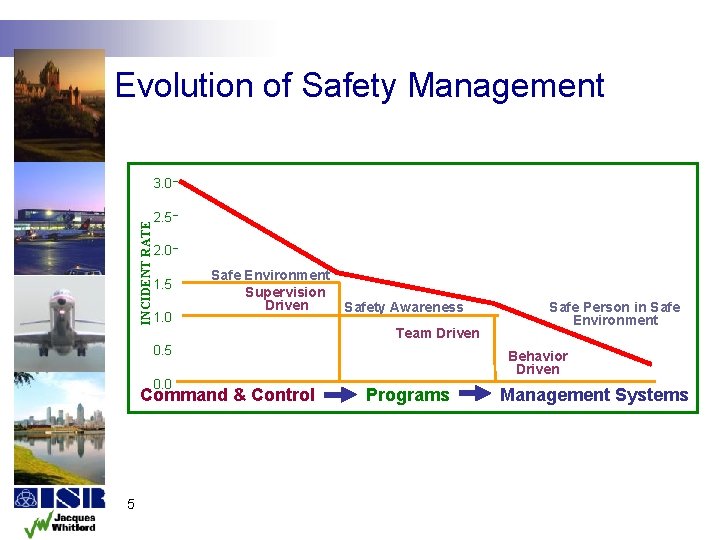
Evolution of Safety Management INCIDENT RATE 3. 0 2. 5 2. 0 1. 5 1. 0 Safe Environment Supervision Driven Safety Awareness Team Driven 0. 5 0. 0 Command & Control 5 Safe Person in Safe Environment Behavior Driven Programs Management Systems
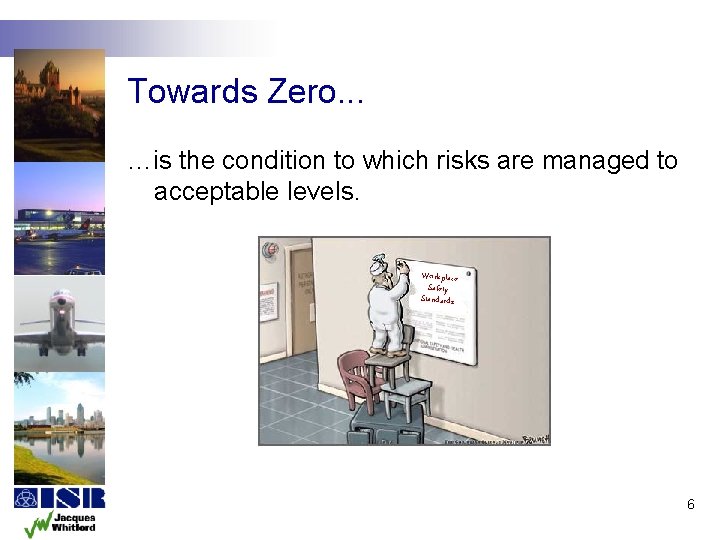
Towards Zero. . . …is the condition to which risks are managed to acceptable levels. Workplace Safety Standards 6
TC Requirements • “Aviation organizations should establish and maintain a safety management system that conforms to all of the requirements of applicable Canadian Aviation Regulations (CARs) and Standards” 7
TC Requirements There are 9 parts to the CARs: 1. General Provisions 2. Aircraft Identification and Registration and Operation of a Leased Aircraft by a NON-registered owner 3. Aerodromes and Airports 4. Personnel Licensing and Training 5. Airworthiness – Aircraft Certification (AC) – Maintenance & Manufacturing (M&M) 6. 7. 8. 9. General Operating and Flight Rules Commercial Air Services Air Navigation Services Repeals and Coming into Force 8
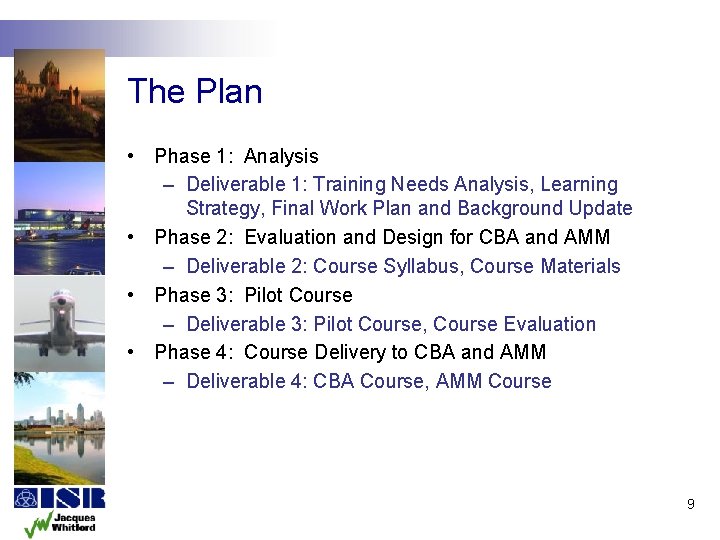
The Plan • Phase 1: Analysis – Deliverable 1: Training Needs Analysis, Learning Strategy, Final Work Plan and Background Update • Phase 2: Evaluation and Design for CBA and AMM – Deliverable 2: Course Syllabus, Course Materials • Phase 3: Pilot Course – Deliverable 3: Pilot Course, Course Evaluation • Phase 4: Course Delivery to CBA and AMM – Deliverable 4: CBA Course, AMM Course 9
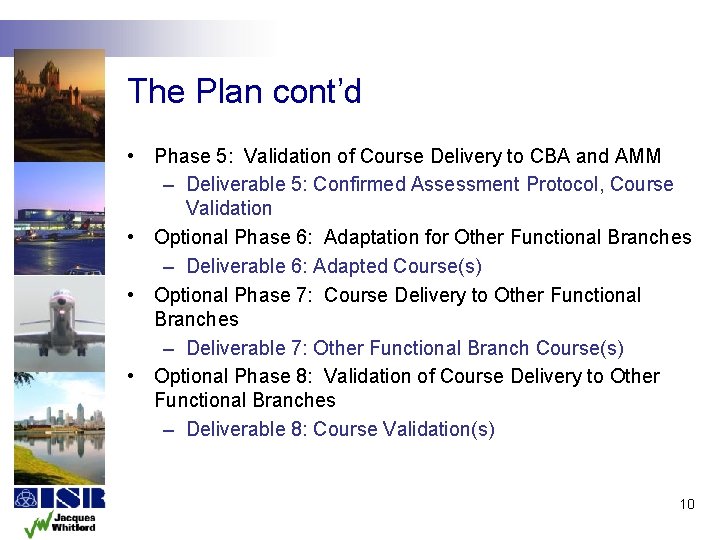
The Plan cont’d • Phase 5: Validation of Course Delivery to CBA and AMM – Deliverable 5: Confirmed Assessment Protocol, Course Validation • Optional Phase 6: Adaptation for Other Functional Branches – Deliverable 6: Adapted Course(s) • Optional Phase 7: Course Delivery to Other Functional Branches – Deliverable 7: Other Functional Branch Course(s) • Optional Phase 8: Validation of Course Delivery to Other Functional Branches – Deliverable 8: Course Validation(s) 10
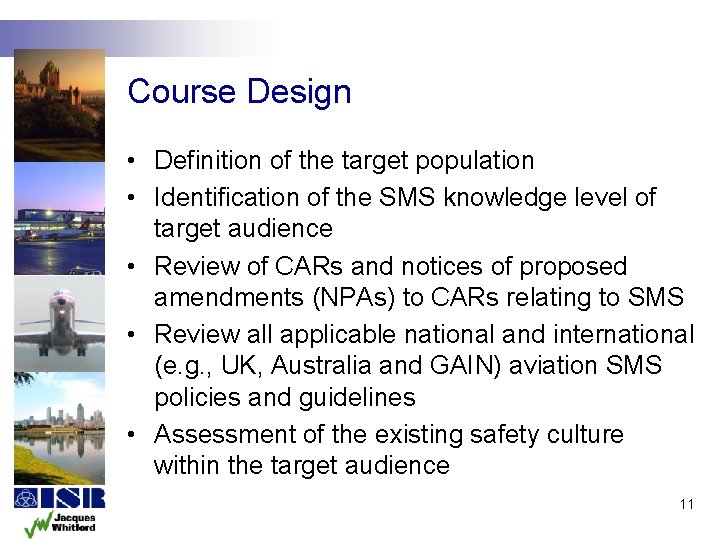
Course Design • Definition of the target population • Identification of the SMS knowledge level of target audience • Review of CARs and notices of proposed amendments (NPAs) to CARs relating to SMS • Review all applicable national and international (e. g. , UK, Australia and GAIN) aviation SMS policies and guidelines • Assessment of the existing safety culture within the target audience 11
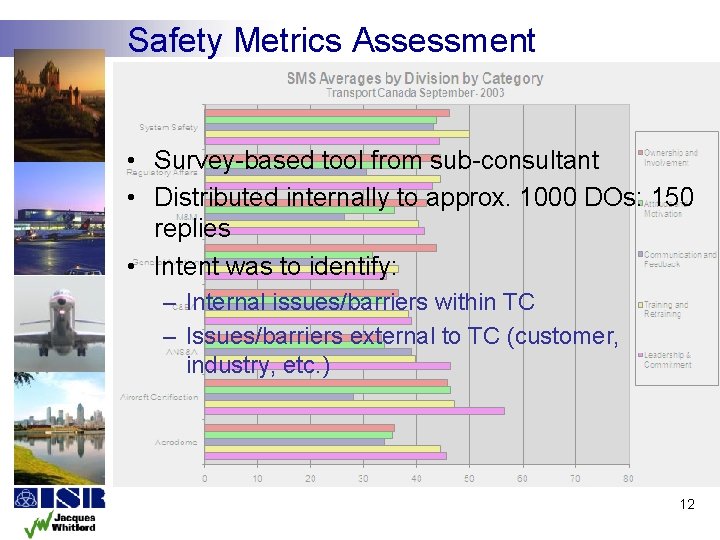
Safety Metrics Assessment • Survey-based tool from sub-consultant • Distributed internally to approx. 1000 DOs: 150 replies • Intent was to identify: – Internal issues/barriers within TC – Issues/barriers external to TC (customer, industry, etc. ) 12
Training Needs Assessment • Front line staff were fully aware of their needs and challenges – Different measures are required to measure safety and SMS; – The interdependencies of attitude, behaviour, and motivation cannot be ignored – Inspectors need practical demonstration of a functioning SMS from the ground up, – If support, guidance, and structural leadership from management are not forthcoming (as happened with Risk Management training), then SMS training will fail. 13
Global Review of TC SMS • Global references: – – OHSAS 18001 GAIN CASA Australia - Guide to Aviation SMS for Commercial Air Transport Operations - Guide to Implementation (UK) – OGP Checklist for an audit of safety management • Resulting additions to the TC model: – – Continuous Improvement Feedback Annual Management Review of the SMS Contractors must meet safety standards which do not impinge on the SMS of the organisation – Inter and Intra-company Safety Performance Comparison 14
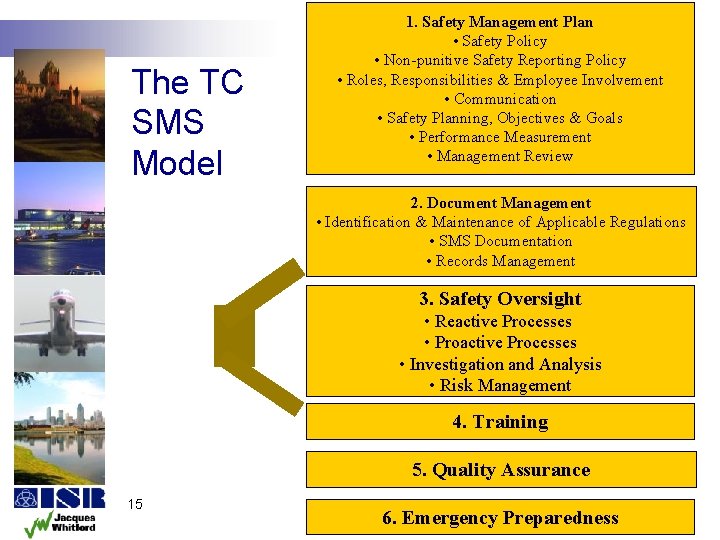
The TC SMS Model 1. Safety Management Plan • Safety Policy • Non-punitive Safety Reporting Policy • Roles, Responsibilities & Employee Involvement • Communication • Safety Planning, Objectives & Goals • Performance Measurement • Management Review 2. Document Management • Identification & Maintenance of Applicable Regulations • SMS Documentation • Records Management 3. Safety Oversight • Reactive Processes • Proactive Processes • Investigation and Analysis • Risk Management 4. Training 5. Quality Assurance 15 6. Emergency Preparedness
Course Development • Addressing Gaps: – Audit Approach – Approach to Assessing SMS: Assessors vs. Inspectors – The TC SMS Model vs. Plan-Do-Check-Act 16
Course Delivery • Initial 4 -day course (‘ 03 -’ 04) – 19 deliveries • V 2: 4 -day course (’ 04 -’ 05) – 18 deliveries • V 3: 3 -day course (’ 05 -’ 09) – 15 deliveries (e. Learning course starts in fall ‘ 09) • 2 -day awareness course • 2 -day multi-model course • ½ day refresher course 17
3 -day Course Content • History of SMS • Introduction to TC SMS • SMS Elements – Safety Management Plan – Documentation – Safety Oversight – QA, Training, EPR • Safety Performance Measurement • Safety Culture • Implementation of SMS • SMS Evaluation Guide • Process to Assess Industry SMS • Completing the Assessment 18
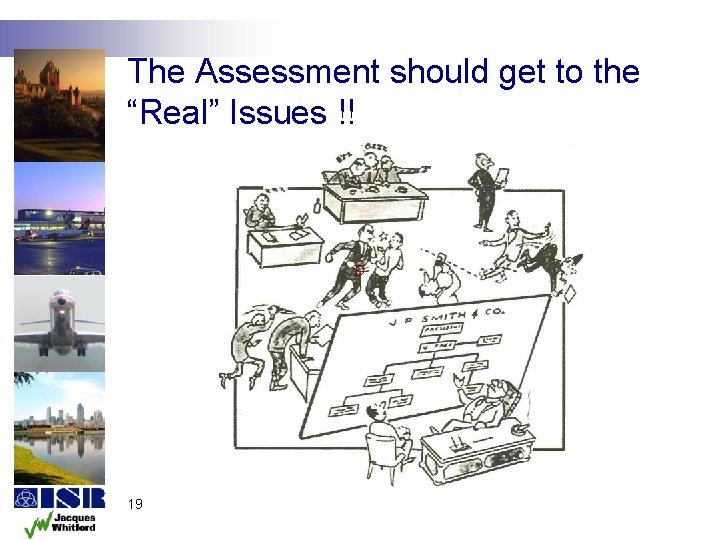
The Assessment should get to the “Real” Issues !! D 19
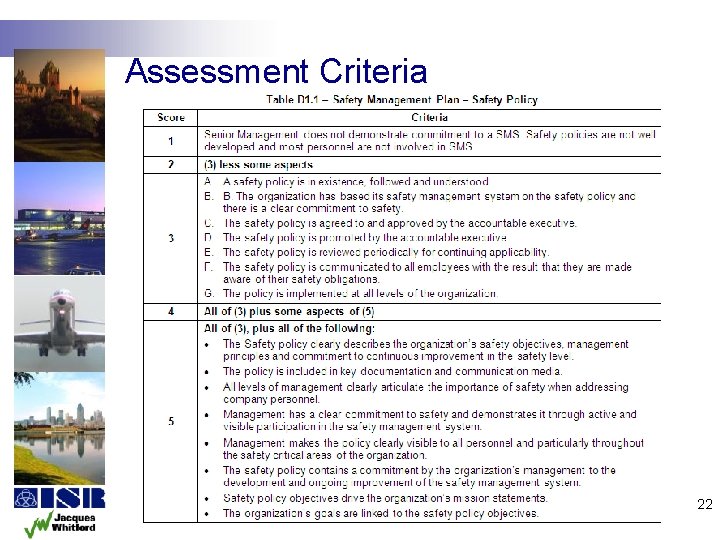
Addition of Broader Audit Approach • DOs used to inspections and checklist-driven audits • ‘Process’ vs. ‘procedure’ view not well differentiated: had to get up out of the trees • No methodology for producing defensible, quantified assessments of SMS: development of the SMS Assessment Process 20
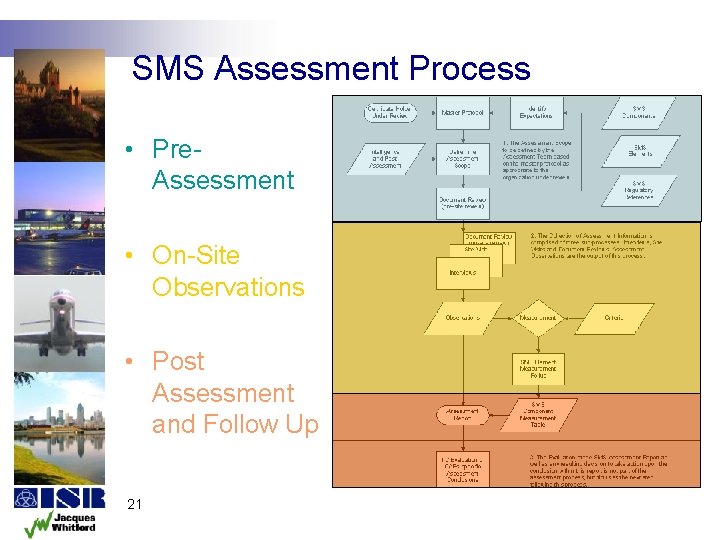
SMS Assessment Process • Pre. Assessment • On-Site Observations • Post Assessment and Follow Up 21
Assessment Criteria 22
Plugging the Holes with PDCA • Gaps in management system elements identified in course design were not addressed until V 2/V 3 of the course: – Management review – Proactive process (risk management) • Some backlash from attendees as a result, however intent was to arm DOs as best possible to allow them to engage industry 23
Institutional Challenges • SMS needs a Paradigm shift within aviation from : – DOs are responsible for aviation safety • responsible for operator’s actions and take accountability for them – Operators must get all actions approved by TC – Audits of operators are only done by DOs and the operators cannot be trusted to do carry out internal ones themselves – Conflict of interest in the "old way of doing things" 24
Regional Challenges • Different degrees of involvement and engagement by Regional Directors • Regional cultural differences: adversarial vs. partner approaches from POIs/PMIs 25
Internal vs. External Reaction • Within TC: – Sounds good in theory – Are we prepared to back this up? – How does this system scale from large to small? – Will TC really enforce the SMS CARS? 26
Internal vs. External Reaction cont’d • Within industry: – Larger operators/AMOs/airports: we do this now (but may lack some rigour…) – Hazard analysis and identifying risk significant activities often a weakness – Smaller operators: what is it exactly that you want me to do (and when exactly do I get to make a living…)? 27
In Conclusion • Training of TC Civil Aviation a major undertaking (time, personnel, cost) • Paradigm shift just now starting to show broadly in TC • Communicate, communicate: can it ever be enough? • We senior managers taking more of a lead, and see that aviation experts are needing to become more proficient in management 28
In Conclusion cont’d • SMS is about risk control - the loop of hazardrisk-objectives-measures-audit-management review drives a big shift in the way management perceive their roles and forces communication into the organizations • Tough part awaits: small operators • Grateful to have been able to play a role 29
Questions