
Design construction and characterization of a lowcost spectrometer
- Slides: 1
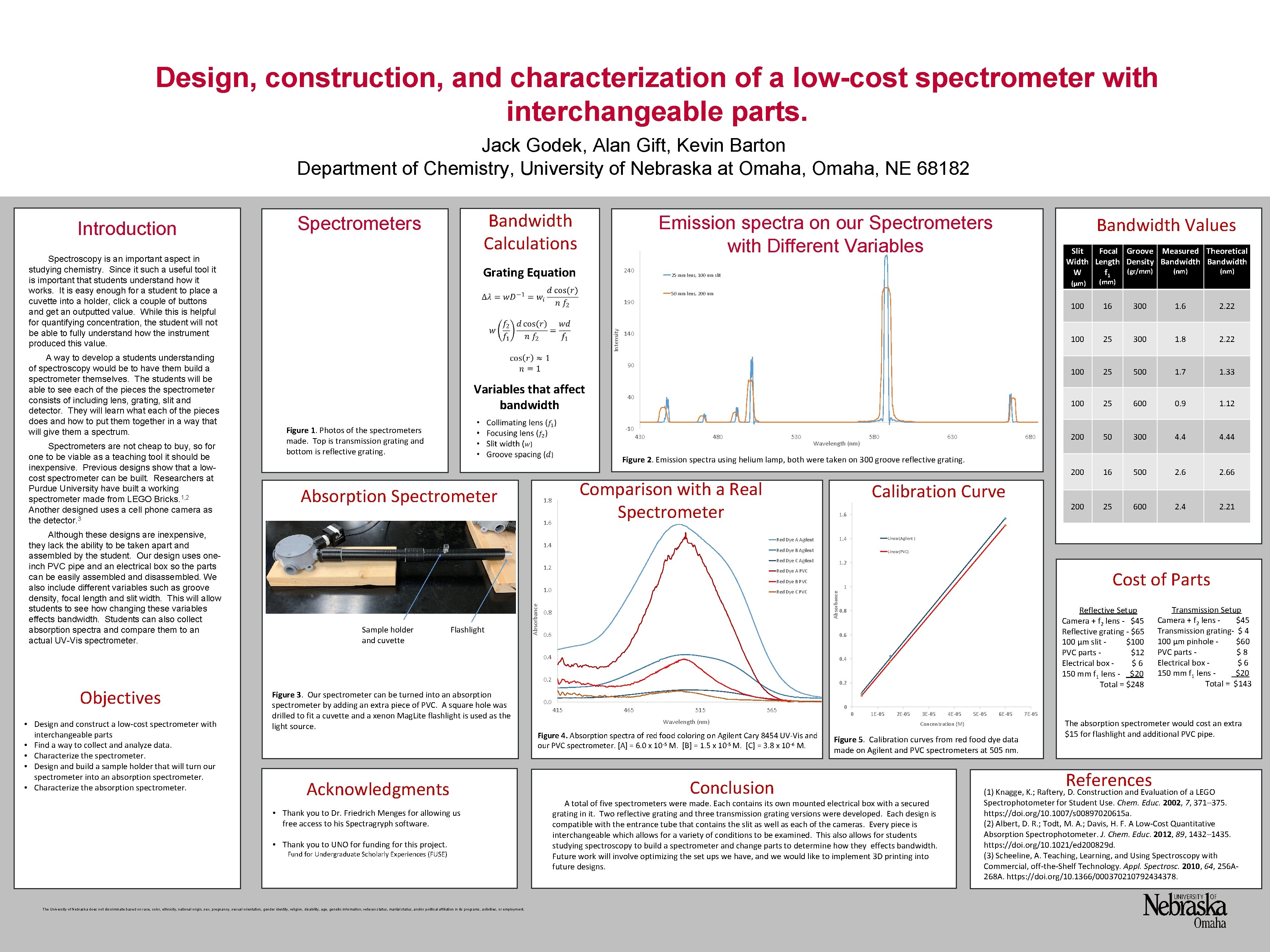
Design, construction, and characterization of a low-cost spectrometer with interchangeable parts. Jack Godek, Alan Gift, Kevin Barton Department of Chemistry, University of Nebraska at Omaha, NE 68182 Spectroscopy is an important aspect in studying chemistry. Since it such a useful tool it is important that students understand how it works. It is easy enough for a student to place a cuvette into a holder, click a couple of buttons and get an outputted value. While this is helpful for quantifying concentration, the student will not be able to fully understand how the instrument produced this value. Spectrometers are not cheap to buy, so for one to be viable as a teaching tool it should be inexpensive. Previous designs show that a lowcost spectrometer can be built. Researchers at Purdue University have built a working spectrometer made from LEGO Bricks. 1, 2 Another designed uses a cell phone camera as the detector. 3 Although these designs are inexpensive, they lack the ability to be taken apart and assembled by the student. Our design uses oneinch PVC pipe and an electrical box so the parts can be easily assembled and disassembled. We also include different variables such as groove density, focal length and slit width. This will allow students to see how changing these variables effects bandwidth. Students can also collect absorption spectra and compare them to an actual UV-Vis spectrometer. Objectives • Design and construct a low-cost spectrometer with interchangeable parts • Find a way to collect and analyze data. • Characterize the spectrometer. • Design and build a sample holder that will turn our spectrometer into an absorption spectrometer. • Characterize the absorption spectrometer. 240 Bandwidth Values Slit Focal Groove Measured Theoretical Width Length Density Bandwidth (gr/mm) (nm) W f 1 25 mm lens, 100 um slit Intensity 190 140 90 Variables that affect bandwidth Figure 1. Photos of the spectrometers made. Top is transmission grating and bottom is reflective grating. 40 -10 (mm) 100 16 300 1. 6 2. 22 100 25 300 1. 8 2. 22 100 25 500 1. 7 1. 33 100 25 600 0. 9 1. 12 430 480 530 Wavelength (nm) Comparison with a Real Spectrometer 1. 8 1. 6 1. 4 200 50 300 4. 44 200 16 500 2. 66 200 25 600 2. 4 2. 21 Red Dye C Agilent 1. 2 • Thank you to Dr. Friedrich Menges for allowing us free access to his Spectragryph software. • Thank you to UNO for funding for this project. Fund for Undergraduate Scholarly Experiences (FUSE) The University of Nebraska does not discriminate based on race, color, ethnicity, national origin, sex, pregnancy, sexual orientation, gender identity, religion, disability, age, genetic information, veteran status, marital status, and/or political affiliation in its programs, activities, or employment. Cost of Parts Red Dye A PVC 1. 0 Red Dye C PVC 0. 8 1 0. 6 0. 4 0. 2 415 465 515 565 Wavelength (nm) Figure 4. Absorption spectra of red food coloring on Agilent Cary 8454 UV-Vis and our PVC spectrometer. [A] = 6. 0 x 10 -5 M. [B] = 1. 5 x 10 -5 M. [C] = 3. 8 x 10 -6 M. Conclusion Reflective Setup Camera + f 2 lens - $45 Reflective grating - $65 100 μm slit - $100 PVC parts - $12 Electrical box - $ 6 150 mm f 1 lens - $20 Total = $248 0. 6 0. 0 Linear(Agilent ) Linear(PVC) Red Dye B PVC Acknowledgments 680 1. 6 Red Dye B Agilent 1. 2 Figure 3. Our spectrometer can be turned into an absorption spectrometer by adding an extra piece of PVC. A square hole was drilled to fit a cuvette and a xenon Mag. Lite flashlight is used as the light source. 630 Calibration Curve Red Dye A Agilent 1. 4 Flashlight 580 Figure 2. Emission spectra using helium lamp, both were taken on 300 groove reflective grating. Absorption Spectrometer Sample holder and cuvette (μm) 50 mm lens, 200 um Absorbance A way to develop a students understanding of spectroscopy would be to have them build a spectrometer themselves. The students will be able to see each of the pieces the spectrometer consists of including lens, grating, slit and detector. They will learn what each of the pieces does and how to put them together in a way that will give them a spectrum. Emission spectra on our Spectrometers with Different Variables Grating Equation Absorbance Introduction Bandwidth Calculations Spectrometers Transmission Setup Camera + f 2 lens - $45 Transmission grating- $ 4 100 μm pinhole - $60 PVC parts - $ 8 Electrical box - $ 6 150 mm f 1 lens - $20 Total = $143 0 0 1 E-05 2 E-05 3 E-05 4 E-05 5 E-05 6 E-05 Concentration (M) Figure 5. Calibration curves from red food dye data made on Agilent and PVC spectrometers at 505 nm. A total of five spectrometers were made. Each contains its own mounted electrical box with a secured grating in it. Two reflective grating and three transmission grating versions were developed. Each design is compatible with the entrance tube that contains the slit as well as each of the cameras. Every piece is interchangeable which allows for a variety of conditions to be examined. This also allows for students studying spectroscopy to build a spectrometer and change parts to determine how they effects bandwidth. Future work will involve optimizing the set ups we have, and we would like to implement 3 D printing into future designs. 7 E-05 The absorption spectrometer would cost an extra $15 for flashlight and additional PVC pipe. References (1) Knagge, K. ; Raftery, D. Construction and Evaluation of a LEGO Spectrophotometer for Student Use. Chem. Educ. 2002, 7, 371– 375. https: //doi. org/10. 1007/s 00897020615 a. (2) Albert, D. R. ; Todt, M. A. ; Davis, H. F. A Low-Cost Quantitative Absorption Spectrophotometer. J. Chem. Educ. 2012, 89, 1432– 1435. https: //doi. org/10. 1021/ed 200829 d. (3) Scheeline, A. Teaching, Learning, and Using Spectroscopy with Commercial, off-the-Shelf Technology. Appl. Spectrosc. 2010, 64, 256 A 268 A. https: //doi. org/10. 1366/000370210792434378.