
Design Considerations and Preliminary Evaluation for an offthevisor
- Slides: 26
Design Considerations and Preliminary Evaluation for an off-the-visor wide field of view HMD Russell S. Draper, Charles D. Balogh Night vision Electronic Sensors Directorate Steven J. Robbins Kaiser Electronics, San Jose, CA
Introduction • Purpose – Performance evaluation of a prototype binocular, WFOV, “off-visor” HMD – Army’s interest in a “Jet Fighter” HMD? • Directed development for Objective Force Warrior – Multi-spectral head worn sensor system – Possible form: binocular/see through vision system • Maintain expertise in “state-of-the-art” HMD technology
Introduction • Purpose – Test key performance attributes • FOV • Resolution – Test key ergonomic attributes • Eye box • Binocular alignment/stability • Head borne weight/CG
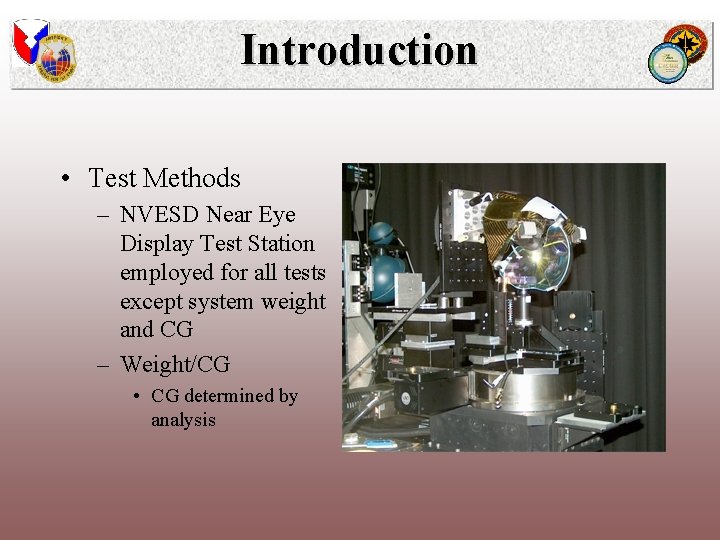
Introduction • Test Methods – NVESD Near Eye Display Test Station employed for all tests except system weight and CG – Weight/CG • CG determined by analysis
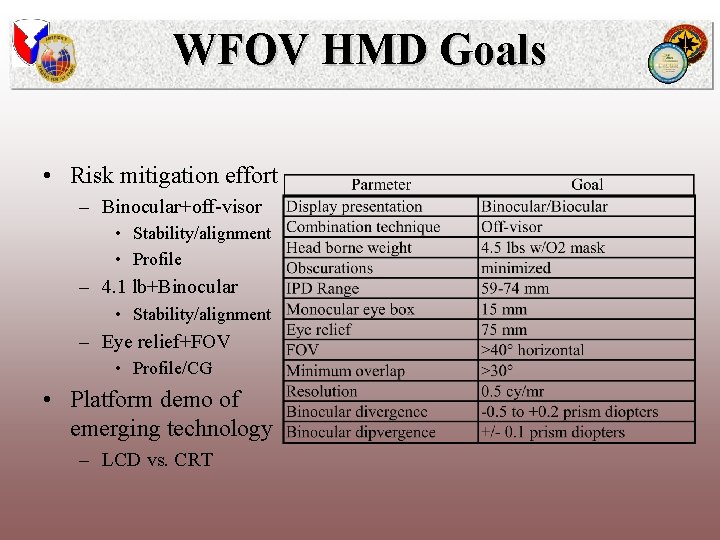
WFOV HMD Goals • Risk mitigation effort – Binocular+off-visor • Stability/alignment • Profile – 4. 1 lb+Binocular • Stability/alignment – Eye relief+FOV • Profile/CG • Platform demo of emerging technology – LCD vs. CRT
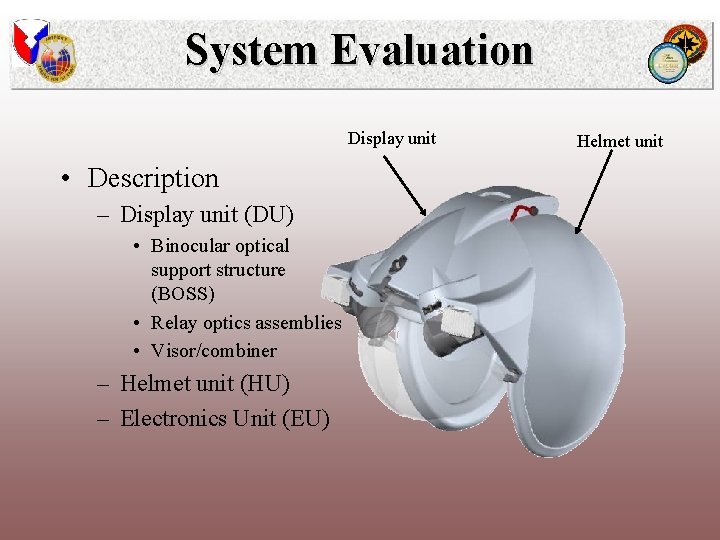
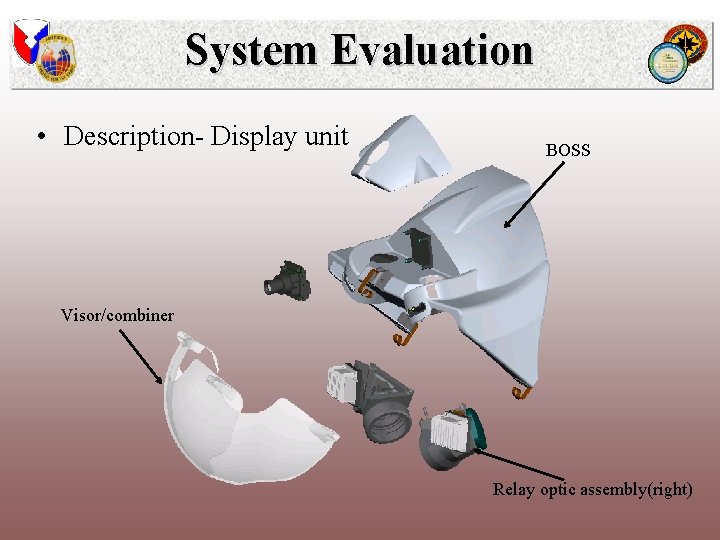
System Evaluation Display unit • Description – Display unit (DU) • Binocular optical support structure (BOSS) • Relay optics assemblies • Visor/combiner – Helmet unit (HU) – Electronics Unit (EU) Helmet unit
System Evaluation • Description- Display unit BOSS Visor/combiner Relay optic assembly(right)
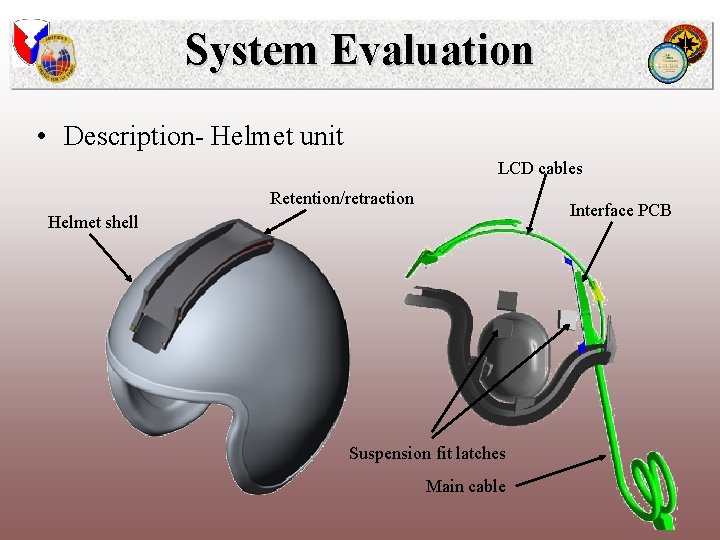
System Evaluation • Description- Helmet unit LCD cables Retention/retraction Interface PCB Helmet shell Suspension fit latches Main cable
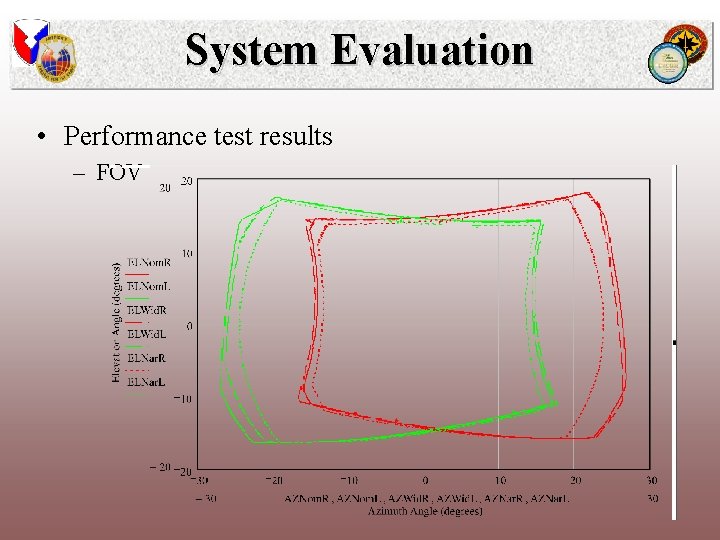
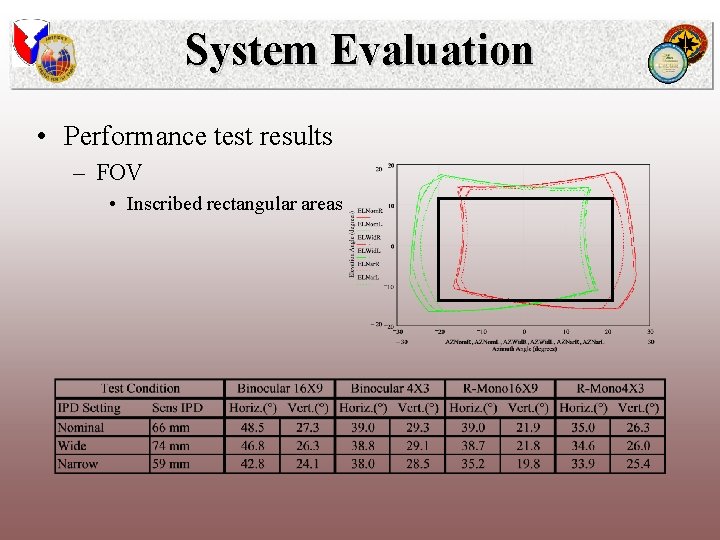
System Evaluation • Performance test results: FOV – Methods • Display active area driven to full “on” condition • Digital image frame captured with NEDTS WFOV CCD array sensor • Unique edge detection algorithm applied to captured image – Edge detection starts at center and propagates outward • Edge pixel values converted to angle space using NEDTS WFOV lens mapping. • Test performed on right and left channels, 3 IPD settings each with sensor located at IPD setting design eye position.
System Evaluation • Performance test results – FOV
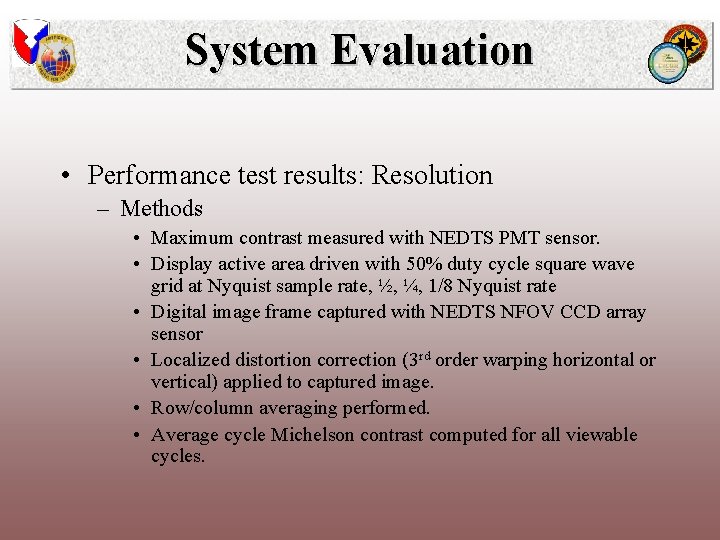
System Evaluation • Performance test results – FOV • Inscribed rectangular areas
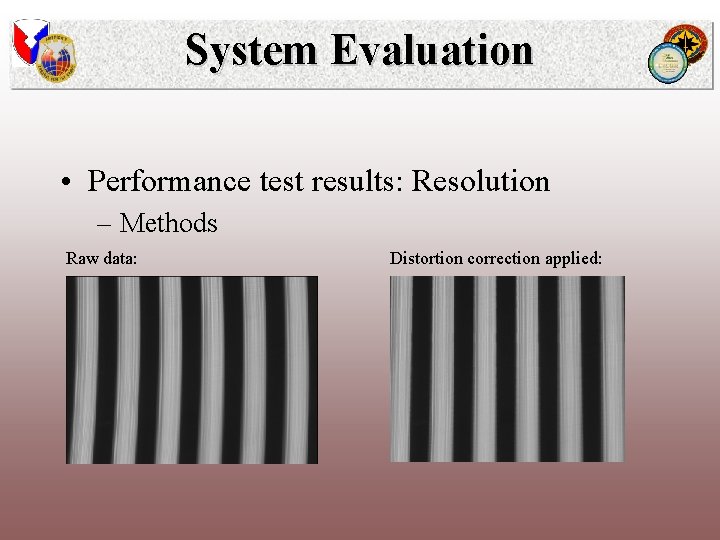
System Evaluation • Performance test results: Resolution – Methods • Maximum contrast measured with NEDTS PMT sensor. • Display active area driven with 50% duty cycle square wave grid at Nyquist sample rate, ½, ¼, 1/8 Nyquist rate • Digital image frame captured with NEDTS NFOV CCD array sensor • Localized distortion correction (3 rd order warping horizontal or vertical) applied to captured image. • Row/column averaging performed. • Average cycle Michelson contrast computed for all viewable cycles.
System Evaluation • Performance test results: Resolution – Methods Raw data: Distortion correction applied:
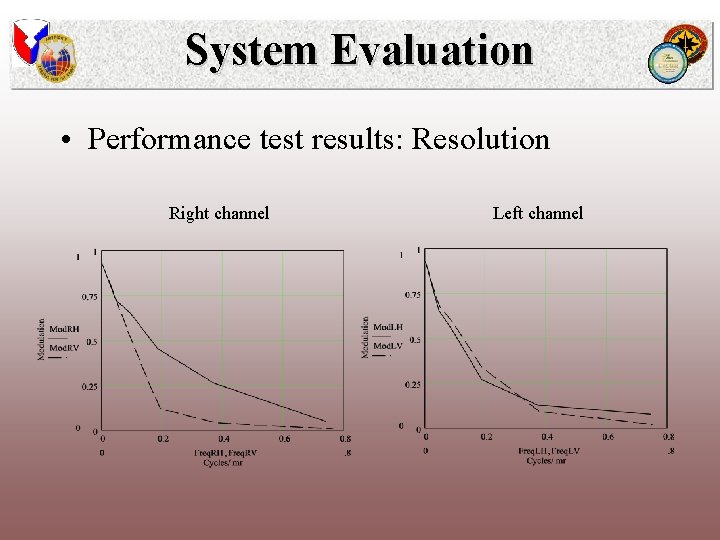
System Evaluation • Performance test results: Resolution Right channel Left channel
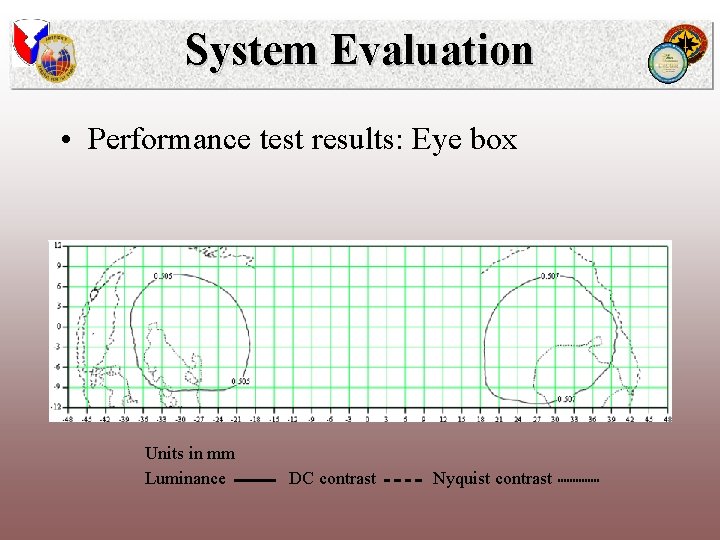
System Evaluation • Performance test results: Eye box – Methods • 2 D scan of eye left and right side design eye location +/-12 mm vertical and +/-15 mm horizontal • 3 parameters measured at each scan position – Luminance – On/off contrast – Nyquist rate contrast • Plotted 50% contour of normalized data
System Evaluation • Performance test results: Eye box Units in mm Luminance DC contrast Nyquist contrast
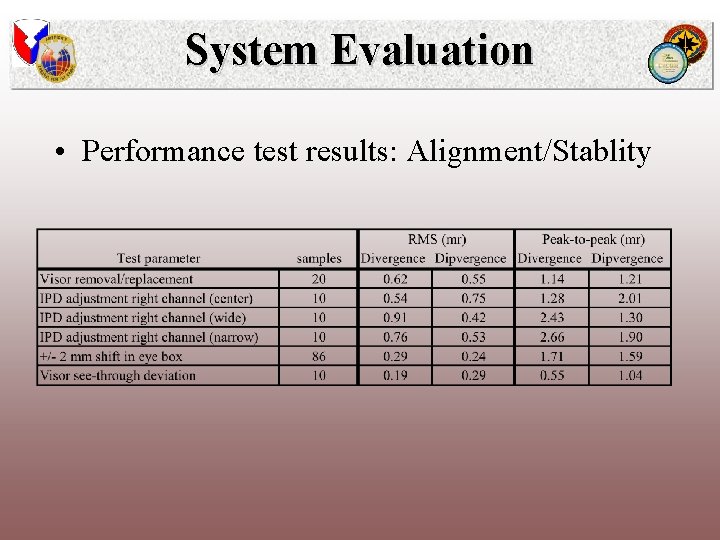
System Evaluation • Performance test results: Alignment/Stablity – Methods • Visor removal/replacement – Single 5 mr spot at approximately 0, 0 field position displayed in each channel – Visor removed and replaced 20 times – Field location of test spot measured with each trial – Relative change between right and left channels recorded.
System Evaluation • Performance test results: Alignment/Stablity – Methods • IPD adjustment – Single 5 mr spot at approximately 0, 0 field position displayed in each channel – IPD adjusted on single channel through all three settings for 10 trials – Field location of test spot measured with each trial for each channel – Relative change between right and left channel recorded
System Evaluation • Performance test results: Alignment/Stablity – Methods • Eye position shift – 2 -D Grid of 5 mr points displayed at approximately 4° increments – Sensor position moved in eye box from design eye location at nominal IPD +/- 2 mm horizontally and vertically – Field location of test spot measured with each trial for each channel – Relative change between right and left channel for corresponding spots within the binocular overlap region recorded
System Evaluation • Performance test results: Alignment/Stablity – Methods • Visor See through deviation – Collimated “plus” symbol generated with bright line theodolite outside of visor at specific field angle relative to DU. – NEDTS sensor with digital cross hair oriented to view collimated image until digital cross hair overlaped “plus” symbol – Visor removed – Theodolite adjusted to re-position “plus” symbol on cross hair – Theodolite change in azimuth/elevation recorded
System Evaluation • Performance test results: Alignment/Stablity
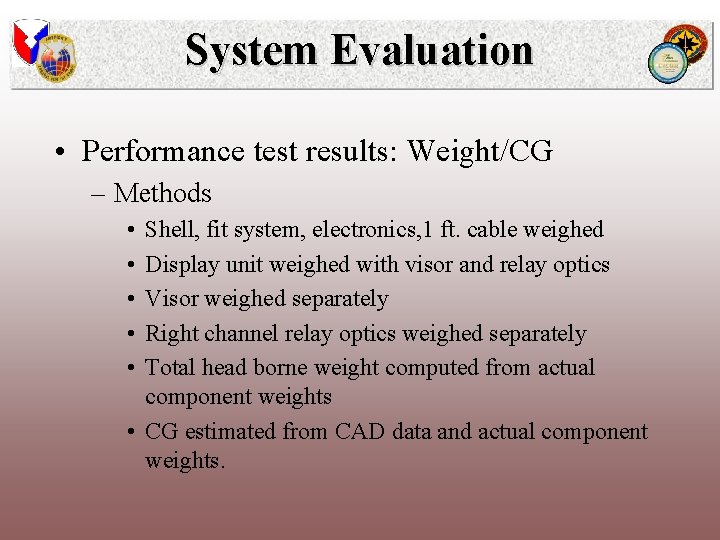
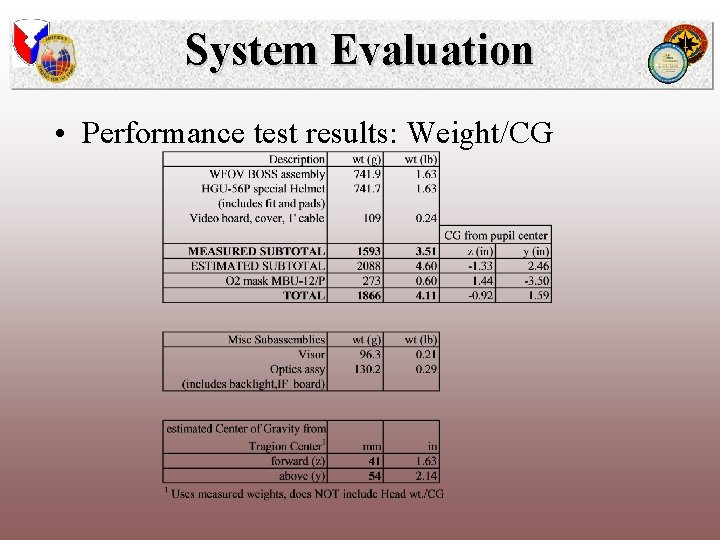
System Evaluation • Performance test results: Weight/CG – Methods • • • Shell, fit system, electronics, 1 ft. cable weighed Display unit weighed with visor and relay optics Visor weighed separately Right channel relay optics weighed separately Total head borne weight computed from actual component weights • CG estimated from CAD data and actual component weights.
System Evaluation • Performance test results: Weight/CG
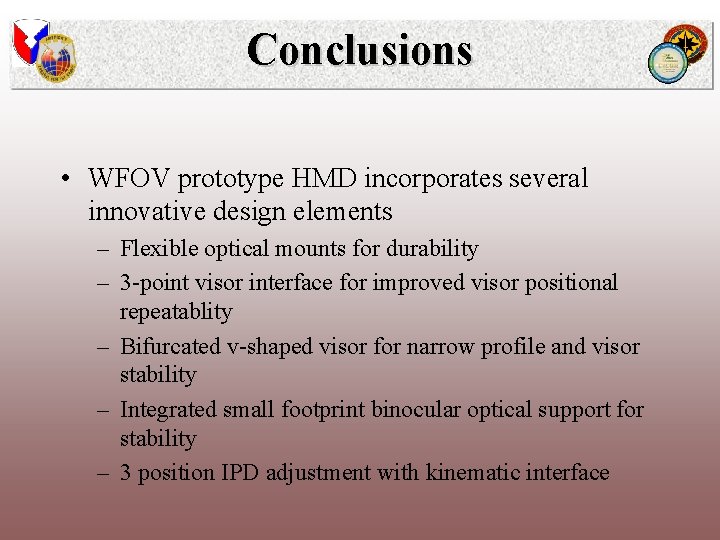
Conclusions • WFOV prototype HMD incorporates several innovative design elements – Flexible optical mounts for durability – 3 -point visor interface for improved visor positional repeatablity – Bifurcated v-shaped visor for narrow profile and visor stability – Integrated small footprint binocular optical support for stability – 3 position IPD adjustment with kinematic interface
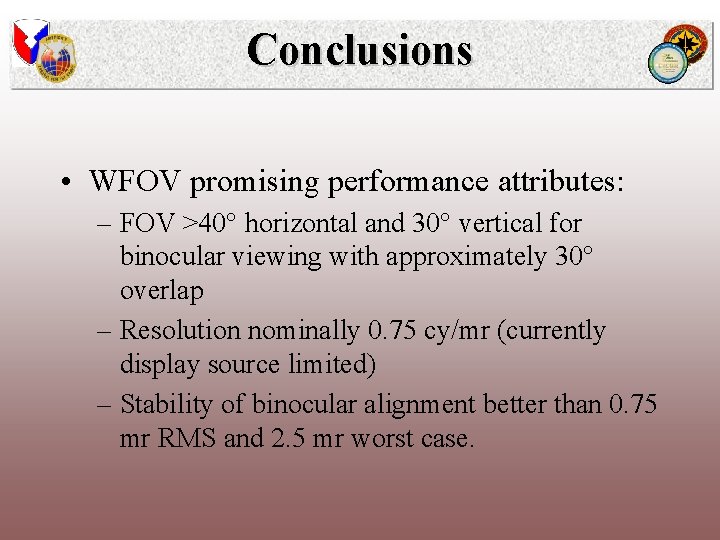
Conclusions • WFOV promising performance attributes: – FOV >40° horizontal and 30° vertical for binocular viewing with approximately 30° overlap – Resolution nominally 0. 75 cy/mr (currently display source limited) – Stability of binocular alignment better than 0. 75 mr RMS and 2. 5 mr worst case.
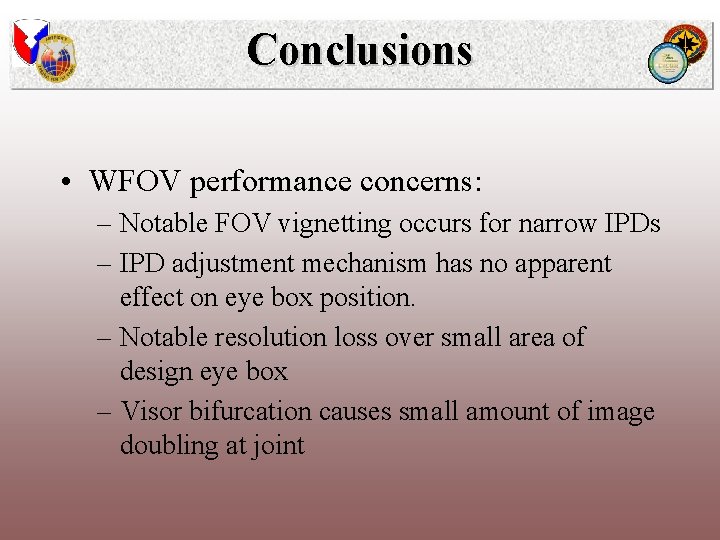
Conclusions • WFOV performance concerns: – Notable FOV vignetting occurs for narrow IPDs – IPD adjustment mechanism has no apparent effect on eye box position. – Notable resolution loss over small area of design eye box – Visor bifurcation causes small amount of image doubling at joint