
Design by contract ObjectOriented Software Construction by Bertrand
Design by contract • Object-Oriented Software Construction by Bertrand Meyer, Prentice Hall • The presence of a precondition or postcondition in a routine is viewed as a contract. 9/19/2021 Design by Contract 1
Rights and obligations • Parties in the contract: class and clients • require pre, ensure post with method r: If you promise to call r with pre satisfied then I, in return, promise to deliver a final state in which post is satisfied. • Contract: entails benefits and obligations for both parties 9/19/2021 Design by Contract 2
Rights and obligations • Precondition binds clients • Postcondition binds class 9/19/2021 Design by Contract 3
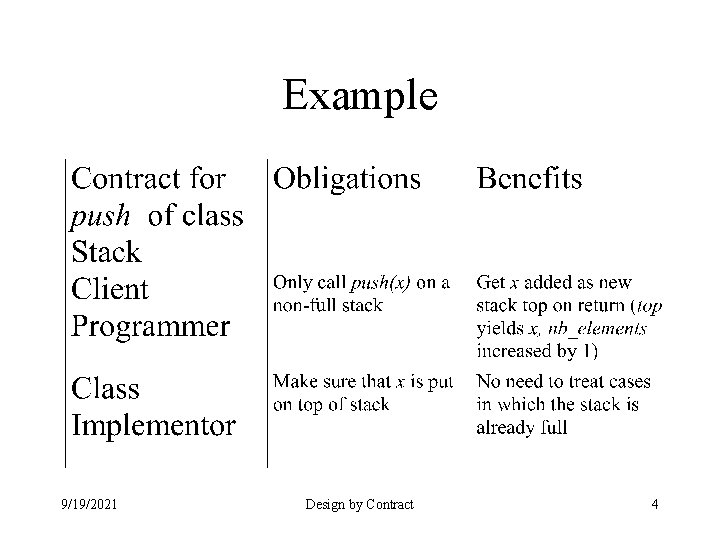
Example 9/19/2021 Design by Contract 4
If precondition is not satisfied • If client’s part of the contract is not fulfilled, class can do what it pleases: return any value, loop indefinitely, terminate in some wild way. • Advantage of convention: simplifies significantly the programming style. 9/19/2021 Design by Contract 5
Source of complexity • Does data passed to a method satisfy requirement for correct processing? • Problem: no checking at all or: multiple checking. • Multiple checking: conceptual pollution: redundancy; complicates maintenance • Recommended approach: use preconditions 9/19/2021 Design by Contract 6
Class invariants and class correctness • Preconditions and postconditions describe properties of individual methods • Need for global properties of instances which must be preserved by all routines • 0<=nb_elements; nb_elements<=max_size 9/19/2021 Design by Contract 7
Class invariants and class correctness • A class invariant is an assertion appearing in the invariant clause of the class. • Must be satisfied by all instances of the class at all “stable” times (instance in stable state): – on instance creation – before and after every remote call to a routine (may be violated during call) 9/19/2021 Design by Contract 8
Class invariants and class correctness • A class invariant only applies to public methods; private methods are not required to maintain the invariant. 9/19/2021 Design by Contract 9
Invariant Rule • An assertion I is a correct class invariant for a class C iff the following two conditions hold: – The constructor of C, when applied to arguments satisfying the constructor’s precondition in a state where the attributes have their default values, yields a state satisfying I. – Every public method of the class, when applied to arguments and a state satisfying both I and the method’s precondition, yields a state satisfying I. 9/19/2021 Design by Contract 10
Invariant Rule • Precondition of a method may involve the initial state and the arguments • Postcondition of a method may only involve the final state, the initial state (through old) and in the case of a function, the returned value. • The class invariant may only involve the state 9/19/2021 Design by Contract 11
Invariant Rule • The class invariant is implicitly added (anded) to both the precondition and postcondition of every exported routine • Could do, in principle, without class invariants. But they give valuable information. • Class invariant acts as control on evolution of class • A class invariant applies to all contracts between a method of the class and a client 9/19/2021 Design by Contract 12
Definitions • Class C • INV class invariant • method r: prer(xr) precondition; postr postcondition • xr: possible arguments of r • Br: body of method r • Default. C: attributes have default values 9/19/2021 Design by Contract 13
Correctness of a class • A class C is said to be correct with respect to its assertions if and only if – For every public method r other than the constructor and any set of valid arguments xr: {INV and prer(xr)} Br {INV and postr} – For any valid set of arguments x. C to the constructor: {Default. C and pre. C(x. C) BC {INV} 9/19/2021 Design by Contract 14
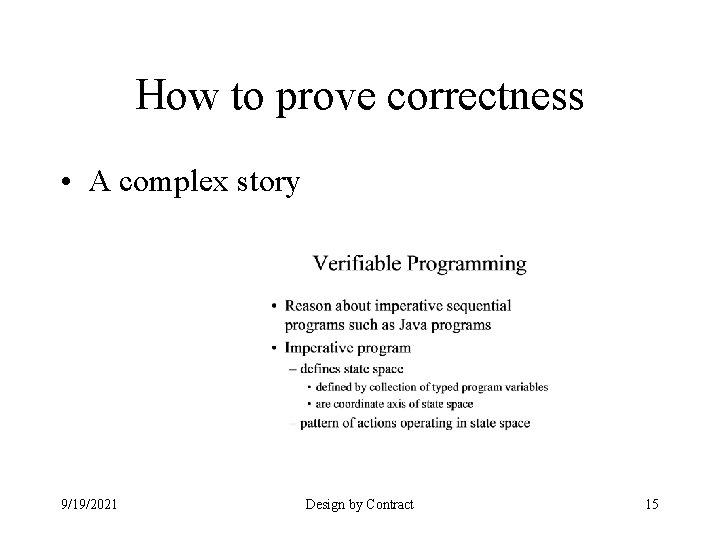
How to prove correctness • A complex story 9/19/2021 Design by Contract 15

The End 9/19/2021 Design by Contract 16
- Slides: 16