
Design Bases From 1957 to 2003 June 18
Design Bases From 1957 to 2003 June 18, 2007 Chuck Casto Region II NRC
HISTORY OF DESIGN BASES • Atomic Energy Act of 1954 – (1957 Thru 1962) • Section 182 • Technical Specifications are part of license • Implemented in 10 CFR 50. 34 & 50. 36 • Hazards Summary Report – Safety Analysis Report

HISTORY OF DESIGN BASES (cont’d) • Two approaches for Tech Specs – Vallecitos –Include entire Hazard Summary Report – Yankee Atomic – TS culled from Hazard Summary Report • Section 189 – Mandatory hearing for issuance of license or license amendment

HISTORY OF DESIGN BASES (cont’d) • Results were unworkable – Diminishing return – Mandatory Hearing – Need recognized for discriminating significant and insignificant changes • The Vallecitos Decision (1960) – Concept of Unreviewed Safety Question (10 CFR 50. 59) – No significant hazards consideration (10 CFR 50. 92)
HISTORY OF DESIGN BASES (cont’d) • Regulations to manage changes – 10 CFR 50. 59 – 10 CFR 50. 91 – 10 CFR 50. 92

Early History of 50. 59 • “Clarifies” the extent which the • licensee may make changes, conduct tests & experiments not specifically provided in the license Changes: – 1. Explicit license authority – 2. Credible probability by possibility – 3. Licensee can conduct test & experiments in HAR approved by NRC • April 8, 1961 (AEC) NRC issues proposed Rule • June 9, 1962 50. 59 issued
Early History of 50. 59 • Changed reference to Safety Analysis Report from HAR (HSR) • 1966 • Tech Specs could serve purpose with less content. The PSAR & SAR explicitly specified and Bases for TS were required • August 16, 1986 Proposed Rule change • Final Rule change brought in • December 17, 1988 Rule Revised – 1. Consideration of “malfunctions” – 2. Inclusions of the “margin of safety” as defined in the bases for any TS

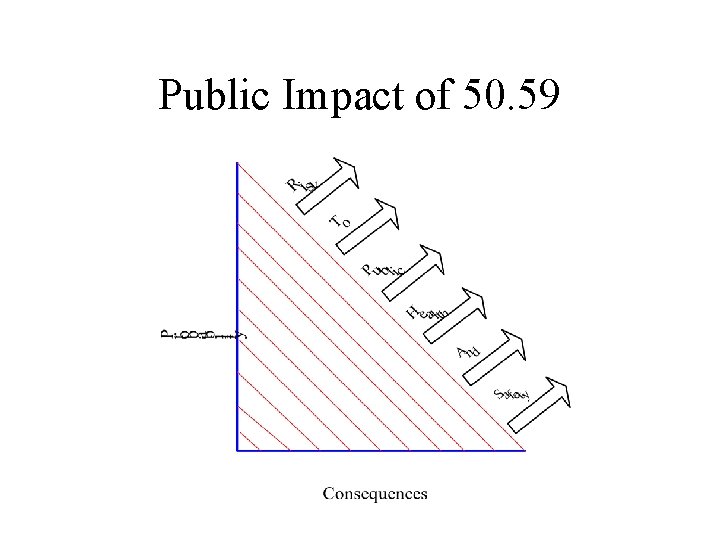
Public Impact of 50. 59
Historical Definitions and Assumptions • No undue risk to health safety • No unreviewed safety questions remain • Licensee’s have freedom to control the plant • Drew a line across which the licensee could not step without NRC approval • Permitted the license to determine if line crossed
Historical Definitions and Assumptions (cont’d) • Consequences equal dose • 50. 2 defines design basis as. . ”That information which identifies the specific functions to be performed by a SSC of a facility, and the specific values or ranges of values chosen for controlling parameters as reference bounds for design. ”
Historical Definitions and Assumptions (cont’d) • Experiment – an operation carried out under controlled conditions in order to discover an unknown effect. • Test – the procedure of submitting a statement to such conditions or operations as will lead to its proof or disproof to its acceptance or rejection.
Historical Definitions and Assumptions (cont’d) • Malfunction – Failure, breakdown, or inaccurate operation. In 50. 59, the term malfunction is more component or equipment oriented, e. g. , single failure. • Margin of safety – the difference between the acceptable limit and the design failure point.

Historical Definitions and Assumptions (cont’d) • Unreviewed safety question – If the probability of occurrence or consequences of an accident or malfunction or equipment important to safety previously evaluated in the SAR may be increased; or • If a possibility for an accident of malfunction of a different type than any evaluated previously in the SAR may be created; or
Historical Definitions and Assumptions (cont’d) • USQ (cont’d) • If the margin of safety as defined in the basis for any TS is reduced. – Seven questions were used to determine if a change was a USQ – USQ did not mean unsafe
Regulatory Significance of the FSAR • Tech Specs are incorporated into the license (50. 36) – Commission approval to change (50. 90/91) • Descriptive information – Controlled under 50. 59 • Descriptive information not controlled under 50. 59 – Subject to 50. 9

History of Design Basis Configuration • • Davis Besse incident NUMARC 90 -12 NUREG 1327 Assessment of DBR 1990 FSAR update Rule GL 91 -18 1992 Commission Policy Statement 1992 Regulatory Review Group
History of Design Basis Configuration (cont’d) • 1993/1995 National Performance Review • August 1995 plant events • July 1996 Commission Policy on Voluntary Industry Initiatives • Risk Informed Regulation • Special Treatment
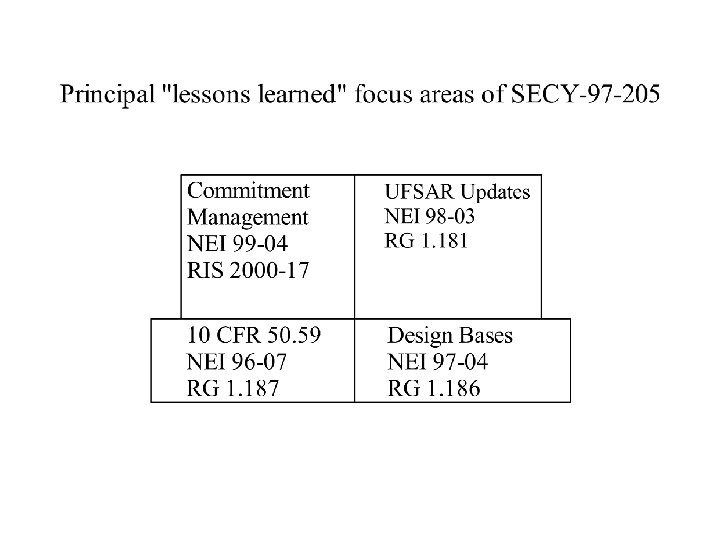

Design Bases Interpretation • Appendix B of NEI 97 -04 proves guidance for interpreting 10 CFR 50. 2 design bases • Commission endorsement through RG 1. 186 • 10 CFR 50. 2 design bases includes: – Design bases functions – Design bases values
Design Bases Functions • SSC functions required by, or otherwise necessary to comply with, regulations, license conditions, tech specs or orders; or • SSC functions credited in licensee safety analyses to meet NRC requirements

Design Bases Values • Design bases values: – Values or ranges of values of controlling parameters established as reference bounds for design to meet design bases functional requirements • Established by NRC requirement • Derived from or confirmed by safety analyses • Chosen by licensees from an applicable code, standard, guidance document

Why are these definitions important? • Common understanding of 10 CFR 50. 2 “design bases” supports: – UFSAR updates – 10 CFR 50. 59 implementation – Proper characterization of design discrepancies
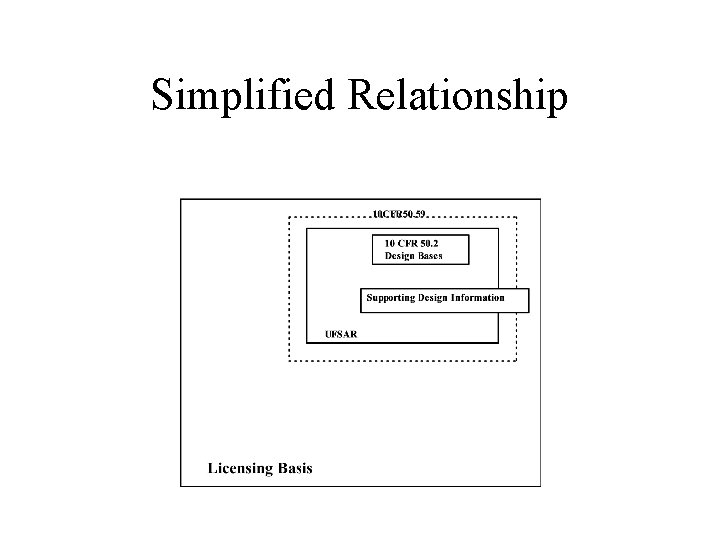
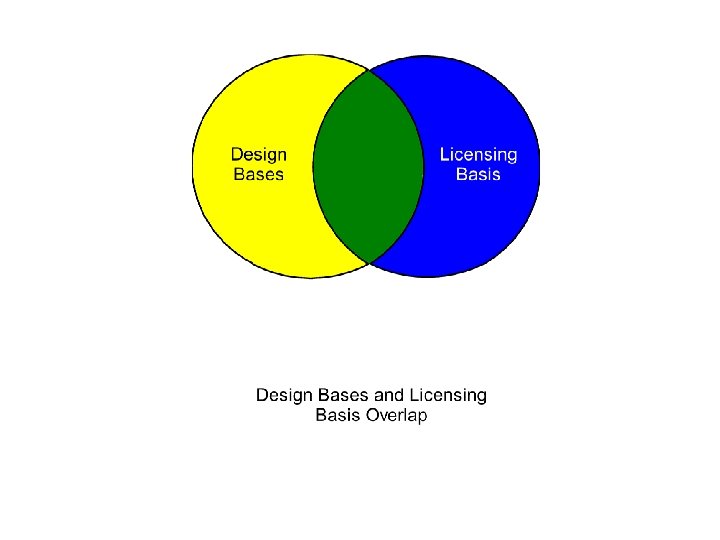
Simplified Relationship

10 CFR 50. 59 • Establishes criteria for making changes to the licensing/design bases • Guideline for implementation NEI 96 -07 • Endorsement of NEI 96 -07 through RG 1. 187

10 CFR 50. 59 • Objectives of guidelines: – Update existing guidance and provide guidance on new provisions – Provide guidance on when to apply processes other than 10 CFR 50. 59 – Promote more consistent, effective implementation

10 CFR 50. 59 • Final Rule changes: – Eliminated “zero standard” – Established “minimal” standard – Enhanced screening process – Replaced problematic “margin of safety” – Clarified role of overlapping requirements – Affirmed purpose as a “regulatory threshold” • No more “unreviewed safety questions”

10 CFR 50. 59 • Key changes in implementation: – Broad scope of “design functions” as used in “change” definition – Only adverse changes “screen in” • Determination based on effects on design functions • Change is not adverse if effects are within the bounds of existing safety analysis
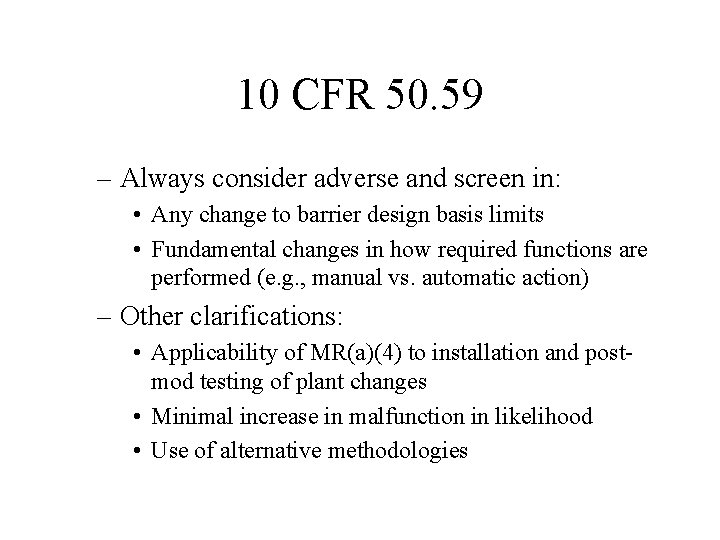
10 CFR 50. 59 – Always consider adverse and screen in: • Any change to barrier design basis limits • Fundamental changes in how required functions are performed (e. g. , manual vs. automatic action) – Other clarifications: • Applicability of MR(a)(4) to installation and postmod testing of plant changes • Minimal increase in malfunction in likelihood • Use of alternative methodologies

10 CFR 50. 59 – Control of maintenance procedures – Definition of “design functions” – Consideration of human factors – Analog-digital upgrades
UFSAR Updates • 10 CFR 50. 71 e • RG 1. 181, Sept 1999, endorses NEI 98 -03 • UFSAR updates must reflect: – New Commission Requirements – Effects on USFAR info of: • Changes made to facility and procedures • Evaluations in support of changes • Requested analysis of new safety issues
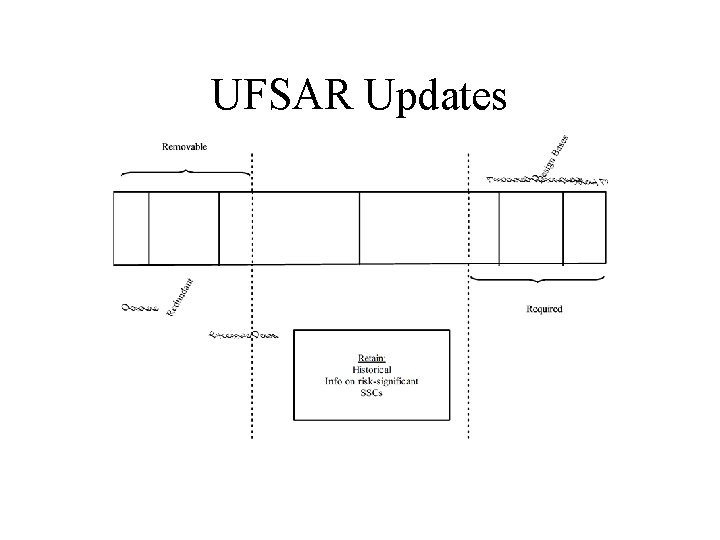
UFSAR Updates
Commitment Management • RIS 2000 -17 endorses NEI 99 -04, Guideline for Managing NRC Commitment changes
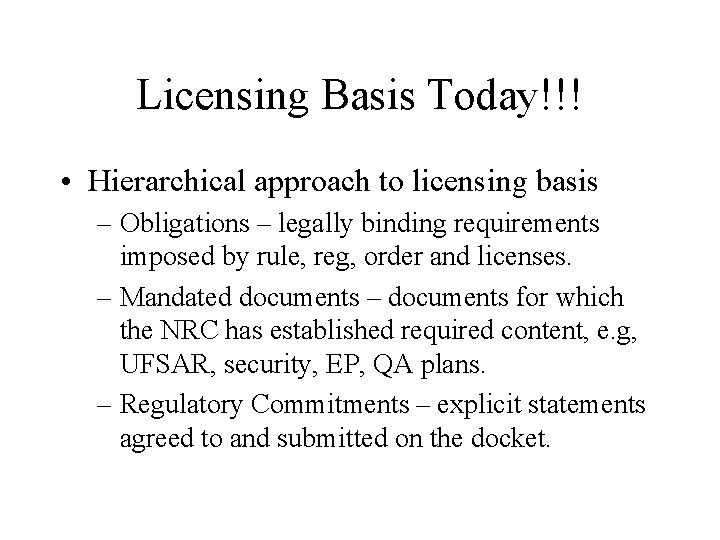
Licensing Basis Today!!! • Hierarchical approach to licensing basis – Obligations – legally binding requirements imposed by rule, reg, order and licenses. – Mandated documents – documents for which the NRC has established required content, e. g, UFSAR, security, EP, QA plans. – Regulatory Commitments – explicit statements agreed to and submitted on the docket.
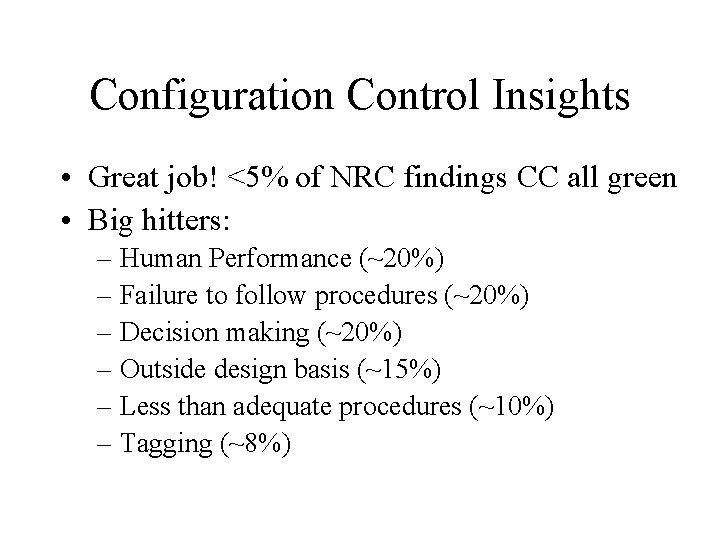
Configuration Control Insights • Great job! <5% of NRC findings CC all green • Big hitters: – Human Performance (~20%) – Failure to follow procedures (~20%) – Decision making (~20%) – Outside design basis (~15%) – Less than adequate procedures (~10%) – Tagging (~8%)

Design Control Insights • ~13% of NRC findings related to DC – Design control (~30%) – Awareness of criteria (~22%) – Calculation error (~15%) – Configuration control (~15%) – Corrective action (~6%) – Other (Op Evals, FSAR, OE, vendor, materials) • ~(12%)

Human Performance in Industry January 2005 – Present Reference NRC Human Factors Information System • Human Performance Cause Codes in LER’s & Inspection Reports – “Work Practices” – Problem identification & resolution – Procedures

Human Performance in Engineering January 2005 – Present Reference NRC Human Factors Information System • Human Performance Cause Codes in LER’s & Inspection Reports – Work Practices 20% • Design work – Skill – Non-conservative decisions – Implementation of action less than adequate – PI&R 18% • Problem Identification • Problem Resolution • Problem Evaluation
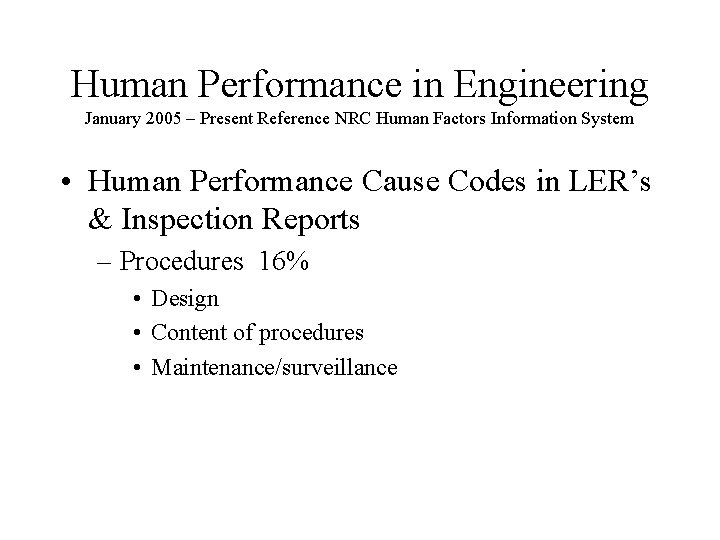
Human Performance in Engineering January 2005 – Present Reference NRC Human Factors Information System • Human Performance Cause Codes in LER’s & Inspection Reports – Procedures 16% • Design • Content of procedures • Maintenance/surveillance
Questions? ?
- Slides: 41