
Design architecture selection plus biasingsizing Verification use analysis

Design: architecture selection plus biasing/sizing Verification: use analysis and simulation to verify operating points, specifications, robustness Fabrication: Characterization: detailed verification by bench test Manufacturing: Final test: fast test of select specs
For each transistor: the designer can control W, L, and two of the 4 terminal voltages, the other two being reference and output. If there are N transistors, this leads to 4 N degrees of freedom in design. But, in most designs, we tie the bulk to either source or a fixed voltage (VDD or VSS). For L, we mostly use L = 1. 5 Lmin or L = 2 Lmin This leaves W/L and Veff as true choices. But, ID = K’ (W/L) Veff^2. If several transistors are stacked, they all have the save current. If ID is used as design parameter, d. o. f. is significantly reduced.
So, we use (W/L) and path currents as design parameters. Path current = current in a VDD VSS path N+M d. o. f. For NMOS and PMOS as counter-partner, we typically use very simple relationships in (W/L) determined by mn and mp ratio. This cuts N by roughly half. For differential circuit, it is required that the left side and the right side are matched. This cuts both N and M by a factor of 2. Design for the quarter circuit.

Some calculations related to Common Source amplifier lab

VDD M 2 vo 10 m Vin CL M 1 Vomin = Veff 1 Vomax = VDD – |Veff 2| Output swing range: VDD – Veff 1 – |Veff 2| Veff 1 + |Veff 2| = VDD – OSR For VDD = 5, OSR>=4, Veff 1 + |Veff 2| <= 1 M 1 is in signal path, needs small Veff and large gm M 2 is current mirror transistors, needs large Veff for robustness. So target: Veff 1 ~ 0. 3, |Veff 2| ~0. 7 Veff^2 ratio 5
Positive slew rate SR+ = I 2 Q/CLtot Negative slew rate SR- = (I 1 max-I 2 Q)/CLtot I 1 max can be very large when Vin is very large. So, SR- is unknown but is not the limit. From SR+, I 2 Q = SR+ * CLtot To accommodate parasitics: I 2 Q = SR+ * 1. 2 CLtot 40*1. 2*5=240 m Current mirror ratio: 1: 24
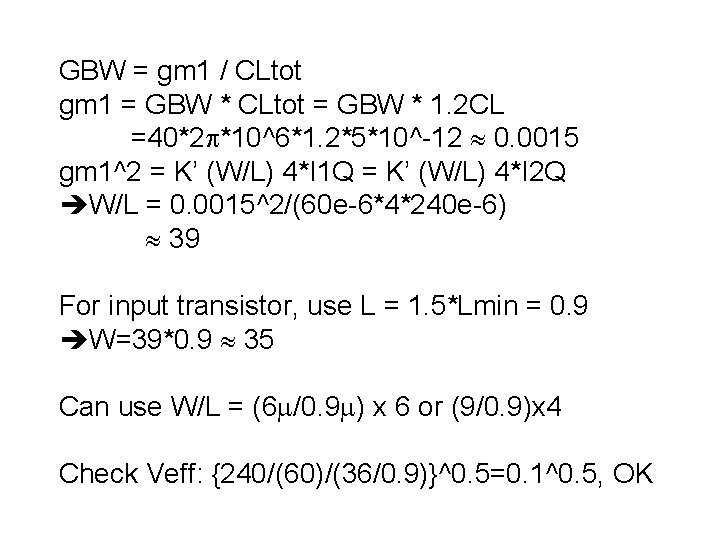
GBW = gm 1 / CLtot gm 1 = GBW * CLtot = GBW * 1. 2 CL =40*2 *10^6*1. 2*5*10^-12 0. 0015 gm 1^2 = K’ (W/L) 4*I 1 Q = K’ (W/L) 4*I 2 Q W/L = 0. 0015^2/(60 e-6*4*240 e-6) 39 For input transistor, use L = 1. 5*Lmin = 0. 9 W=39*0. 9 35 Can use W/L = (6 m/0. 9 m) x 6 or (9/0. 9)x 4 Check Veff: {240/(60)/(36/0. 9)}^0. 5=0. 1^0. 5, OK
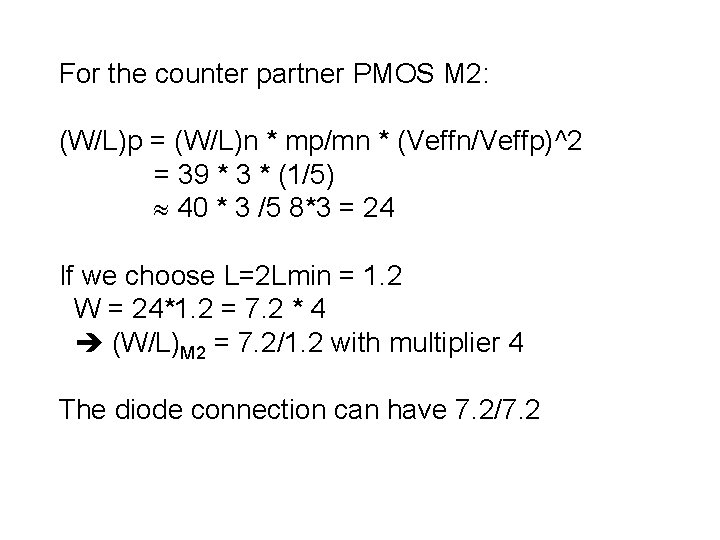
For the counter partner PMOS M 2: (W/L)p = (W/L)n * mp/mn * (Veffn/Veffp)^2 = 39 * 3 * (1/5) 40 * 3 /5 8*3 = 24 If we choose L=2 Lmin = 1. 2 W = 24*1. 2 = 7. 2 * 4 (W/L)M 2 = 7. 2/1. 2 with multiplier 4 The diode connection can have 7. 2/7. 2
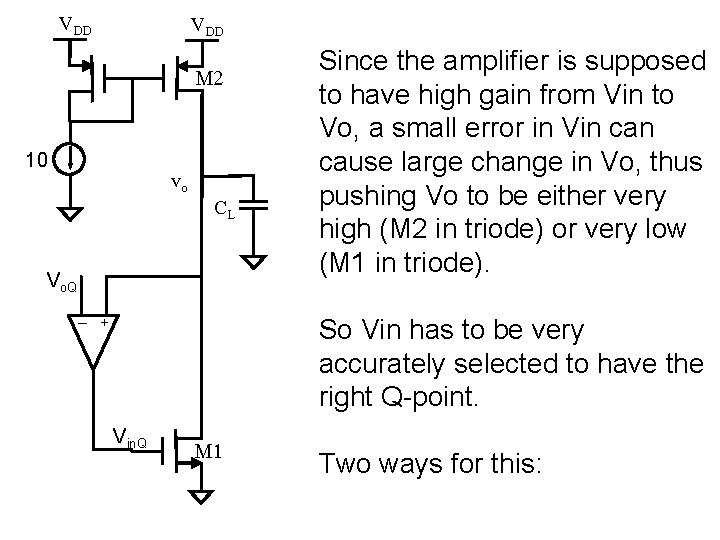
VDD M 2 10 vo CL Vo. Q Since the amplifier is supposed to have high gain from Vin to Vo, a small error in Vin cause large change in Vo, thus pushing Vo to be either very high (M 2 in triode) or very low (M 1 in triode). So Vin has to be very accurately selected to have the right Q-point. – + Vin. Q M 1 Two ways for this:
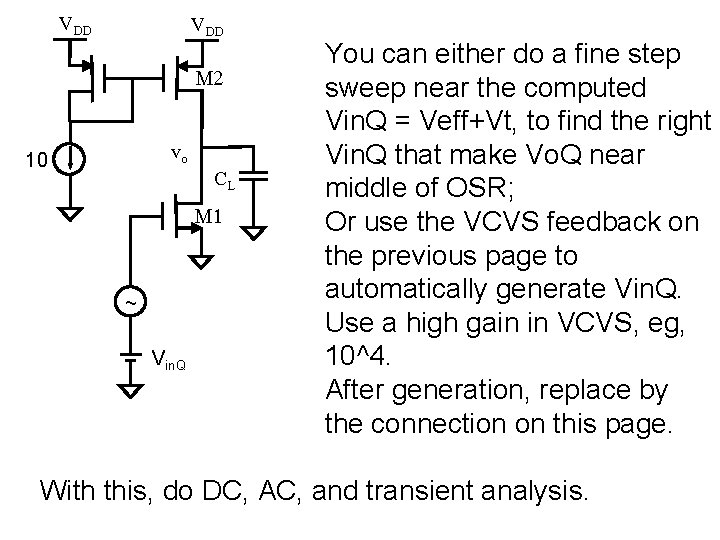
VDD M 2 vo 10 CL M 1 ~ Vin. Q You can either do a fine step sweep near the computed Vin. Q = Veff+Vt, to find the right Vin. Q that make Vo. Q near middle of OSR; Or use the VCVS feedback on the previous page to automatically generate Vin. Q. Use a high gain in VCVS, eg, 10^4. After generation, replace by the connection on this page. With this, do DC, AC, and transient analysis.
- Slides: 11