
Design and UML Class Diagrams Suggested reading Practical
![Class diagram example: student Student. Body + main (args : String[]) 1 100 Student](https://slidetodoc.com/presentation_image_h2/0f46efa192832777da1ce188a8624d63/image-27.jpg "Class diagram example: student Student. Body + main (args : String[]) 1 100 Student")
- Slides: 30
Design and UML Class Diagrams Suggested reading: Practical UML: A hands on introduction for developers http: //dn. codegear. com/article/31863 UML Distilled Ch. 3, by M. Fowler 1
How do people draw / write down software architectures?
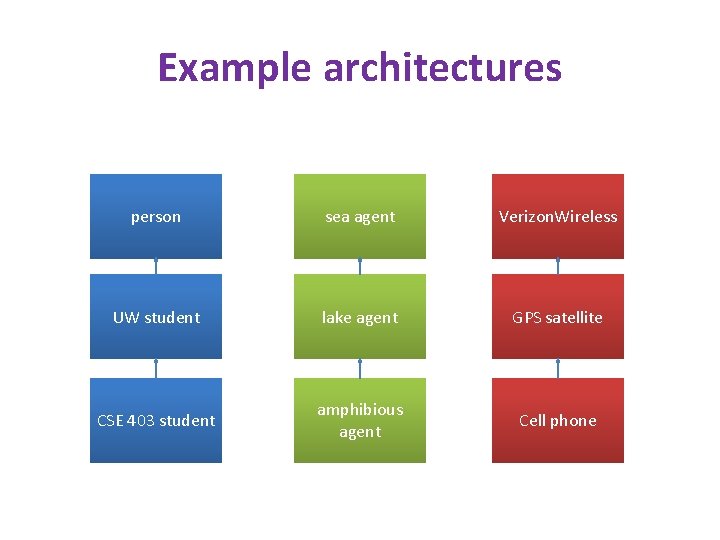
Example architectures person sea agent Verizon. Wireless UW student lake agent GPS satellite CSE 403 student amphibious agent Cell phone
Big questions • What is UML? – Why should I bother? Do people really use UML? • What is a UML class diagram? – What kind of information goes into it? – How do I create it? – When should I create it?
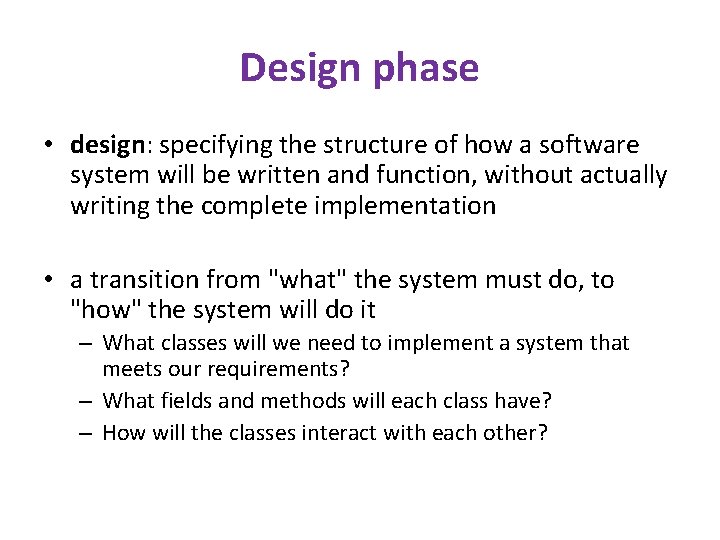
Design phase • design: specifying the structure of how a software system will be written and function, without actually writing the complete implementation • a transition from "what" the system must do, to "how" the system will do it – What classes will we need to implement a system that meets our requirements? – What fields and methods will each class have? – How will the classes interact with each other?
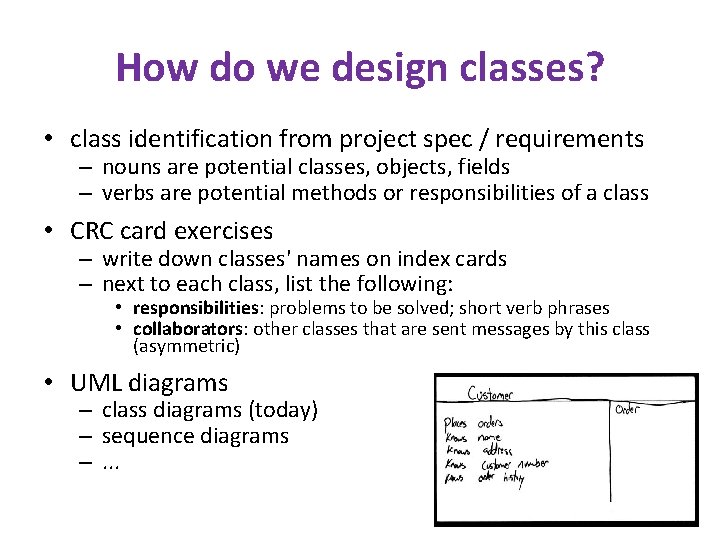
How do we design classes? • class identification from project spec / requirements – nouns are potential classes, objects, fields – verbs are potential methods or responsibilities of a class • CRC card exercises – write down classes' names on index cards – next to each class, list the following: • responsibilities: problems to be solved; short verb phrases • collaborators: other classes that are sent messages by this class (asymmetric) • UML diagrams – class diagrams (today) – sequence diagrams –. . .
What is UML? • UML: pictures of an OO system – programming languages are not abstract enough for OO design – UML is an open standard; lots of companies use it • What is legal UML? – a descriptive language: rigid formal syntax (like programming) – a prescriptive language: shaped by usage and convention – it's okay to omit things from UML diagrams if they aren't needed by team/supervisor/instructor
Uses for UML • as a sketch: to communicate aspects of system – – forward design: doing UML before coding backward design: doing UML after coding as documentation often done on whiteboard or paper used to get rough selective ideas • as a blueprint: a complete design to be implemented – sometimes done with CASE (Computer-Aided Software Engineering) tools • as a programming language: with the right tools, code can be auto-generated and executed from UML – only good if this is faster than coding in a "real" language
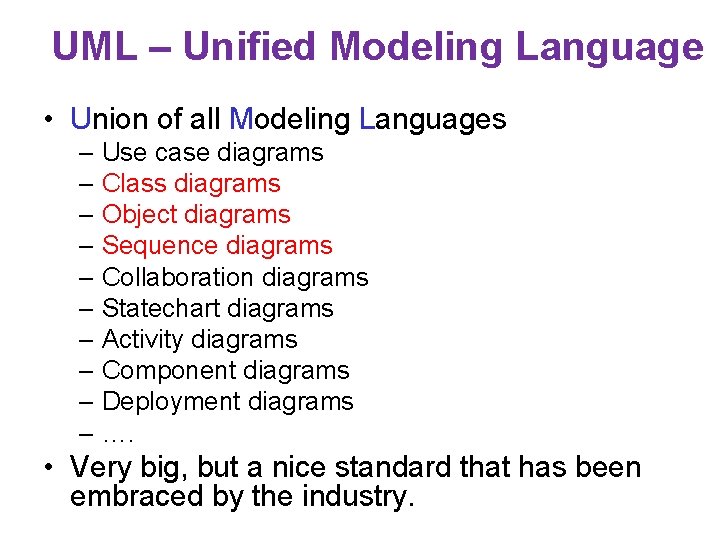
UML – Unified Modeling Language • Union of all Modeling Languages – Use case diagrams – Class diagrams – Object diagrams – Sequence diagrams – Collaboration diagrams – Statechart diagrams – Activity diagrams – Component diagrams – Deployment diagrams – …. • Very big, but a nice standard that has been embraced by the industry.
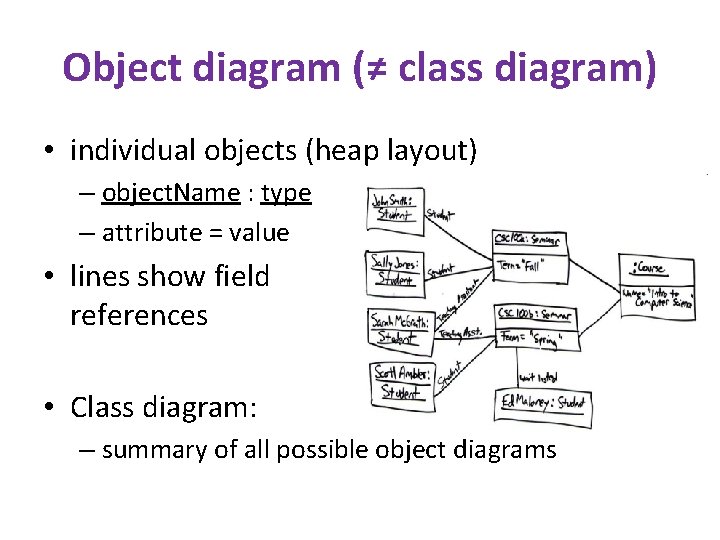
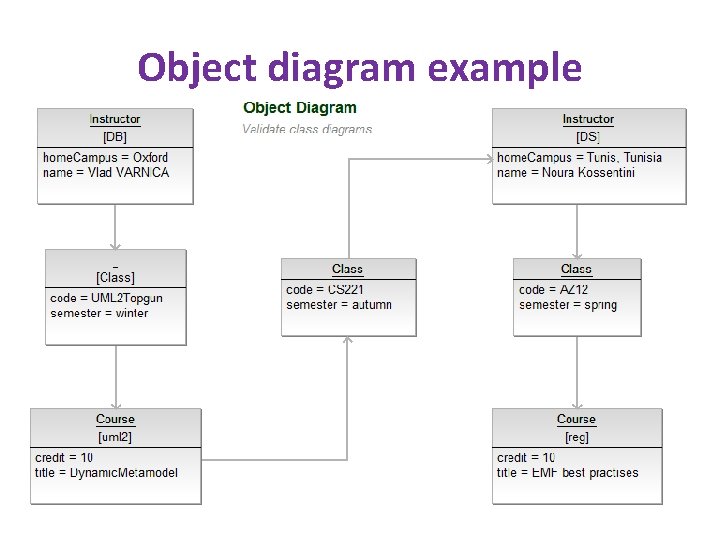
Object diagram (≠ class diagram) • individual objects (heap layout) – object. Name : type – attribute = value • lines show field references • Class diagram: – summary of all possible object diagrams
Object diagram example
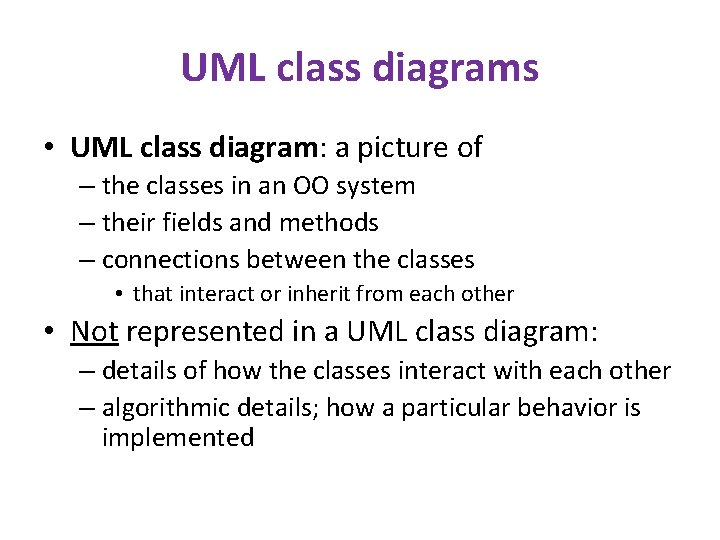
UML class diagrams • UML class diagram: a picture of – the classes in an OO system – their fields and methods – connections between the classes • that interact or inherit from each other • Not represented in a UML class diagram: – details of how the classes interact with each other – algorithmic details; how a particular behavior is implemented
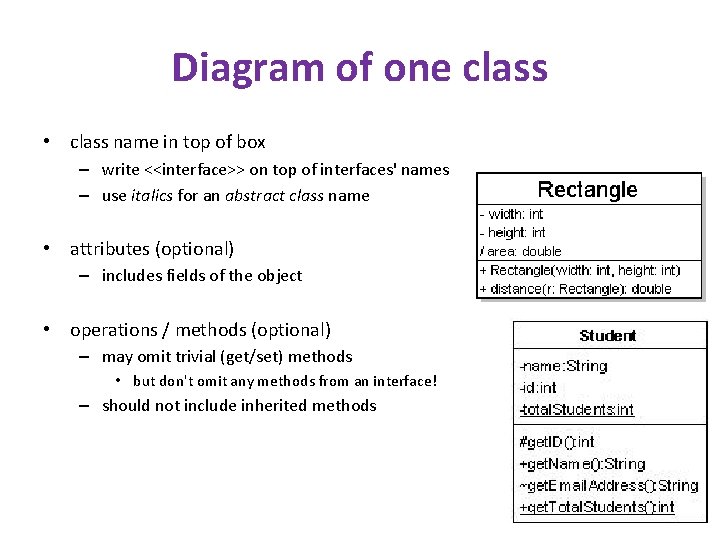
Diagram of one class • class name in top of box – write <<interface>> on top of interfaces' names – use italics for an abstract class name • attributes (optional) – includes fields of the object • operations / methods (optional) – may omit trivial (get/set) methods • but don't omit any methods from an interface! – should not include inherited methods
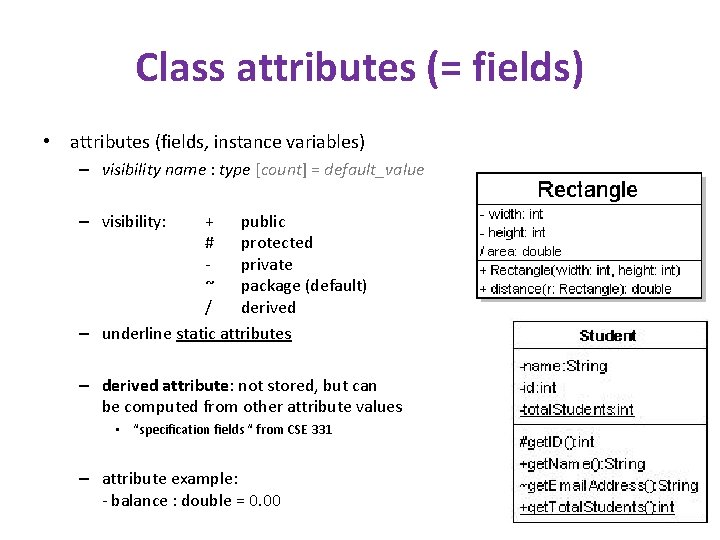
Class attributes (= fields) • attributes (fields, instance variables) – visibility name : type [count] = default_value – visibility: + public # protected private ~ package (default) / derived – underline static attributes – derived attribute: not stored, but can be computed from other attribute values • “specification fields “ from CSE 331 – attribute example: - balance : double = 0. 00
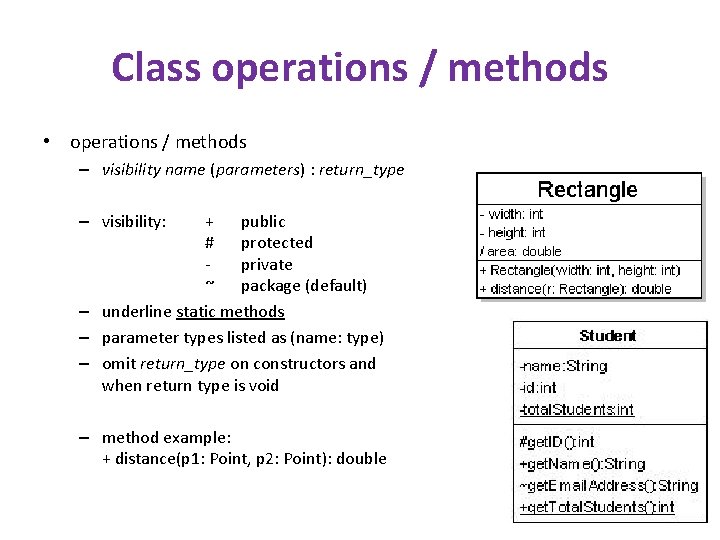
Class operations / methods • operations / methods – visibility name (parameters) : return_type – visibility: + public # protected private ~ package (default) – underline static methods – parameter types listed as (name: type) – omit return_type on constructors and when return type is void – method example: + distance(p 1: Point, p 2: Point): double
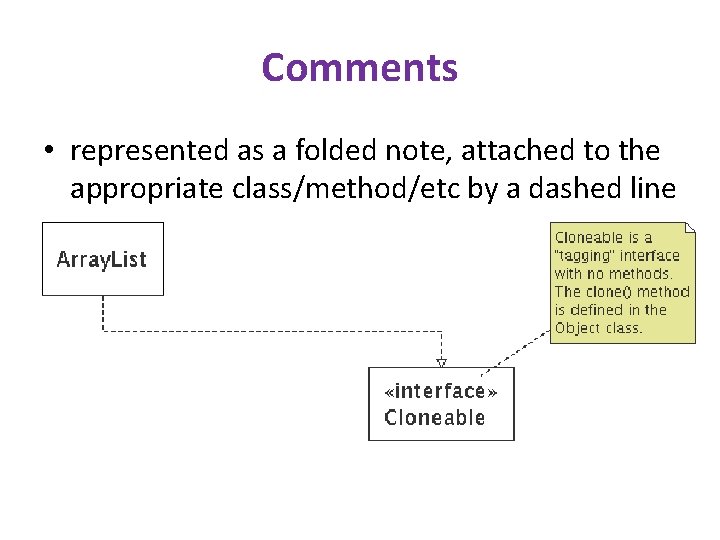
Comments • represented as a folded note, attached to the appropriate class/method/etc by a dashed line
Relationships between classes • generalization: an inheritance relationship – inheritance between classes – interface implementation • association: a usage relationship – dependency – aggregation – composition
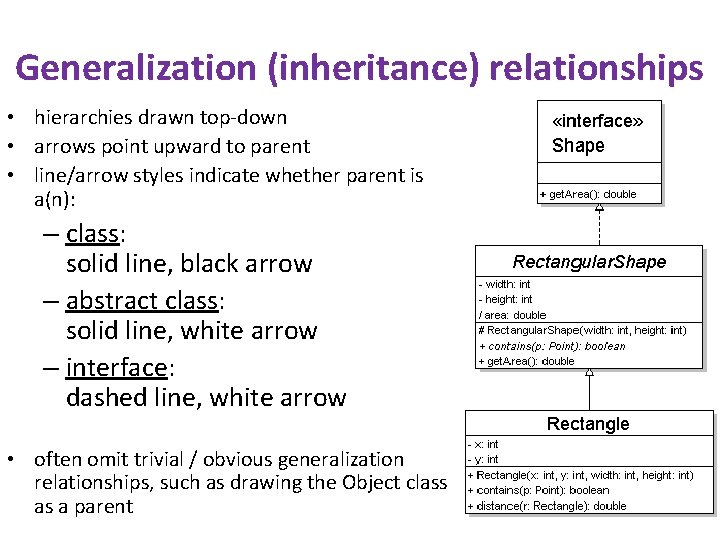
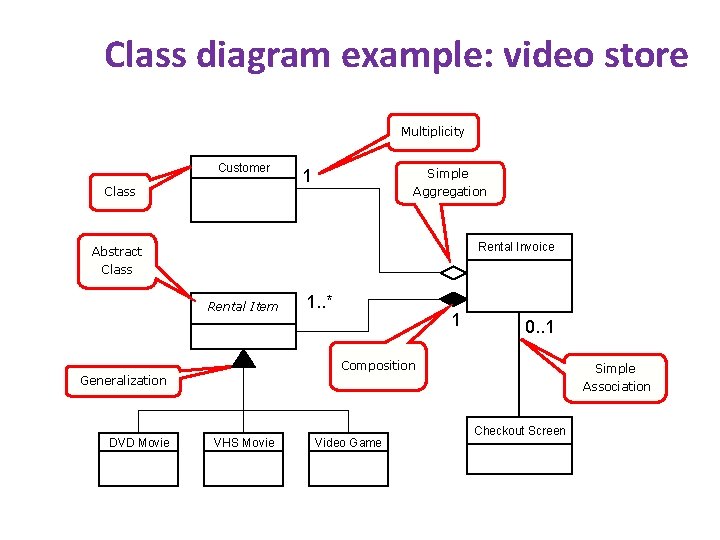
Generalization (inheritance) relationships • hierarchies drawn top-down • arrows point upward to parent • line/arrow styles indicate whether parent is a(n): – class: solid line, black arrow – abstract class: solid line, white arrow – interface: dashed line, white arrow • often omit trivial / obvious generalization relationships, such as drawing the Object class as a parent
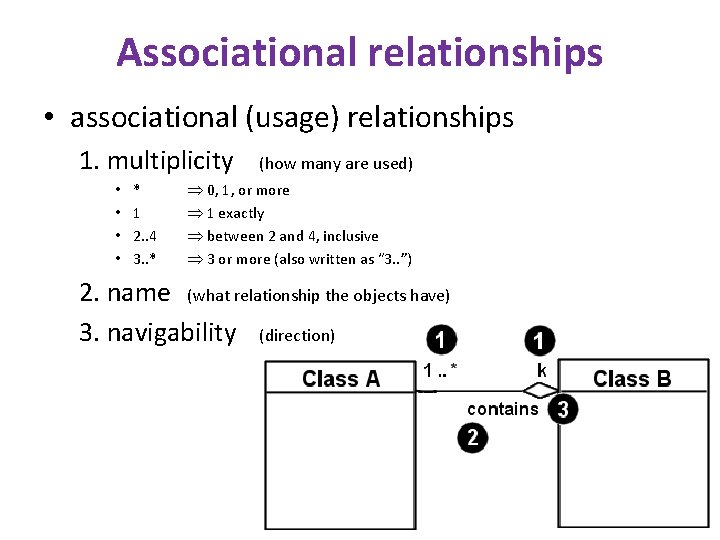
Associational relationships • associational (usage) relationships 1. multiplicity • • * 1 2. . 4 3. . * (how many are used) 0, 1, or more 1 exactly between 2 and 4, inclusive 3 or more (also written as “ 3. . ”) 2. name (what relationship the objects have) 3. navigability (direction)
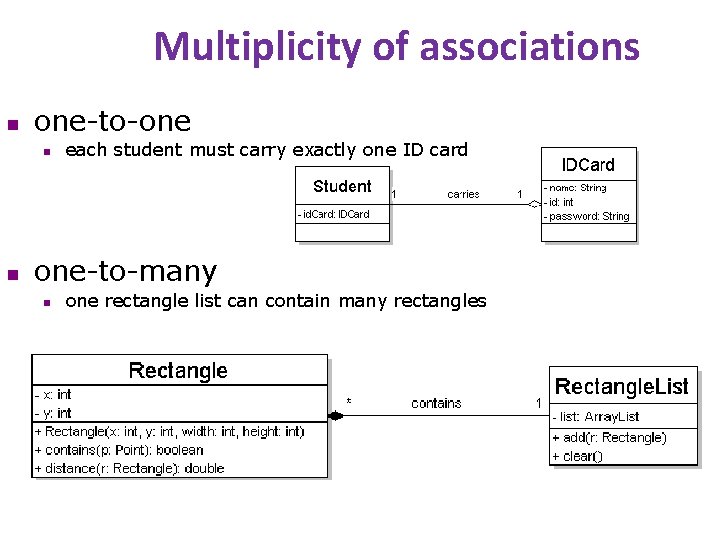
Multiplicity of associations n one-to-one n n each student must carry exactly one ID card one-to-many n one rectangle list can contain many rectangles
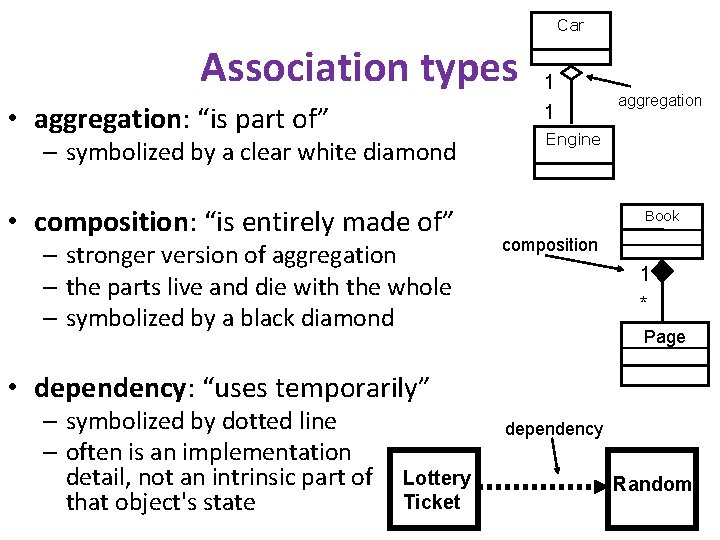
Car Association types • aggregation: “is part of” – symbolized by a clear white diamond • composition: “is entirely made of” – stronger version of aggregation – the parts live and die with the whole – symbolized by a black diamond 1 1 aggregation Engine Book composition 1 * Page • dependency: “uses temporarily” – symbolized by dotted line – often is an implementation detail, not an intrinsic part of that object's state dependency Lottery Ticket Random
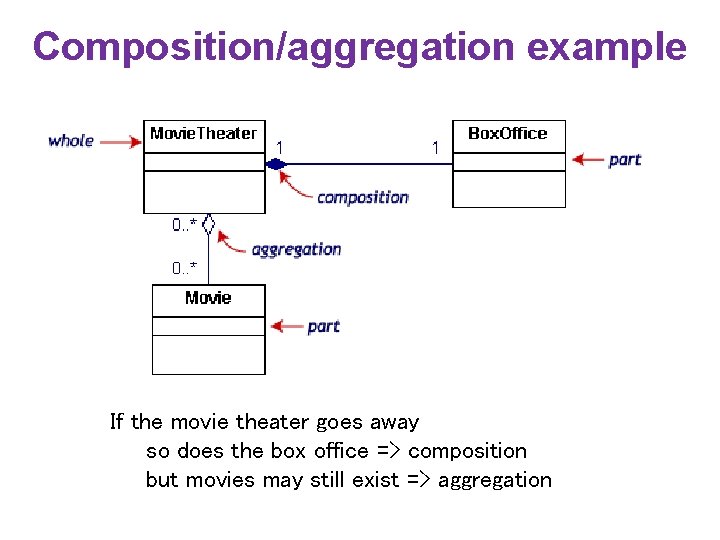
Composition/aggregation example If the movie theater goes away so does the box office => composition but movies may still exist => aggregation
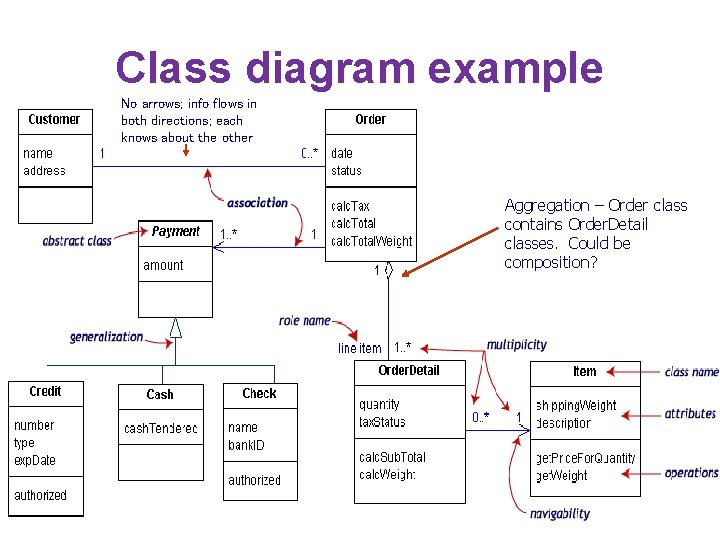
Class diagram example No arrows; info flows in both directions; each knows about the other Aggregation – Order class contains Order. Detail classes. Could be composition?
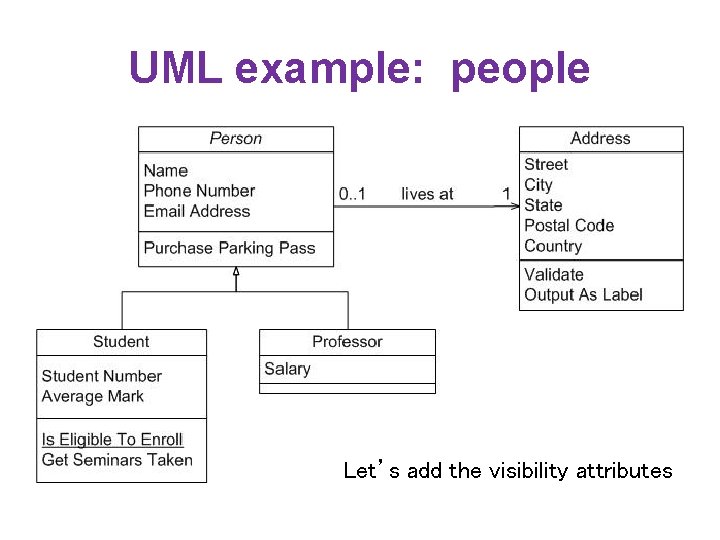
UML example: people Let’s add the visibility attributes
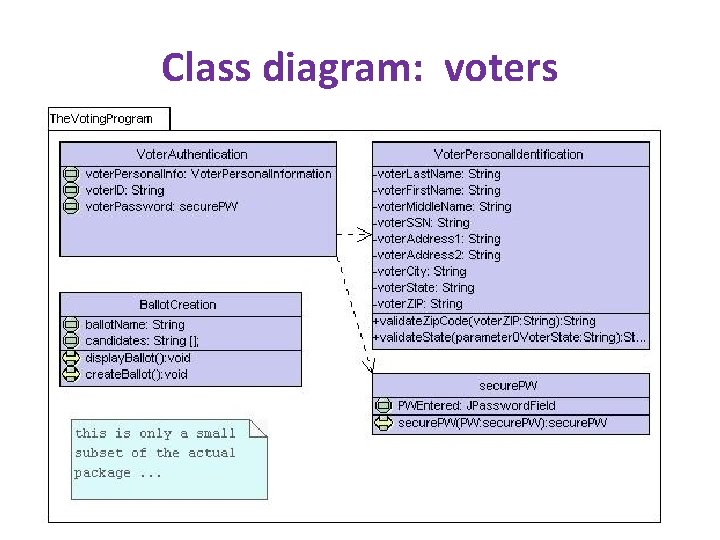
Class diagram: voters 26
Class diagram example: video store Multiplicity Customer Class Simple 1 Aggregation Rental Invoice Abstract Class Rental Item 1. . * 1 0. . 1 Composition Simple Generalization DVD Movie Association VHS Movie Video Game Checkout Screen
Class diagram example: student Student. Body + main (args : String[]) 1 100 Student - first. Name : String last. Name : String home. Address : Address school. Address : Address + to. String() : String Address - street. Address : String city : String state : String zip. Code : long + to. String() : String
Tools for creating UML diagrams • Violet (free) – http: //horstmann. com/violet/ • Rational Rose – http: //www. rational. com/ • Visual Paradigm UML Suite (trial) – http: //www. visual-paradigm. com/ – (nearly) direct download link: http: //www. visual-paradigm. com/vp/download. jsp? product=vpuml&edition=ce (there are many others, but most are commercial)
Design exercise: Texas Hold ‘em poker game • • 2 to 8 human or computer players Each player has a name and stack of chips Computer players have a difficulty setting: easy, medium, hard Summary of each hand: – Dealer collects ante from appropriate players, shuffles the deck, and deals each player a hand of 2 cards from the deck. – A betting round occurs, followed by dealing 3 shared cards from the deck. – As shared cards are dealt, more betting rounds occur, where each player can fold, check, or raise. – At the end of a round, if more than one player is remaining, players' hands are compared, and the best hand wins the pot of all chips bet so far. • What classes are in this system? What are their responsibilities? Which classes collaborate? • Draw a class diagram for this system. Include relationships between classes (generalization and associational).
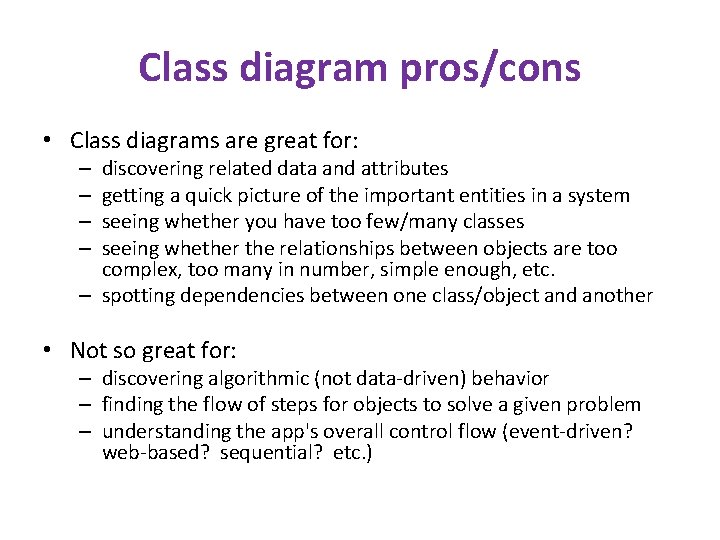
Class diagram pros/cons • Class diagrams are great for: discovering related data and attributes getting a quick picture of the important entities in a system seeing whether you have too few/many classes seeing whether the relationships between objects are too complex, too many in number, simple enough, etc. – spotting dependencies between one class/object and another – – • Not so great for: – discovering algorithmic (not data-driven) behavior – finding the flow of steps for objects to solve a given problem – understanding the app's overall control flow (event-driven? web-based? sequential? etc. )