
Design and Technology Productions Among Middle School Students
- Slides: 23
Design and Technology Productions Among Middle School Students: An Indian Experience Ritesh Khunyakari, Swati Mehrotra, Sugra Chunawala, Chitra Natarajan Homi Bhabha Centre for Science Education (HBCSE) Tata Institute of Fundamental Research, Mumbai, India
Objective • Exploring design productions for evidences of cognitive activity: spatial, analogical and functional reasoning ICTE 2006, Hong Kong HBCSE, TIFR, India
Sample for study • Grade VI (11 -14 years) • 3 socio-cultural settings – Urban Marathi – Urban English – Rural (Tribal) Marathi • 20 -25 students from each setting – Near equal number of girls & boys – Voluntary participation ICTE 2006, Hong Kong HBCSE, TIFR, India
Intervention: D&T units • Students work in groups in 3 Design and Technology (D&T) units – Making a bag to carry some books – Making a windmill that can lift a certain weight – Each group making a puppet and collectively staging a puppet show ICTE 2006, Hong Kong HBCSE, TIFR, India
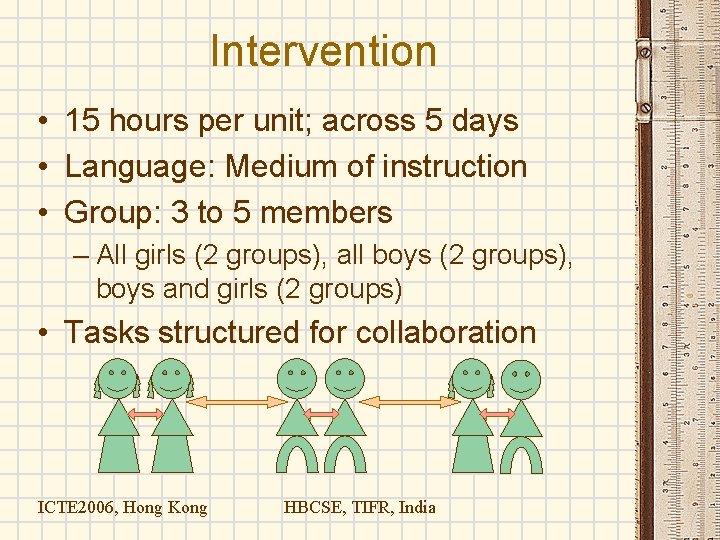
Intervention • 15 hours per unit; across 5 days • Language: Medium of instruction • Group: 3 to 5 members – All girls (2 groups), all boys (2 groups), boys and girls (2 groups) • Tasks structured for collaboration ICTE 2006, Hong Kong HBCSE, TIFR, India
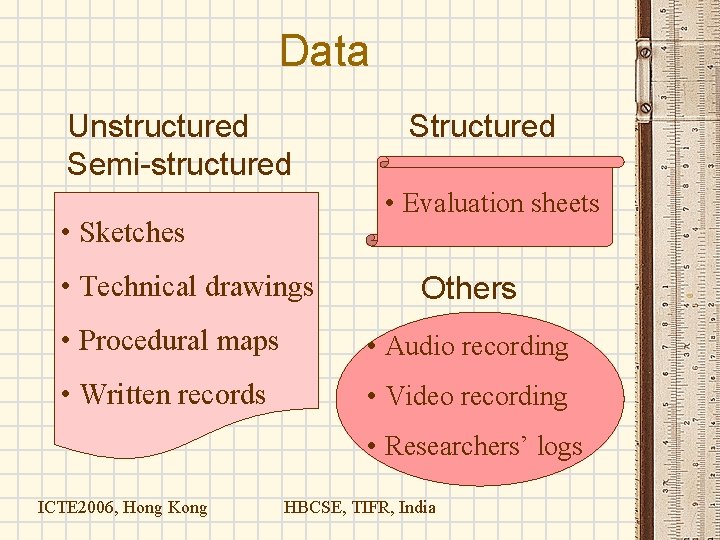
Data Unstructured Semi-structured Structured • Evaluation sheets • Sketches • Technical drawings Others • Procedural maps • Audio recording • Written records • Video recording • Researchers’ logs ICTE 2006, Hong Kong HBCSE, TIFR, India
Design productions • Paper and pencil productions (of naïve designers) engaged in a D&T unit on designing and making a windmill – Exploratory sketches – Technical drawings – Procedural maps ICTE 2006, Hong Kong HBCSE, TIFR, India
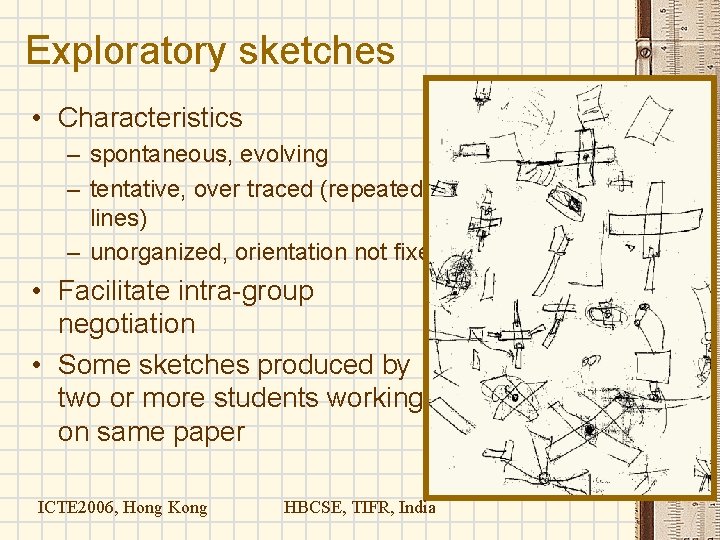
Exploratory sketches • Characteristics – spontaneous, evolving – tentative, over traced (repeated lines) – unorganized, orientation not fixed • Facilitate intra-group negotiation • Some sketches produced by two or more students working on same paper ICTE 2006, Hong Kong HBCSE, TIFR, India
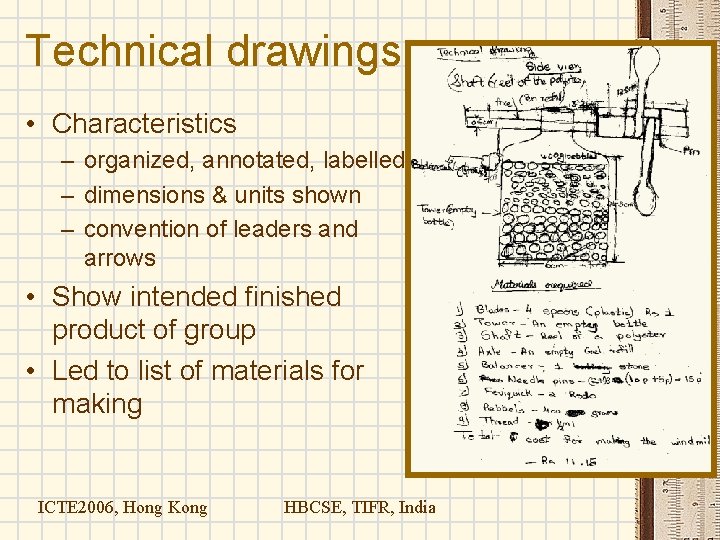
Technical drawings • Characteristics – organized, annotated, labelled – dimensions & units shown – convention of leaders and arrows • Show intended finished product of group • Led to list of materials for making ICTE 2006, Hong Kong HBCSE, TIFR, India
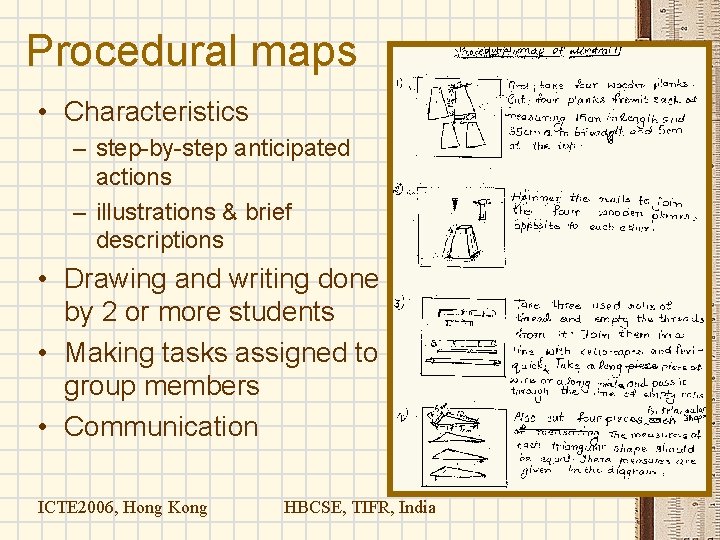
Procedural maps • Characteristics – step-by-step anticipated actions – illustrations & brief descriptions • Drawing and writing done by 2 or more students • Making tasks assigned to group members • Communication ICTE 2006, Hong Kong HBCSE, TIFR, India
Analysis: General observations • Students reconsidered their preferences and refined their ideas while designing; designs evolved through making. • All designs ultimately led to working windmill models • Designs and materials differed in the three socio-cultural settings – urban Marathi and English medium; tribal (Marathi) ICTE 2006, Hong Kong HBCSE, TIFR, India
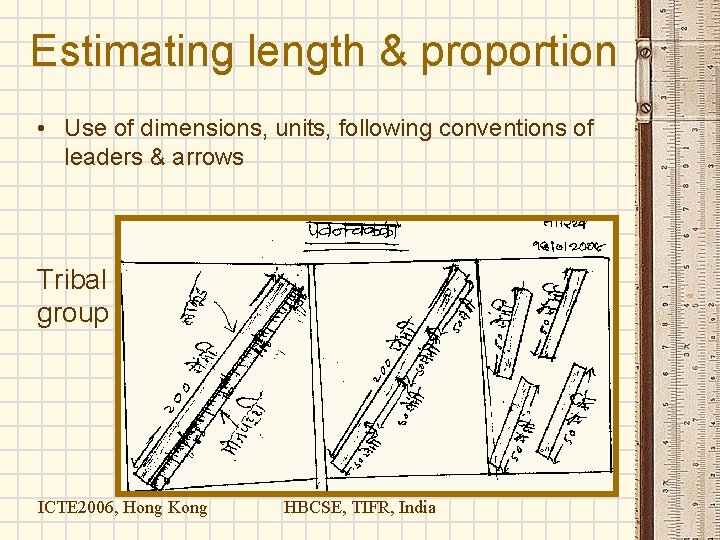
Estimating length & proportion • Use of dimensions, units, following conventions of leaders & arrows Tribal group ICTE 2006, Hong Kong HBCSE, TIFR, India
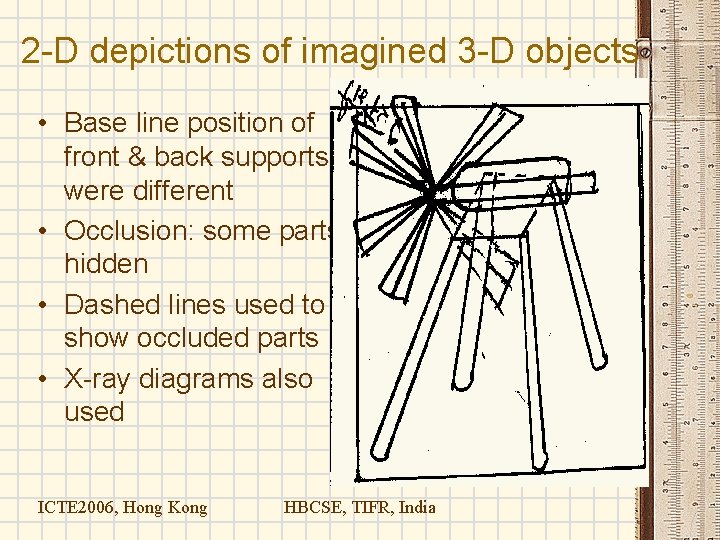
2 -D depictions of imagined 3 -D objects • Base line position of front & back supports were different • Occlusion: some parts hidden • Dashed lines used to show occluded parts • X-ray diagrams also used ICTE 2006, Hong Kong HBCSE, TIFR, India
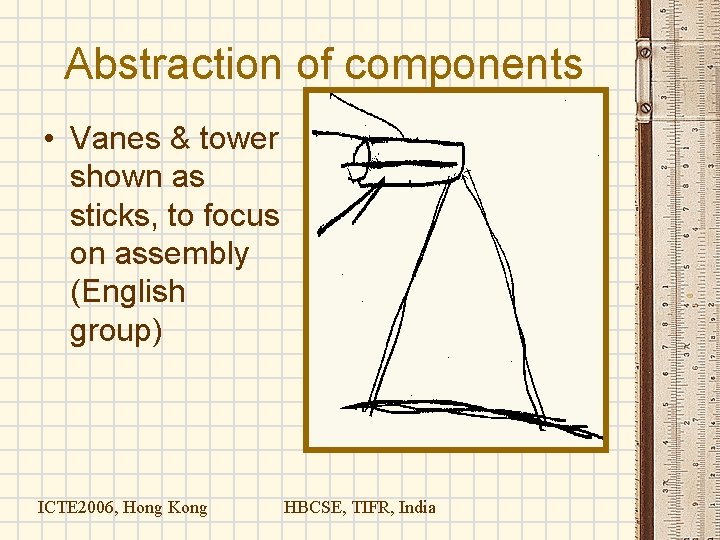
Abstraction of components • Vanes & tower shown as sticks, to focus on assembly (English group) ICTE 2006, Hong Kong HBCSE, TIFR, India
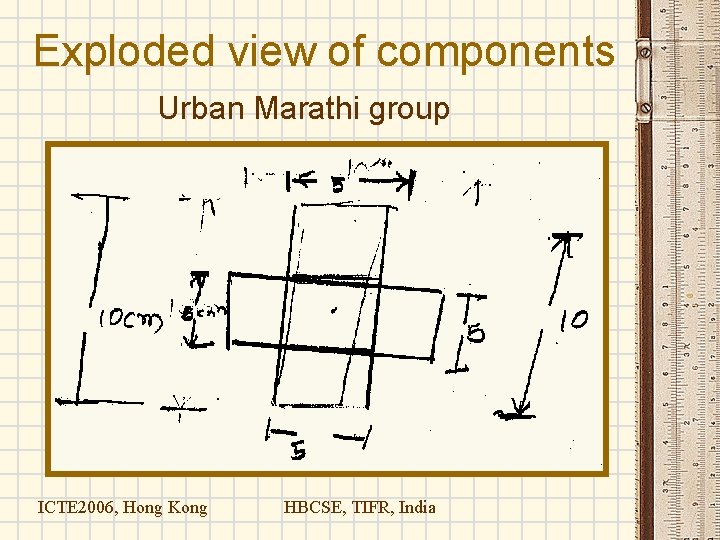
Exploded view of components Urban Marathi group ICTE 2006, Hong Kong HBCSE, TIFR, India
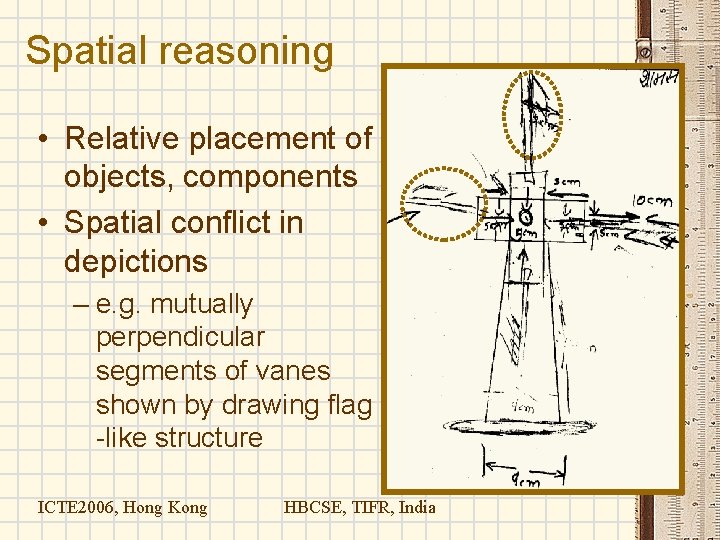
Spatial reasoning • Relative placement of objects, components • Spatial conflict in depictions – e. g. mutually perpendicular segments of vanes shown by drawing flag -like structure ICTE 2006, Hong Kong HBCSE, TIFR, India
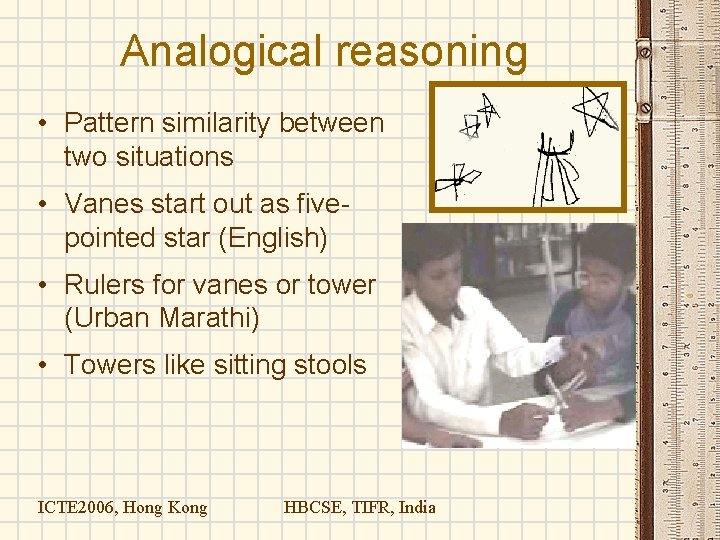
Analogical reasoning • Pattern similarity between two situations • Vanes start out as fivepointed star (English) • Rulers for vanes or tower (Urban Marathi) • Towers like sitting stools ICTE 2006, Hong Kong HBCSE, TIFR, India
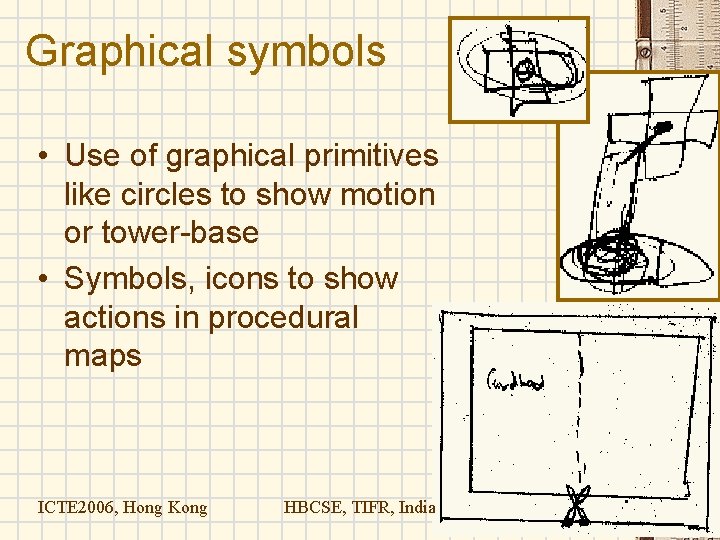
Graphical symbols • Use of graphical primitives like circles to show motion or tower-base • Symbols, icons to show actions in procedural maps ICTE 2006, Hong Kong HBCSE, TIFR, India
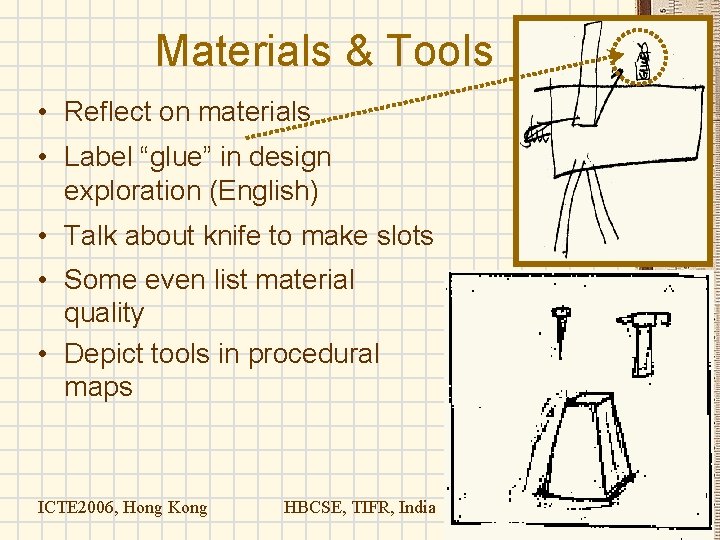
Materials & Tools • Reflect on materials • Label “glue” in design exploration (English) • Talk about knife to make slots • Some even list material quality • Depict tools in procedural maps ICTE 2006, Hong Kong HBCSE, TIFR, India
…materials & tools • Urban: range of materials – cardboard, styrofoam, wood, metal foils and containers, plastics, broom sticks – joining: adhesives, sticking tapes, variety of glues • Tribal: limited range – wood, metal foils – joining: nails, wire, one type of glue • Preferences reflect settings, exposure ICTE 2006, Hong Kong HBCSE, TIFR, India
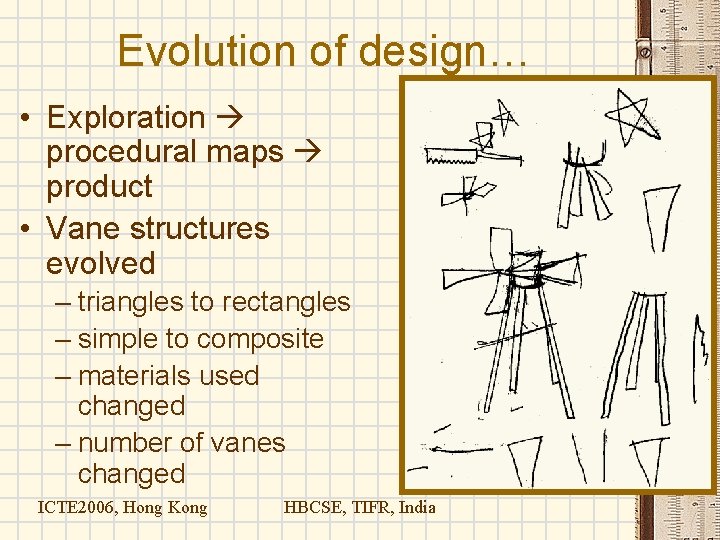
Evolution of design… • Exploration procedural maps product • Vane structures evolved – triangles to rectangles – simple to composite – materials used changed – number of vanes changed ICTE 2006, Hong Kong HBCSE, TIFR, India
Conclusions • Students devised ways to express their design ideas – occlusion and dashed lines – compromised on conventions for clarity; x-ray drawings – used multiple perspectives in the same drawing • Greater diversity of materials in urban • Stability, rigidity reflected in choices of tribal groups ICTE 2006, Hong Kong HBCSE, TIFR, India
Thank you! • • • Students who participated in our study Teachers who made it possible The Centre Director, HBCSE ICTE 2006 Organizing Committee Colleagues who helped in trials ICTE 2006, Hong Kong HBCSE, TIFR, India