
DESIGN AND STRUCTURE FOR ONLINE TEACHING AND LEARNING

- Slides: 29
DESIGN AND STRUCTURE FOR ONLINE TEACHING AND LEARNING Charlie Reis PGCert Director June 2020 1
SESSION OUTCOMES • Begin to design for easy navigation; • Ensure clarity of communications and expectations; • Chunking of all content paired with student opportunities for: • Application, Interaction, Reflection; • Build-in agility to be able to respond to learning; • Co-creation and incorporation of student voice • Internalisation of the question and outlook of: What else can we do to support student learning through better design? 2
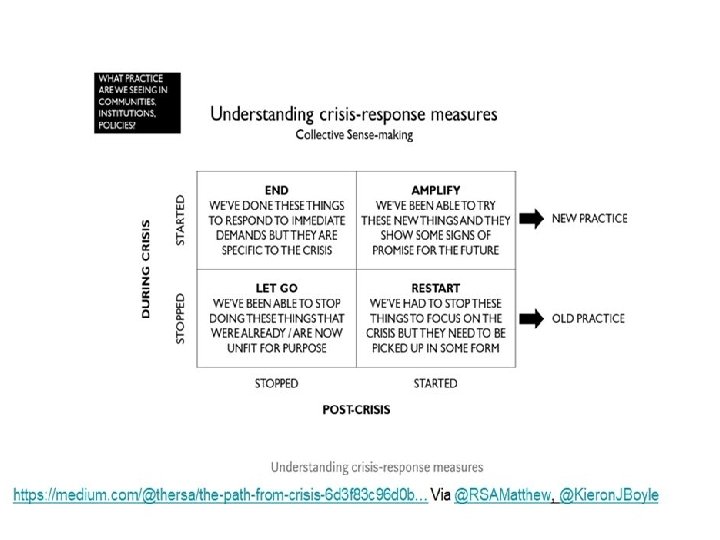
3
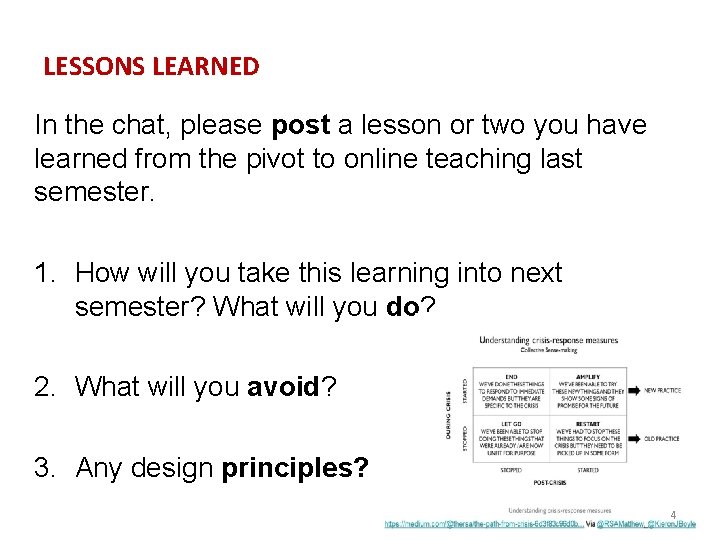
LESSONS LEARNED In the chat, please post a lesson or two you have learned from the pivot to online teaching last semester. 1. How will you take this learning into next semester? What will you do? 2. What will you avoid? 3. Any design principles? 4
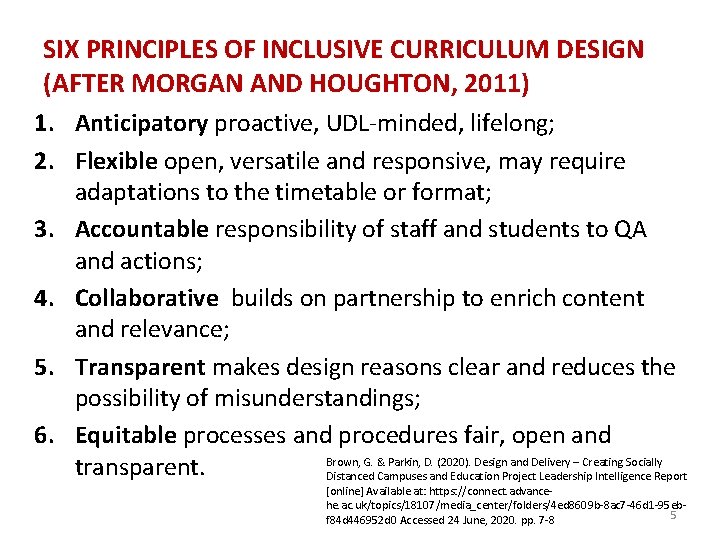
SIX PRINCIPLES OF INCLUSIVE CURRICULUM DESIGN (AFTER MORGAN AND HOUGHTON, 2011) 1. Anticipatory proactive, UDL-minded, lifelong; 2. Flexible open, versatile and responsive, may require adaptations to the timetable or format; 3. Accountable responsibility of staff and students to QA and actions; 4. Collaborative builds on partnership to enrich content and relevance; 5. Transparent makes design reasons clear and reduces the possibility of misunderstandings; 6. Equitable processes and procedures fair, open and Brown, G. & Parkin, D. (2020). Design and Delivery – Creating Socially transparent. Distanced Campuses and Education Project Leadership Intelligence Report [online] Available at: https: //connect. advancehe. ac. uk/topics/18107/media_center/folders/4 ed 8609 b-8 ac 7 -46 d 1 -95 eb 5 f 84 d 446952 d 0 Accessed 24 June, 2020. pp. 7 -8
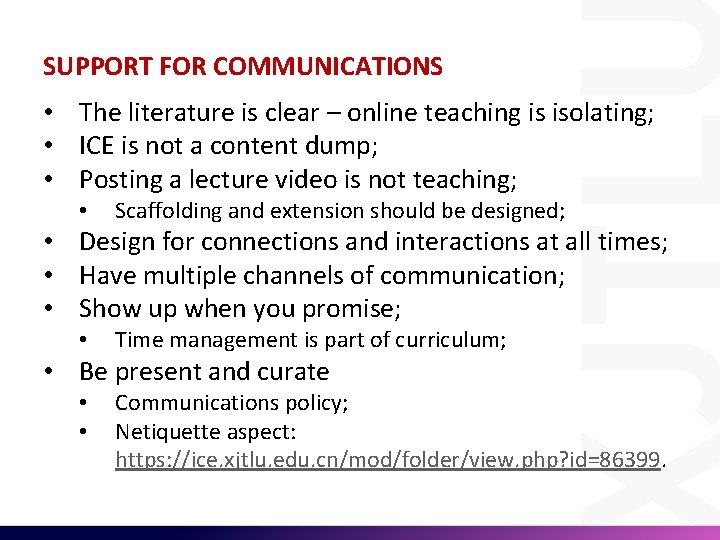
SUPPORT FOR COMMUNICATIONS • The literature is clear – online teaching is isolating; • ICE is not a content dump; • Posting a lecture video is not teaching; • Scaffolding and extension should be designed; • Design for connections and interactions at all times; • Have multiple channels of communication; • Show up when you promise; • Time management is part of curriculum; • Be present and curate • • Communications policy; Netiquette aspect: https: //ice. xjtlu. edu. cn/mod/folder/view. php? id=86399.
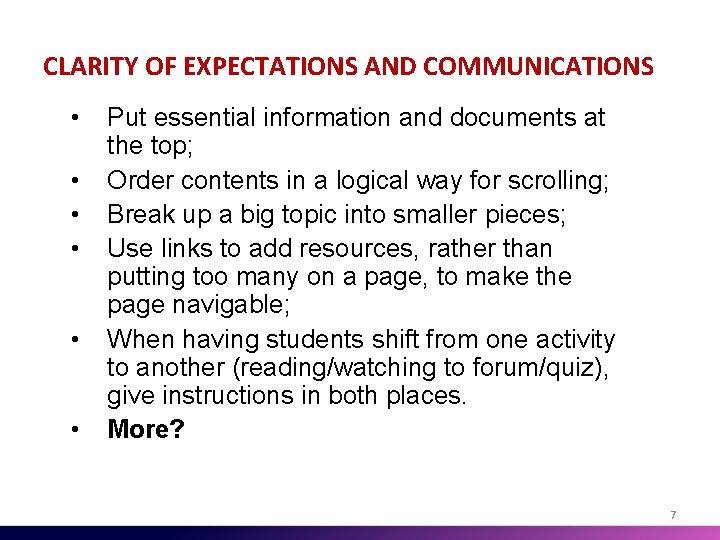
CLARITY OF EXPECTATIONS AND COMMUNICATIONS • • • Put essential information and documents at the top; Order contents in a logical way for scrolling; Break up a big topic into smaller pieces; Use links to add resources, rather than putting too many on a page, to make the page navigable; When having students shift from one activity to another (reading/watching to forum/quiz), give instructions in both places. More? 7
COMMUNICATIONS POLICY Why have a communications policy? What should go into communications policies or instructions?
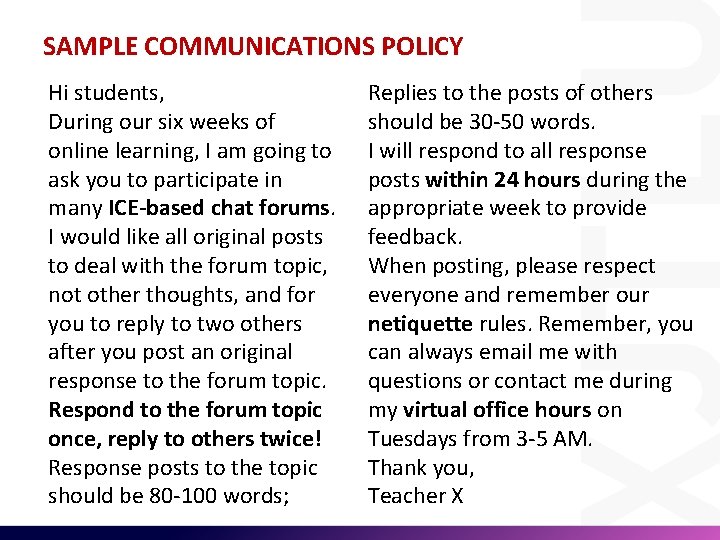
SAMPLE COMMUNICATIONS POLICY Hi students, During our six weeks of online learning, I am going to ask you to participate in many ICE-based chat forums. I would like all original posts to deal with the forum topic, not other thoughts, and for you to reply to two others after you post an original response to the forum topic. Respond to the forum topic once, reply to others twice! Response posts to the topic should be 80 -100 words; Replies to the posts of others should be 30 -50 words. I will respond to all response posts within 24 hours during the appropriate week to provide feedback. When posting, please respect everyone and remember our netiquette rules. Remember, you can always email me with questions or contact me during my virtual office hours on Tuesdays from 3 -5 AM. Thank you, Teacher X
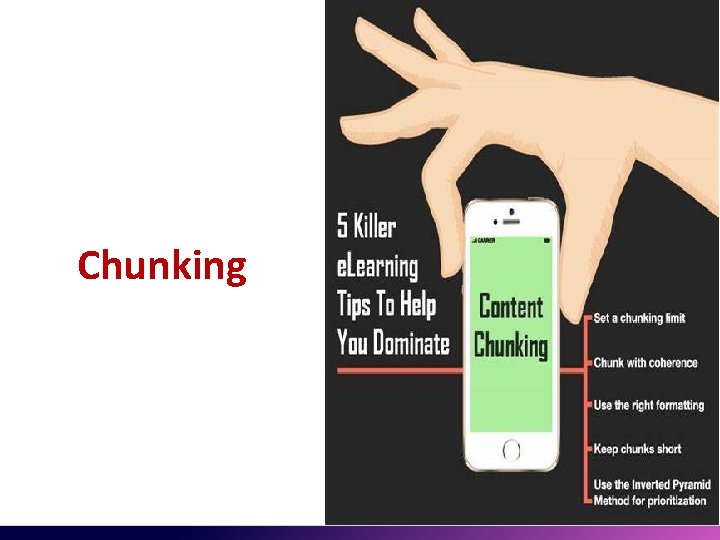
Chunking
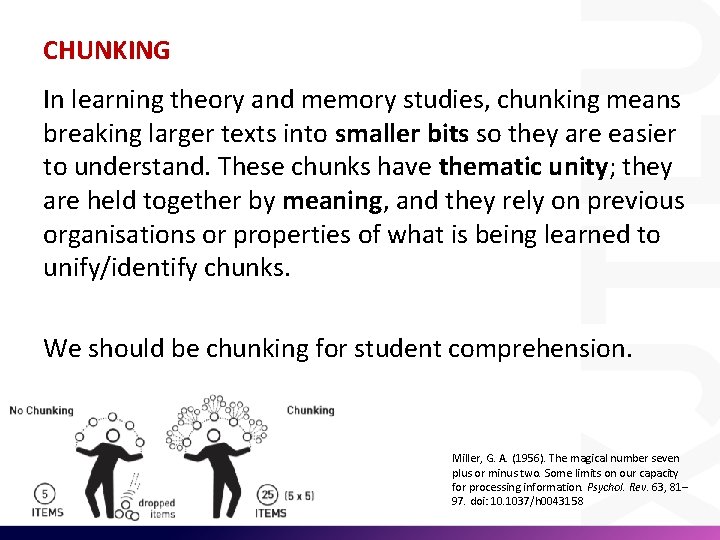
CHUNKING In learning theory and memory studies, chunking means breaking larger texts into smaller bits so they are easier to understand. These chunks have thematic unity; they are held together by meaning, and they rely on previous organisations or properties of what is being learned to unify/identify chunks. We should be chunking for student comprehension. Miller, G. A. (1956). The magical number seven plus or minus two. Some limits on our capacity for processing information. Psychol. Rev. 63, 81– 97. doi: 10. 1037/h 0043158
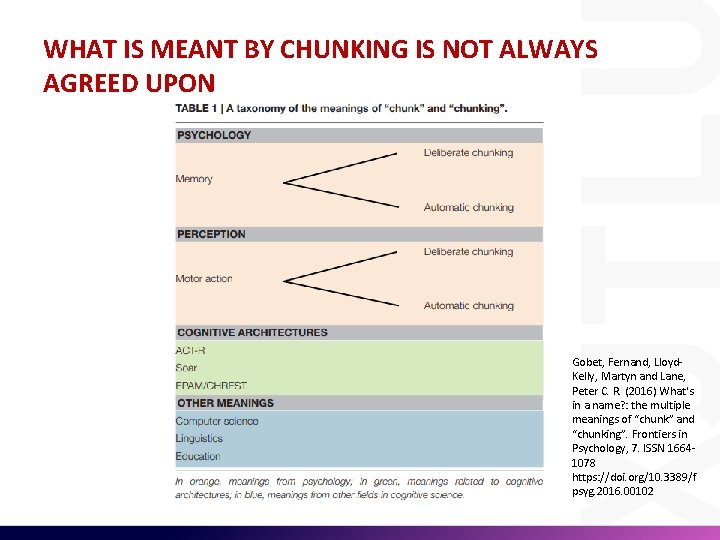
WHAT IS MEANT BY CHUNKING IS NOT ALWAYS AGREED UPON Gobet, Fernand, Lloyd. Kelly, Martyn and Lane, Peter C. R. (2016) What's in a name? : the multiple meanings of “chunk” and “chunking”. Frontiers in Psychology, 7. ISSN 16641078 https: //doi. org/10. 3389/f psyg. 2016. 00102
CONTENT MUST BE PARED WITH ACTIVITY Chunks alone are not enough. Ask students to do something with content in order to better contextualise it within understanding and fix it in long term memory. When students are encouraged to engage in the process of eliciting their ideas, they receive an opportunity to articulate and clarify their views and reflect critically on them (Kearney, 2002). This can be done many ways. Such as? Kearney, M. (2002). Classroom use of multimediasupported predict-observe-explain tasks to elicit and promote discussion about students' physics conceptions. Perth: Doctoral dissertation), Curtin University of Technology. Retrieved from https: //espace. curtin. edu. au/handle/20. 500. 11937/15 43. 13
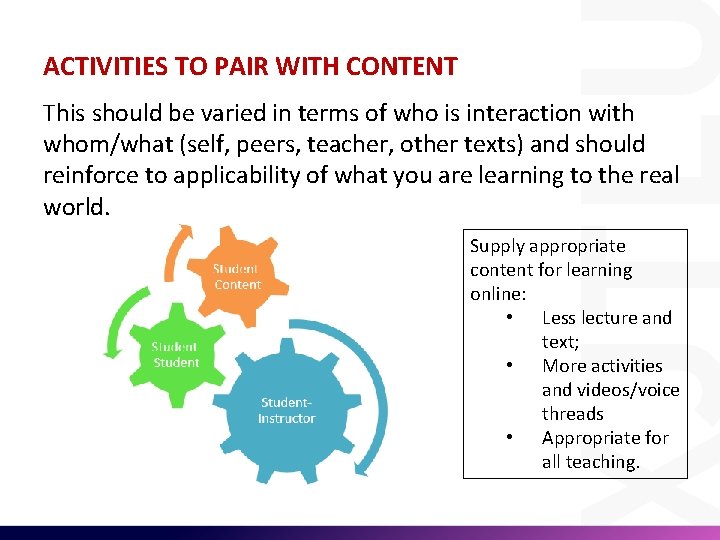
ACTIVITIES TO PAIR WITH CONTENT This should be varied in terms of who is interaction with whom/what (self, peers, teacher, other texts) and should reinforce to applicability of what you are learning to the real world. Supply appropriate content for learning online: • Less lecture and text; • More activities and videos/voice threads • Appropriate for all teaching.
ACTIVITIES TO PAIR WITH CONTENT Ideas include: • Self-guided quizzes • Discussion/discussion forums • Q&A • Exemplification activities • Role play • Application to case studies • Problem solving/diagramming • More? https: //ice. xjtlu. edu. cn/mod/folder/view. php? id=87735
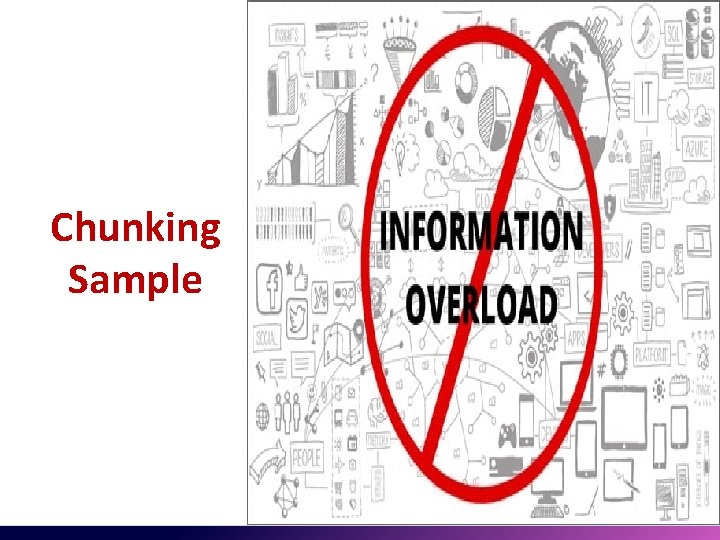
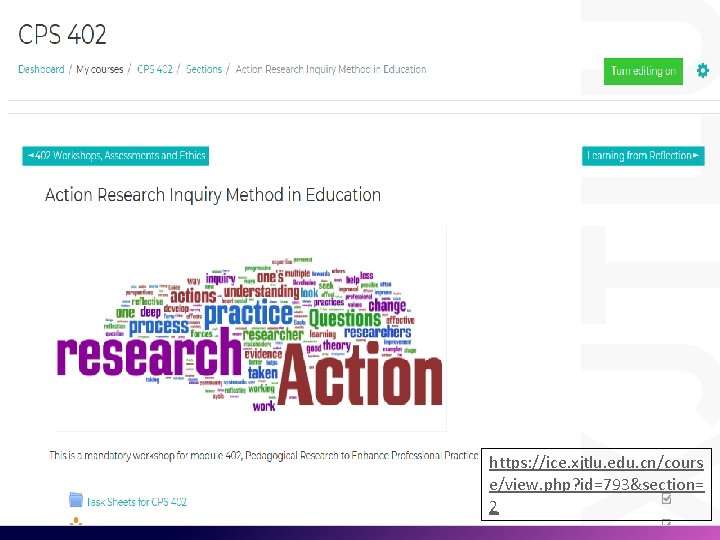
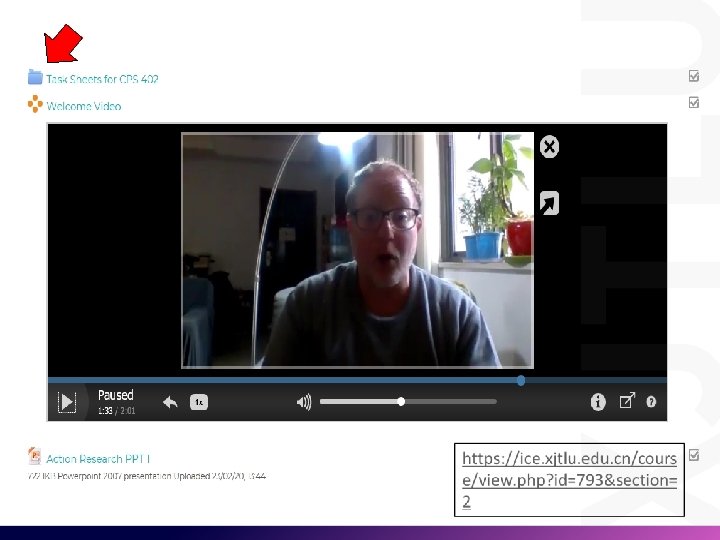
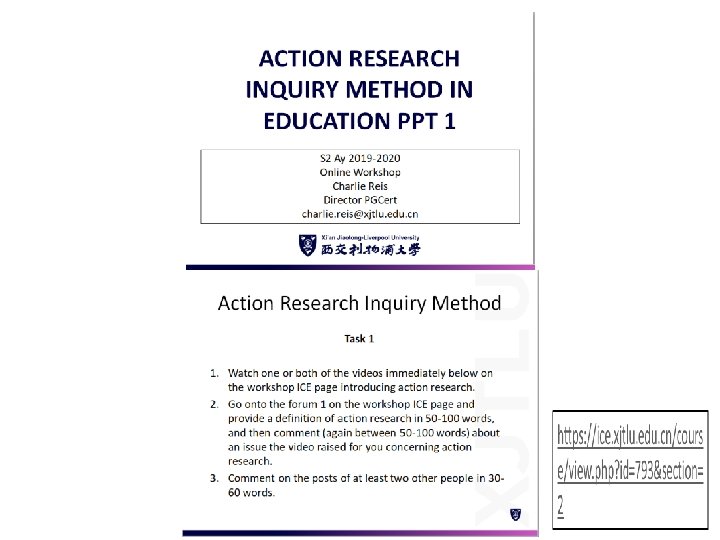
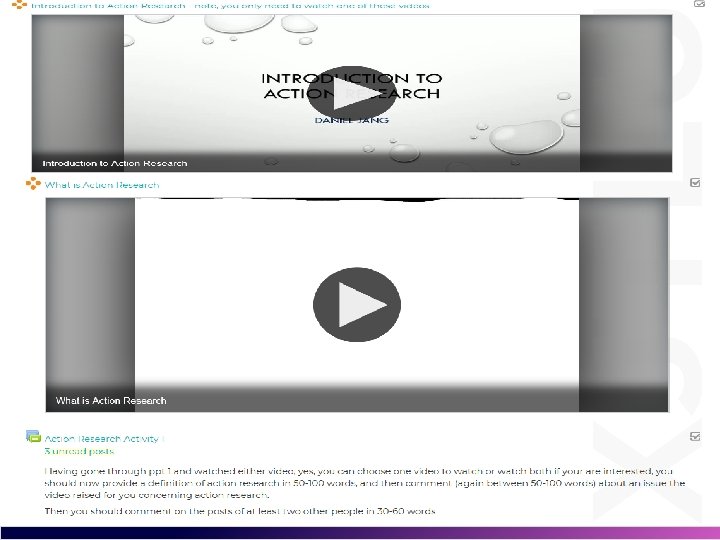
Chunking Sample
https: //ice. xjtlu. edu. cn/cours e/view. php? id=793§ion= 2
REFLECTION AND SELF-ASSESSMENT “Self-assessment is defined as ‘the involvement of learners in making judgements about their achievements and the outcomes of their learning’ (Boud and Falchikov (1989; p 529) and ‘identifying standards and/or criteria to apply to their work and making judgements about the extent to which they have met these criteria and standards’ Boud (1995; p 4). ” (Wride, 2017) • Learner-centred, not teacher-centred; • Deeper learning; • Capacity building. Wride, M. (2017) Guide to Self. Assessment. [Trinity College Dublin. [online] Available at: https: //www. tcd. ie/CAPSL/asset s/pdf/Academic%20 Practice%20 Resources/Guide%20 to%20 Stud ent%20 Self%20 Assessment. pdf Accessed 23 June, 2020.
REFLECTION In order to monitor their learning students most receive both feedback from instructors and peers as well as opportunities to reflect on their learning, attitudes and beliefs. 1. How are they seeing themselves/their progress? 2. How are they able to identify gaps in learning/broader conceptual confusions? 3. How are you facilitating reflection on membership Stefano, G. D. , Gino, F. , Pisano, G. & Staats, B. (2014). Making in your discipline? Experience Count: The Role of Reflection in Individual Learning (June 14, 2016). Harvard Business School NOM Unit Working Paper No. 14 -093; Harvard Business School Technology & Operations Mgt. Unit Working Paper No. 14 -093. Available at SSRN: https: //ssrn. com/abstract=2414478.
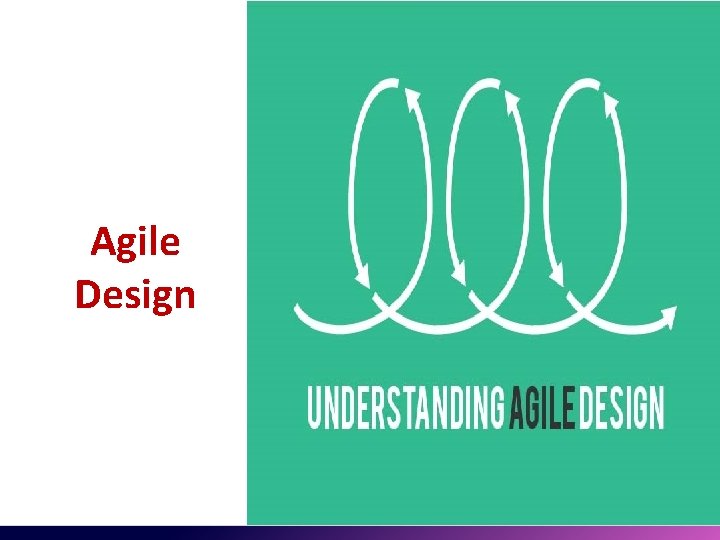
Agile Design
AGILE DESIGN 1. What is your understanding of agile design? 2. Why is agile design important; how does it fit into your vision of learning and teaching? 3. How does the student voice impact instructor agility?
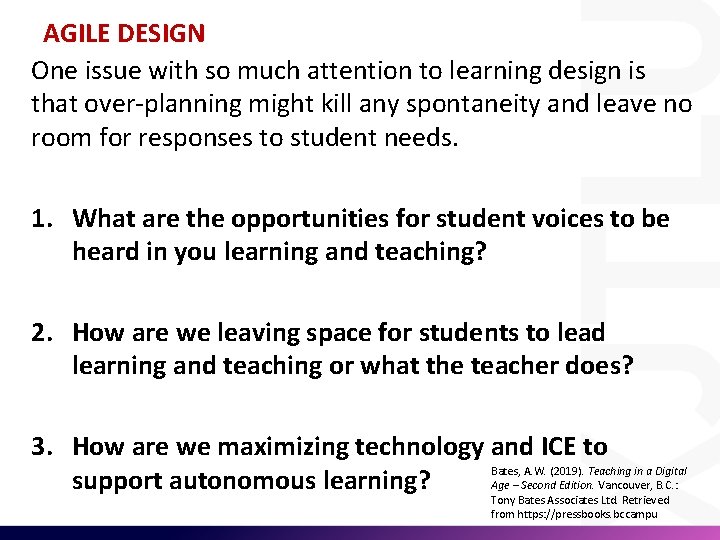
AGILE DESIGN One issue with so much attention to learning design is that over-planning might kill any spontaneity and leave no room for responses to student needs. 1. What are the opportunities for student voices to be heard in you learning and teaching? 2. How are we leaving space for students to lead learning and teaching or what the teacher does? 3. How are we maximizing technology and ICE to Bates, A. W. (2019). Teaching in a Digital support autonomous learning? Age – Second Edition. Vancouver, B. C. : Tony Bates Associates Ltd. Retrieved from https: //pressbooks. bccampu
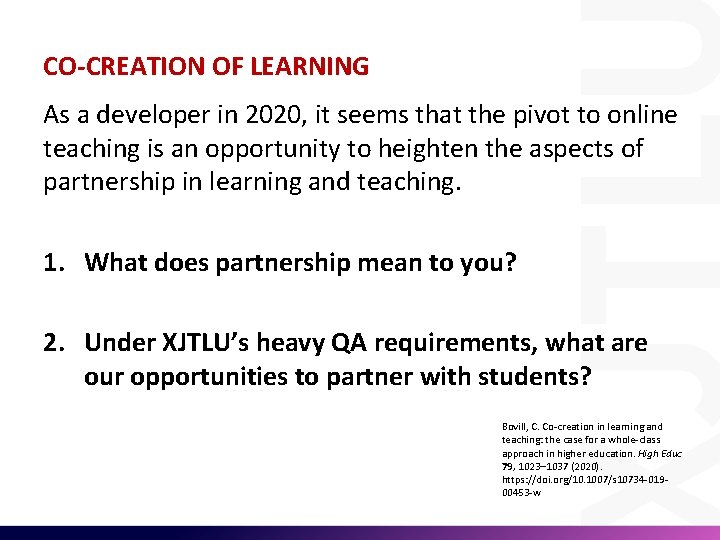
CO-CREATION OF LEARNING As a developer in 2020, it seems that the pivot to online teaching is an opportunity to heighten the aspects of partnership in learning and teaching. 1. What does partnership mean to you? 2. Under XJTLU’s heavy QA requirements, what are our opportunities to partner with students? Bovill, C. Co-creation in learning and teaching: the case for a whole-class approach in higher education. High Educ 79, 1023– 1037 (2020). https: //doi. org/10. 1007/s 10734 -01900453 -w
WHAT ELSE CAN WE DO? This is a question that you should ask yourself often in order to continually improve.
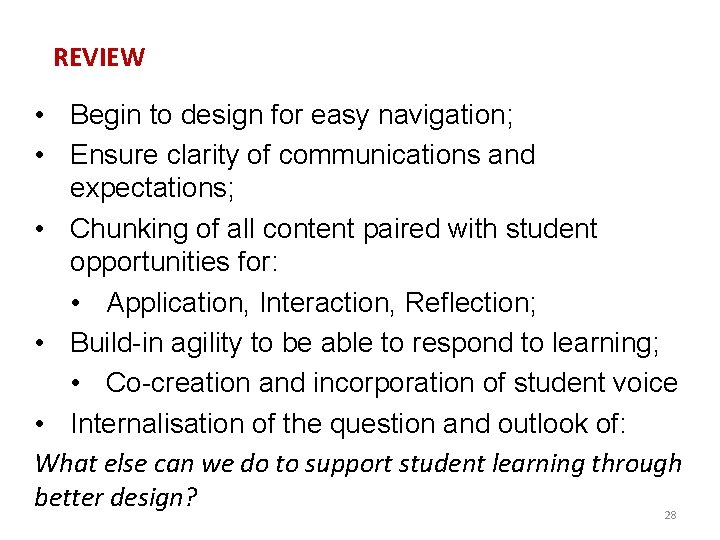
REVIEW • Begin to design for easy navigation; • Ensure clarity of communications and expectations; • Chunking of all content paired with student opportunities for: • Application, Interaction, Reflection; • Build-in agility to be able to respond to learning; • Co-creation and incorporation of student voice • Internalisation of the question and outlook of: What else can we do to support student learning through better design? 28
THANK YOU VISIT US FOLLOW US WWW. XJTLU. EDU. CN @XJTLU