
Design and Statistical Analysis of Thorough QT TQT



- Slides: 65
Design and Statistical Analysis of Thorough QT (TQT) Studies Yi Tsong, Ph. D. , CDER/FDA Co-author – Joanne Zhang, Ph. D. , CDER/FDA The opinions presented by here do not necessarily represent those of the U. S. Food and Drug Administration. Biostatistics Seminar at Columbia University October 11, 2007
Acknowledgement • TQT Study Statistical Review Coordinator – Joanne Zhang, Ph. D. , Div. of Biostatistics VI, CDER • TQT Statistical Method Support Team Leader: Stella Machado, Ph. D. , Director, Div. of Biometrics VI – James Hung, Ph. D. , Director, Div. of Biometrics I – Robert O’Neill, Ph. D. , Director, Office of Biostat. – Meiyu Shen, Ph. D. , Stat. Reviewer, DBVI – Yi Tsong, Ph. D. , Deputy Director, DBVI – Joanne Zhang, Ph. D. , Stat. Reviewer, DBVI • Other Supporting Statisticians – Ling Chen, Ph. D. , Stat. Reviewer, DBVI – Jinglin Zhong, Ph. D. , Stat. Reviewer, DBVI Biostatistics Seminar at Columbia University October 11, 2007 2
Outline I. III. IV. Background Objective of TQT Study Design Considerations Primary Analysis - ICH E 14 approach - Concentration – response modeling approach - Validation test (Assay Sensitivity) Other Issues - Sample size planning - Missing data - Adaptive designs Biostatistics Seminar at Columbia University October 11, 2007 3
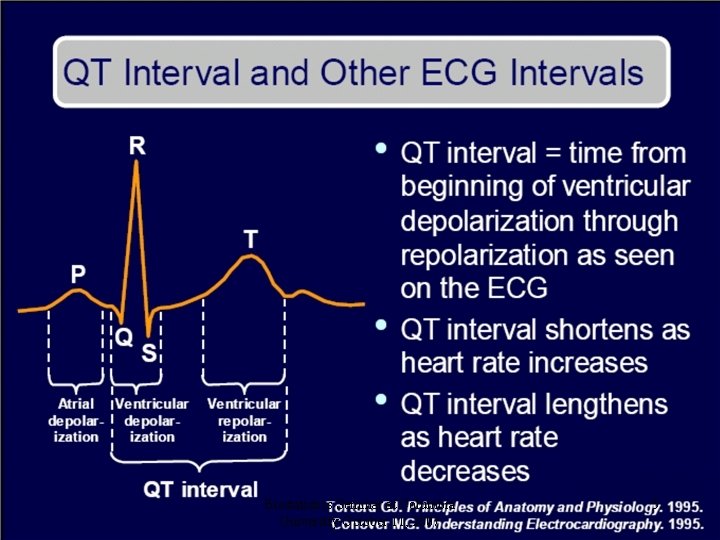
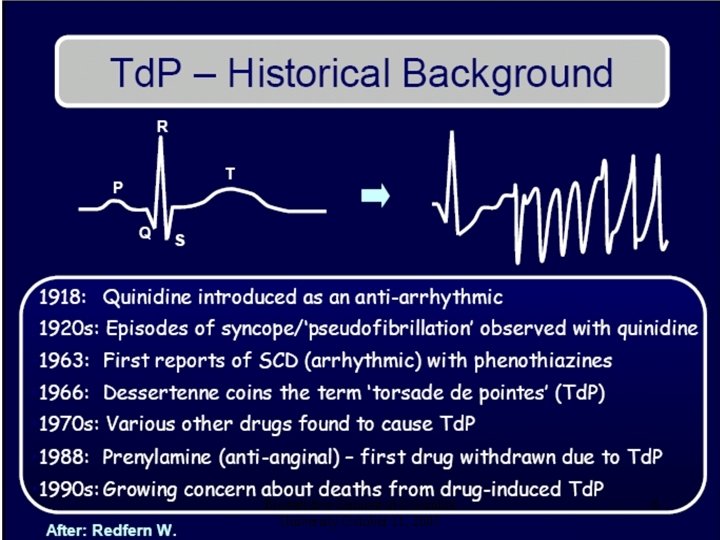
I. BACKGROUND Biostatistics Seminar at Columbia University October 11, 2007 4
Biostatistics Seminar at Columbia University October 11, 2007 5
Biostatistics Seminar at Columbia University October 11, 2007 6
Biostatistics Seminar at Columbia University October 11, 2007 7
Biostatistics Seminar at Columbia University October 11, 2007 8
Biostatistics Seminar at Columbia University October 11, 2007 9
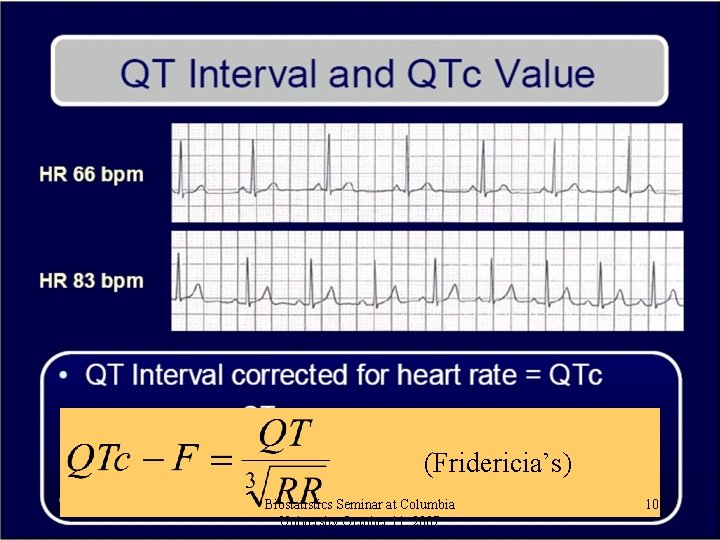
(Fridericia’s) Biostatistics Seminar at Columbia University October 11, 2007 10
Biostatistics Seminar at Columbia University October 11, 2007 11
II. Objective of TQT Study Biostatistics Seminar at Columbia University October 11, 2007 12
• Current ICH E 14 Guidance requests all sponsors submitting new drug applications to conduct a thorough QT/QTc study – Generally conducted in early clinical development after some knowledge of the pharmacokinetics of the drug • Goal: to demonstrate the lack of QT prolongation effect due to the drug Biostatistics Seminar at Columbia University October 11, 2007 13
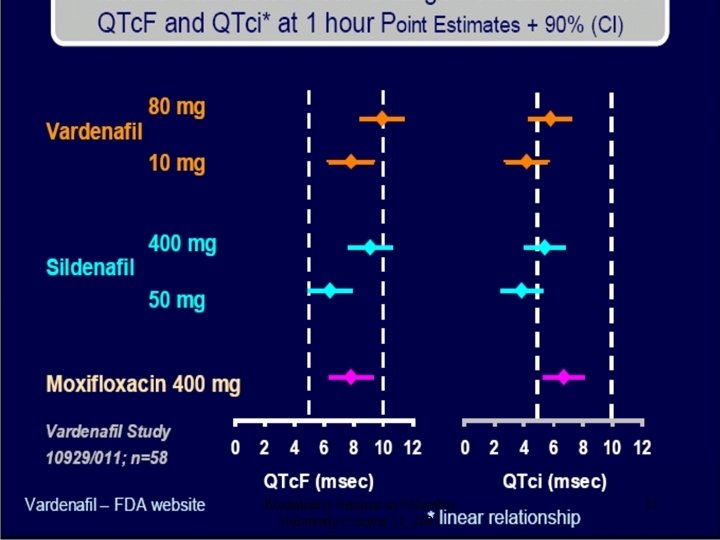
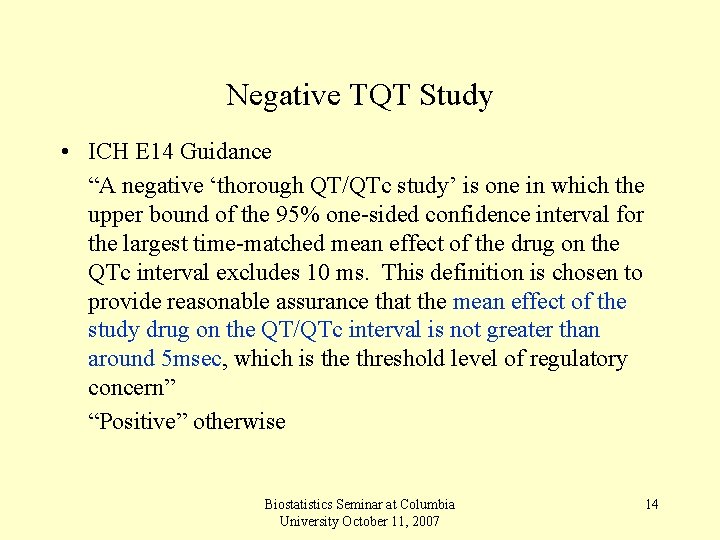
Negative TQT Study • ICH E 14 Guidance “A negative ‘thorough QT/QTc study’ is one in which the upper bound of the 95% one-sided confidence interval for the largest time-matched mean effect of the drug on the QTc interval excludes 10 ms. This definition is chosen to provide reasonable assurance that the mean effect of the study drug on the QT/QTc interval is not greater than around 5 msec, which is the threshold level of regulatory concern” “Positive” otherwise Biostatistics Seminar at Columbia University October 11, 2007 14
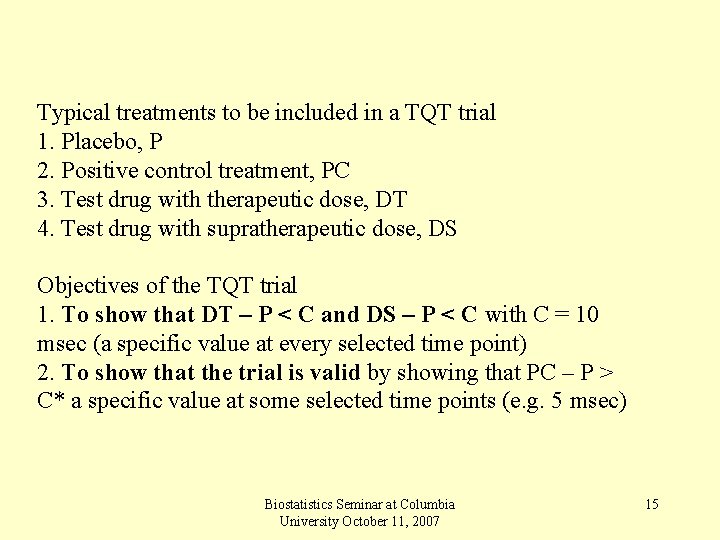
Typical treatments to be included in a TQT trial 1. Placebo, P 2. Positive control treatment, PC 3. Test drug with therapeutic dose, DT 4. Test drug with supratherapeutic dose, DS Objectives of the TQT trial 1. To show that DT – P < C and DS – P < C with C = 10 msec (a specific value at every selected time point) 2. To show that the trial is valid by showing that PC – P > C* a specific value at some selected time points (e. g. 5 msec) Biostatistics Seminar at Columbia University October 11, 2007 15
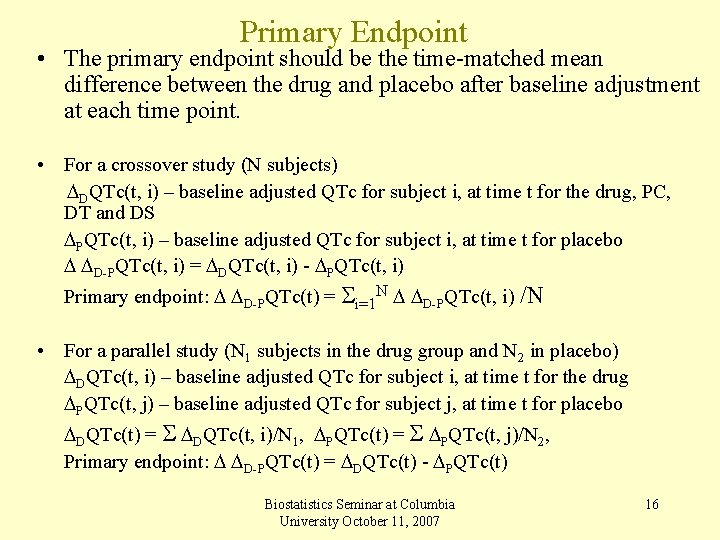
Primary Endpoint • The primary endpoint should be the time-matched mean difference between the drug and placebo after baseline adjustment at each time point. • For a crossover study (N subjects) DQTc(t, i) – baseline adjusted QTc for subject i, at time t for the drug, PC, DT and DS PQTc(t, i) – baseline adjusted QTc for subject i, at time t for placebo D-PQTc(t, i) = DQTc(t, i) - PQTc(t, i) Primary endpoint: D-PQTc(t) = i=1 N D-PQTc(t, i) /N • For a parallel study (N 1 subjects in the drug group and N 2 in placebo) DQTc(t, i) – baseline adjusted QTc for subject i, at time t for the drug PQTc(t, j) – baseline adjusted QTc for subject j, at time t for placebo DQTc(t) = DQTc(t, i)/N 1, PQTc(t) = PQTc(t, j)/N 2, Primary endpoint: D-PQTc(t) = DQTc(t) - PQTc(t) Biostatistics Seminar at Columbia University October 11, 2007 16
III. Design Considerations Biostatistics Seminar at Columbia University October 11, 2007 17
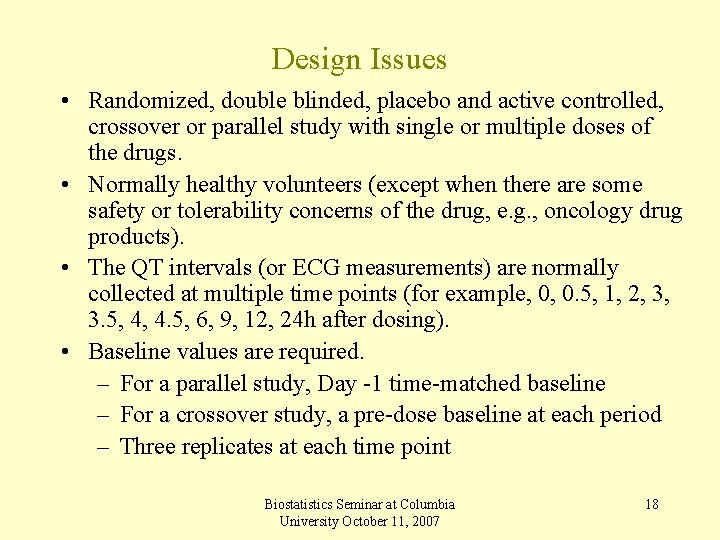
Design Issues • Randomized, double blinded, placebo and active controlled, crossover or parallel study with single or multiple doses of the drugs. • Normally healthy volunteers (except when there are some safety or tolerability concerns of the drug, e. g. , oncology drug products). • The QT intervals (or ECG measurements) are normally collected at multiple time points (for example, 0, 0. 5, 1, 2, 3, 3. 5, 4, 4. 5, 6, 9, 12, 24 h after dosing). • Baseline values are required. – For a parallel study, Day -1 time-matched baseline – For a crossover study, a pre-dose baseline at each period – Three replicates at each time point Biostatistics Seminar at Columbia University October 11, 2007 18
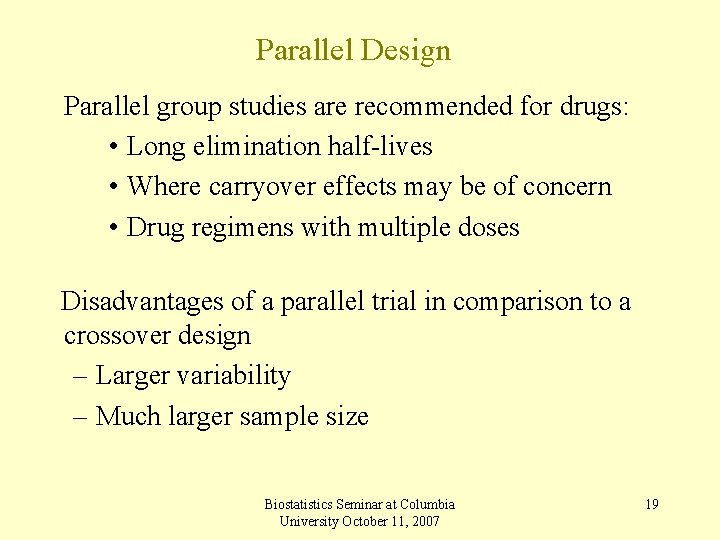
Parallel Design Parallel group studies are recommended for drugs: • Long elimination half-lives • Where carryover effects may be of concern • Drug regimens with multiple doses Disadvantages of a parallel trial in comparison to a crossover design – Larger variability – Much larger sample size Biostatistics Seminar at Columbia University October 11, 2007 19
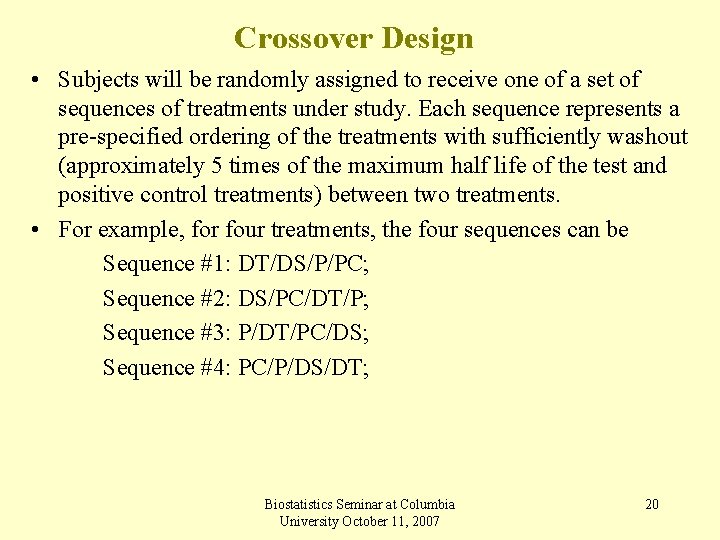
Crossover Design • Subjects will be randomly assigned to receive one of a set of sequences of treatments under study. Each sequence represents a pre-specified ordering of the treatments with sufficiently washout (approximately 5 times of the maximum half life of the test and positive control treatments) between two treatments. • For example, for four treatments, the four sequences can be Sequence #1: DT/DS/P/PC; Sequence #2: DS/PC/DT/P; Sequence #3: P/DT/PC/DS; Sequence #4: PC/P/DS/DT; Biostatistics Seminar at Columbia University October 11, 2007 20
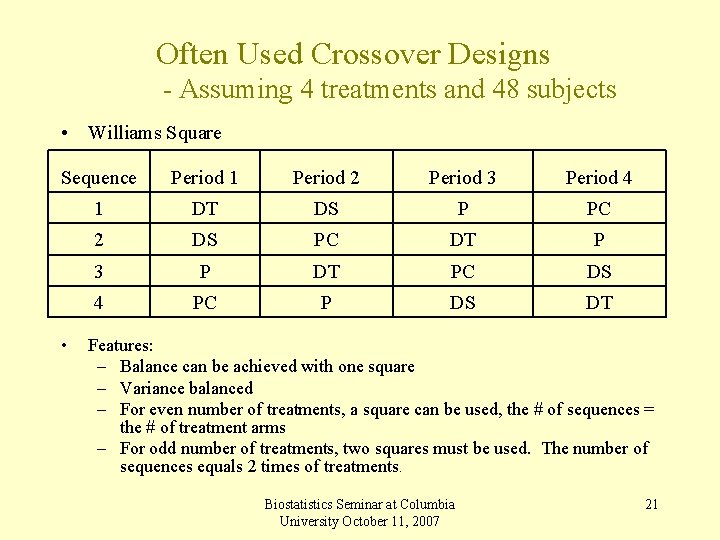
Often Used Crossover Designs - Assuming 4 treatments and 48 subjects • Williams Square Sequence Period 1 Period 2 Period 3 Period 4 1 DT DS P PC 2 DS PC DT P 3 P DT PC DS 4 PC P DS DT • Features: – Balance can be achieved with one square – Variance balanced – For even number of treatments, a square can be used, the # of sequences = the # of treatment arms – For odd number of treatments, two squares must be used. The number of sequences equals 2 times of treatments. Biostatistics Seminar at Columbia University October 11, 2007 21
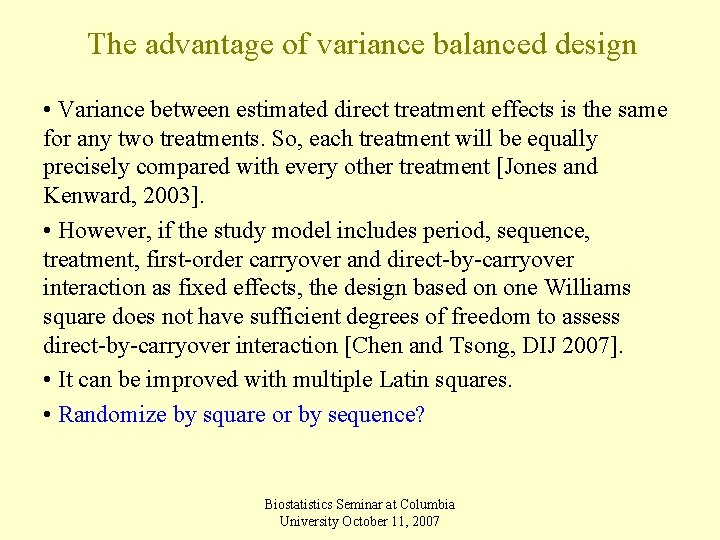
The advantage of variance balanced design • Variance between estimated direct treatment effects is the same for any two treatments. So, each treatment will be equally precisely compared with every other treatment [Jones and Kenward, 2003]. • However, if the study model includes period, sequence, treatment, first-order carryover and direct-by-carryover interaction as fixed effects, the design based on one Williams square does not have sufficient degrees of freedom to assess direct-by-carryover interaction [Chen and Tsong, DIJ 2007]. • It can be improved with multiple Latin squares. • Randomize by square or by sequence? Biostatistics Seminar at Columbia University October 11, 2007
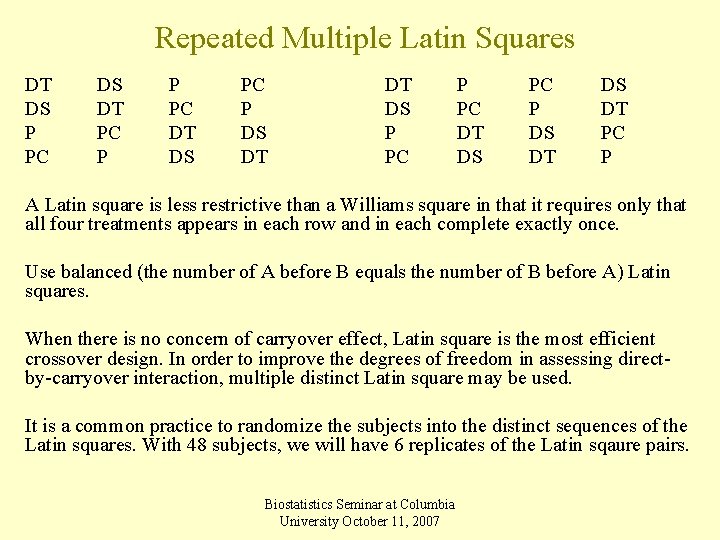
Repeated Multiple Latin Squares DT DS P PC DS DT PC P P PC DT DS PC P DS DT DT DS P PC DT DS PC P DS DT PC P A Latin square is less restrictive than a Williams square in that it requires only that all four treatments appears in each row and in each complete exactly once. Use balanced (the number of A before B equals the number of B before A) Latin squares. When there is no concern of carryover effect, Latin square is the most efficient crossover design. In order to improve the degrees of freedom in assessing directby-carryover interaction, multiple distinct Latin square may be used. It is a common practice to randomize the subjects into the distinct sequences of the Latin squares. With 48 subjects, we will have 6 replicates of the Latin sqaure pairs. Biostatistics Seminar at Columbia University October 11, 2007
• Note that the two Latin squares presented here are orthogonal (i. e. , when they are superimposed, each letter of one square occurs exactly once with every letter of the other Latin square). • Note also that with this design, there is only one subject who receives DS right before P once but there are three subjects who receive P right before PC. It leads to the unbalance of carryover effect in the analysis. • A better design used by some sponsors is a completely orthogonal set of Latin squares as described below. Biostatistics Seminar at Columbia University October 11, 2007 24
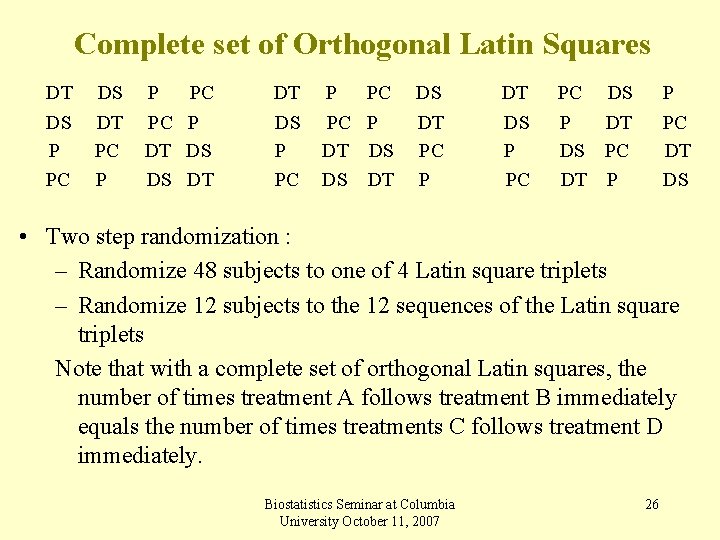
• For the assessment of treatment effect using a Williams square or a set of Latin squares, the investigator and regulator may adjust the estimate of treatment effect for the carryover effect from the period immediately preceding. It is assumed that no carryover effect persists from the treatment two periods back. • A completely orthogonal set of I – 1 Latin square supplies the design to balance the carryover effect of the treatment in periods both follow immediately and two periods back. One of the complete orthogonal set of Latin squares of the four treatments is listed below [Jones and Kenward, 2003][Chen and Tsong, DIJ 2007]. Biostatistics Seminar at Columbia University October 11, 2007 25
Complete set of Orthogonal Latin Squares DT DS P PC DS DT PC P P PC DT DS PC P DS DT DT DS P PC DT DS PC P DS DT PC P DT DS P PC PC DS P DT DS PC DT P P PC DT DS • Two step randomization : – Randomize 48 subjects to one of 4 Latin square triplets – Randomize 12 subjects to the 12 sequences of the Latin square triplets Note that with a complete set of orthogonal Latin squares, the number of times treatment A follows treatment B immediately equals the number of times treatments C follows treatment D immediately. Biostatistics Seminar at Columbia University October 11, 2007 26
• Although this design consists also of twelve Latin squares, because these squares consist twelve distinct sequences, there are 48 degrees of freedom available to assess fixed effects using Model (2). The advantages of using this design are: It is a variance-balanced design. There are enough degrees of freedom to assess direct-bycarryover interaction. Treatment effect can be adjusted for 1 st order and 2 nd order direct-by-carryover interaction. • However, more squares means the whole design is more destructible. Biostatistics Seminar at Columbia University October 11, 2007 27
Concerns of Crossover Design • Note that in TQT studies, depending on the length of the washout period required, drop-out rate of subjects varies. Conventionally, the investigator either replaces the sequence of the drop-out subject by a new subject in order to maintain the design form or the study is analyzed with the data of the completers. In the latter case, a Williams square or Latin square design with missing data is often analyzed as a complete randomized crossover trial. Biostatistics Seminar at Columbia University October 11, 2007 28
Primary Analysis Biostatistics Seminar at Columbia University October 11, 2007 29
ICH E 14 recommended method Thorough QT (TQT) Study and goals: statistical considerations • A ‘thorough QT/QTc Study’ of a drug is a single clinical trial, conducted early in development, dedicated to evaluating the effect of the drug on cardiac repolarization, as detected by QT/QTc prolongation. • Overall goal: to determine whether the TQT study is negative or not Source: Statistical Aspects of ICH E 14 by Stella G. Machado Biostatistics Seminar at Columbia University October 11, 2007 30
“A negative thorough QT/QTc study is one in which the upper bound of the 95% one-sided confidence interval for the largest time-matched mean effect* of the drug on the QTc interval is 10 ms. This definition is chosen to provide reasonable assurance that the mean effect of the study drug on the QT/QTc interval is not greater than around 5 ms, which is the threshold level of regulatory concern” * time-matched mean effect at each time point after dosing is the difference in the QT/QTc interval between the drug and placebo (baseline adjusted) AT EACH MATCHED TIMEPOINT. Source: Statistical Aspects of ICH E 14 by Stella G. Machado Biostatistics Seminar at Columbia University October 11, 2007
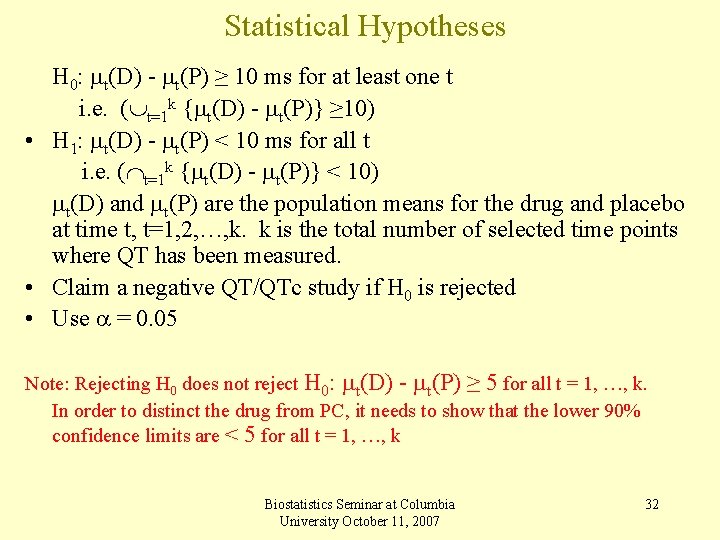
Statistical Hypotheses H 0: t(D) - t(P) ≥ 10 ms for at least one t i. e. ( t=1 k { t(D) - t(P)} ≥ 10) • H 1: t(D) - t(P) < 10 ms for all t i. e. ( t=1 k { t(D) - t(P)} < 10) t(D) and t(P) are the population means for the drug and placebo at time t, t=1, 2, …, k. k is the total number of selected time points where QT has been measured. • Claim a negative QT/QTc study if H 0 is rejected • Use = 0. 05 Note: Rejecting H 0 does not reject H 0: t(D) - t(P) ≥ 5 for all t = 1, …, k. In order to distinct the drug from PC, it needs to show that the lower 90% confidence limits are < 5 for all t = 1, …, k Biostatistics Seminar at Columbia University October 11, 2007 32
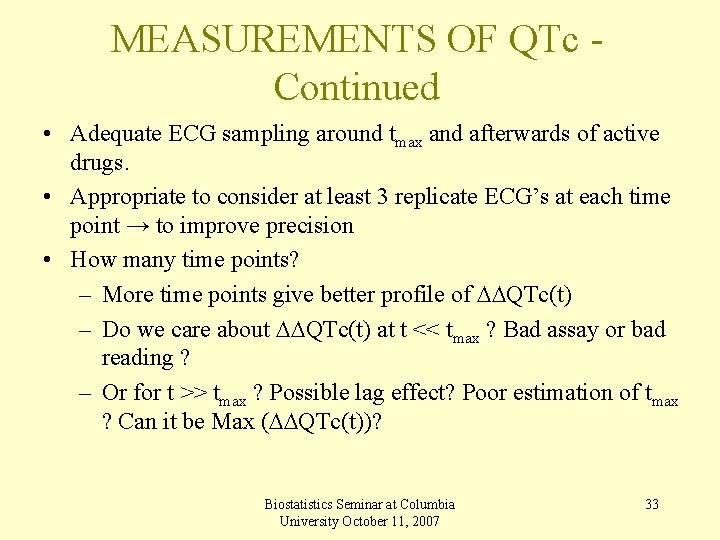
MEASUREMENTS OF QTc Continued • Adequate ECG sampling around tmax and afterwards of active drugs. • Appropriate to consider at least 3 replicate ECG’s at each time point → to improve precision • How many time points? – More time points give better profile of QTc(t) – Do we care about QTc(t) at t << tmax ? Bad assay or bad reading ? – Or for t >> tmax ? Possible lag effect? Poor estimation of tmax ? Can it be Max ( QTc(t))? Biostatistics Seminar at Columbia University October 11, 2007 33
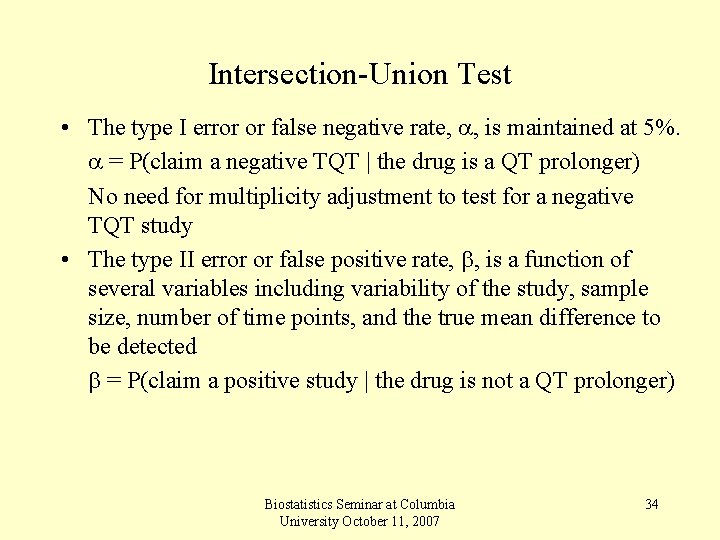
Intersection-Union Test • The type I error or false negative rate, , is maintained at 5%. = P(claim a negative TQT | the drug is a QT prolonger) No need for multiplicity adjustment to test for a negative TQT study • The type II error or false positive rate, , is a function of several variables including variability of the study, sample size, number of time points, and the true mean difference to be detected = P(claim a positive study | the drug is not a QT prolonger) Biostatistics Seminar at Columbia University October 11, 2007 34
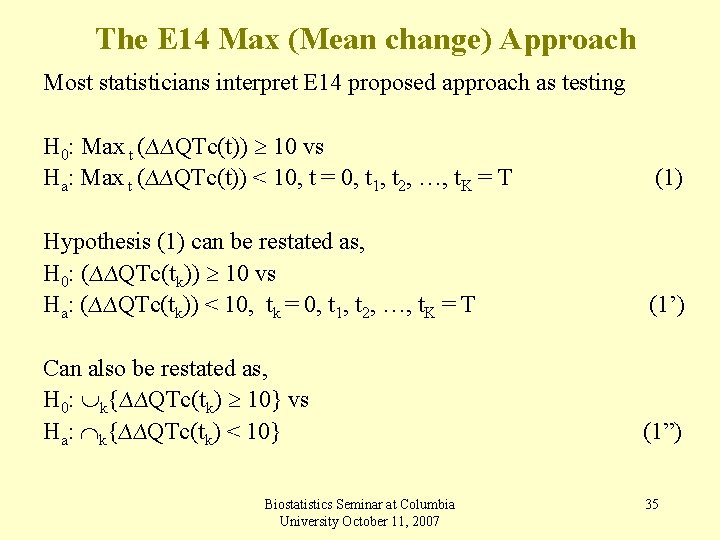
The E 14 Max (Mean change) Approach Most statisticians interpret E 14 proposed approach as testing H 0: Max t (∆∆QTc(t)) 10 vs Ha: Max t (∆∆QTc(t)) < 10, t = 0, t 1, t 2, …, t. K = T (1) Hypothesis (1) can be restated as, H 0: (∆∆QTc(tk)) 10 vs Ha: (∆∆QTc(tk)) < 10, tk = 0, t 1, t 2, …, t. K = T (1’) Can also be restated as, H 0: k{∆∆QTc(tk) 10} vs Ha: k{∆∆QTc(tk) < 10} (1”) Biostatistics Seminar at Columbia University October 11, 2007 35
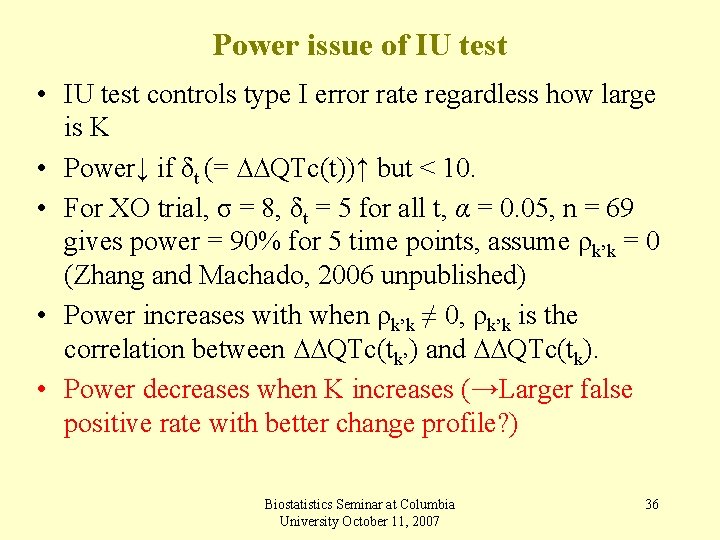
Power issue of IU test • IU test controls type I error rate regardless how large is K • Power↓ if δt (= ∆∆QTc(t))↑ but < 10. • For XO trial, σ = 8, δt = 5 for all t, α = 0. 05, n = 69 gives power = 90% for 5 time points, assume ρk’k = 0 (Zhang and Machado, 2006 unpublished) • Power increases with when ρk’k ≠ 0, ρk’k is the correlation between ∆∆QTc(tk’) and ∆∆QTc(tk). • Power decreases when K increases (→Larger false positive rate with better change profile? ) Biostatistics Seminar at Columbia University October 11, 2007 36
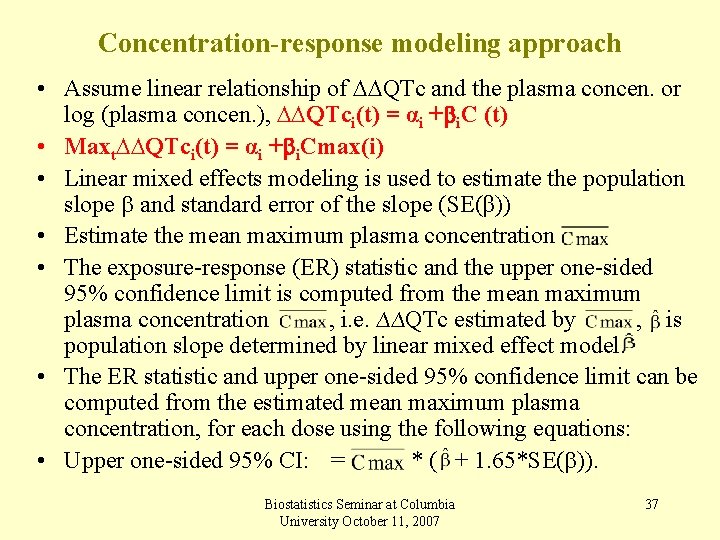
Concentration-response modeling approach • Assume linear relationship of QTc and the plasma concen. or log (plasma concen. ), ∆∆QTci(t) = αi + i. C (t) • Maxt∆∆QTci(t) = αi + i. Cmax(i) • Linear mixed effects modeling is used to estimate the population slope and standard error of the slope (SE(β)) • Estimate the mean maximum plasma concentration • The exposure-response (ER) statistic and the upper one-sided 95% confidence limit is computed from the mean maximum plasma concentration , i. e. ∆∆QTc estimated by , is population slope determined by linear mixed effect model. • The ER statistic and upper one-sided 95% confidence limit can be computed from the estimated mean maximum plasma concentration, for each dose using the following equations: • Upper one-sided 95% CI: = * ( + 1. 65*SE( )). Biostatistics Seminar at Columbia University October 11, 2007 37
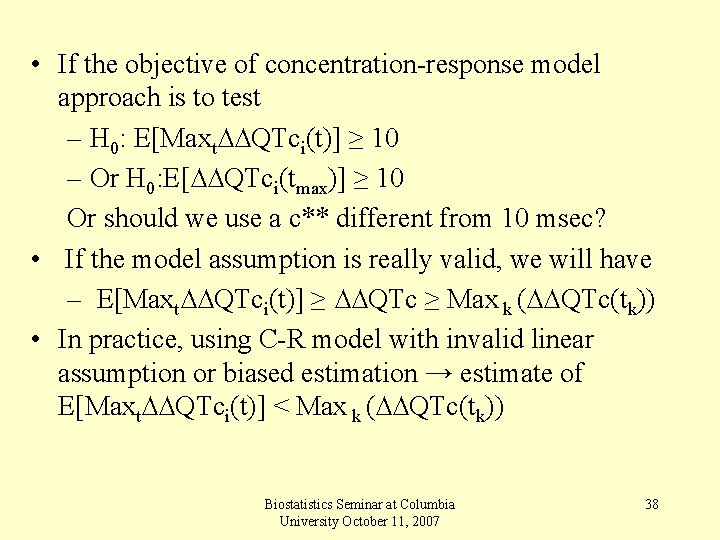
• If the objective of concentration-response model approach is to test – H 0: E[Maxt∆∆QTci(t)] ≥ 10 – Or H 0: E[∆∆QTci(tmax)] ≥ 10 Or should we use a c** different from 10 msec? • If the model assumption is really valid, we will have – E[Maxt∆∆QTci(t)] ≥ ∆∆QTc ≥ Max k (∆∆QTc(tk)) • In practice, using C-R model with invalid linear assumption or biased estimation → estimate of E[Maxt∆∆QTci(t)] < Max k (∆∆QTc(tk)) Biostatistics Seminar at Columbia University October 11, 2007 38
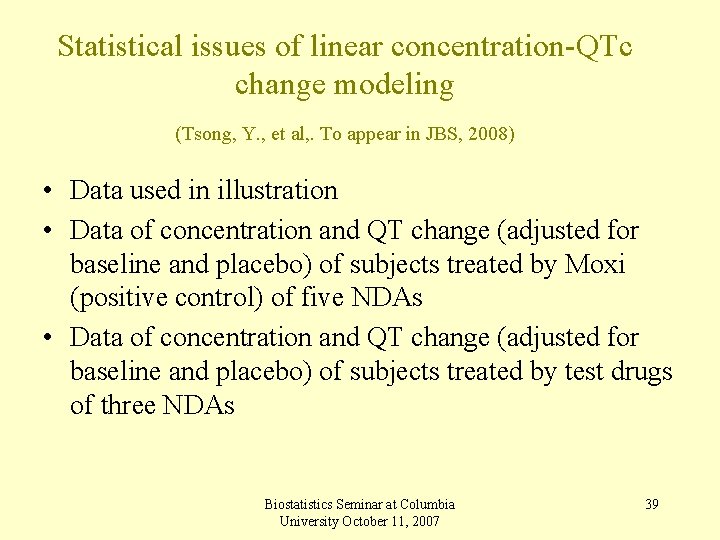
Statistical issues of linear concentration-QTc change modeling (Tsong, Y. , et al, . To appear in JBS, 2008) • Data used in illustration • Data of concentration and QT change (adjusted for baseline and placebo) of subjects treated by Moxi (positive control) of five NDAs • Data of concentration and QT change (adjusted for baseline and placebo) of subjects treated by test drugs of three NDAs Biostatistics Seminar at Columbia University October 11, 2007 39
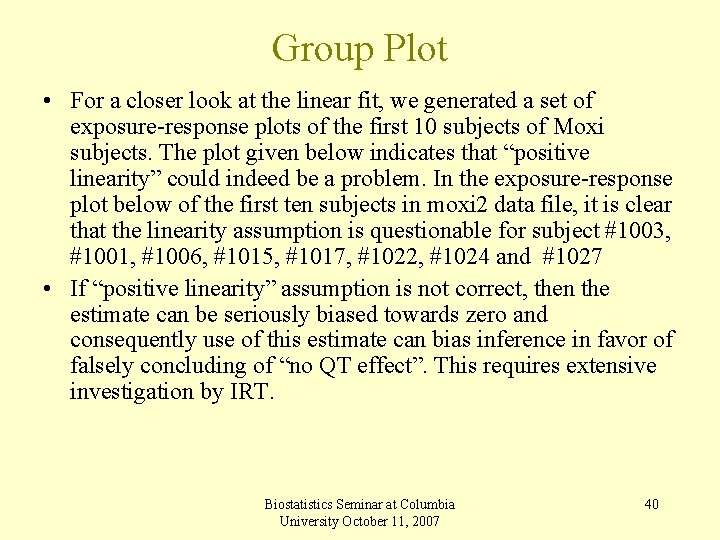
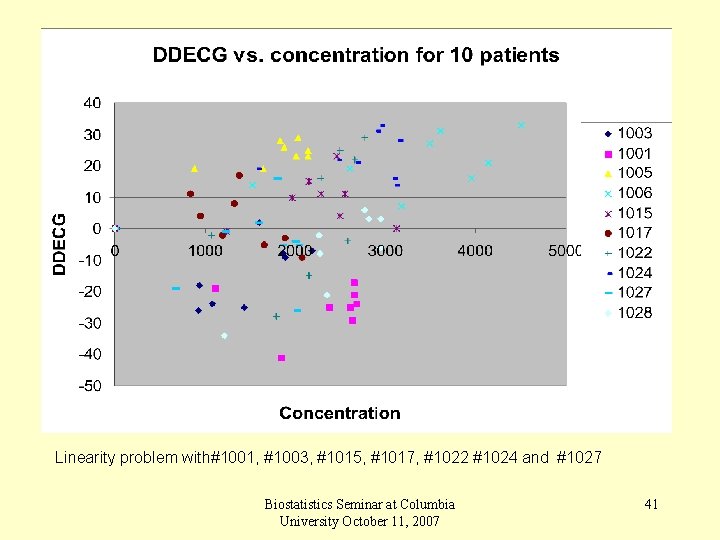
Group Plot • For a closer look at the linear fit, we generated a set of exposure-response plots of the first 10 subjects of Moxi subjects. The plot given below indicates that “positive linearity” could indeed be a problem. In the exposure-response plot below of the first ten subjects in moxi 2 data file, it is clear that the linearity assumption is questionable for subject #1003, #1001, #1006, #1015, #1017, #1022, #1024 and #1027 • If “positive linearity” assumption is not correct, then the estimate can be seriously biased towards zero and consequently use of this estimate can bias inference in favor of falsely concluding of “no QT effect”. This requires extensive investigation by IRT. Biostatistics Seminar at Columbia University October 11, 2007 40
Linearity problem with#1001, #1003, #1015, #1017, #1022 #1024 and #1027 Biostatistics Seminar at Columbia University October 11, 2007 41
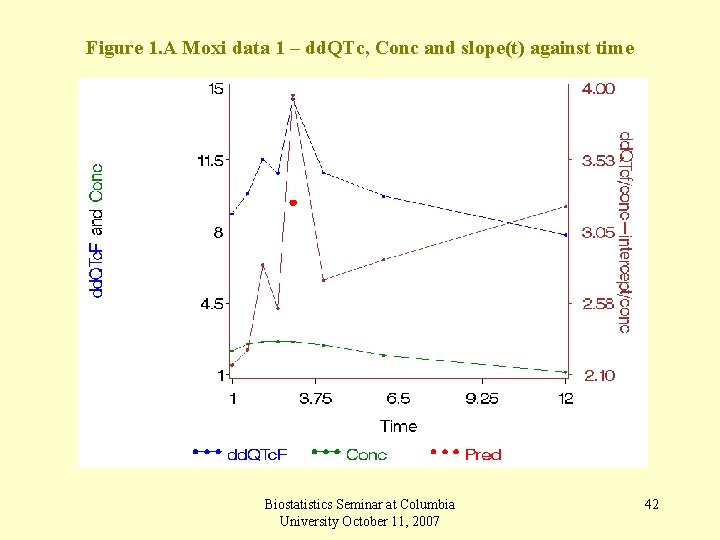
Figure 1. A Moxi data 1 – dd. QTc, Conc and slope(t) against time Biostatistics Seminar at Columbia University October 11, 2007 42
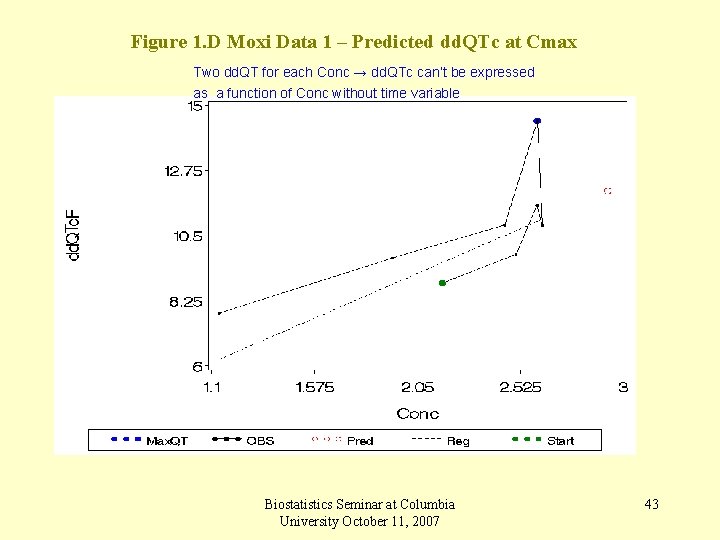
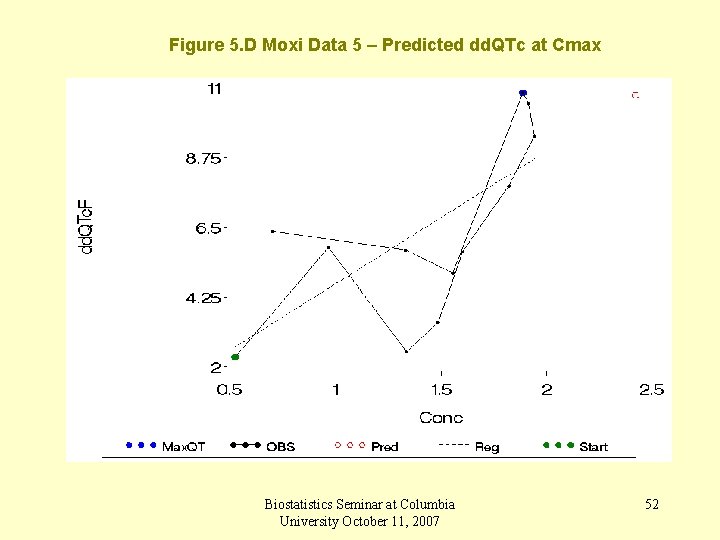
Figure 1. D Moxi Data 1 – Predicted dd. QTc at Cmax Two dd. QT for each Conc → dd. QTc can’t be expressed as a function of Conc without time variable Biostatistics Seminar at Columbia University October 11, 2007 43
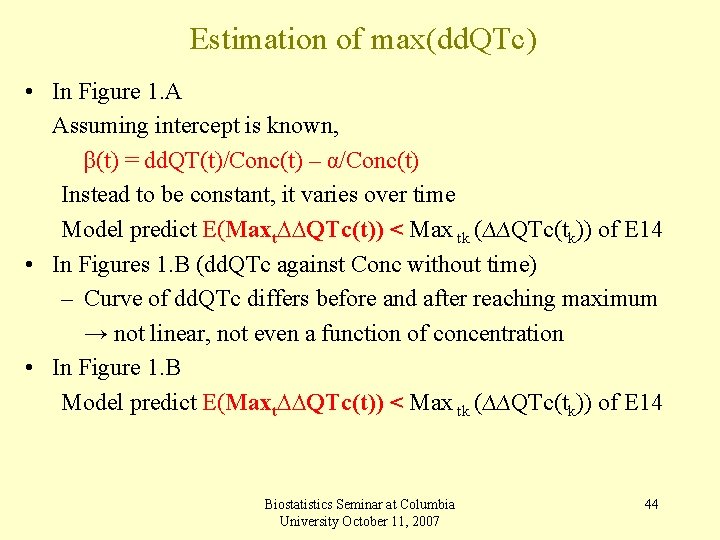
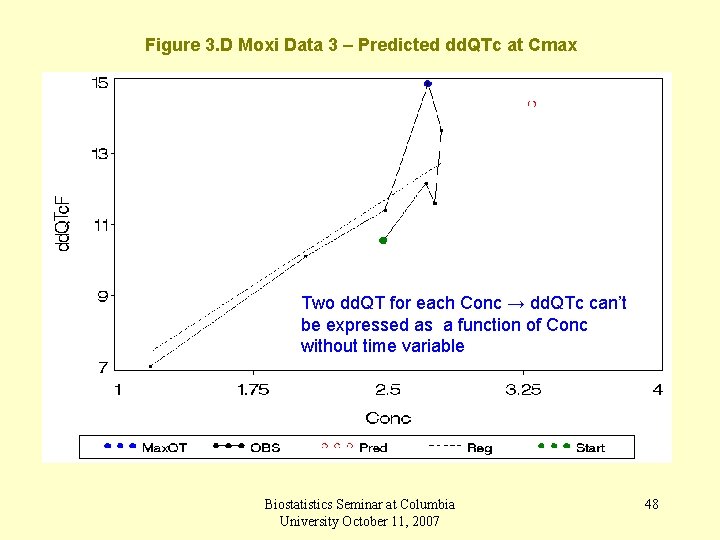
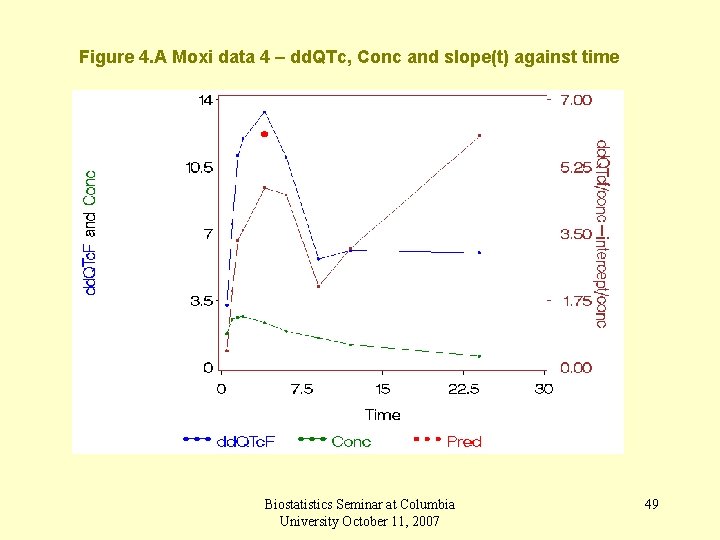
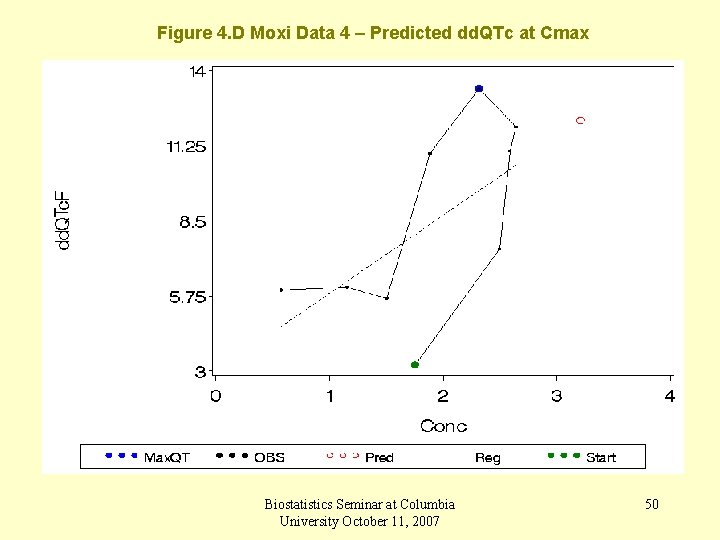
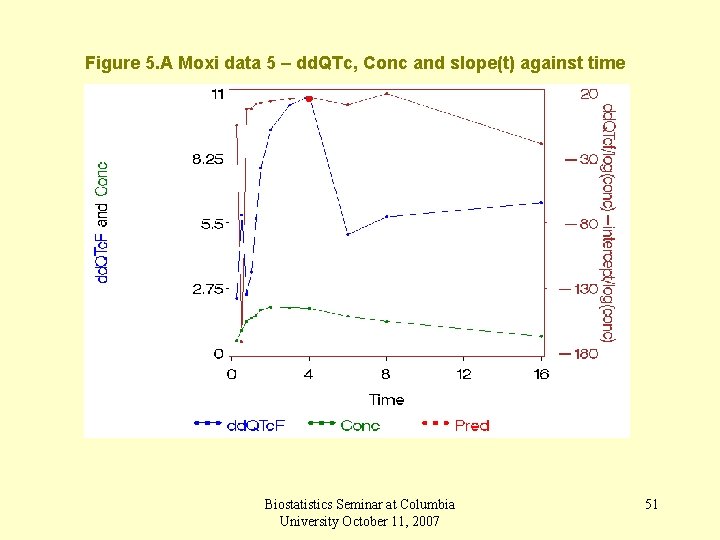
Estimation of max(dd. QTc) • In Figure 1. A Assuming intercept is known, β(t) = dd. QT(t)/Conc(t) – α/Conc(t) Instead to be constant, it varies over time Model predict E(Maxt∆∆QTc(t)) < Max tk (∆∆QTc(tk)) of E 14 • In Figures 1. B (dd. QTc against Conc without time) – Curve of dd. QTc differs before and after reaching maximum → not linear, not even a function of concentration • In Figure 1. B Model predict E(Maxt∆∆QTc(t)) < Max tk (∆∆QTc(tk)) of E 14 Biostatistics Seminar at Columbia University October 11, 2007 44
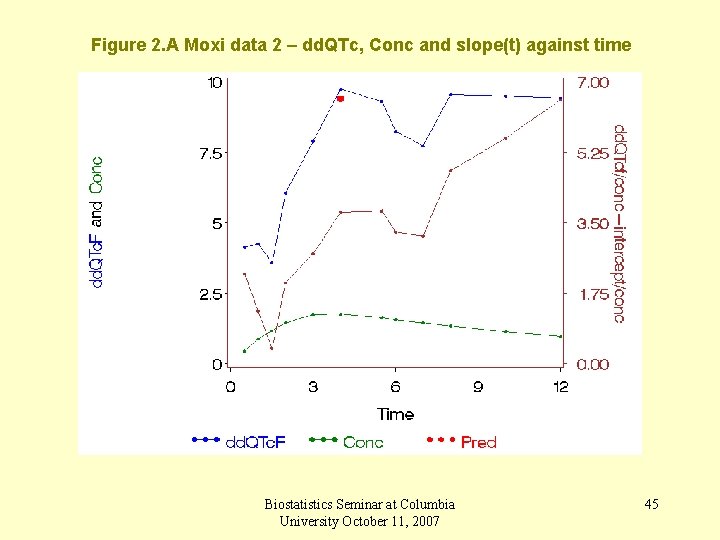
Figure 2. A Moxi data 2 – dd. QTc, Conc and slope(t) against time Biostatistics Seminar at Columbia University October 11, 2007 45
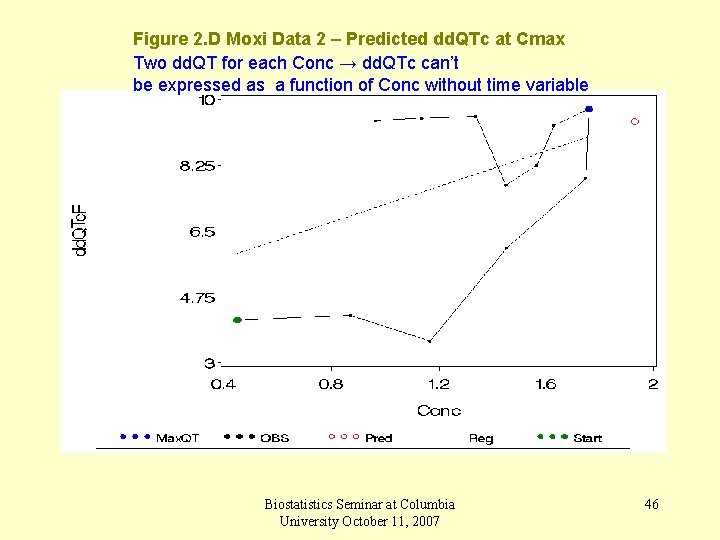
Figure 2. D Moxi Data 2 – Predicted dd. QTc at Cmax Two dd. QT for each Conc → dd. QTc can’t be expressed as a function of Conc without time variable Biostatistics Seminar at Columbia University October 11, 2007 46
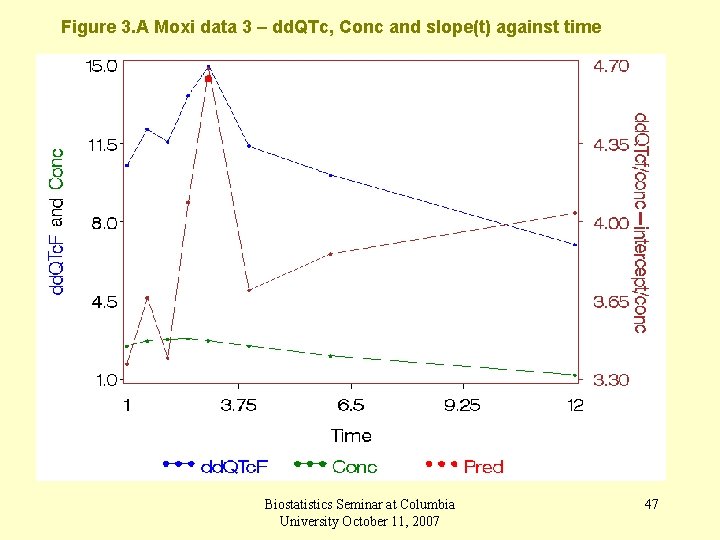
Figure 3. A Moxi data 3 – dd. QTc, Conc and slope(t) against time Biostatistics Seminar at Columbia University October 11, 2007 47
Figure 3. D Moxi Data 3 – Predicted dd. QTc at Cmax Two dd. QT for each Conc → dd. QTc can’t be expressed as a function of Conc without time variable Biostatistics Seminar at Columbia University October 11, 2007 48
Figure 4. A Moxi data 4 – dd. QTc, Conc and slope(t) against time Biostatistics Seminar at Columbia University October 11, 2007 49
Figure 4. D Moxi Data 4 – Predicted dd. QTc at Cmax Biostatistics Seminar at Columbia University October 11, 2007 50
Figure 5. A Moxi data 5 – dd. QTc, Conc and slope(t) against time Biostatistics Seminar at Columbia University October 11, 2007 51
Figure 5. D Moxi Data 5 – Predicted dd. QTc at Cmax Biostatistics Seminar at Columbia University October 11, 2007 52
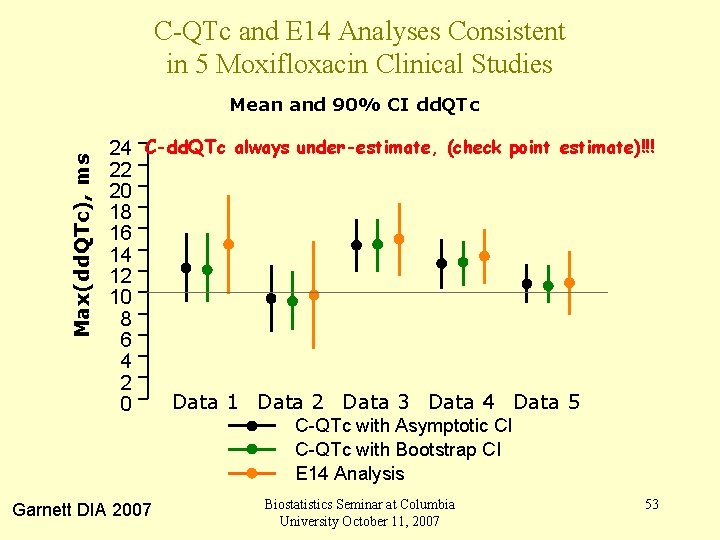
C-QTc and E 14 Analyses Consistent in 5 Moxifloxacin Clinical Studies Max(dd. QTc), ms Mean and 90% CI dd. QTc 24 C-dd. QTc always under-estimate, (check point estimate)!!! 22 20 18 16 14 12 10 8 6 4 2 Data 1 Data 2 Data 3 Data 4 Data 5 0 C-QTc with Asymptotic CI C-QTc with Bootstrap CI E 14 Analysis Garnett DIA 2007 Biostatistics Seminar at Columbia University October 11, 2007 53
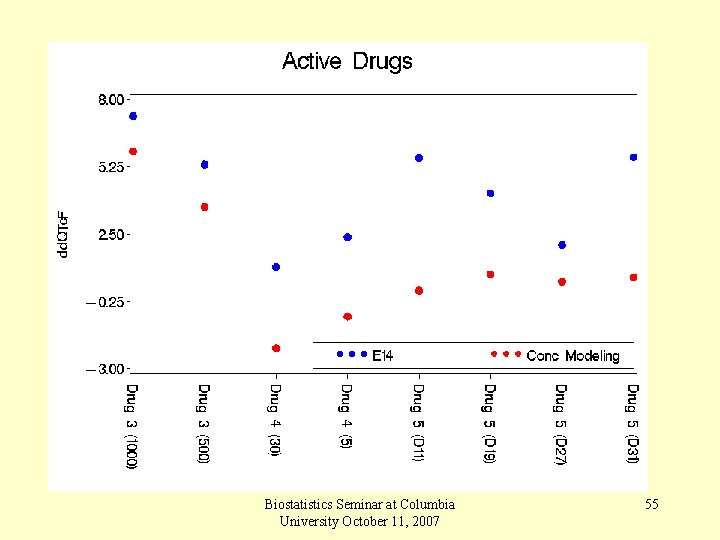
Does conc-resp model approach under-estimate QTc interval change of test drug too? Three of the five data sets have proper test drug data Biostatistics Seminar at Columbia University October 11, 2007
Biostatistics Seminar at Columbia University October 11, 2007 55
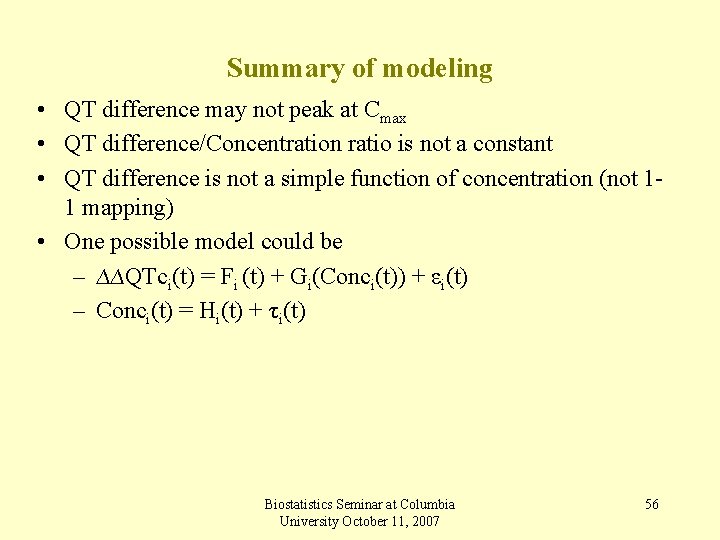
Summary of modeling • QT difference may not peak at Cmax • QT difference/Concentration ratio is not a constant • QT difference is not a simple function of concentration (not 11 mapping) • One possible model could be – ∆∆QTci(t) = Fi (t) + Gi(Conci(t)) + εi(t) – Conci(t) = Hi(t) + τi(t) Biostatistics Seminar at Columbia University October 11, 2007 56
Validation test (Assay Sensitivity) Biostatistics Seminar at Columbia University October 11, 2007 57
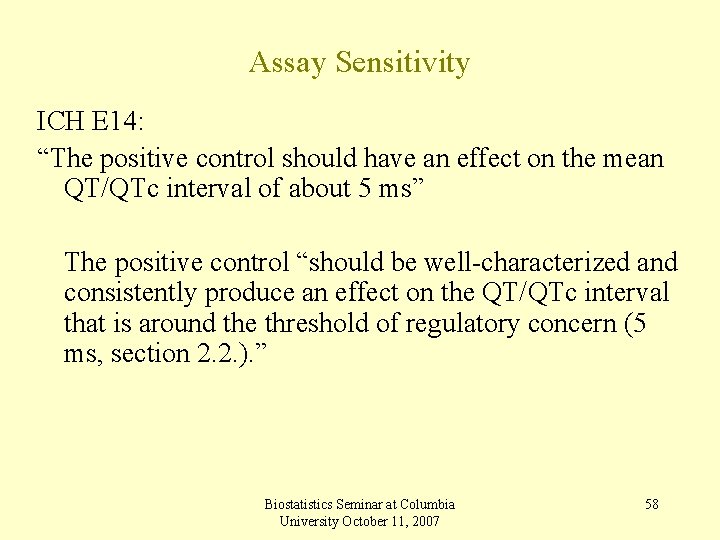
Assay Sensitivity ICH E 14: “The positive control should have an effect on the mean QT/QTc interval of about 5 ms” The positive control “should be well-characterized and consistently produce an effect on the QT/QTc interval that is around the threshold of regulatory concern (5 ms, section 2. 2. ). ” Biostatistics Seminar at Columbia University October 11, 2007 58
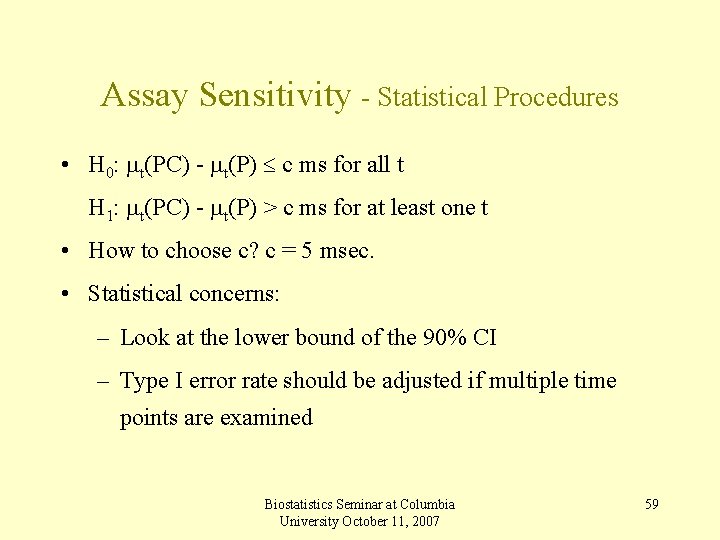
Assay Sensitivity - Statistical Procedures • H 0: t(PC) - t(P) c ms for all t H 1: t(PC) - t(P) > c ms for at least one t • How to choose c? c = 5 msec. • Statistical concerns: – Look at the lower bound of the 90% CI – Type I error rate should be adjusted if multiple time points are examined Biostatistics Seminar at Columbia University October 11, 2007 59
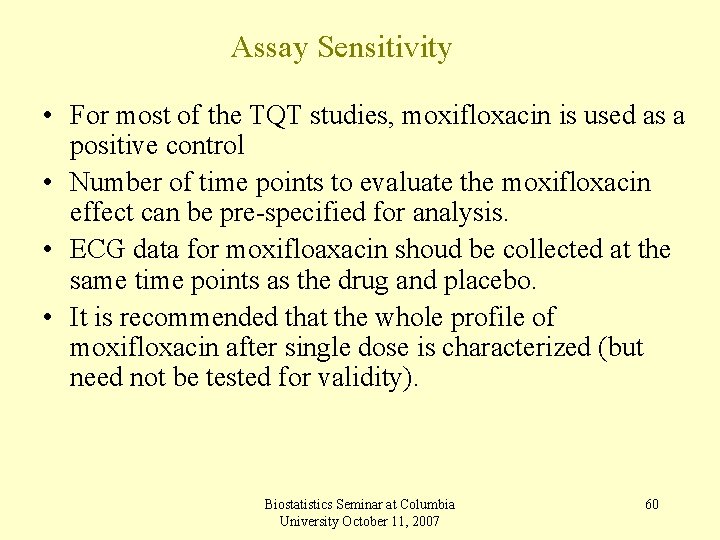
Assay Sensitivity • For most of the TQT studies, moxifloxacin is used as a positive control • Number of time points to evaluate the moxifloxacin effect can be pre-specified for analysis. • ECG data for moxifloaxacin shoud be collected at the same time points as the drug and placebo. • It is recommended that the whole profile of moxifloxacin after single dose is characterized (but need not be tested for validity). Biostatistics Seminar at Columbia University October 11, 2007 60
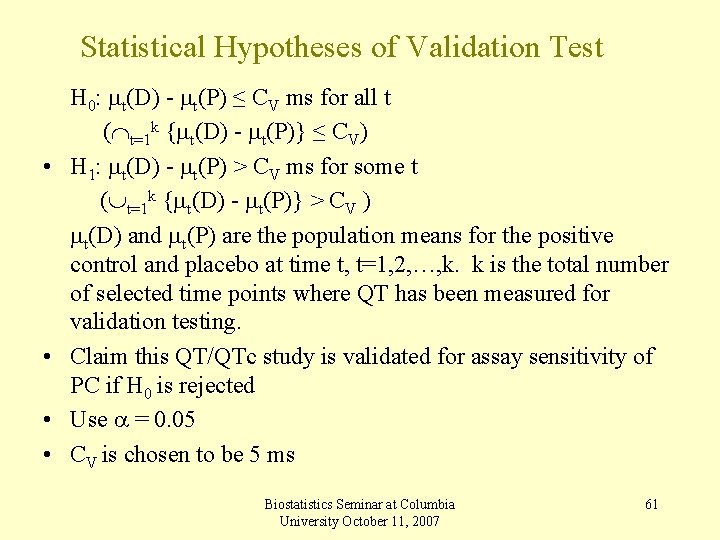
Statistical Hypotheses of Validation Test • • H 0: t(D) - t(P) ≤ CV ms for all t ( t=1 k { t(D) - t(P)} ≤ CV) H 1: t(D) - t(P) > CV ms for some t ( t=1 k { t(D) - t(P)} > CV ) t(D) and t(P) are the population means for the positive control and placebo at time t, t=1, 2, …, k. k is the total number of selected time points where QT has been measured for validation testing. Claim this QT/QTc study is validated for assay sensitivity of PC if H 0 is rejected Use = 0. 05 CV is chosen to be 5 ms Biostatistics Seminar at Columbia University October 11, 2007 61
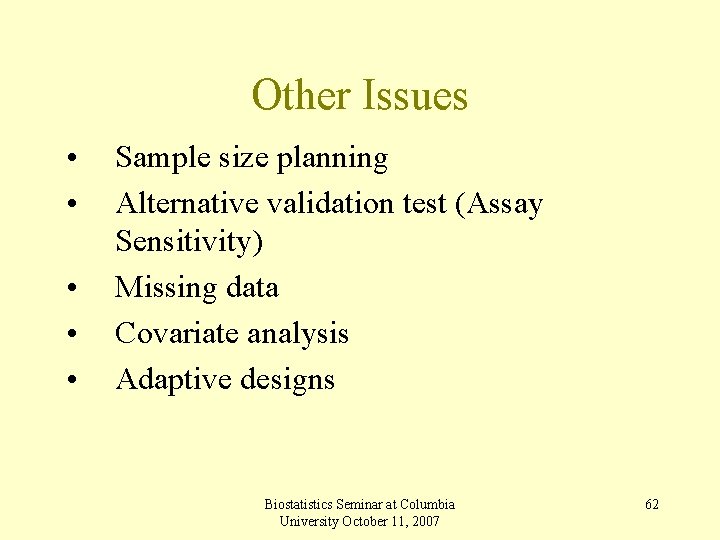
Other Issues • • • Sample size planning Alternative validation test (Assay Sensitivity) Missing data Covariate analysis Adaptive designs Biostatistics Seminar at Columbia University October 11, 2007 62
Thanks for your time! Biostatistics Seminar at Columbia University October 11, 2007
Parallel Arm Design • Let yijt be the baseline adjusted QT measurement corrected with heart rate of the j-th subject of the i-th treatment (i = DT, DS, PC, and P) measured at the t-th time point in a parallel arm design. For any given time point, statistical models using a parallel arm design can be briefly described below. • yijt = μit +εijt (1) where μit is the mean of the i-th treatment effect, εijt are distributed as multivariate normal random variables with mean 0 and covariance ∑t. Biostatistics Seminar at Columbia University October 11, 2007 64
• Let yijkl be the baseline adjusted QT interval of the kth recording time point of the jth subject in the lth sequence who receives the ith treatment, where i = DT, DS, P, PC; j = 1, … n; t = 1, …, k; and l = 1, …, 4. For any given kth time point, the model of this crossover trial at the t-th time point is yijtl = μit + βitl + γijt + εijtl (2) μit - the mean of i-th treatment at the t-th time point, βitl - the mean of period effect (period uniquely determined by sequence l and treatment i); it can also be used as a random effect with mean 0 and variance σtp 2 γijt - independent and identically normally distributed random subject effects with mean 0 and variance σts 2, εijtl - independent and identically distributed normal random errors with mean 0 and variance σt. 2. Note that σtp 2 = σp 2, σts 2 = σs 2 and σt. 2 = σ. 2 when the variance of βitl , γijt, and εijtl are equal across all time points. Biostatistics Seminar at Columbia University October 11, 2007 65