
Design and Simulation of Induction Coils for Welding
- Slides: 1
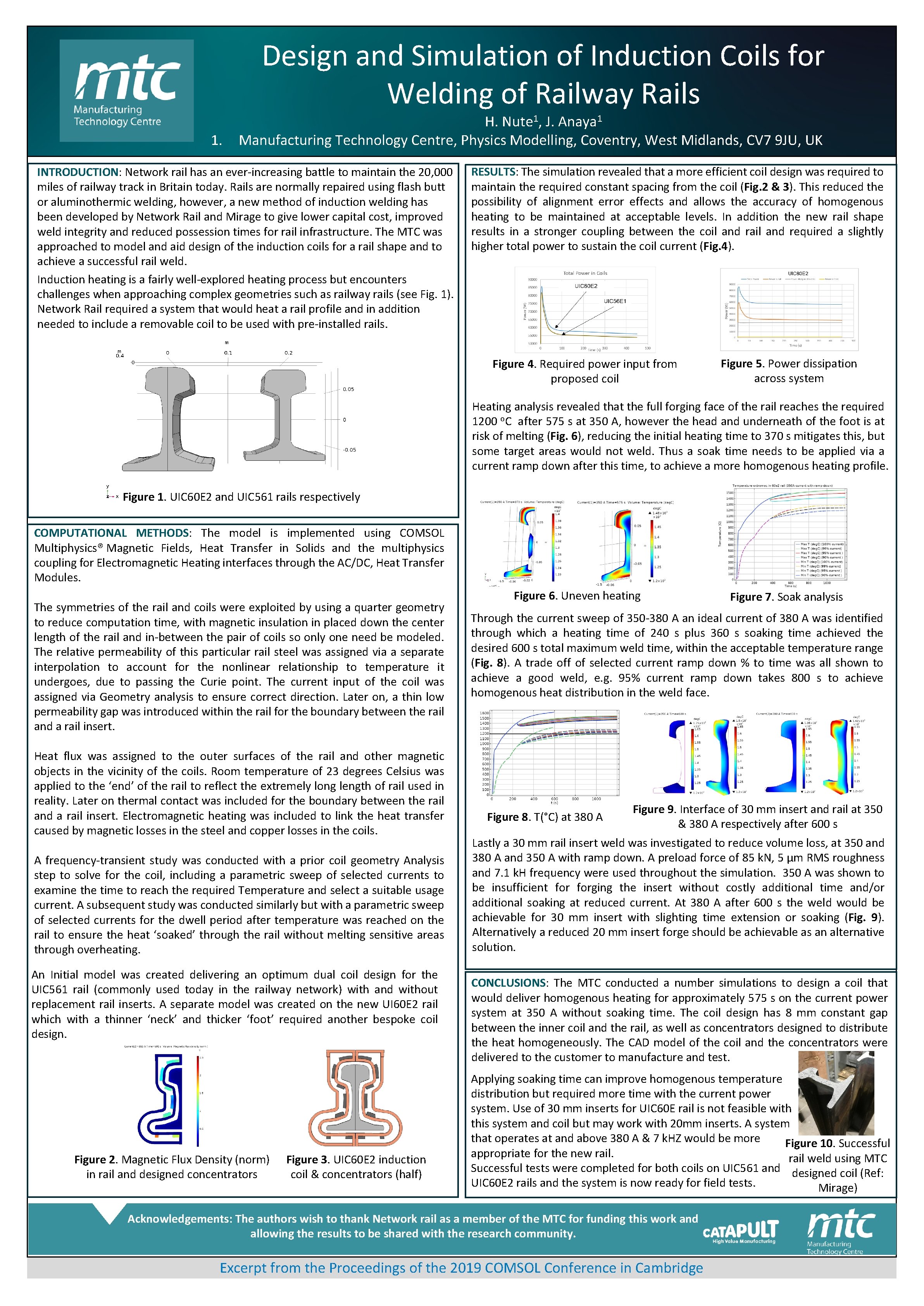
Design and Simulation of Induction Coils for Welding of Railway Rails 1. H. Nute 1, J. Anaya 1 Manufacturing Technology Centre, Physics Modelling, Coventry, West Midlands, CV 7 9 JU, UK INTRODUCTION: Network rail has an ever-increasing battle to maintain the 20, 000 miles of railway track in Britain today. Rails are normally repaired using flash butt or aluminothermic welding, however, a new method of induction welding has been developed by Network Rail and Mirage to give lower capital cost, improved weld integrity and reduced possession times for rail infrastructure. The MTC was approached to model and aid design of the induction coils for a rail shape and to achieve a successful rail weld. Induction heating is a fairly well-explored heating process but encounters challenges when approaching complex geometries such as railway rails (see Fig. 1). Network Rail required a system that would heat a rail profile and in addition needed to include a removable coil to be used with pre-installed rails. RESULTS: The simulation revealed that a more efficient coil design was required to maintain the required constant spacing from the coil (Fig. 2 & 3). This reduced the possibility of alignment error effects and allows the accuracy of homogenous heating to be maintained at acceptable levels. In addition the new rail shape results in a stronger coupling between the coil and rail and required a slightly higher total power to sustain the coil current (Fig. 4). Figure 4. Required power input from proposed coil Figure 5. Power dissipation across system Heating analysis revealed that the full forging face of the rail reaches the required 1200 o. C after 575 s at 350 A, however the head and underneath of the foot is at risk of melting (Fig. 6), reducing the initial heating time to 370 s mitigates this, but some target areas would not weld. Thus a soak time needs to be applied via a current ramp down after this time, to achieve a more homogenous heating profile. Figure 1. UIC 60 E 2 and UIC 561 rails respectively COMPUTATIONAL METHODS: The model is implemented using COMSOL Multiphysics® Magnetic Fields, Heat Transfer in Solids and the multiphysics coupling for Electromagnetic Heating interfaces through the AC/DC, Heat Transfer Modules. The symmetries of the rail and coils were exploited by using a quarter geometry to reduce computation time, with magnetic insulation in placed down the center length of the rail and in-between the pair of coils so only one need be modeled. The relative permeability of this particular rail steel was assigned via a separate interpolation to account for the nonlinear relationship to temperature it undergoes, due to passing the Curie point. The current input of the coil was assigned via Geometry analysis to ensure correct direction. Later on, a thin low permeability gap was introduced within the rail for the boundary between the rail and a rail insert. Heat flux was assigned to the outer surfaces of the rail and other magnetic objects in the vicinity of the coils. Room temperature of 23 degrees Celsius was applied to the ‘end’ of the rail to reflect the extremely long length of rail used in reality. Later on thermal contact was included for the boundary between the rail and a rail insert. Electromagnetic heating was included to link the heat transfer caused by magnetic losses in the steel and copper losses in the coils. A frequency-transient study was conducted with a prior coil geometry Analysis step to solve for the coil, including a parametric sweep of selected currents to examine the time to reach the required Temperature and select a suitable usage current. A subsequent study was conducted similarly but with a parametric sweep of selected currents for the dwell period after temperature was reached on the rail to ensure the heat ‘soaked’ through the rail without melting sensitive areas through overheating. An Initial model was created delivering an optimum dual coil design for the UIC 561 rail (commonly used today in the railway network) with and without replacement rail inserts. A separate model was created on the new UI 60 E 2 rail which with a thinner ‘neck’ and thicker ‘foot’ required another bespoke coil design. Figure 2. Magnetic Flux Density (norm) in rail and designed concentrators Figure 3. UIC 60 E 2 induction coil & concentrators (half) Figure 6. Uneven heating Figure 7. Soak analysis Through the current sweep of 350 -380 A an ideal current of 380 A was identified through which a heating time of 240 s plus 360 s soaking time achieved the desired 600 s total maximum weld time, within the acceptable temperature range (Fig. 8). A trade off of selected current ramp down % to time was all shown to achieve a good weld, e. g. 95% current ramp down takes 800 s to achieve homogenous heat distribution in the weld face. Figure 8. T(°C) at 380 A Figure 9. Interface of 30 mm insert and rail at 350 & 380 A respectively after 600 s Lastly a 30 mm rail insert weld was investigated to reduce volume loss, at 350 and 380 A and 350 A with ramp down. A preload force of 85 k. N, 5 μm RMS roughness and 7. 1 k. H frequency were used throughout the simulation. 350 A was shown to be insufficient forging the insert without costly additional time and/or additional soaking at reduced current. At 380 A after 600 s the weld would be achievable for 30 mm insert with slighting time extension or soaking (Fig. 9). Alternatively a reduced 20 mm insert forge should be achievable as an alternative solution. CONCLUSIONS: The MTC conducted a number simulations to design a coil that would deliver homogenous heating for approximately 575 s on the current power system at 350 A without soaking time. The coil design has 8 mm constant gap between the inner coil and the rail, as well as concentrators designed to distribute the heat homogeneously. The CAD model of the coil and the concentrators were delivered to the customer to manufacture and test. Applying soaking time can improve homogenous temperature distribution but required more time with the current power system. Use of 30 mm inserts for UIC 60 E rail is not feasible with this system and coil but may work with 20 mm inserts. A system that operates at and above 380 A & 7 k. HZ would be more Figure 10. Successful appropriate for the new rail weld using MTC Successful tests were completed for both coils on UIC 561 and designed coil (Ref: UIC 60 E 2 rails and the system is now ready for field tests. Mirage) Acknowledgements: The authors wish to thank Network rail as a member of the MTC for funding this work and allowing the results to be shared with the research community. Excerpt from the Proceedings of the 2019 COMSOL Conference in Cambridge