
Design and Optimization of Passive and Active Imaging

- Slides: 23
Design and Optimization of Passive and Active Imaging Radar DARPA grant F 49620 -98 -1 -0498 Dept. of Electrical and Computer Engineering in collaboration with Gaithersburg, MD Sponsored by Administered by
Objectives • Apply statistical inference techniques, information theory, and state-of-the-art physics-based modeling of electromagnetic phenomena to develop algorithms for imaging and recognizing airborne targets via radar. • Emphasize passive systems which exploit “illuminators of opportunity” such as commercial TV and FM radio broadcasts • Predict the fundamental performance limits of any system employing this kind of data
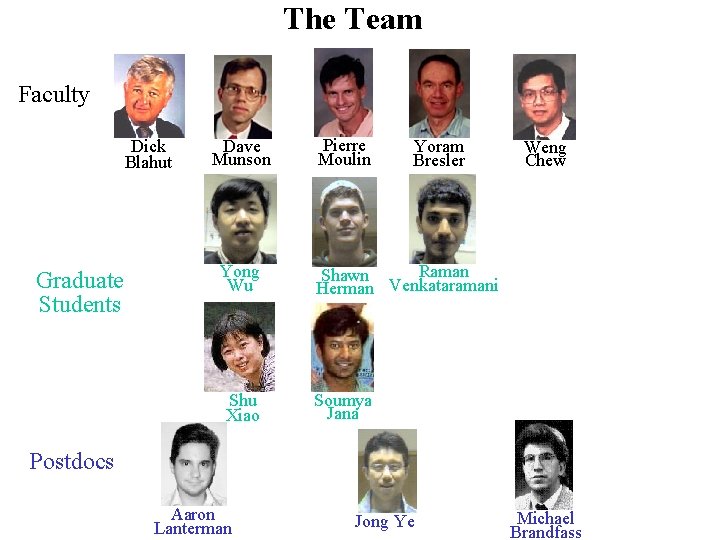
The Team Faculty Dick Blahut Graduate Students Dave Munson Yong Wu Shu Xiao Pierre Moulin Yoram Bresler Weng Chew Raman Shawn Venkataramani Herman Soumya Jana Postdocs Aaron Lanterman Jong Ye Michael Brandfass
Passive Radar Systems • Multistatic system using commercial transmitters – System remains covert – No cost of building transmitters – Coverage of low altitude targets • Television and FM radio signals – Low frequency – Low practical bandwidths – On all the time – Good doppler resolution, poor range resolution – Need high SNR receivers
Interaction with Lockheed Martin • The Passive Coherent Location (PCL) group at Lockheed Martin Mission Systems in Gaithersburg, MD is acting as an unfunded and unfunding partner • Makers of the Silent Sentry. TM PCL system • Helped isolate specific areas of investigation • Provided Silent Sentry. TM data (position, velocity, complex reflectances) of a cooperatively flown Dassault Falcon 20 observed using 3 FM transmitters
Silent Sentry. TM: Current System Target Tracking Positions Velocities Silent Sentry. TM
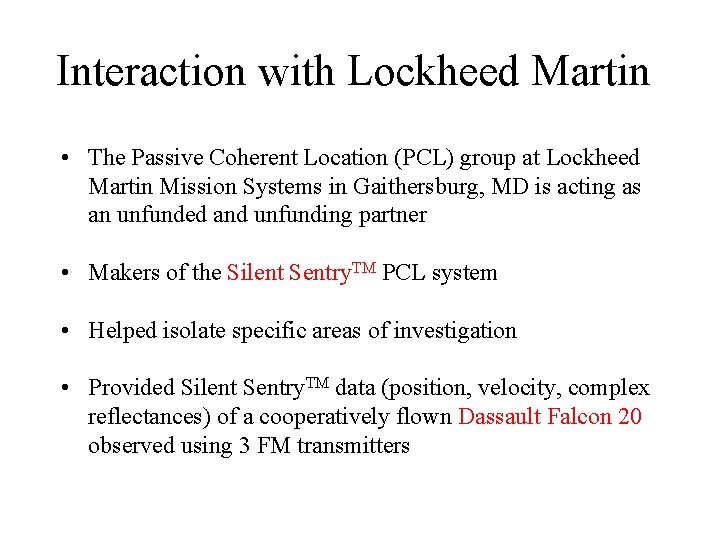
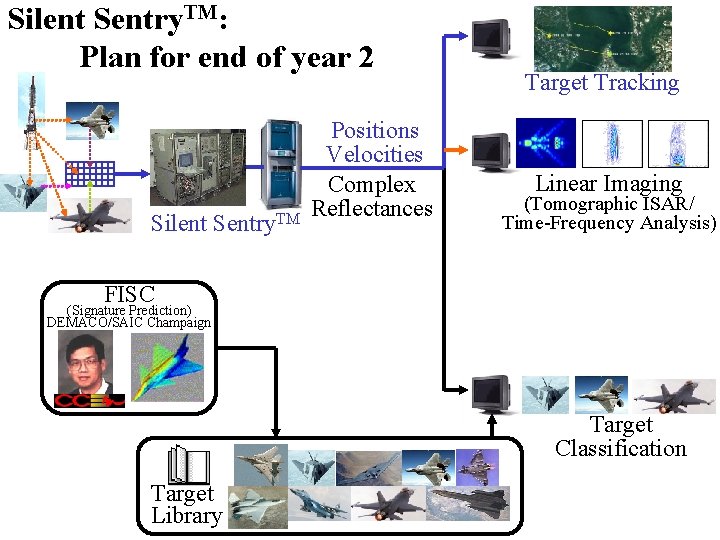
Silent Sentry. TM: Plan for end of year 2 Silent Sentry. TM Target Tracking Positions Velocities Complex Reflectances Target Classification
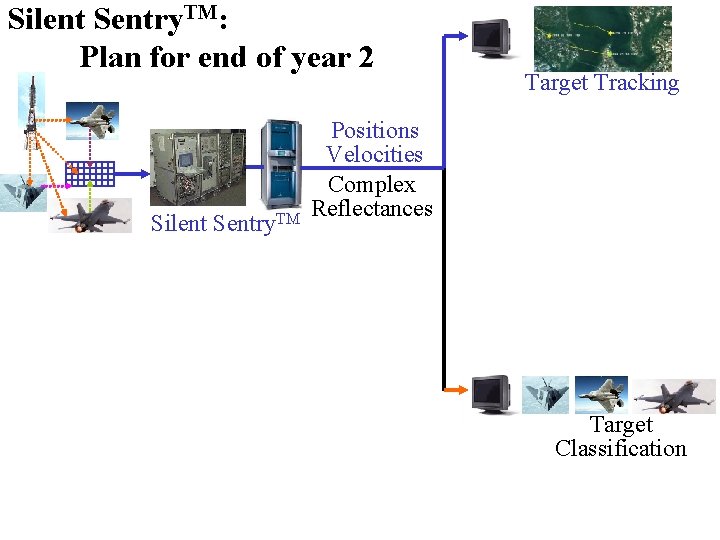
Silent Sentry. TM: Plan for end of year 2 Silent Sentry. TM Target Tracking Positions Velocities Complex Reflectances Target Classification Target Library
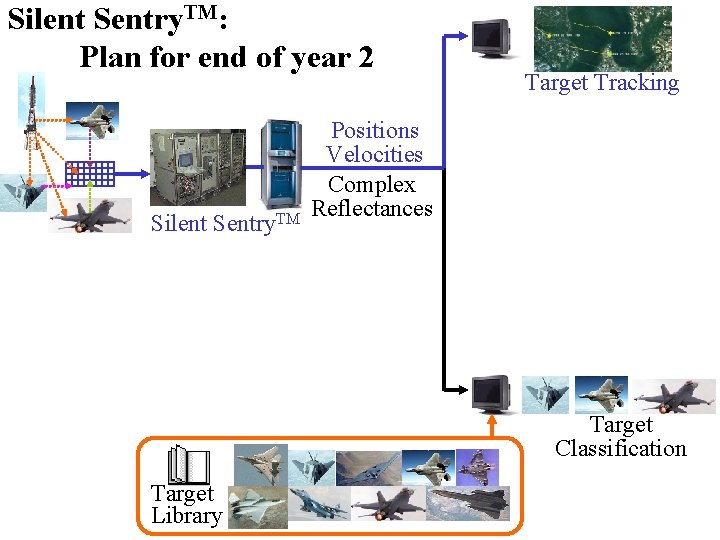
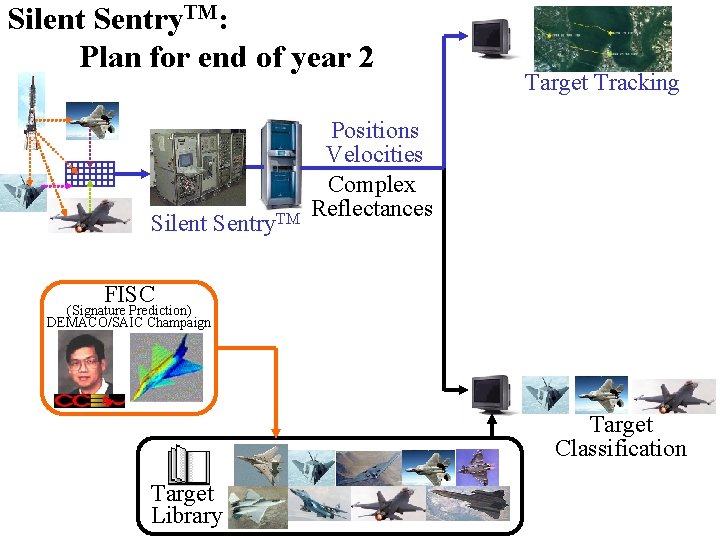
Silent Sentry. TM: Plan for end of year 2 Silent Sentry. TM Target Tracking Positions Velocities Complex Reflectances FISC (Signature Prediction) DEMACO/SAIC Champaign Target Classification Target Library
Silent Sentry. TM: Plan for end of year 2 Silent Sentry. TM Positions Velocities Complex Reflectances Target Tracking Linear Imaging (Tomographic ISAR/ Time-Frequency Analysis) FISC (Signature Prediction) DEMACO/SAIC Champaign Target Classification Target Library
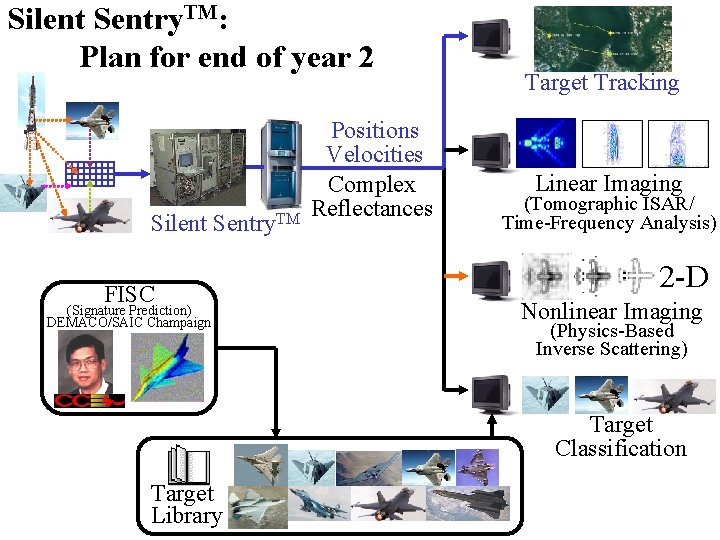
Silent Sentry. TM: Plan for end of year 2 Silent Sentry. TM FISC (Signature Prediction) DEMACO/SAIC Champaign Positions Velocities Complex Reflectances Target Tracking Linear Imaging (Tomographic ISAR/ Time-Frequency Analysis) 2 -D Nonlinear Imaging (Physics-Based Inverse Scattering) Target Classification Target Library
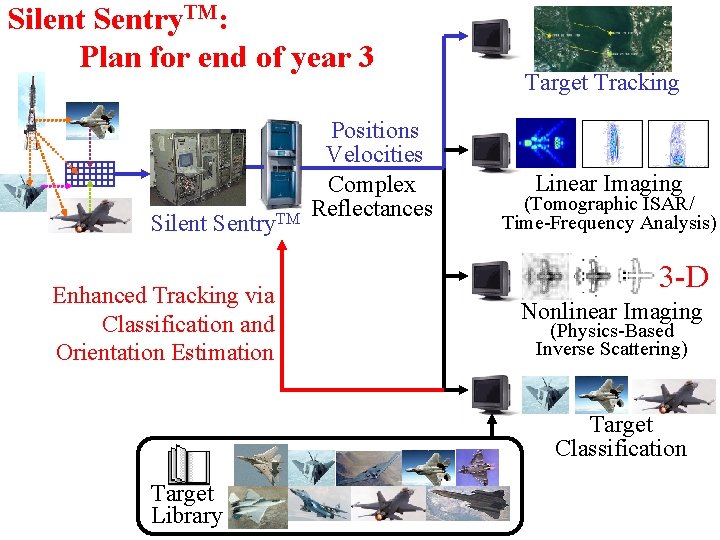
Silent Sentry. TM: Plan for end of year 3 Silent Sentry. TM Enhanced Tracking via Classification and Orientation Estimation Positions Velocities Complex Reflectances Target Tracking Linear Imaging (Tomographic ISAR/ Time-Frequency Analysis) 3 -D Nonlinear Imaging (Physics-Based Inverse Scattering) Target Classification Target Library
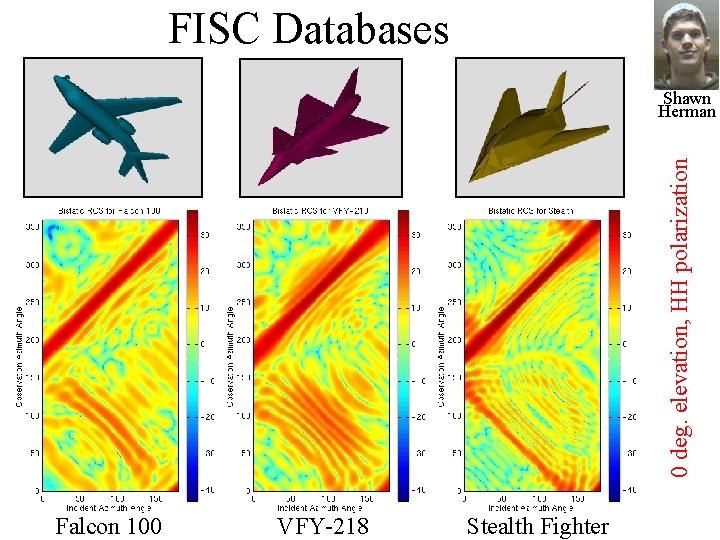
FISC Databases 0 deg. elevation, HH polarization Shawn Herman Falcon 100 VFY-218 Stealth Fighter
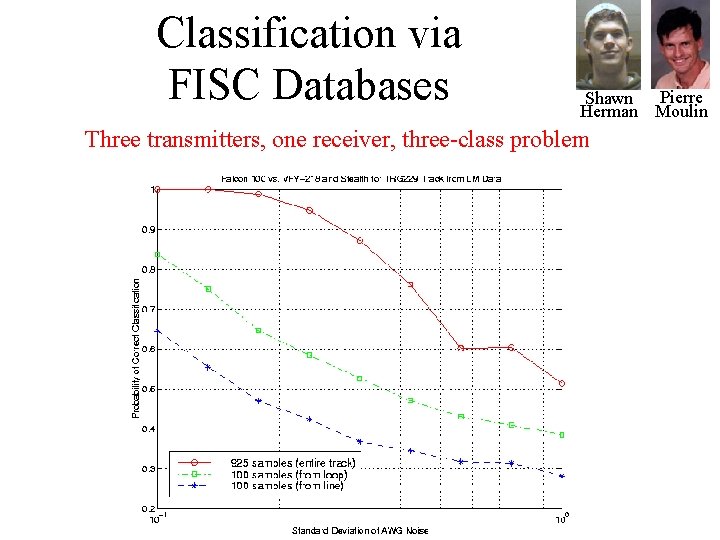
Classification via FISC Databases Shawn Pierre Herman Moulin Three transmitters, one receiver, three-class problem
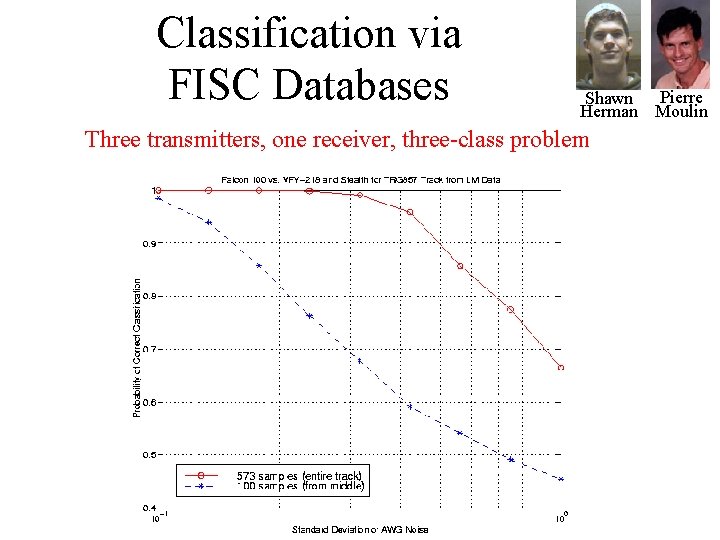
Classification via FISC Databases Shawn Pierre Herman Moulin Three transmitters, one receiver, three-class problem
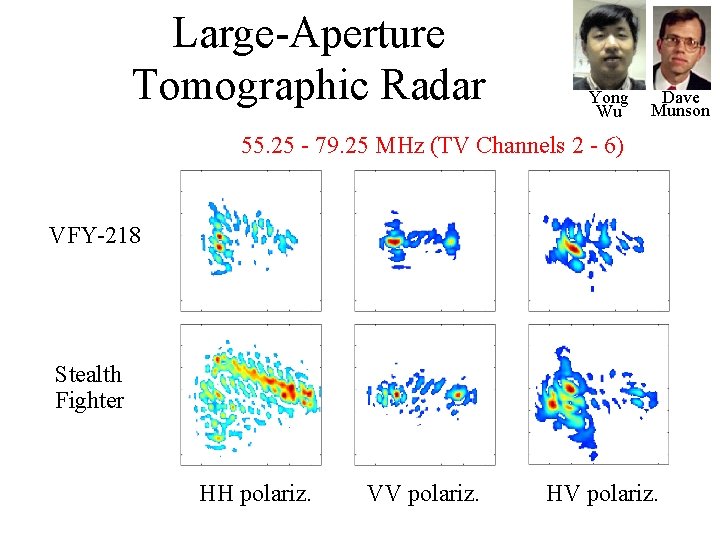
Large-Aperture Tomographic Radar Yong Wu Dave Munson 55. 25 - 79. 25 MHz (TV Channels 2 - 6) VFY-218 Stealth Fighter HH polariz. VV polariz. HV polariz.
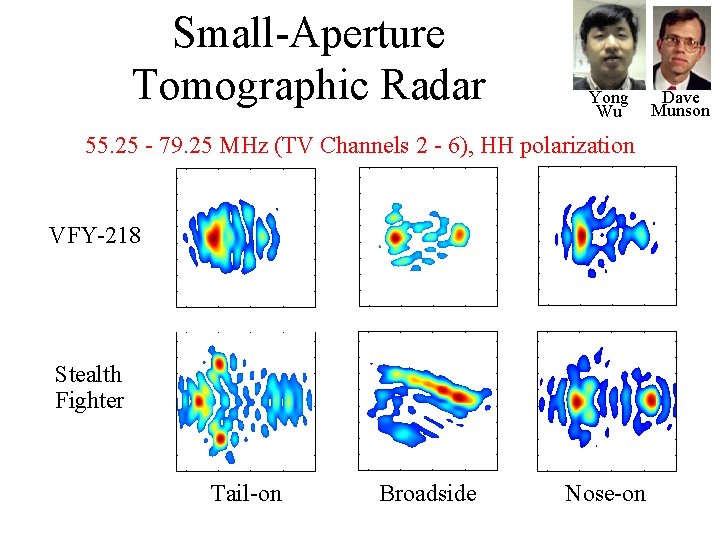
Small-Aperture Tomographic Radar Yong Wu 55. 25 - 79. 25 MHz (TV Channels 2 - 6), HH polarization VFY-218 Stealth Fighter Tail-on Broadside Nose-on Dave Munson
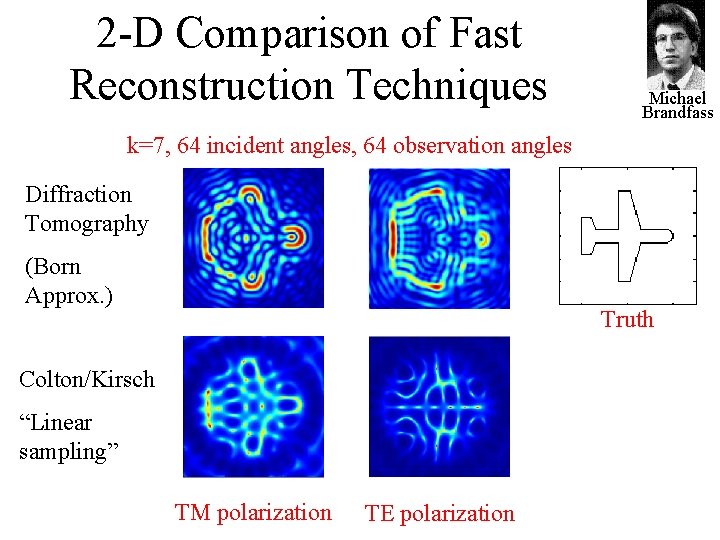
2 -D Comparison of Fast Reconstruction Techniques Michael Brandfass k=7, 64 incident angles, 64 observation angles Diffraction Tomography (Born Approx. ) Truth Colton/Kirsch “Linear sampling” TM polarization TE polarization
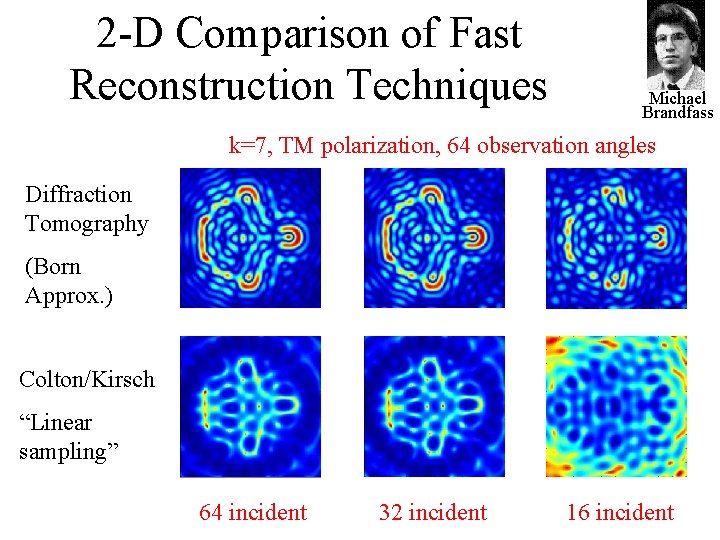
2 -D Comparison of Fast Reconstruction Techniques Michael Brandfass k=7, TM polarization, 64 observation angles Diffraction Tomography (Born Approx. ) Colton/Kirsch “Linear sampling” 64 incident 32 incident 16 incident
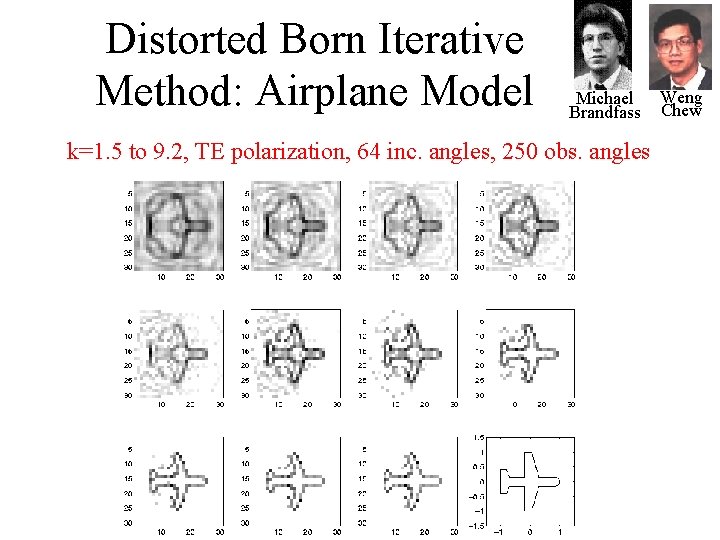
Distorted Born Iterative Method: Airplane Model Michael Brandfass k=1. 5 to 9. 2, TE polarization, 64 inc. angles, 250 obs. angles Weng Chew
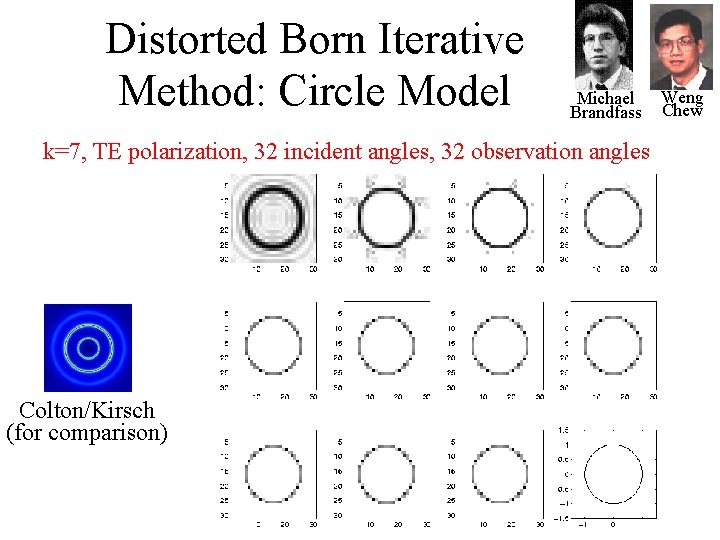
Distorted Born Iterative Method: Circle Model Michael Brandfass k=7, TE polarization, 32 incident angles, 32 observation angles Colton/Kirsch (for comparison) Weng Chew
Fast Multilevel Backprojection Algorithm Shu Xiao Dave Munson • Traditional backprojection algorithm: O(N 3) computation • New backprojection algorithm: O(N log N) computation • Inspired by the multilevel fast multipole algorithms (MLFMA) of computational electromagnetics • New algorithm can readily accommodate curved projections for near-field imaging (for instance, imaging runways)
To Learn More. . . Technical POC: Dr. Aaron Lanterman work: 217 -333 -9638 home: 217 -355 -9094 lanterma@ifp. uiuc. edu Project website: www. ifp. uiuc. edu/~lanterma/darpa