
Design and Optimization of Passive and Active Imaging
- Slides: 26
Design and Optimization of Passive and Active Imaging Radar DARPA grant F 49620 -98 -1 -0498 Dept. of Electrical and Computer Engineering in collaboration with Gaithersburg, MD Sponsored by Administered by
Objectives • Apply statistical inference techniques, information theory, and state-of-the-art physics-based modeling of electromagnetic phenomena to develop algorithms for imaging and recognizing airborne targets via radar. • Emphasize passive systems which exploit “illuminators of opportunity” such as commercial TV and FM radio broadcasts • The two primary thrusts detailed on this poster are: recognition and imaging
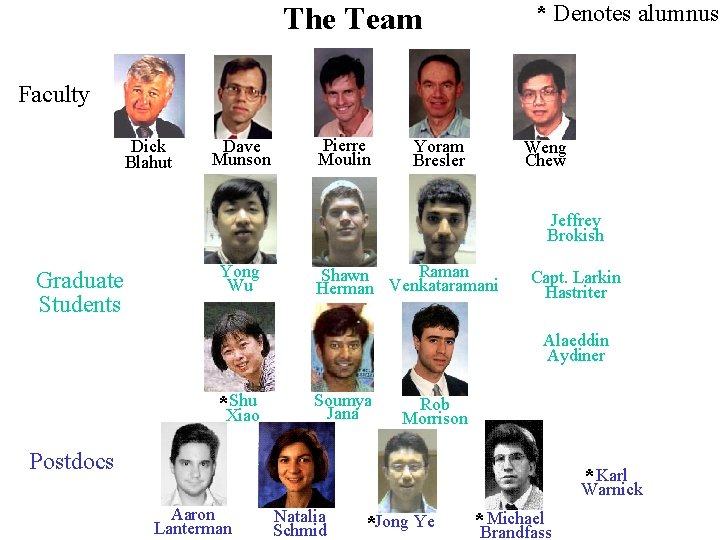
* Denotes alumnus The Team Faculty Dick Blahut Dave Munson Pierre Moulin Yoram Bresler Weng Chew Jeffrey Brokish Graduate Students Yong Wu Raman Shawn Venkataramani Herman Capt. Larkin Hastriter Alaeddin Aydiner Shu *Xiao Soumya Jana Rob Morrison Postdocs * Karl Warnick Aaron Lanterman Natalia Schmid *Jong Ye Michael *Brandfass
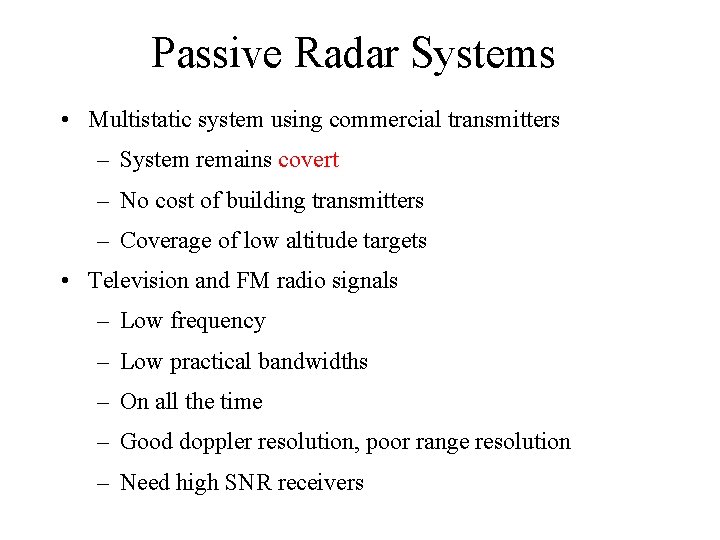
Passive Radar Systems • Multistatic system using commercial transmitters – System remains covert – No cost of building transmitters – Coverage of low altitude targets • Television and FM radio signals – Low frequency – Low practical bandwidths – On all the time – Good doppler resolution, poor range resolution – Need high SNR receivers
Interaction with Lockheed Martin • The Passive Coherent Location (PCL) group at Lockheed Martin Mission Systems in Gaithersburg, MD is acting as an unfunded and unfunding partner • Makers of the Silent Sentry. TM PCL system • Helped isolate specific areas of investigation • Provided Silent Sentry. TM data (position, velocity, complex reflectances) of a cooperatively flown Dassault Falcon 20 observed using 3 FM transmitters
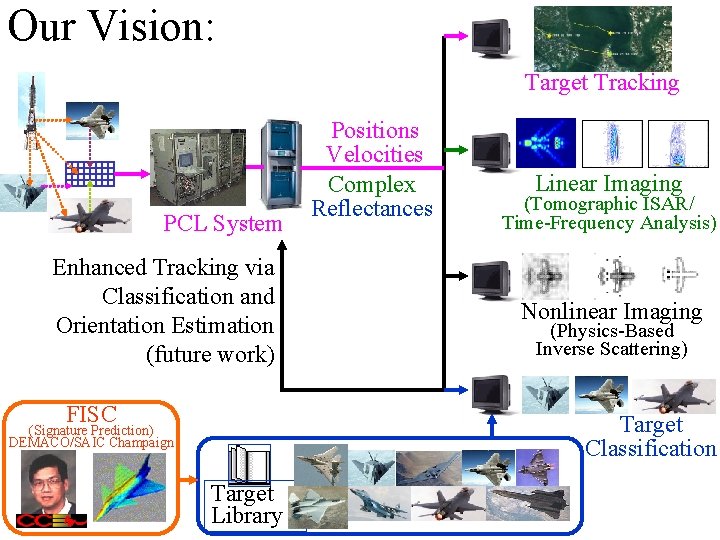
Our Vision: Target Tracking PCL System Enhanced Tracking via Classification and Orientation Estimation (future work) FISC Positions Velocities Complex Reflectances Linear Imaging (Tomographic ISAR/ Time-Frequency Analysis) Nonlinear Imaging (Physics-Based Inverse Scattering) Target Classification (Signature Prediction) DEMACO/SAIC Champaign Target Library
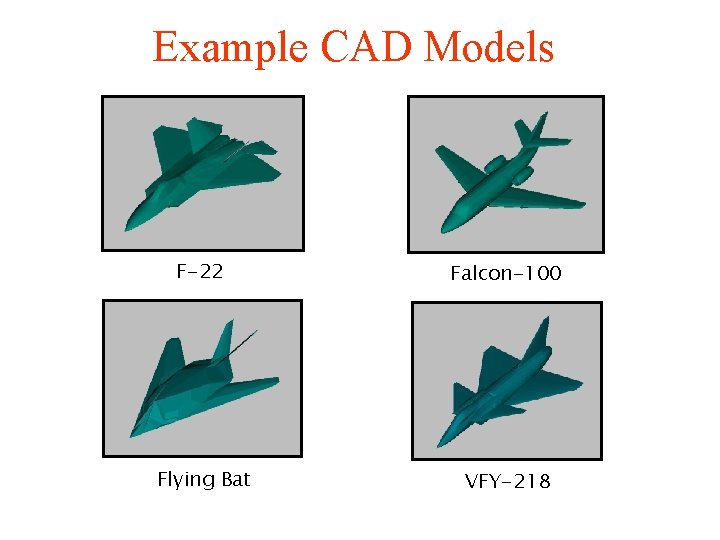
Example CAD Models F-22 Falcon-100 Flying Bat VFY-218
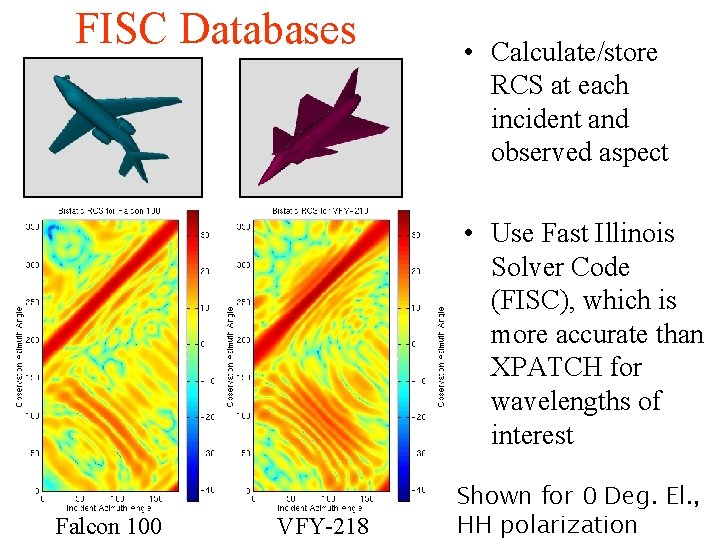
FISC Databases • Calculate/store RCS at each incident and observed aspect • Use Fast Illinois Solver Code (FISC), which is more accurate than XPATCH for wavelengths of interest Falcon 100 VFY-218 Shown for 0 Deg. El. , HH polarization
Target Recognition via FISC Databases Shawn Pierre Herman Moulin • Compare collected data to simulated data via a statistical loglikelihood function • Just want recognition, so target position and orientation are nuisance parameters • Search simplified via Markov assumption on nuisance parameters Big advantage to using TV and FM radio: need to store fewer RCS values at lower frequencies!
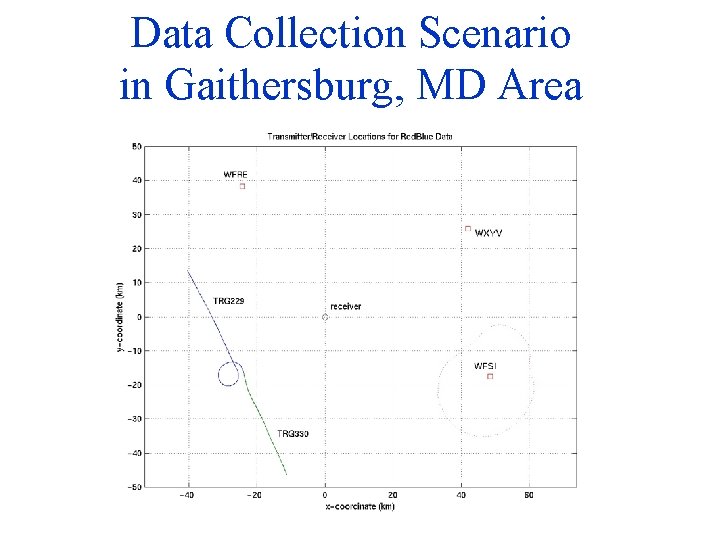
Data Collection Scenario in Gaithersburg, MD Area
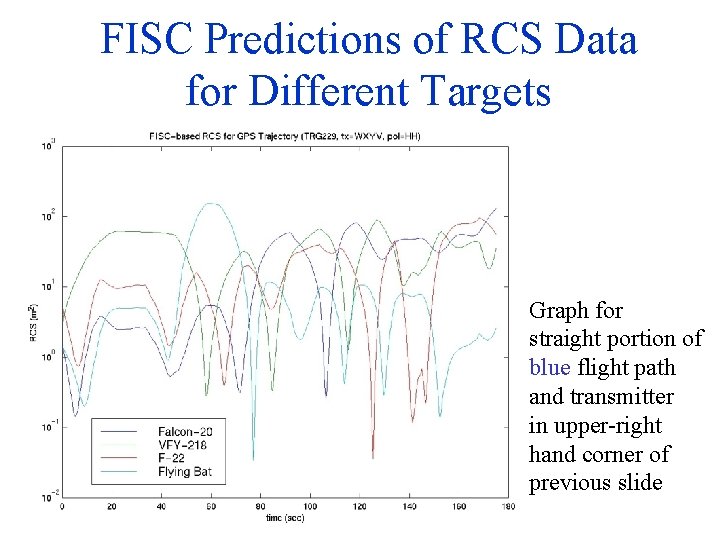
FISC Predictions of RCS Data for Different Targets Graph for straight portion of blue flight path and transmitter in upper-right hand corner of previous slide
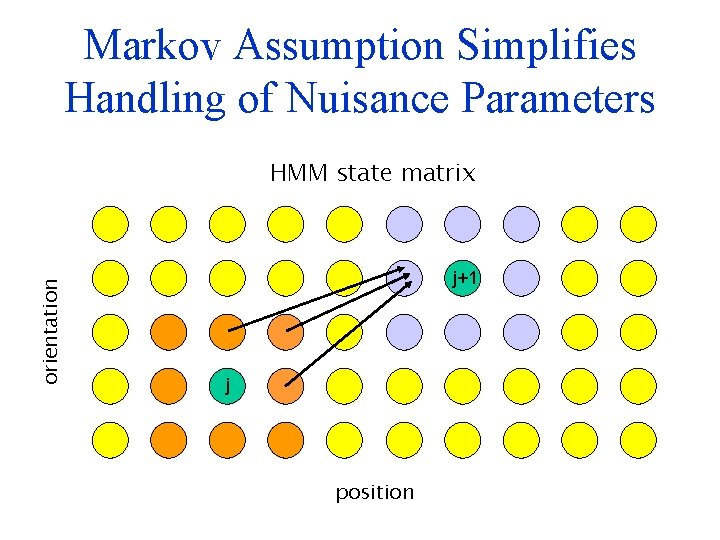
Markov Assumption Simplifies Handling of Nuisance Parameters orientation HMM state matrix j+1 j position
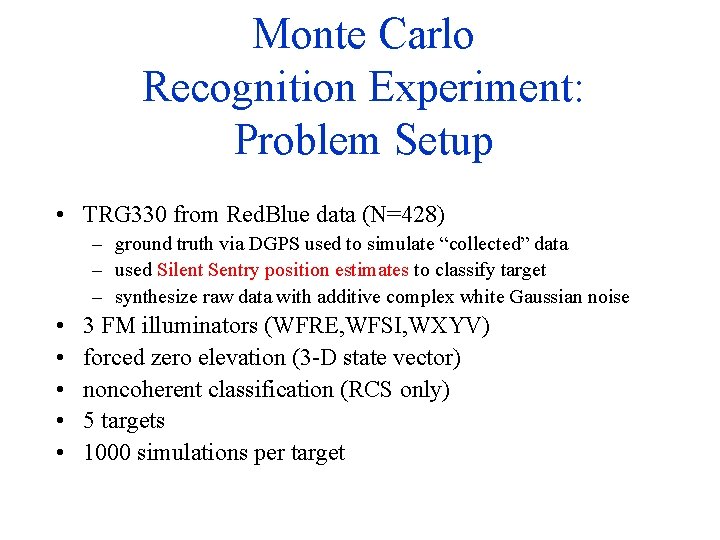
Monte Carlo Recognition Experiment: Problem Setup • TRG 330 from Red. Blue data (N=428) – ground truth via DGPS used to simulate “collected” data – used Silent Sentry position estimates to classify target – synthesize raw data with additive complex white Gaussian noise • • • 3 FM illuminators (WFRE, WFSI, WXYV) forced zero elevation (3 -D state vector) noncoherent classification (RCS only) 5 targets 1000 simulations per target
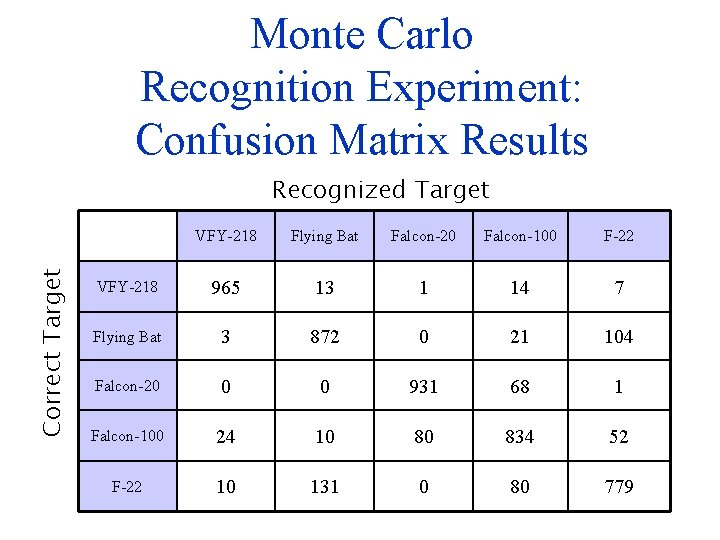
Monte Carlo Recognition Experiment: Confusion Matrix Results Correct Target Recognized Target VFY-218 Flying Bat Falcon-20 Falcon-100 F-22 VFY-218 965 13 1 14 7 Flying Bat 3 872 0 21 104 Falcon-20 0 0 931 68 1 Falcon-100 24 10 80 834 52 F-22 10 131 0 80 779
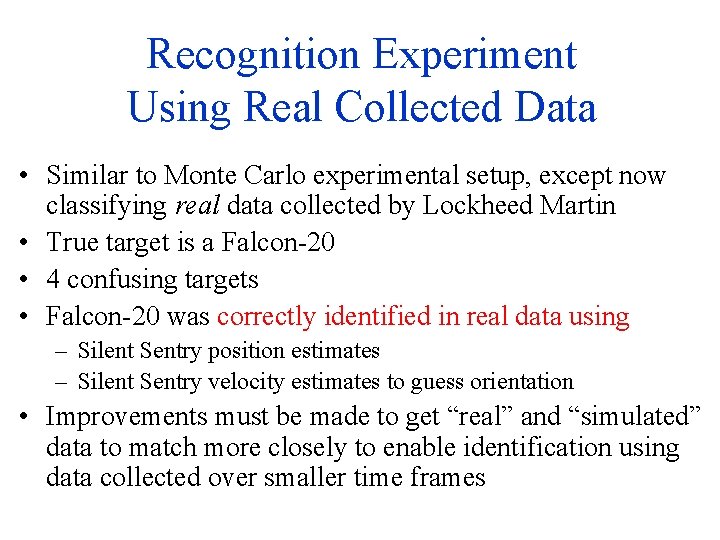
Recognition Experiment Using Real Collected Data • Similar to Monte Carlo experimental setup, except now classifying real data collected by Lockheed Martin • True target is a Falcon-20 • 4 confusing targets • Falcon-20 was correctly identified in real data using – Silent Sentry position estimates – Silent Sentry velocity estimates to guess orientation • Improvements must be made to get “real” and “simulated” data to match more closely to enable identification using data collected over smaller time frames
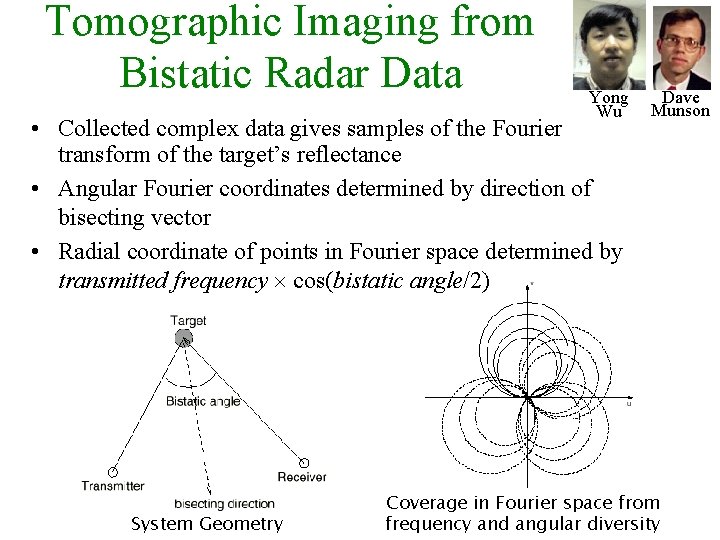
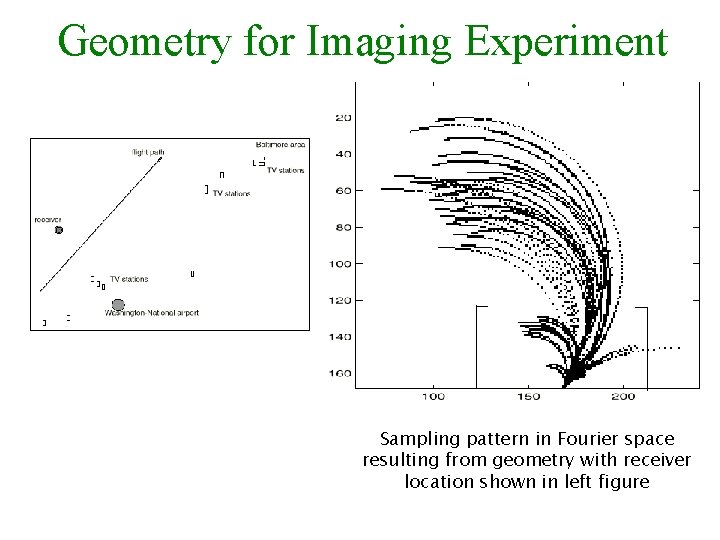
Tomographic Imaging from Bistatic Radar Data Yong Wu • Collected complex data gives samples of the Fourier transform of the target’s reflectance • Angular Fourier coordinates determined by direction of bisecting vector • Radial coordinate of points in Fourier space determined by transmitted frequency cos(bistatic angle/2) System Geometry Dave Munson Coverage in Fourier space from frequency and angular diversity
Geometry for Imaging Experiment Sampling pattern in Fourier space resulting from geometry with receiver location shown in left figure
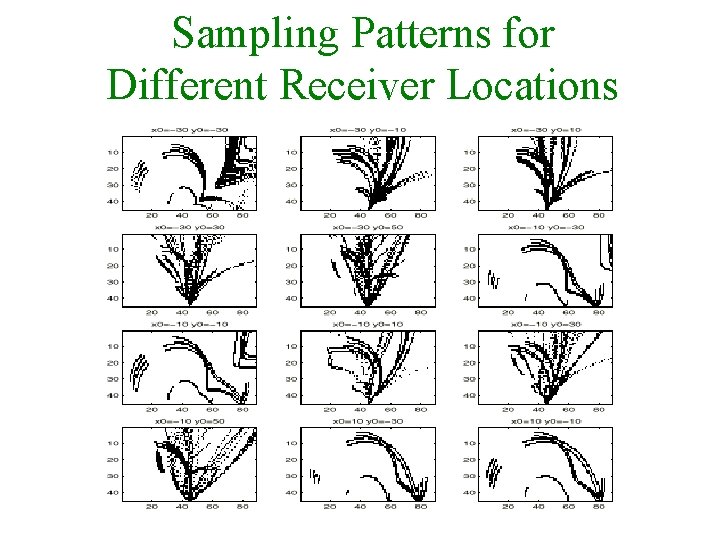
Sampling Patterns for Different Receiver Locations
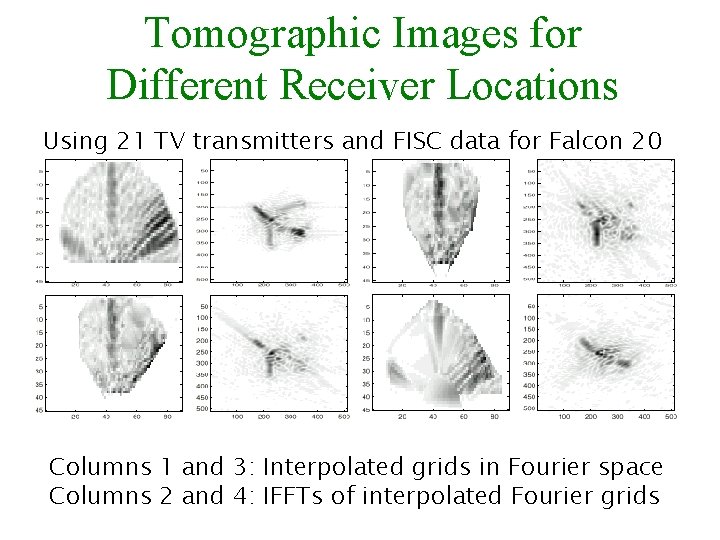
Tomographic Images for Different Receiver Locations Using 21 TV transmitters and FISC data for Falcon 20 Columns 1 and 3: Interpolated grids in Fourier space Columns 2 and 4: IFFTs of interpolated Fourier grids
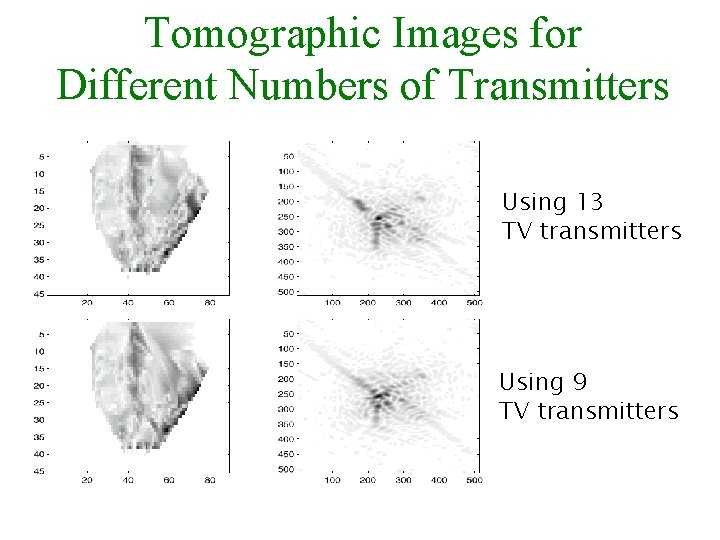
Tomographic Images for Different Numbers of Transmitters Using 13 TV transmitters Using 9 TV transmitters
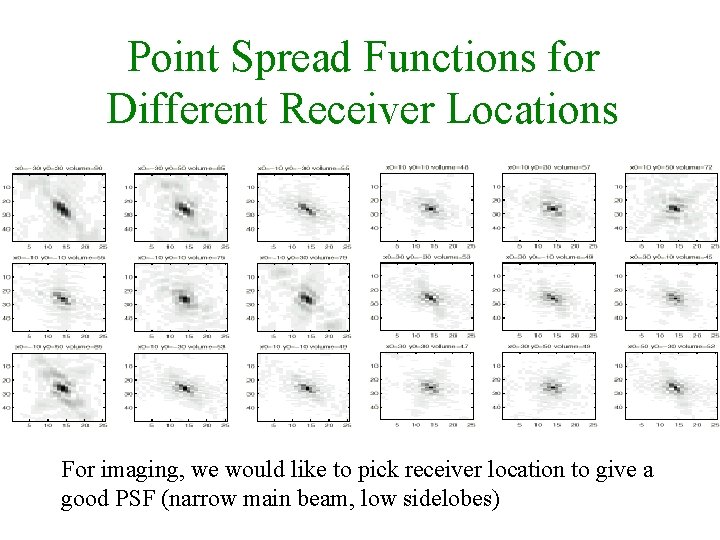
Point Spread Functions for Different Receiver Locations For imaging, we would like to pick receiver location to give a good PSF (narrow main beam, low sidelobes)
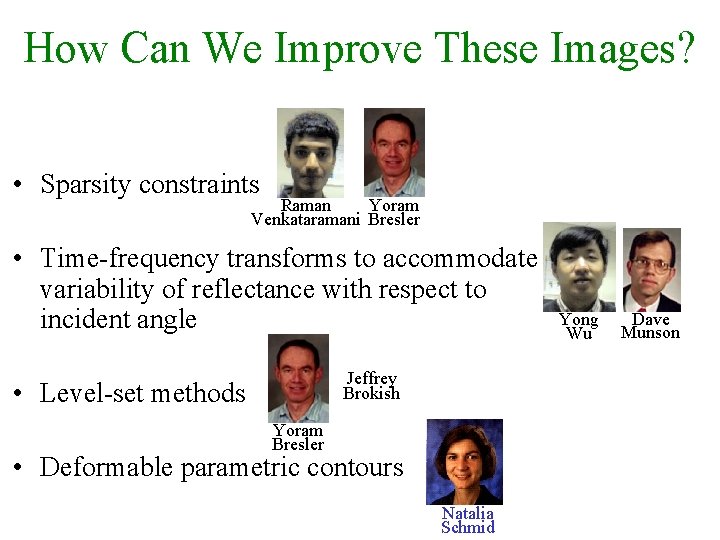
How Can We Improve These Images? • Sparsity constraints Yoram Raman Venkataramani Bresler • Time-frequency transforms to accommodate variability of reflectance with respect to incident angle Jeffrey Brokish • Level-set methods Yoram Bresler • Deformable parametric contours Natalia Schmid Yong Wu Dave Munson
Autofocus Algorithms Essential for Processing Real Data Dave Rob Munson Morrison • Phase data corrupted by inaccuracies in estimates of distance to target – But most of the information is in the phase, not the magnitude! Primary remaining challenge to forming images from real passive radar data • Fortunately, errors along various transmitter-receiver pairs are related (similar to “phase closure” in radio astronomy)
Completed Work • Fast O(N^2 log N), instead of O(N^3), projection and backprojection algorithm, adapted to SAR imaging – Good for curved projections for near-field imaging – Compatible with a wide variety of autofocus algorithms • Distorted Born Iterative Method (DBIM) for reconstruction of metallic scatterers in nonlinear scattering Shu Xiao Dave Munson Michael Weng Brandfass Chew • Confidence region bounds for 2 -D and 3 -D shape estimation problems in both linear and nonlinear scattering problems Jong Ye Yoram Pierre Bresler Moulin
Completed Work (Con’t) • Comparison of the Colton-Kirsch “linear sampling” method with linearized tomographic algorithms Aaron Michael Brandfass Lanterman • Antenna spacing selection for interferometric imaging radar using more than two antennas Dave Shu Munson Xiao • Linear algorithms for “holographic” imaging from polerimetric radar data Michael Brandfass
To Learn More. . . Technical POC: Dr. Aaron Lanterman work: 217 -333 -9638 home: 217 -355 -9094 lanterma@ifp. uiuc. edu Project website: www. ifp. uiuc. edu/~lanterma/darpa Many papers available for download!