
Design and Modeling TenStage Design Process What Is
- Slides: 20
Design and Modeling Ten-Stage Design Process
What Is Engineering Design? “Engineering Design is the process of designing a system, component, or process to meet a desired need. ” (Gomez et al 349)
Engineering Design cont. Continuous process Can be short and simple, or complex and in-depth processes Used for: n n Ongoing manufacturing processes One-time designs
Significant Factors Tacoma Narrows Bridge Disaster http: //www. enm. bris. ac. uk/research/nonlinear/tacoma. html Functionality Quality Safety Ergonomics Appearance Environmental Considerations Economics
Ten-Stage Design Process Begins with appointment of project manager n Responsible for oversight of project Recruitment of team members of various backgrounds and expertise
Stage 1: Identify the Problem/ Product Innovation Establish the Problem Identify information sources to understand problem’s scope and nature Develop a preliminary, formal problem statement All correct issues and backgrounds have been explored
Stage 2: Define the Working Criteria and Goals Establish preliminary goals n Act as focal points throughout process Determine working criteria Develop process goals n Checkpoints for progress Example Working Criteria Questions n n n n Costs? Production Difficulty? Size, Weight, Strength? Appearance? Ease of Use? Safe to Use? Legality Concerns? Reliable & Durable?
Stage 3: Research & Gather Data All problem aspects explored with good, reliable background information What information is needed Best sources for information Organization is key
Stage 3: What Info is Needed? Published info on problem? n n Availability of existing solution? Who is providing info? Advantages and disadvantages to solution. Costs? n n Significant issue? Ratio of time spent compared to overall costs. Legal issues? Environmental concerns considered?
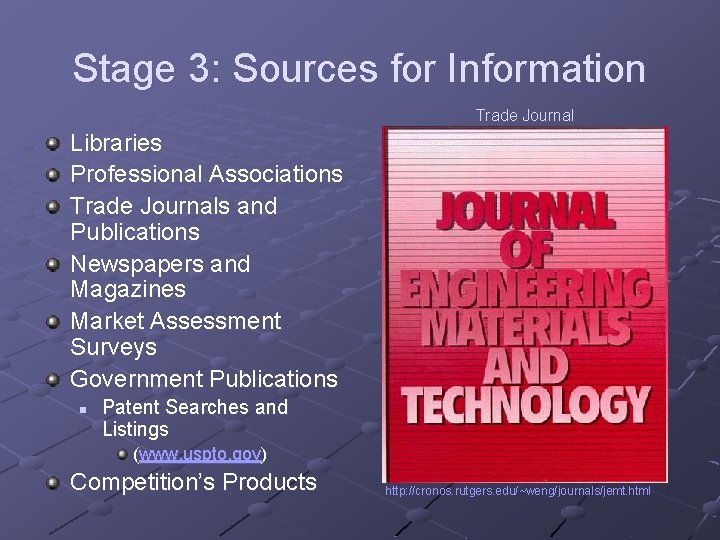
Stage 3: Sources for Information Trade Journal Libraries Professional Associations Trade Journals and Publications Newspapers and Magazines Market Assessment Surveys Government Publications n Patent Searches and Listings (www. uspto. gov) Competition’s Products http: //cronos. rutgers. edu/~weng/journals/jemt. html
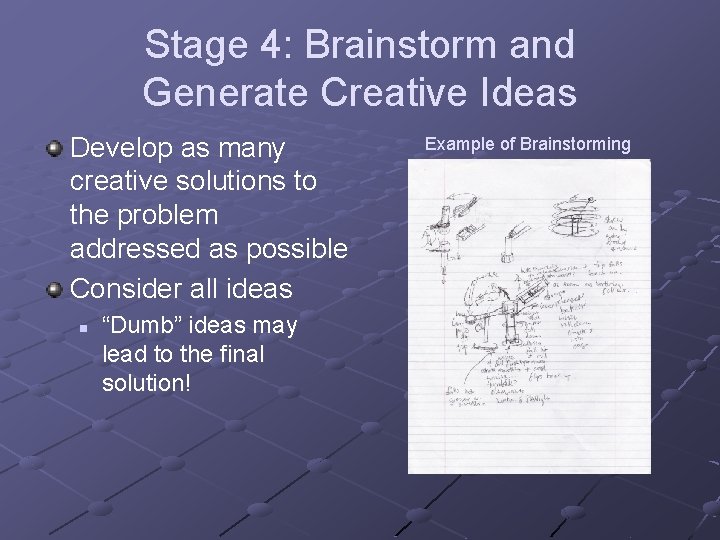
Stage 4: Brainstorm and Generate Creative Ideas Develop as many creative solutions to the problem addressed as possible Consider all ideas n “Dumb” ideas may lead to the final solution! Example of Brainstorming
Stage 5: Analyze Potential Solutions Phase I Generated ideas narrowed to few ideas n Examine list and eliminate duplicates Similar ideas may remain, but not duplicate Clarifying questions offered by team n Evaluation by vote
Stage 5: Analyze Potential Solutions Phase II Remaining ideas analyzed thoroughly and accurately Analyzing Possibilities n n n 3 to 5 options should remain after analysis May have to start process over n n n Common Sense Economic Analysis Estimation Compatibility Analysis Computer Analysis Techniques Conservative Assumptions
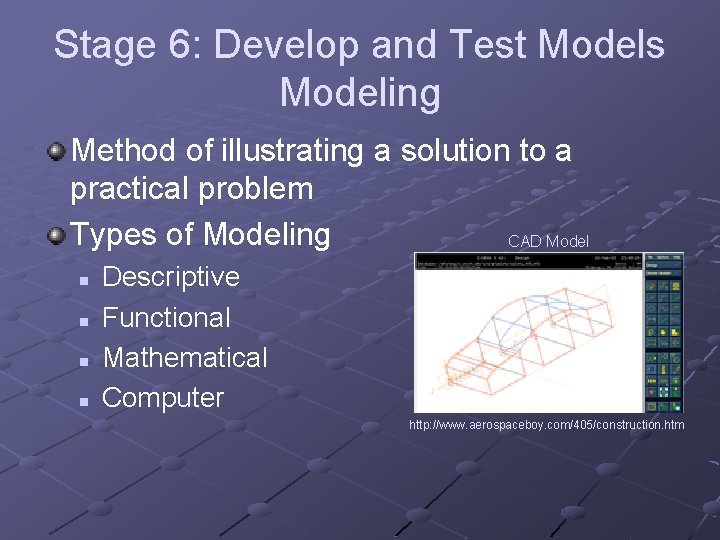
Stage 6: Develop and Test Models Modeling Method of illustrating a solution to a practical problem Types of Modeling CAD Model n n Descriptive Functional Mathematical Computer http: //www. aerospaceboy. com/405/construction. htm
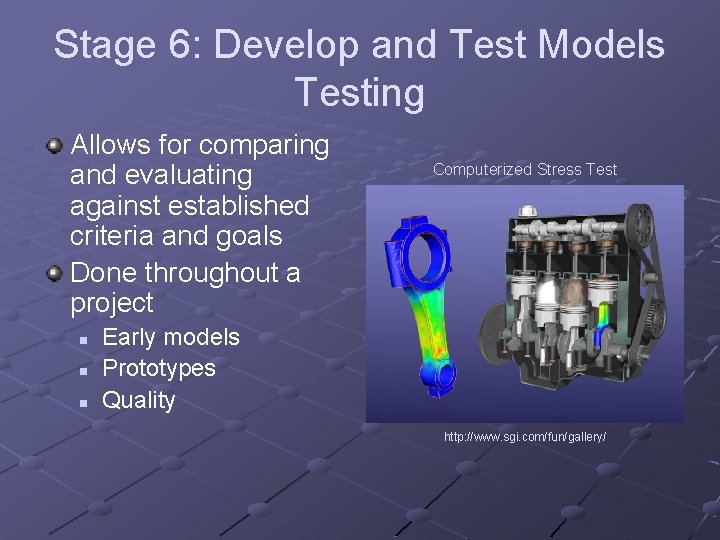
Stage 6: Develop and Test Models Testing Allows for comparing and evaluating against established criteria and goals Done throughout a project n n n Computerized Stress Test Early models Prototypes Quality http: //www. sgi. com/fun/gallery/
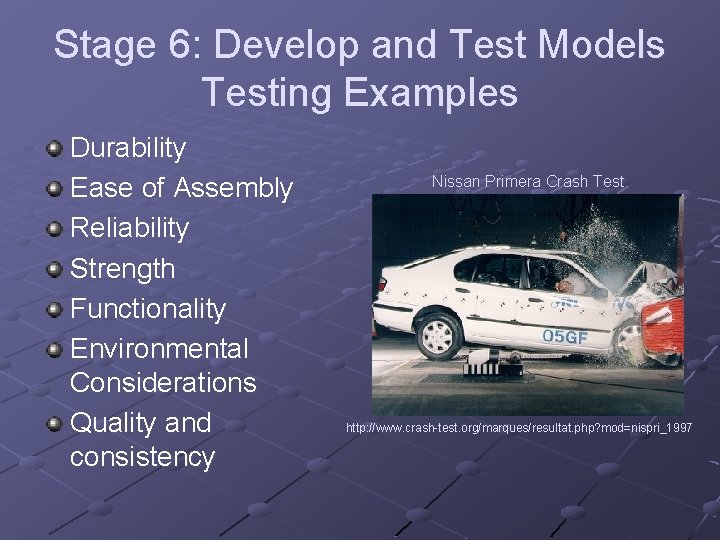
Stage 6: Develop and Test Models Testing Examples Durability Ease of Assembly Reliability Strength Functionality Environmental Considerations Quality and consistency Nissan Primera Crash Test http: //www. crash-test. org/marques/resultat. php? mod=nispri_1997
Stage 7: Make the Decision Team members establish a means to compare and evaluate results of testing Working criteria will determine advantages and disadvantages of possible solutions Develop a Decision Table to visualize each solution’s merits
Stage 8: Communicate and Specify All information gathered reported to client n n n n Detailed written reports Summaries of technical presentations/memos Relevant e-mails Diagrams, charts, graphs Drawings and sketches Computer printouts Relevant documented material Last chance to make revisions/terminate
Stage 9: Implement and Commercialize Project Manager and Team Members Management and Key Personnel Technical Representatives Business Representatives Attorneys and Legal Support Staff
Stage 10: Post-Implementation Review and Assessment Project is probably in full production n Team is terminated because task is complete Product Performance Review Assessment Report detailing product n Used as reference for future project managers and teams Product Performance Review n n n Data on production efficiency Quality Control Reports Money Issues Assessment Report n n n Strengths & Weaknesses Outline what has been learned Suggest ways to improve process quality