
Design And In Silico Validation Of PCRmetabarcoding Primers

Design And In Silico Validation Of PCR-metabarcoding Primers Daniel Marquina - Naturhistoriska Riksmuseet
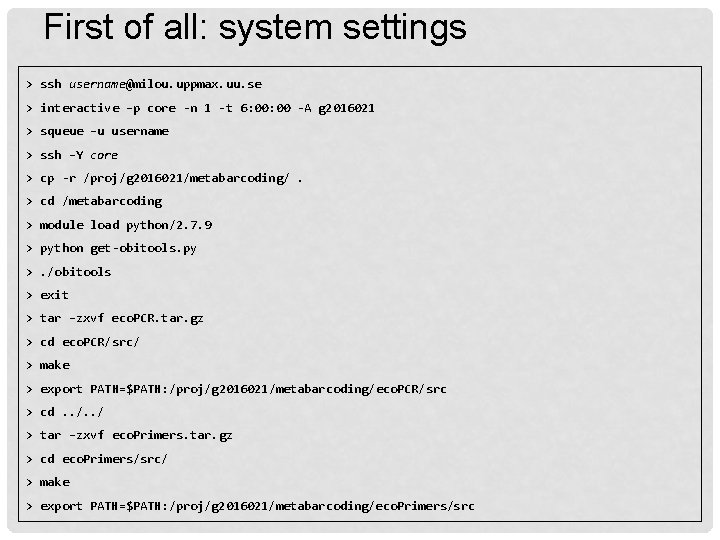
First of all: system settings > ssh username@milou. uppmax. uu. se > interactive –p core -n 1 -t 6: 00 -A g 2016021 > squeue –u username > ssh –Y core > cp -r /proj/g 2016021/metabarcoding/. > cd /metabarcoding > module load python/2. 7. 9 > python get-obitools. py >. /obitools > exit > tar –zxvf eco. PCR. tar. gz > cd eco. PCR/src/ > make > export PATH=$PATH: /proj/g 2016021/metabarcoding/eco. PCR/src > cd. . / > tar –zxvf eco. Primers. tar. gz > cd eco. Primers/src/ > make > export PATH=$PATH: /proj/g 2016021/metabarcoding/eco. Primers/src
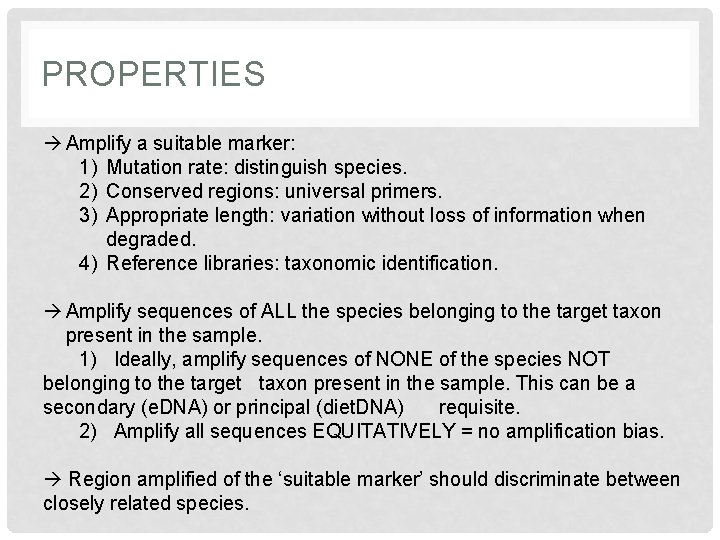
PROPERTIES Amplify a suitable marker: 1) Mutation rate: distinguish species. 2) Conserved regions: universal primers. 3) Appropriate length: variation without loss of information when degraded. 4) Reference libraries: taxonomic identification. Amplify sequences of ALL the species belonging to the target taxon present in the sample. 1) Ideally, amplify sequences of NONE of the species NOT belonging to the target taxon present in the sample. This can be a secondary (e. DNA) or principal (diet. DNA) requisite. 2) Amplify all sequences EQUITATIVELY = no amplification bias. Region amplified of the ‘suitable marker’ should discriminate between closely related species.
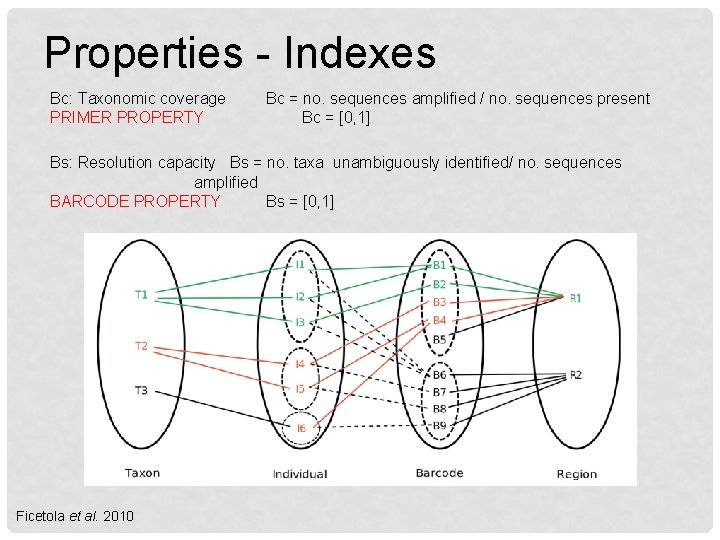
Properties - Indexes Bc: Taxonomic coverage PRIMER PROPERTY Bc = no. sequences amplified / no. sequences present Bc = [0, 1] Bs: Resolution capacity Bs = no. taxa unambiguously identified/ no. sequences amplified BARCODE PROPERTY Bs = [0, 1] Ficetola et al. 2010
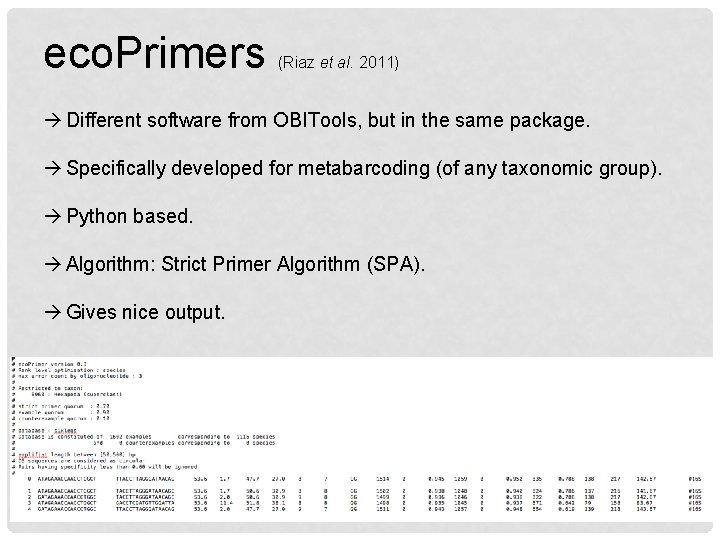
eco. Primers (Riaz et al. 2011) Different software from OBITools, but in the same package. Specifically developed for metabarcoding (of any taxonomic group). Python based. Algorithm: Strict Primer Algorithm (SPA). Gives nice output.
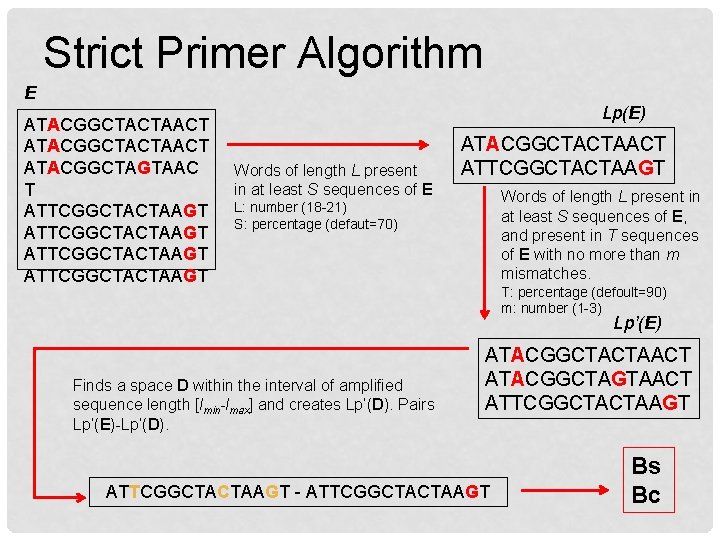
Strict Primer Algorithm E ATACGGCTACTAACT ATACGGCTAGTAAC T ATTCGGCTACTAAGT Lp(E) Words of length L present in at least S sequences of E ATACGGCTACTAACT ATTCGGCTACTAAGT Words of length L present in at least S sequences of E, and present in T sequences of E with no more than m mismatches. L: number (18 -21) S: percentage (defaut=70) T: percentage (defoult=90) m: number (1 -3) Lp’(E) Finds a space D within the interval of amplified sequence length [lmin-lmax] and creates Lp’(D). Pairs Lp’(E)-Lp’(D). ATACGGCTACTAACT ATACGGCTAGTAACT ATTCGGCTACTAAGT - ATTCGGCTACTAAGT Bs Bc
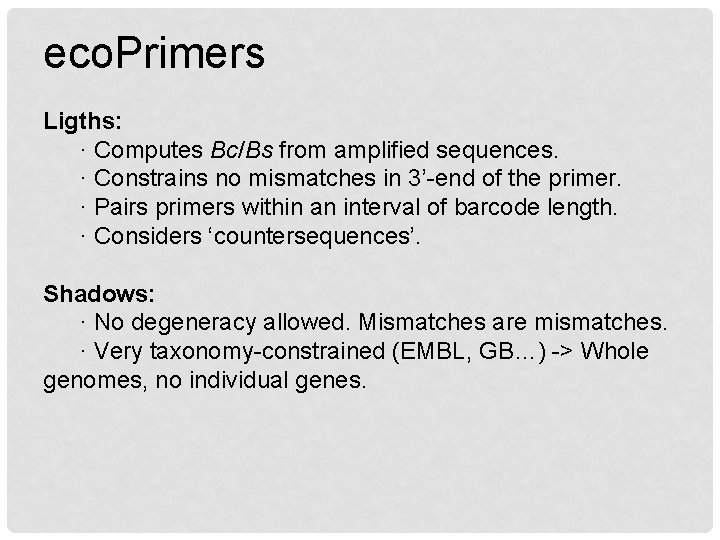
eco. Primers Ligths: · Computes Bc/Bs from amplified sequences. · Constrains no mismatches in 3’-end of the primer. · Pairs primers within an interval of barcode length. · Considers ‘countersequences’. Shadows: · No degeneracy allowed. Mismatches are mismatches. · Very taxonomy-constrained (EMBL, GB…) -> Whole genomes, no individual genes.
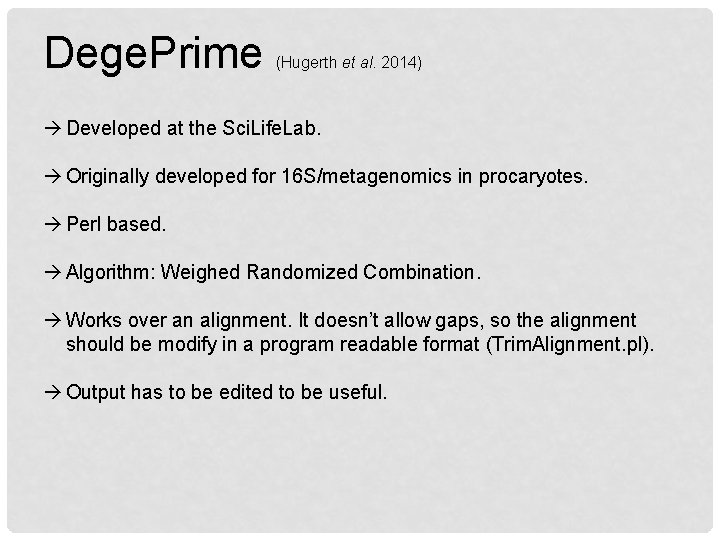
Dege. Prime (Hugerth et al. 2014) Developed at the Sci. Life. Lab. Originally developed for 16 S/metagenomics in procaryotes. Perl based. Algorithm: Weighed Randomized Combination. Works over an alignment. It doesn’t allow gaps, so the alignment should be modify in a program readable format (Trim. Alignment. pl). Output has to be edited to be useful.
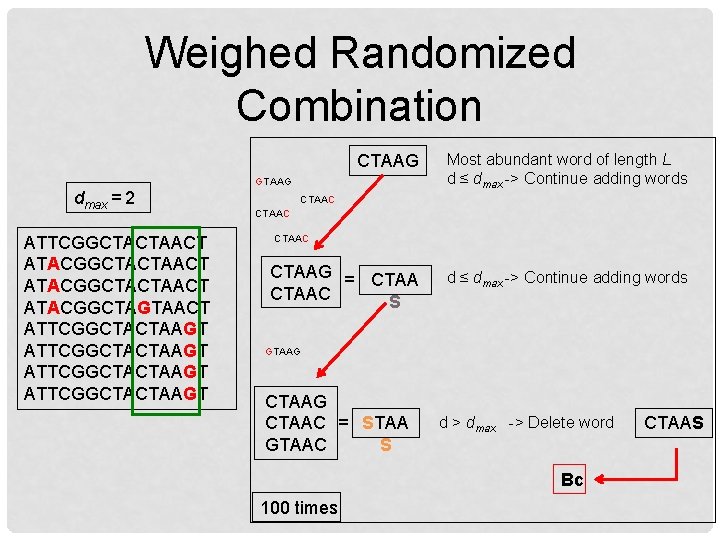
Weighed Randomized Combination CTAAG Most abundant word of length L d ≤ dmax -> Continue adding words CTAAG = CTAAC S d ≤ dmax -> Continue adding words GTAAG dmax = 2 ATTCGGCTACTAACT ATACGGCTACTAACT ATACGGCTAGTAACT ATTCGGCTACTAAGT CTAAC GTAAG CTAAC = STAA GTAAC S d > dmax -> Delete word Bc 100 times CTAAS
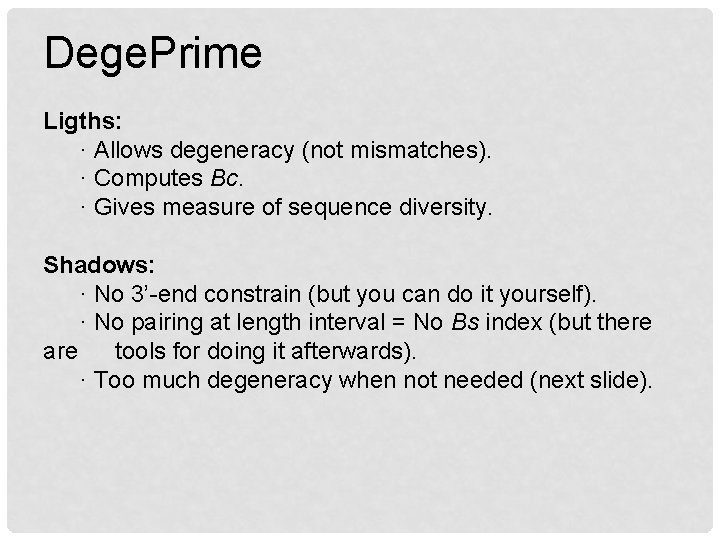
Dege. Prime Ligths: · Allows degeneracy (not mismatches). · Computes Bc. · Gives measure of sequence diversity. Shadows: · No 3’-end constrain (but you can do it yourself). · No pairing at length interval = No Bs index (but there are tools for doing it afterwards). · Too much degeneracy when not needed (next slide).
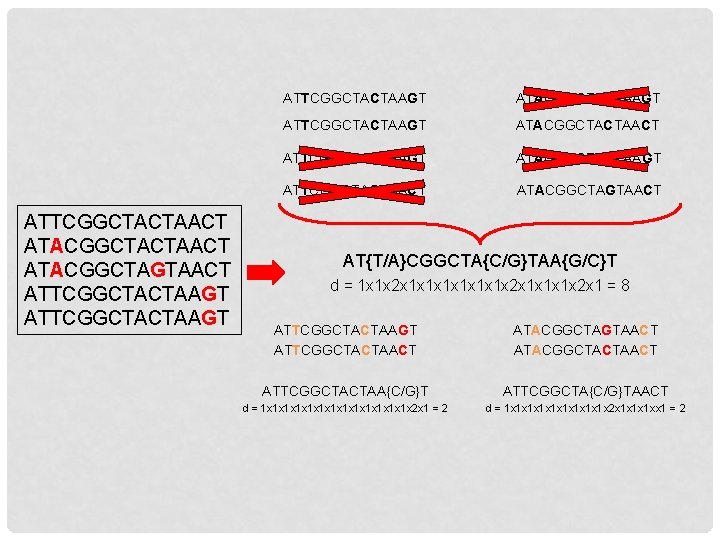
ATTCGGCTACTAACT ATACGGCTAGTAACT ATTCGGCTACTAAGT ATACGGCTACTAAGT ATTCGGCTACTAAGT ATACGGCTACTAACT ATTCGGCTAGTAAGT ATACGGCTAGTAAGT ATTCGGCTAGTAACT ATACGGCTAGTAACT AT{T/A}CGGCTA{C/G}TAA{G/C}T d = 1 x 1 x 2 x 1 x 1 x 1 x 2 x 1 = 8 ATTCGGCTACTAAGT ATTCGGCTACTAACT ATACGGCTAGTAACT ATACGGCTACTAACT ATTCGGCTACTAA{C/G}T ATTCGGCTA{C/G}TAACT d = 1 x 1 x 1 x 1 x 2 x 1 = 2 d = 1 x 1 x 1 x 2 x 1 x 1 x 1 xx 1 = 2

LET’S DO SOME SCIENCE NOW
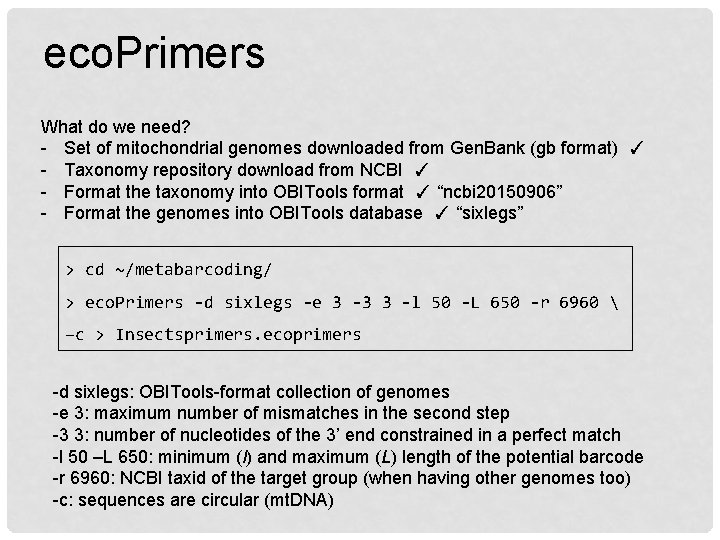
eco. Primers What do we need? - Set of mitochondrial genomes downloaded from Gen. Bank (gb format) ✓ - Taxonomy repository download from NCBI ✓ - Format the taxonomy into OBITools format ✓ “ncbi 20150906” - Format the genomes into OBITools database ✓ “sixlegs” > cd ~/metabarcoding/ > eco. Primers -d sixlegs -e 3 -3 3 -l 50 -L 650 -r 6960 –c > Insectsprimers. ecoprimers -d sixlegs: OBITools-format collection of genomes -e 3: maximum number of mismatches in the second step -3 3: number of nucleotides of the 3’ end constrained in a perfect match -l 50 –L 650: minimum (l) and maximum (L) length of the potential barcode -r 6960: NCBI taxid of the target group (when having other genomes too) -c: sequences are circular (mt. DNA)
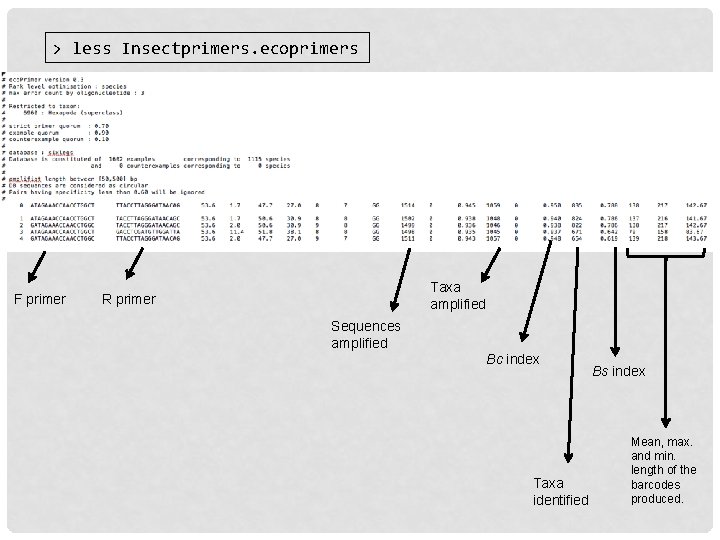
> less Insectprimers. ecoprimers F primer Taxa amplified R primer Sequences amplified Bc index Taxa identified Bs index Mean, max. and min. length of the barcodes produced.
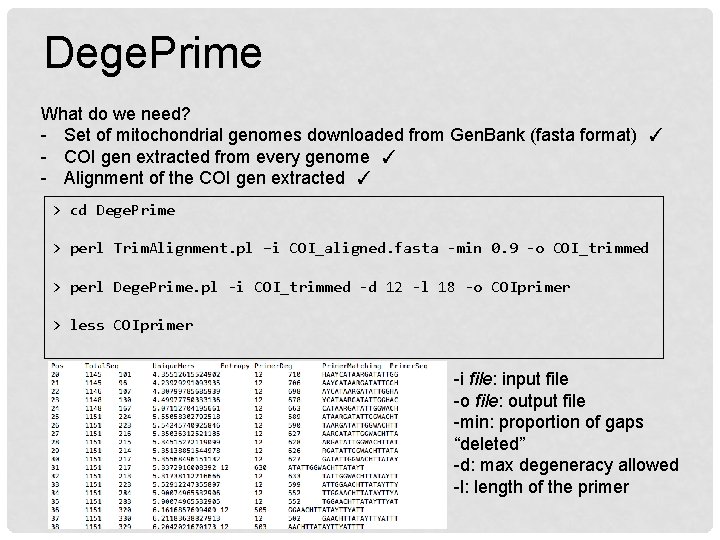
Dege. Prime What do we need? - Set of mitochondrial genomes downloaded from Gen. Bank (fasta format) ✓ - COI gen extracted from every genome ✓ - Alignment of the COI gen extracted ✓ > cd Dege. Prime > perl Trim. Alignment. pl –i COI_aligned. fasta -min 0. 9 -o COI_trimmed > perl Dege. Prime. pl -i COI_trimmed -d 12 -l 18 -o COIprimer > less COIprimer -i file: input file -o file: output file -min: proportion of gaps “deleted” -d: max degeneracy allowed -l: length of the primer
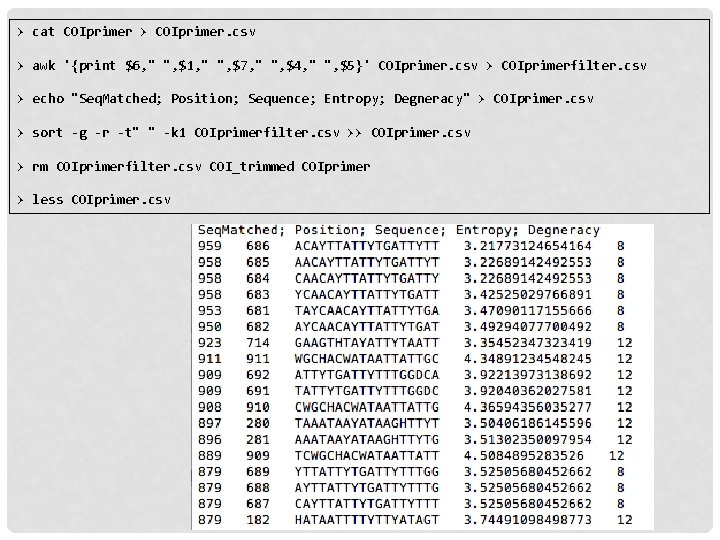
> cat COIprimer > COIprimer. csv > awk '{print $6, " ", $1, " ", $7, " ", $4, " ", $5}' COIprimer. csv > COIprimerfilter. csv > echo "Seq. Matched; Position; Sequence; Entropy; Degneracy" > COIprimer. csv > sort -g -r -t" " -k 1 COIprimerfilter. csv >> COIprimer. csv > rm COIprimerfilter. csv COI_trimmed COIprimer > less COIprimer. csv
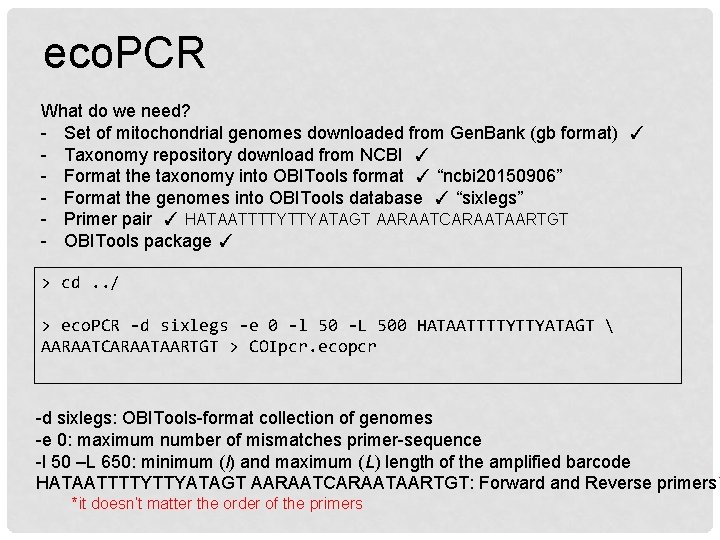
eco. PCR What do we need? - Set of mitochondrial genomes downloaded from Gen. Bank (gb format) ✓ - Taxonomy repository download from NCBI ✓ - Format the taxonomy into OBITools format ✓ “ncbi 20150906” - Format the genomes into OBITools database ✓ “sixlegs” - Primer pair ✓ HATAATTTTYTTYATAGT AARAATCARAATAARTGT - OBITools package ✓ > cd. . / > eco. PCR -d sixlegs -e 0 -l 50 -L 500 HATAATTTTYTTYATAGT AARAATCARAATAARTGT > COIpcr. ecopcr -d sixlegs: OBITools-format collection of genomes -e 0: maximum number of mismatches primer-sequence -l 50 –L 650: minimum (l) and maximum (L) length of the amplified barcode HATAATTTTYTTYATAGT AARAATCARAATAARTGT: Forward and Reverse primers* *it doesn’t matter the order of the primers
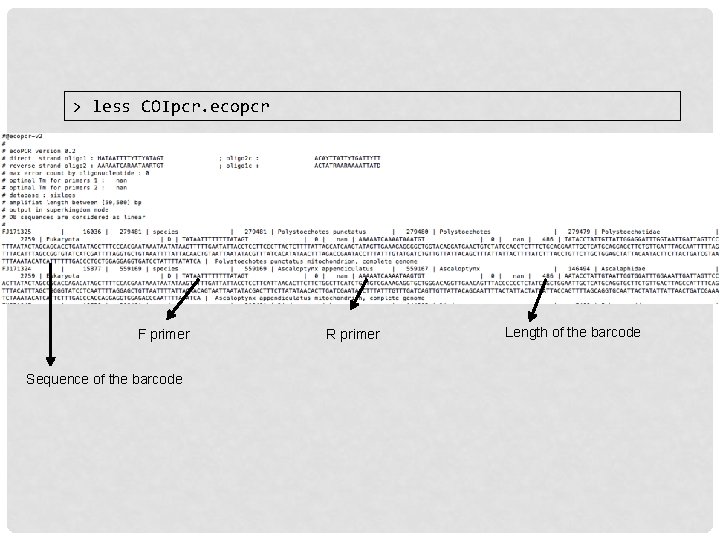
> less COIpcr. ecopcr F primer Sequence of the barcode R primer Length of the barcode
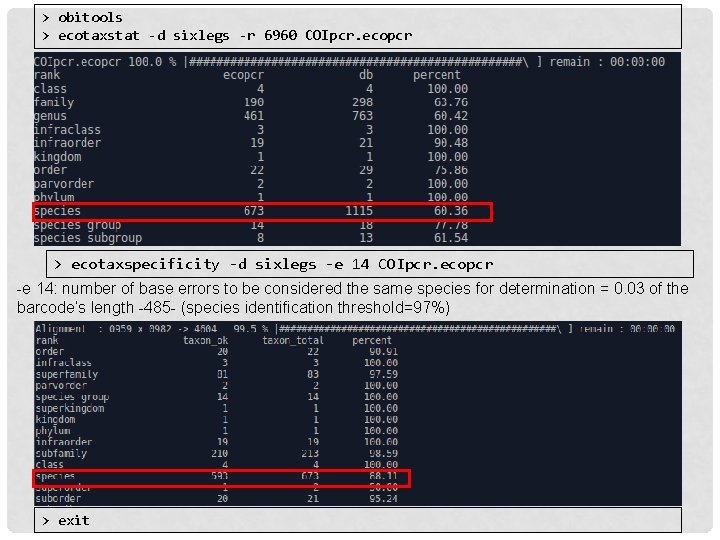
> obitools > ecotaxstat -d sixlegs -r 6960 COIpcr. ecopcr > ecotaxspecificity -d sixlegs -e 14 COIpcr. ecopcr -e 14: number of base errors to be considered the same species for determination = 0. 03 of the barcode’s length -485 - (species identification threshold=97%) > exit
- Slides: 19