
DESIGN AND IMPLEMENTATION OF A WEB MINING RESEARCH

DESIGN AND IMPLEMENTATION OF A WEB MINING RESEARCH SUPPORT SYSTEM l l Jin Xu Department of Computer Science & Engineering l Presented at the Ph. D. Candidacy exam l Advisors: Dr. Gregory Madey Dr. Patrick Flynn l l Nov. 21, 2003
OUTLINE l l l INTRODUCTION WEB INFORMATION RETRIEVAL (IR) WEB INFORMATION EXTRACTION (IE) GENERALIZATION SIMULATION & VALIDATION CONCLUSIONS & TIME PLAN Jin Xu, CSE Dept.
INTRODUCTION l World Wide Web – l Web resources – – – l Abundant information On-line databases Web documents Archives: forums, newsgroups Important resource for research Jin Xu, CSE Dept.
OPEN SOURCE SOFTWARE STUDY l Open Source Software (OSS) study at ND – – l Development of projects Behaviors of developers Web resources – Source. Forge Developer Site l Largest OSS development site – l 70, 000 projects, 90, 000 developers, 700, 000 users Detailed information Project characteristics – Developer activities – Jin Xu, CSE Dept.
MOTIVATION l Traditional Web Data Retrieval – – l Web data features – – – l Browsing: following links keyword query: irrelevant results Semi-structured Heterogeneous Dynamic Web data mining research support systems – – Web-based IR support system, J. T. Yao, et al, 2003 CUPTRESS, H. Tang, et al, 2003 Jin Xu, CSE Dept.
SYSTEM DESCRIPTION l Objective – l Functions – – l General solution to use web resources and discover knowledge Web resource identification – IR Web data extraction – IE Data mining – Generalization Analysis & Validation Will be tested on the OSS study at ND Jin Xu, CSE Dept.
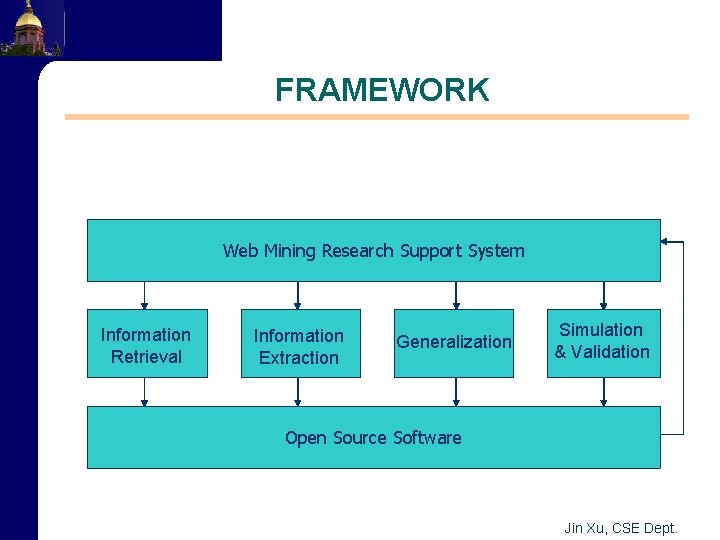
FRAMEWORK Web Mining Research Support System Information Retrieval Information Extraction Generalization Simulation & Validation Open Source Software Jin Xu, CSE Dept.
WEB INFORMATION RETRIEVAL l l Current IR tools Web page classification Proposed classification search tool Example Jin Xu, CSE Dept.
CURRENT IR TOOLS l Current IR Tools – – l Directory - subject lists Search engine - keywords query Limitations – – Low precision - too many irrelevant documents Low recall - too little of the web is covered by wellcategorized directories – l Not well-categorized for research needs Classification search tool Jin Xu, CSE Dept.
WEB PAGE CLASSIFICATION l Manual classification – – – l Accurate Yahoo, Informine Impossible for large number of web pages Automatic classification – Nearest neighbor (NN) classifier (C. Chekuri, 1996) l – Feature selection (S. Chakrabarti, 1998) l – Similar documents are assigned the same class label Eliminate features with low correlations Naïve Bayes classifier (A. K. Mc. Callum, 2000) Jin Xu, CSE Dept.
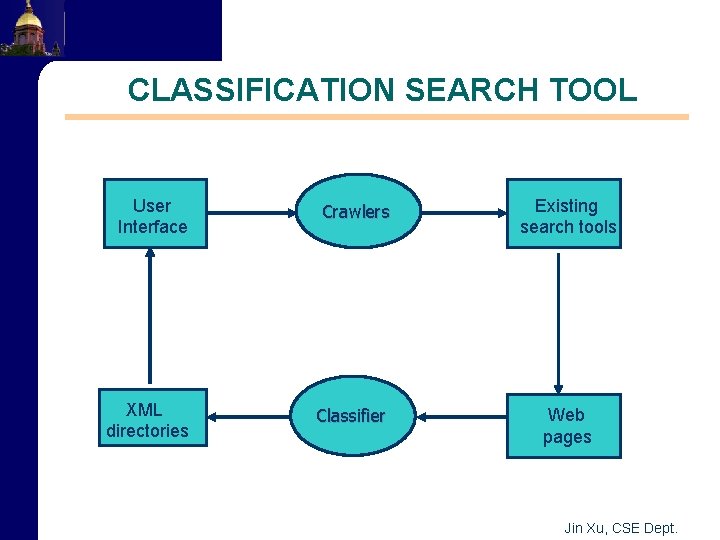
CLASSIFICATION SEARCH TOOL User Interface Crawlers Existing search tools XML directories Classifier Web pages Jin Xu, CSE Dept.
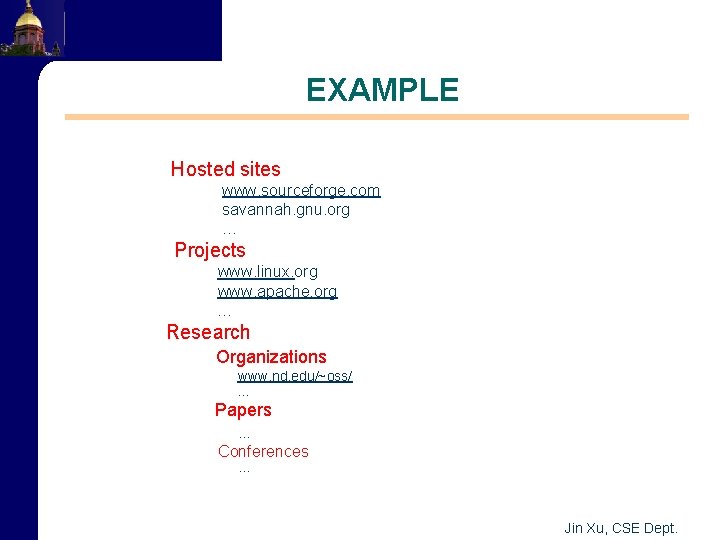
EXAMPLE Hosted sites www. sourceforge. com savannah. gnu. org … Projects www. linux. org www. apache. org … Research Organizations www. nd. edu/~oss/ … Papers … Conferences … Jin Xu, CSE Dept.
WEB INFORMATION EXTRACTION l l l Wrapper generation OSS wrapper & data collection Wrapper generation tools Hybrid IE Jin Xu, CSE Dept.
WEB INFORMATION EXTRACTION l Web IE – – l Extract a specific portion of web documents Port into databases Wrapper – – Extract information from a particular web site Extraction rules and code to apply rules Jin Xu, CSE Dept.
WRAPPER GENERATION (WG) l Manual generation – – – l Semi-automatic generation – – l Understanding of web documents Writing codes Dynamic changes of web sites Sample pages Demonstration by users Automatic generation – Learn extraction rules Jin Xu, CSE Dept.
OSS WEB WRAPPER l OSS web wrapper – – – Perl and CPAN modules URL accessing– fetch pages (LWP) HTML parser – parse pages l l HTML: : Table. Extract – extract information Link extractor – extract links Word extractor Features – – – Manual High maintenance cost Not suitable to handle free text Jin Xu, CSE Dept.
WEB DOCUMENT TYPES l Structured text – – – l Free text – l Fixed order Labels/tags On-line data generated by database Natural language text Semistructured text Bill Smith – admin, Perl, Graduate student, University of Notre Dame, IN 46556, (574)333 -3333 Jin Xu, CSE Dept.
WG TECHNIQUES l Wrapper induction (Soft. Mealy, 1998; WIEN, 2000; STALKER 2001; LIXTO 2003) – – l Training examples Extraction rules Format features to delineate the structure of data Not suitable for free text Natural language processing (NLP) (WHISK, 1999) – – – Training examples Extraction rules Linguistic constraints Work for all Complex, time cost Jin Xu, CSE Dept.
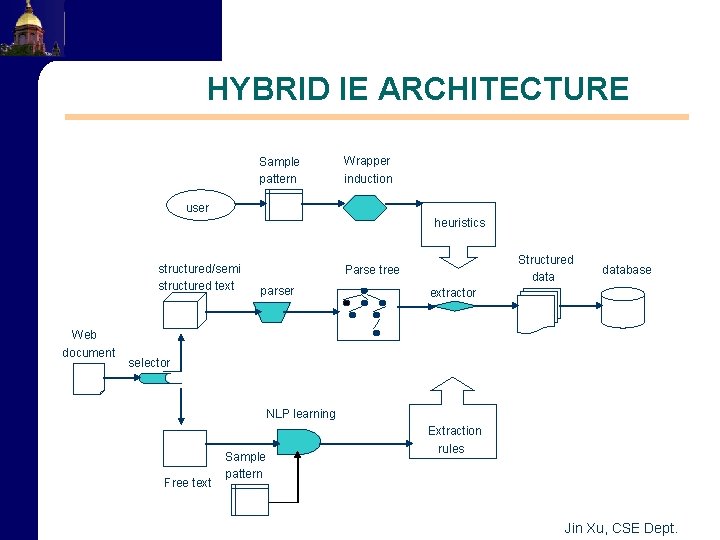
HYBRID IE ARCHITECTURE Sample pattern Wrapper induction user heuristics structured/semi structured text Web document Structured data Parse tree parser database extractor selector NLP learning Free text Sample pattern Extraction rules Jin Xu, CSE Dept.
OSS APPLICATION l Web sites – l Structured/semi-structured – l Source. Forge, Savanah, Linux, Apache, Mozilla Membership tables, statistics tables, etc. Free text – Message board, emails, etc. Jin Xu, CSE Dept.
GENERALIZATION l l l Overview Preprocessing Data mining functions Previous OSS generalization study Infrastructure Jin Xu, CSE Dept.
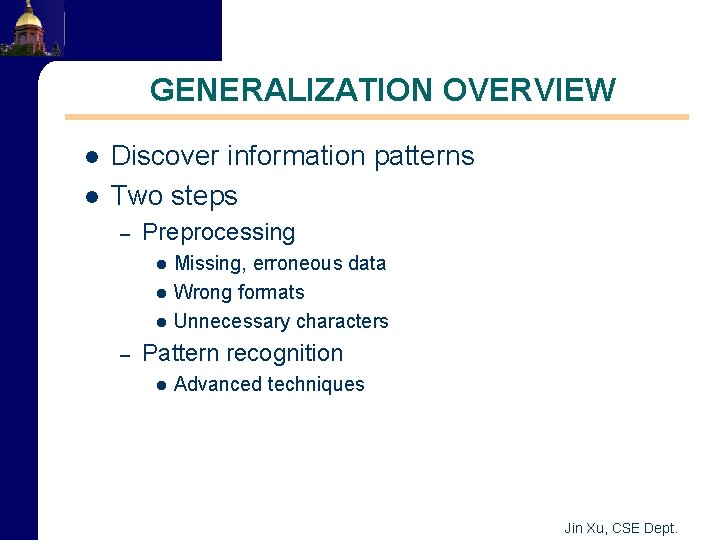
GENERALIZATION OVERVIEW l l Discover information patterns Two steps – Preprocessing l l l – Missing, erroneous data Wrong formats Unnecessary characters Pattern recognition l Advanced techniques Jin Xu, CSE Dept.
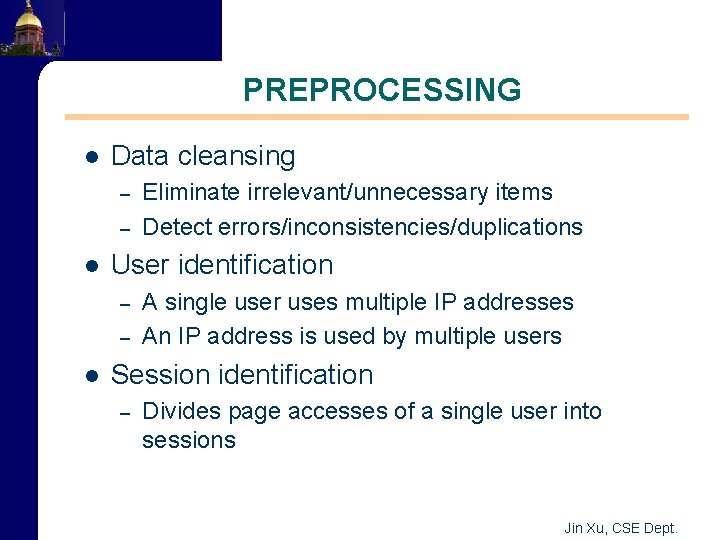
PREPROCESSING l Data cleansing – – l User identification – – l Eliminate irrelevant/unnecessary items Detect errors/inconsistencies/duplications A single user uses multiple IP addresses An IP address is used by multiple users Session identification – Divides page accesses of a single user into sessions Jin Xu, CSE Dept.
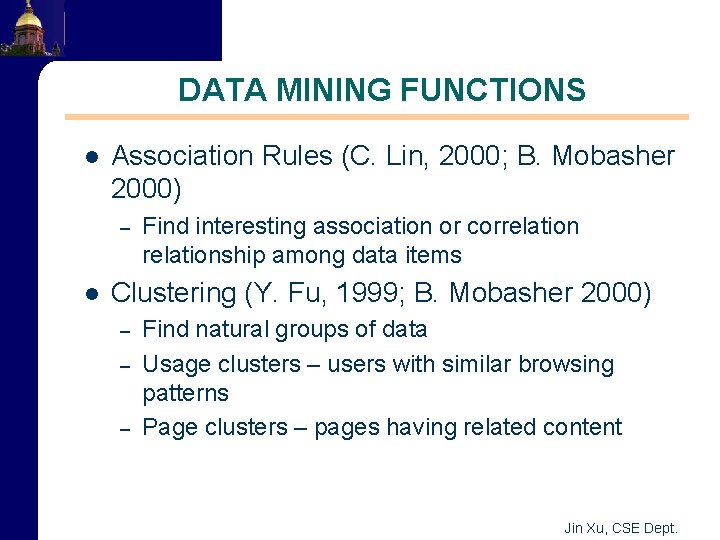
DATA MINING FUNCTIONS l Association Rules (C. Lin, 2000; B. Mobasher 2000) – l Find interesting association or correlationship among data items Clustering (Y. Fu, 1999; B. Mobasher 2000) – – – Find natural groups of data Usage clusters – users with similar browsing patterns Page clusters – pages having related content Jin Xu, CSE Dept.
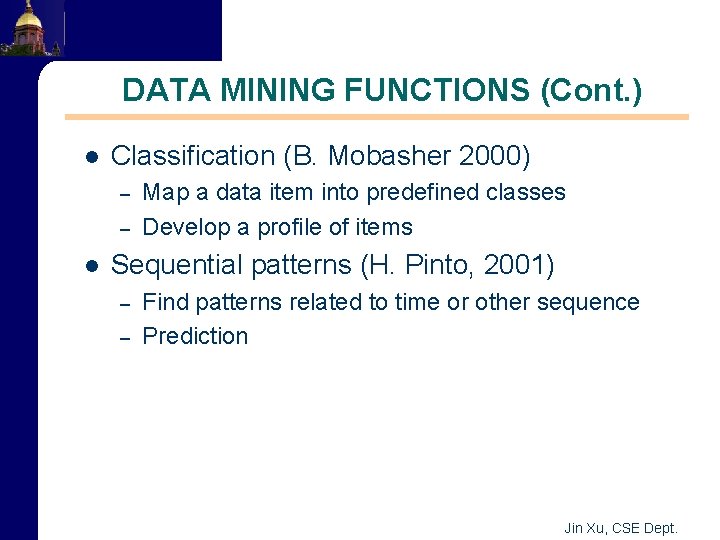
DATA MINING FUNCTIONS (Cont. ) l Classification (B. Mobasher 2000) – – l Map a data item into predefined classes Develop a profile of items Sequential patterns (H. Pinto, 2001) – – Find patterns related to time or other sequence Prediction Jin Xu, CSE Dept.
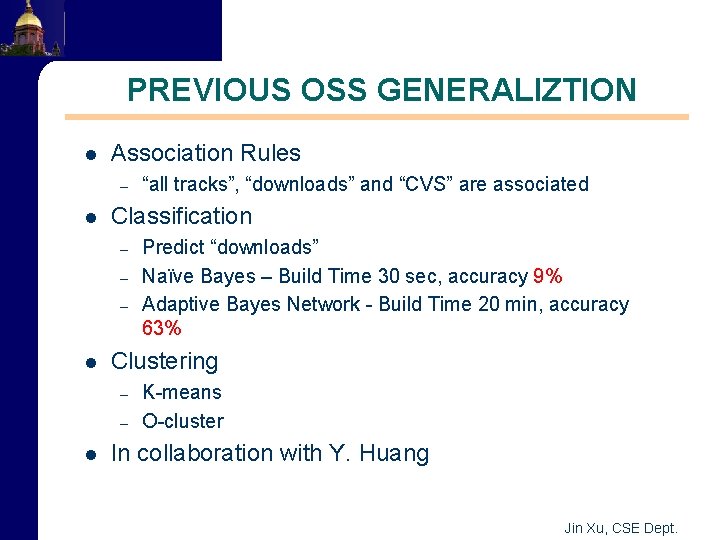
PREVIOUS OSS GENERALIZTION l Association Rules – l Classification – – – l Predict “downloads” Naïve Bayes – Build Time 30 sec, accuracy 9% Adaptive Bayes Network - Build Time 20 min, accuracy 63% Clustering – – l “all tracks”, “downloads” and “CVS” are associated K-means O-cluster In collaboration with Y. Huang Jin Xu, CSE Dept.
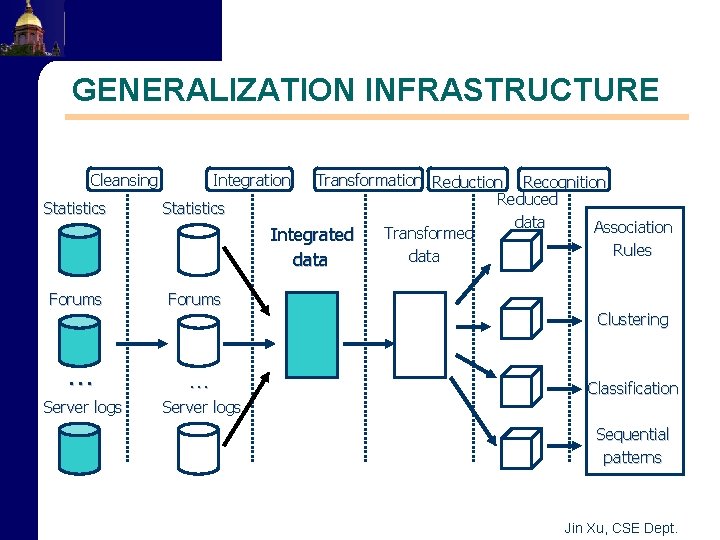
GENERALIZATION INFRASTRUCTURE Cleansing Integration Statistics Forums Transformation Reduction Recognition Reduced data Association Transformed Integrated Rules data Clustering … … Server logs Classification Sequential patterns Jin Xu, CSE Dept.
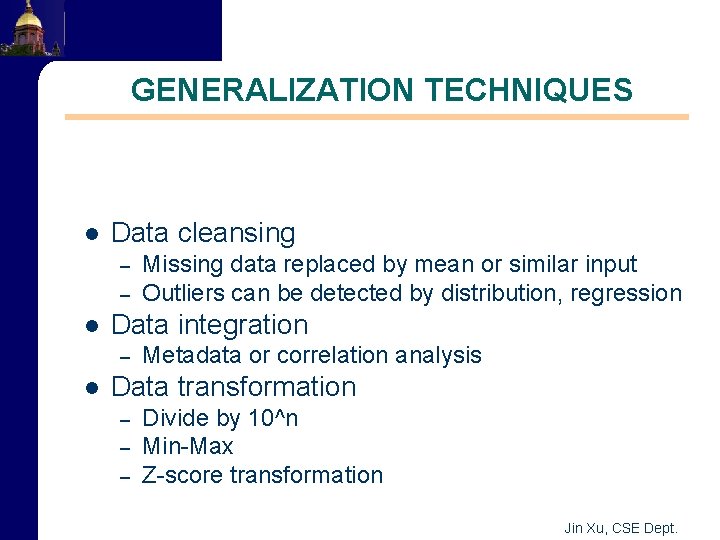
GENERALIZATION TECHNIQUES l Data cleansing – – l Data integration – l Missing data replaced by mean or similar input Outliers can be detected by distribution, regression Metadata or correlation analysis Data transformation – – – Divide by 10^n Min-Max Z-score transformation Jin Xu, CSE Dept.
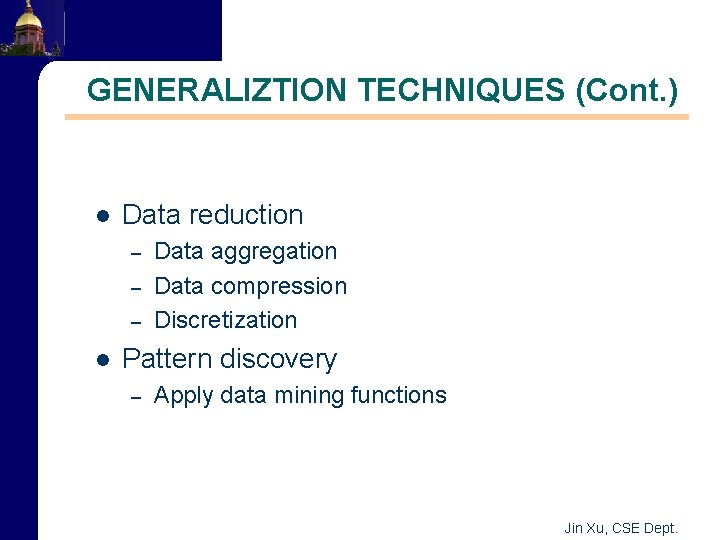
GENERALIZTION TECHNIQUES (Cont. ) l Data reduction – – – l Data aggregation Data compression Discretization Pattern discovery – Apply data mining functions Jin Xu, CSE Dept.
OSS APPLICATION l Patterns to characterize the activeness of a project – l l Downloads, page view, bug reports Clustering and dependencies of OSS projects Groups of developers and their relationships Jin Xu, CSE Dept.
SIMULATION & VALIDATION l l Introduction Validation approaches Previous validation – OSS docking Future work Jin Xu, CSE Dept.
SIMULATION & VALIDATION l Simulation (In collaboration with Y. Gao) – – – l l Interpret the mined patterns Build models and simulations Use simulations to test and evaluate hypothesis Validation OSS validation – docking Jin Xu, CSE Dept.
VALIDATION l Three methods of Validation – – – l Comparison with real phenomenon Comparison with mathematical models Docking with other simulations Docking – – – Verify simulation correctness Discover pros & cons of toolkits R. Axtell, 1996; M. North 2001; M. Ashworth, 2002 Jin Xu, CSE Dept.
OSS DOCKING EXPERIMENT l Four Models of OSS – – l random graphs preferential attachment with constant fitness preferential attachment with dynamic fitness Agent-based Simulation – – Swarm Repast Jin Xu, CSE Dept.
OSS NETWORK l l l A classic example of a dynamic social network Two Entities: developer, project Graph Representation – – l Node – developers Edge – two developers are participating in the same project Activities – – Create projects Join projects Abandon projects Continue with current projects Jin Xu, CSE Dept.
OSS MODEL l l Agent: developer Each time interval: – – Certain number developers generated New developers: create or join Old developers: create, join, abandon, idle Update preference for preferential models Jin Xu, CSE Dept.
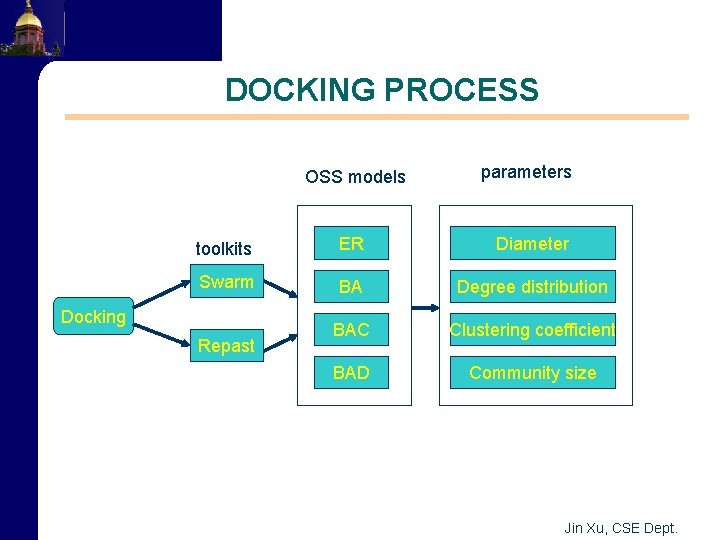
DOCKING PROCESS OSS models parameters toolkits ER Diameter Swarm BA Degree distribution BAC Clustering coefficient BAD Community size Docking Repast Jin Xu, CSE Dept.
DOCKING PROCEDURE l l Process: comparisons of parameters corresponding models. Findings: – – – Different Random Generators Databases creation errors in the original version Different starting time of schedulers Jin Xu, CSE Dept.
DOCKING PARAMETERS l Diameter – l Degree distribution – l The distribution of degrees throughout a network Clustering coefficient (CC) – – l Average length of shortest paths between all pairs of vertices CCi: Fraction representing the number of links actually present relative to the total possible number of links among the vertices in its neighborhood. CC: average of all CCi in a network Community size Jin Xu, CSE Dept.
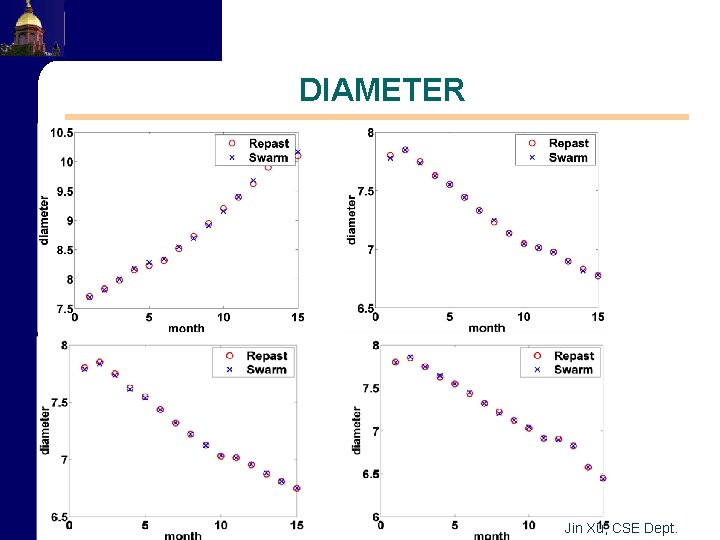
DIAMETER Jin Xu, CSE Dept.
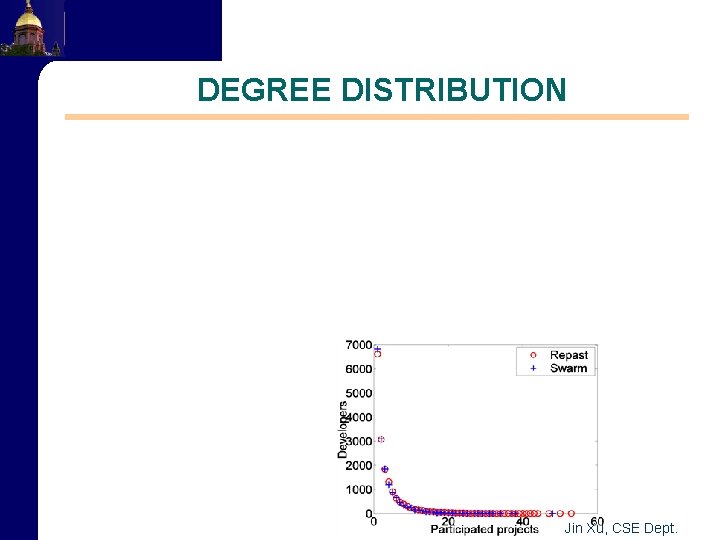
DEGREE DISTRIBUTION Jin Xu, CSE Dept.
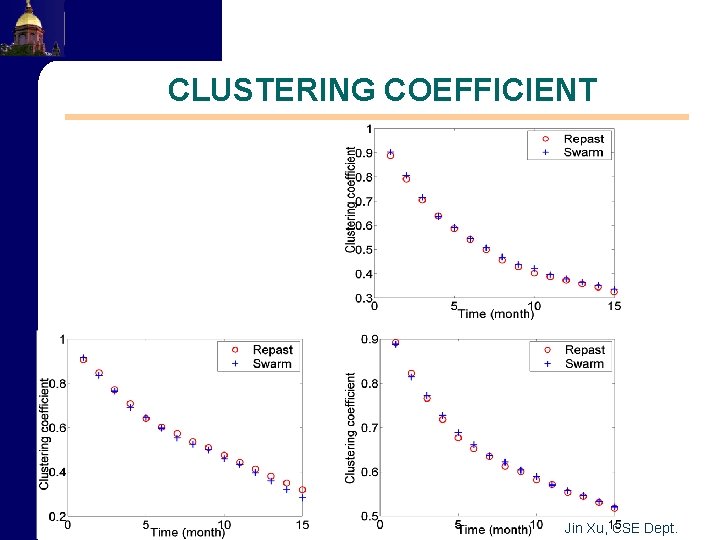
CLUSTERING COEFFICIENT Jin Xu, CSE Dept.
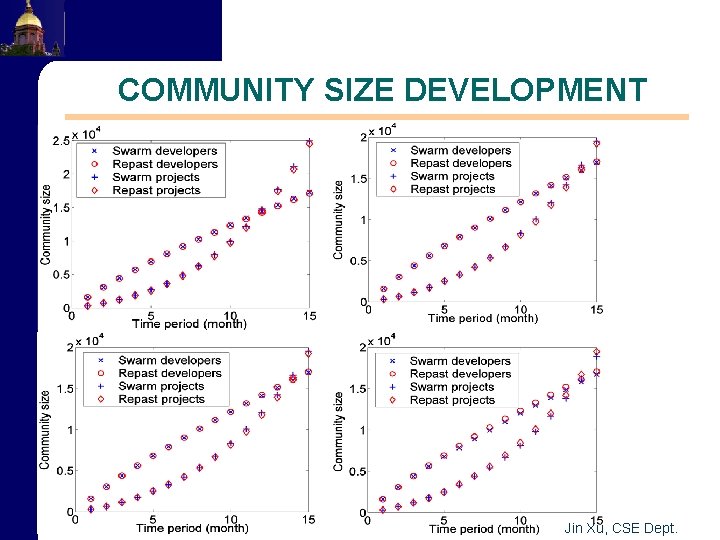
COMMUNITY SIZE DEVELOPMENT Jin Xu, CSE Dept.
PROPOSED WORK OF VALIDATION l Docking – – – Many runs instead of one Statistical analysis More network parameters l l Average degree Cluster size distribution Fitness and life cycle Statistic comparison Jin Xu, CSE Dept.
CONTRIBUTIONS l l l Provide an integrated web mining system to support research – a new tool Build a classification retrieval tool to improve precision and recall, as well as meet users’ search requirements Implement a hybrid IE tool to extract web data effectively and efficiently Create a generalization infrastructure which is suitable for web data mining Provide methods to validate OSS simulations Jin Xu, CSE Dept.
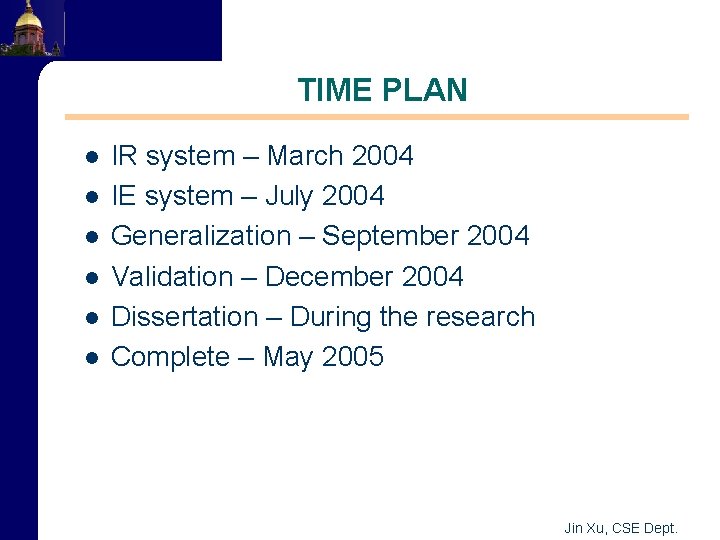
TIME PLAN l l l IR system – March 2004 IE system – July 2004 Generalization – September 2004 Validation – December 2004 Dissertation – During the research Complete – May 2005 Jin Xu, CSE Dept.
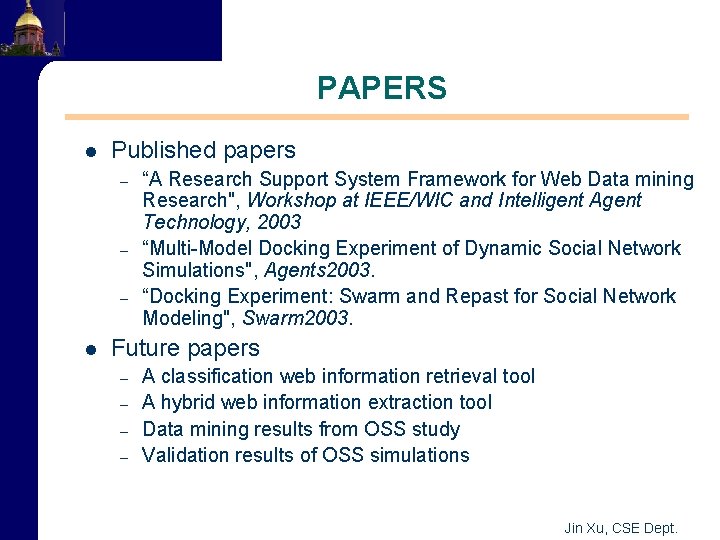
PAPERS l Published papers – – – l “A Research Support System Framework for Web Data mining Research", Workshop at IEEE/WIC and Intelligent Agent Technology, 2003 “Multi-Model Docking Experiment of Dynamic Social Network Simulations", Agents 2003. “Docking Experiment: Swarm and Repast for Social Network Modeling", Swarm 2003. Future papers – – A classification web information retrieval tool A hybrid web information extraction tool Data mining results from OSS study Validation results of OSS simulations Jin Xu, CSE Dept.

THANK YOU Jin Xu, CSE Dept.
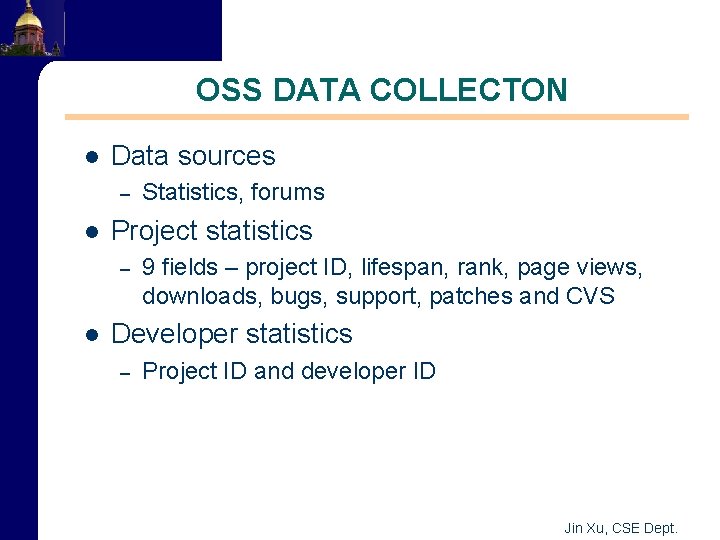
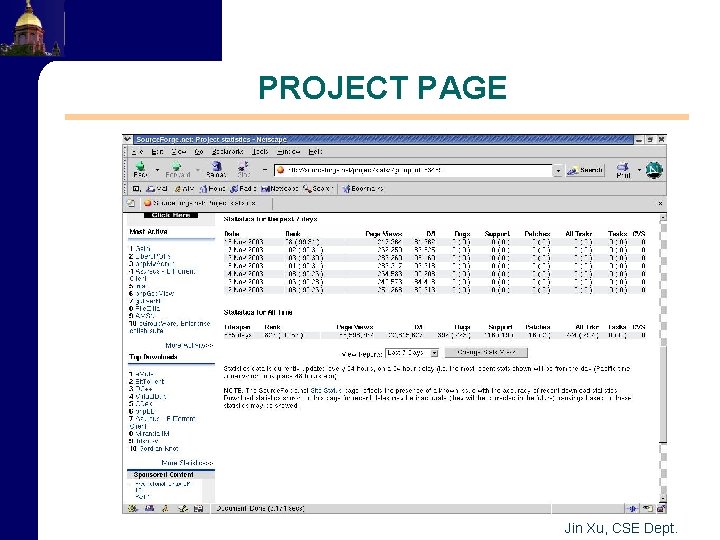
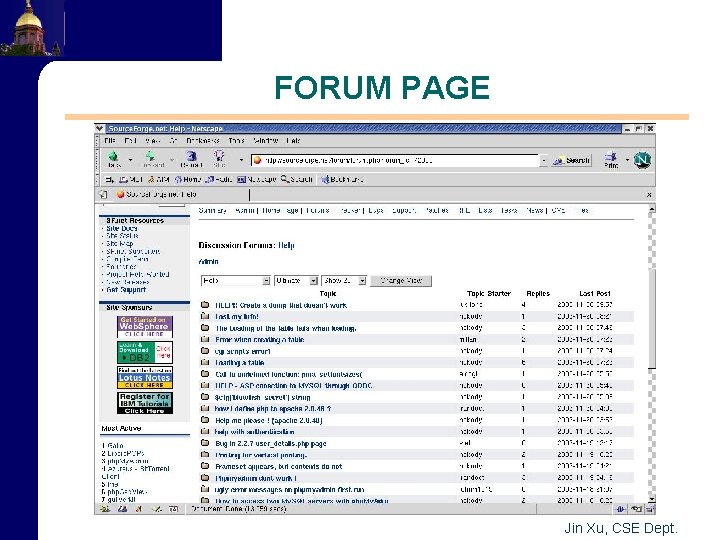
OSS DATA COLLECTON l Data sources – l Project statistics – l Statistics, forums 9 fields – project ID, lifespan, rank, page views, downloads, bugs, support, patches and CVS Developer statistics – Project ID and developer ID Jin Xu, CSE Dept.
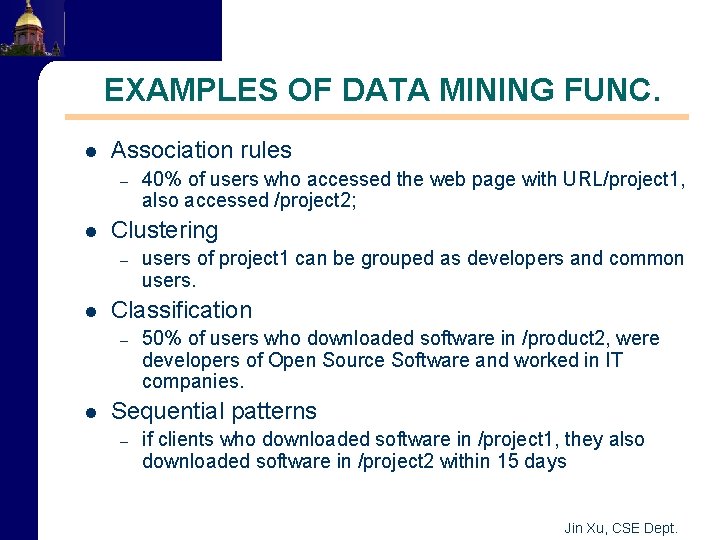
EXAMPLES OF DATA MINING FUNC. l Association rules – l Clustering – l users of project 1 can be grouped as developers and common users. Classification – l 40% of users who accessed the web page with URL/project 1, also accessed /project 2; 50% of users who downloaded software in /product 2, were developers of Open Source Software and worked in IT companies. Sequential patterns – if clients who downloaded software in /project 1, they also downloaded software in /project 2 within 15 days Jin Xu, CSE Dept.
SOCIAL NETWORK MODEL l Graph Representation – – – l Node/vertex – Social Agent Edge/link – Relationship Index/degree - The number of edges connected to a node ER (random) Graph – – edges attached in a random process No power law distribution Jin Xu, CSE Dept.
SOCIAL NETWORK MODEL(Cont. ) l Watts-Strogatz (WS) model – – l Barabasi-Albert (BA) model with preferential attachment – – l Addition of preferential attachment Power law distribution BA model with constant fitness – l include some random reattachment No power law distribution addition of random fitness BA model with dynamic fitness Jin Xu, CSE Dept.
SWARM SIMULATION l Model. Swarm – – – l Observer. Swarm – l l Creats developers Controls the activities of developers in the model Generate a schedule Collects information and draws graphs main Developer (agent) – – Properties: ID, degree, participated projects Methods: daily actions Jin Xu, CSE Dept.
REPAST SIMULATON l Model – – creates and controls the activities of developers collects information and draws graphs l l l Network display Movie snapshot Developer (agent) Project Edge Jin Xu, CSE Dept.
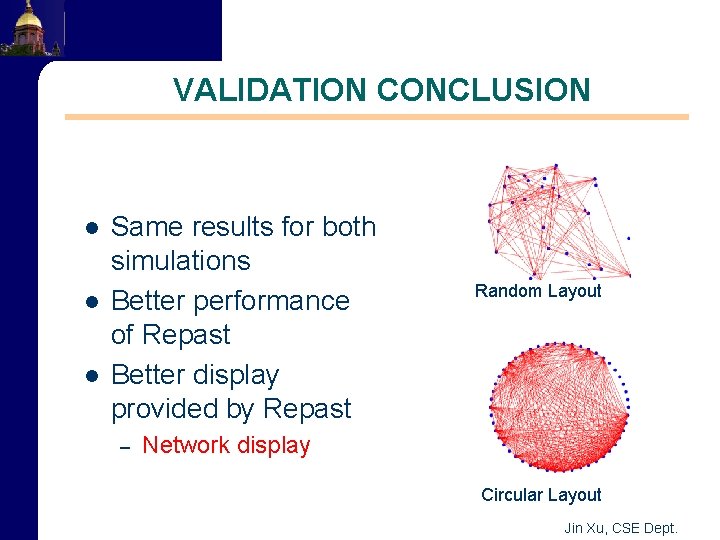
VALIDATION CONCLUSION l l l Same results for both simulations Better performance of Repast Better display provided by Repast – Random Layout Network display Circular Layout Jin Xu, CSE Dept.
PROJECT PAGE Jin Xu, CSE Dept.
FORUM PAGE Jin Xu, CSE Dept.
- Slides: 57