
Design and implementation of a Tesla coil Christopher
- Slides: 20
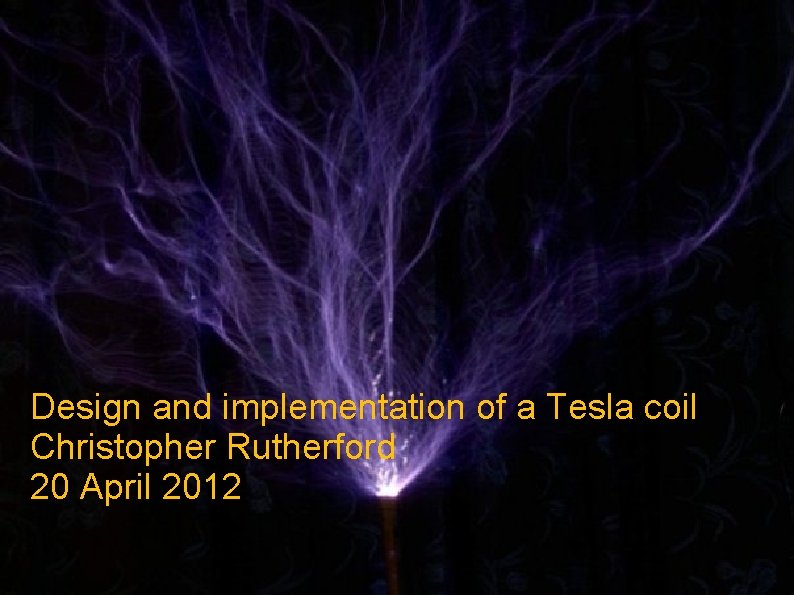
Design and implementation of a Tesla coil Christopher Rutherford 20 April 2012
Introduction Scope and context Tesla coil theory and operation Tesla coil design Lumped circuit equations Java. TC calculator Measurements Conclusions
Scope and Context Objectives Constraints Learn about Tesla coils Make system that works Satisfy an interest Use easily available parts and equipment Keep costs to a minimum Carried out in spare time Remarks Wheeler’s and Medhurst’s formulas are empirical
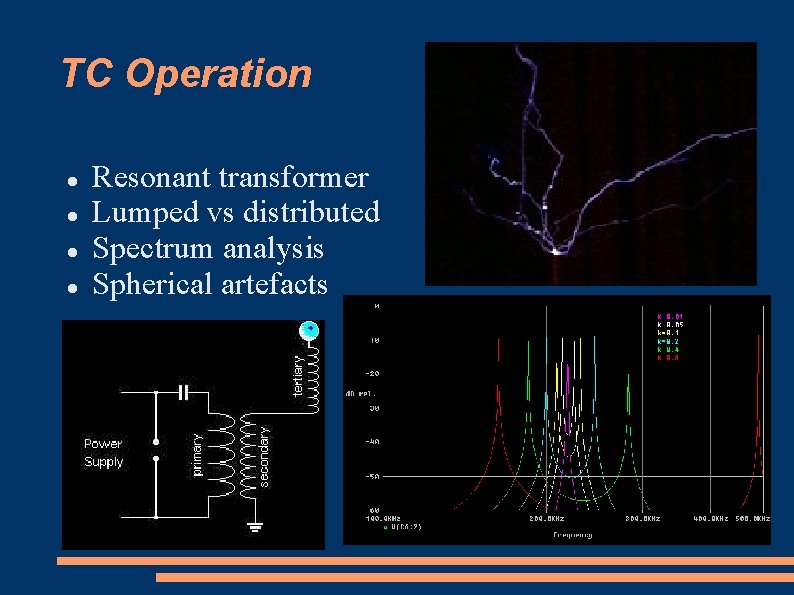
TC Operation Resonant transformer Lumped vs distributed Spectrum analysis Spherical artefacts
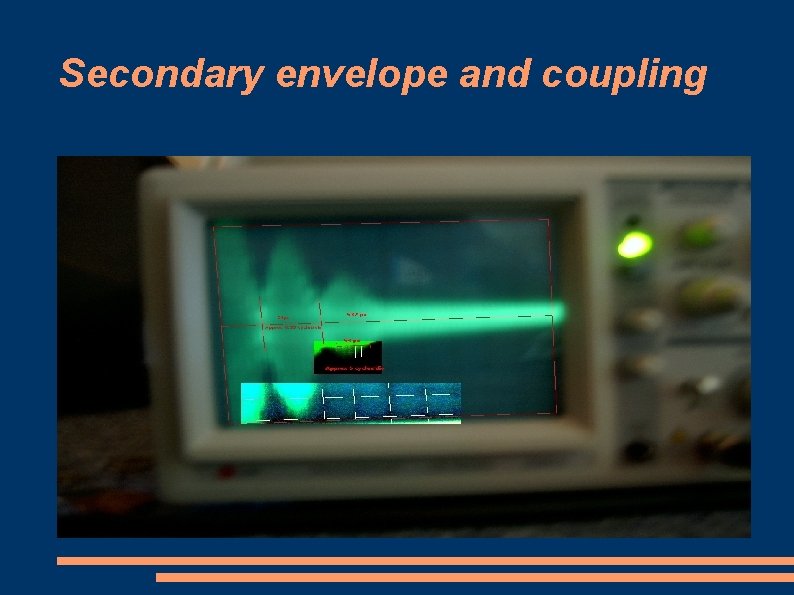
Secondary envelope and coupling
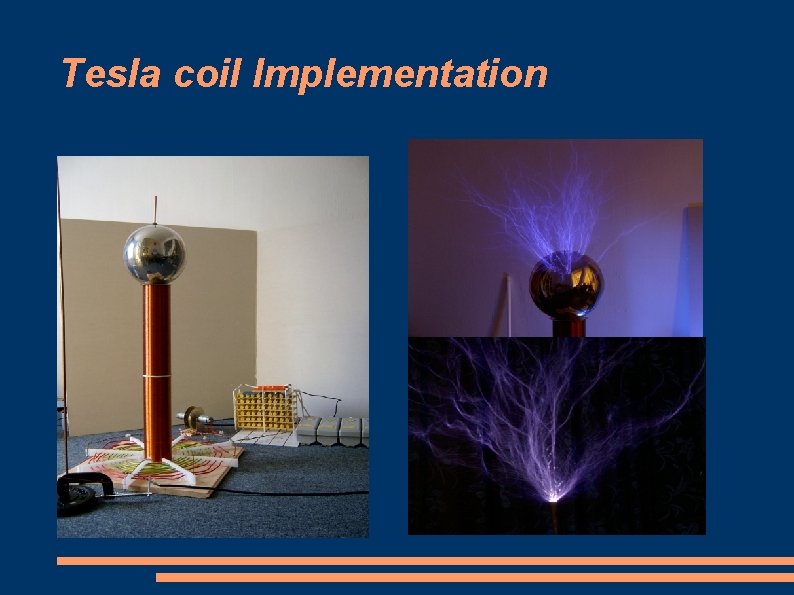
Tesla coil Implementation
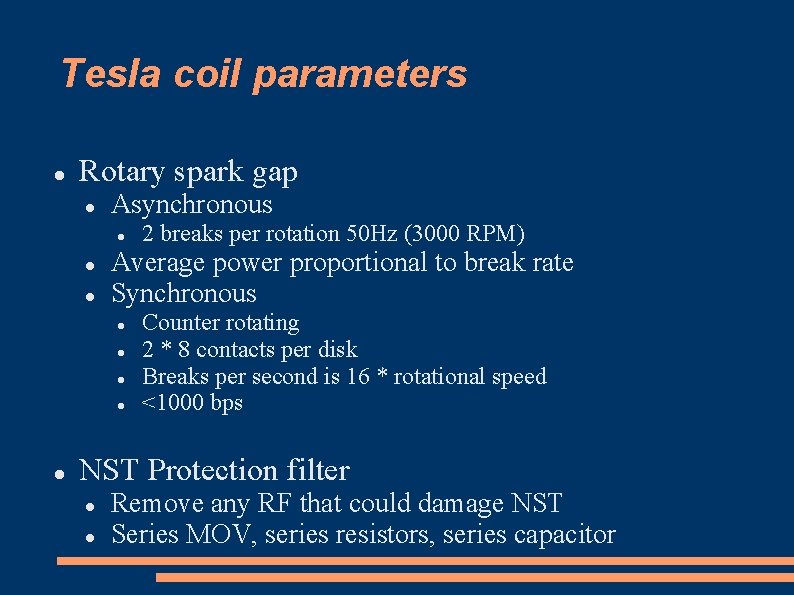
Tesla coil parameters Rotary spark gap Asynchronous Average power proportional to break rate Synchronous 2 breaks per rotation 50 Hz (3000 RPM) Counter rotating 2 * 8 contacts per disk Breaks per second is 16 * rotational speed <1000 bps NST Protection filter Remove any RF that could damage NST Series MOV, series resistors, series capacitor
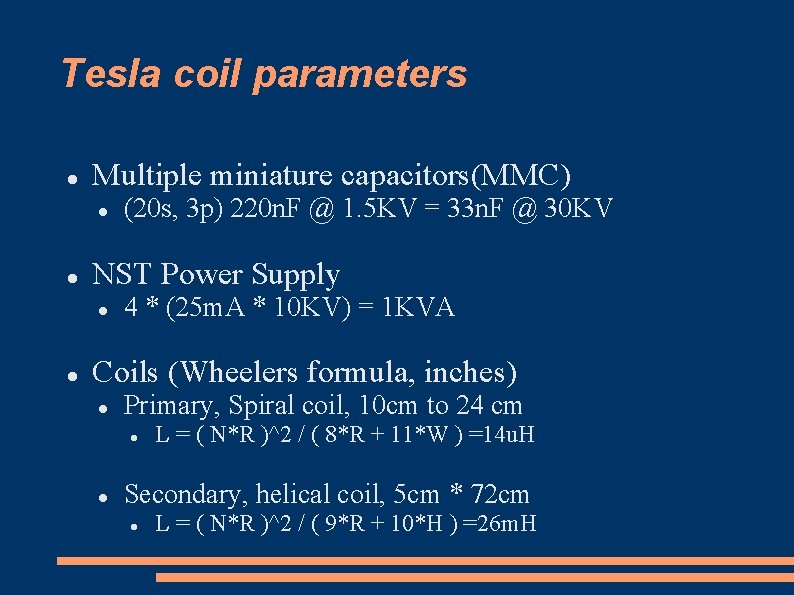
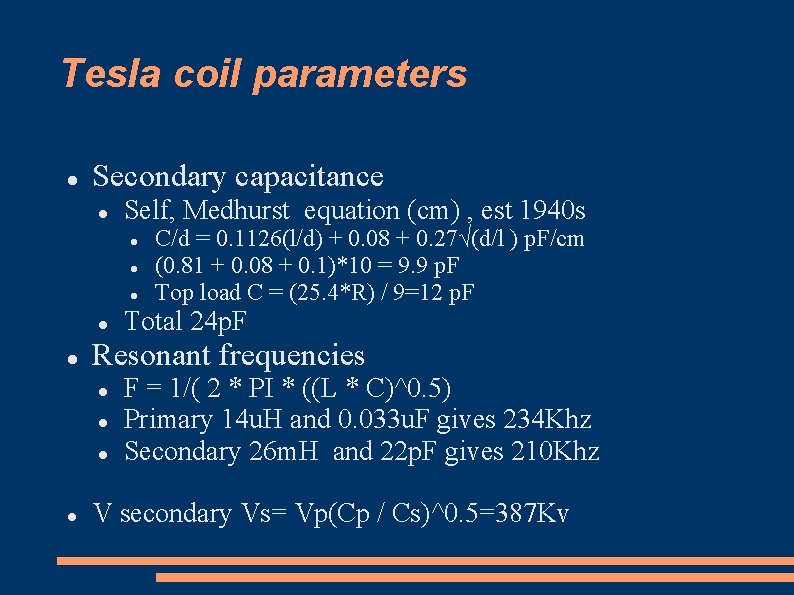
Tesla coil parameters Multiple miniature capacitors(MMC) NST Power Supply (20 s, 3 p) 220 n. F @ 1. 5 KV = 33 n. F @ 30 KV 4 * (25 m. A * 10 KV) = 1 KVA Coils (Wheelers formula, inches) Primary, Spiral coil, 10 cm to 24 cm L = ( N*R )^2 / ( 8*R + 11*W ) =14 u. H Secondary, helical coil, 5 cm * 72 cm L = ( N*R )^2 / ( 9*R + 10*H ) =26 m. H
Tesla coil parameters Secondary capacitance Self, Medhurst equation (cm) , est 1940 s Total 24 p. F Resonant frequencies C/d = 0. 1126(l/d) + 0. 08 + 0. 27√(d/l ) p. F/cm (0. 81 + 0. 08 + 0. 1)*10 = 9. 9 p. F Top load C = (25. 4*R) / 9=12 p. F F = 1/( 2 * PI * ((L * C)^0. 5) Primary 14 u. H and 0. 033 u. F gives 234 Khz Secondary 26 m. H and 22 p. F gives 210 Khz V secondary Vs= Vp(Cp / Cs)^0. 5=387 Kv
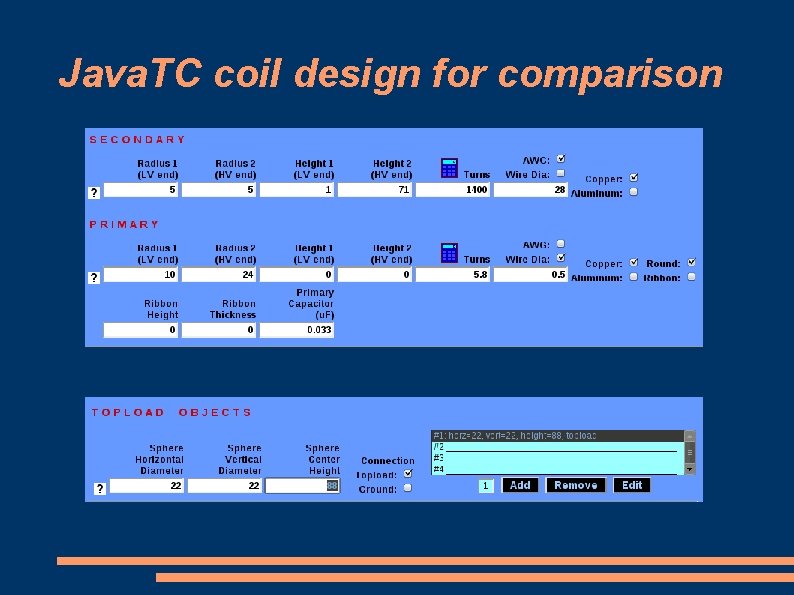
Java. TC coil design for comparison
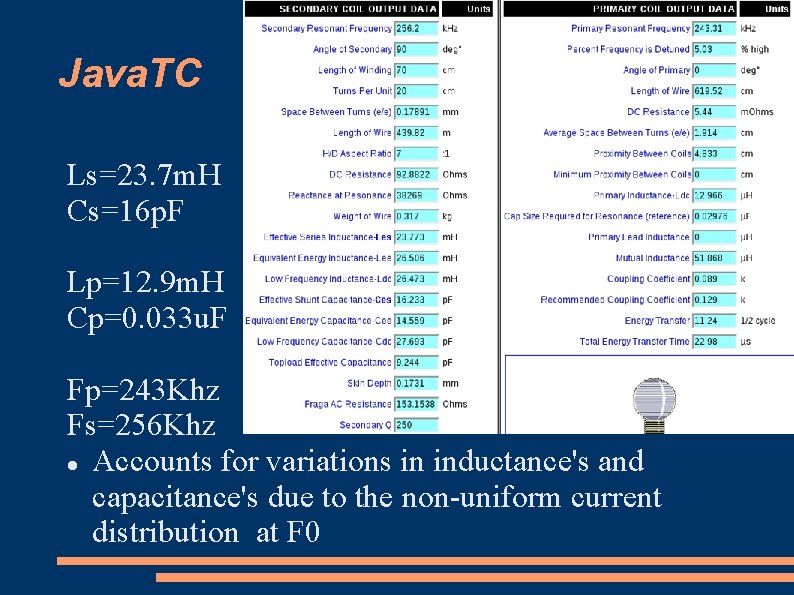
Java. TC Ls=23. 7 m. H Cs=16 p. F Lp=12. 9 m. H Cp=0. 033 u. F Fp=243 Khz Fs=256 Khz Accounts for variations in inductance's and capacitance's due to the non-uniform current distribution at F 0
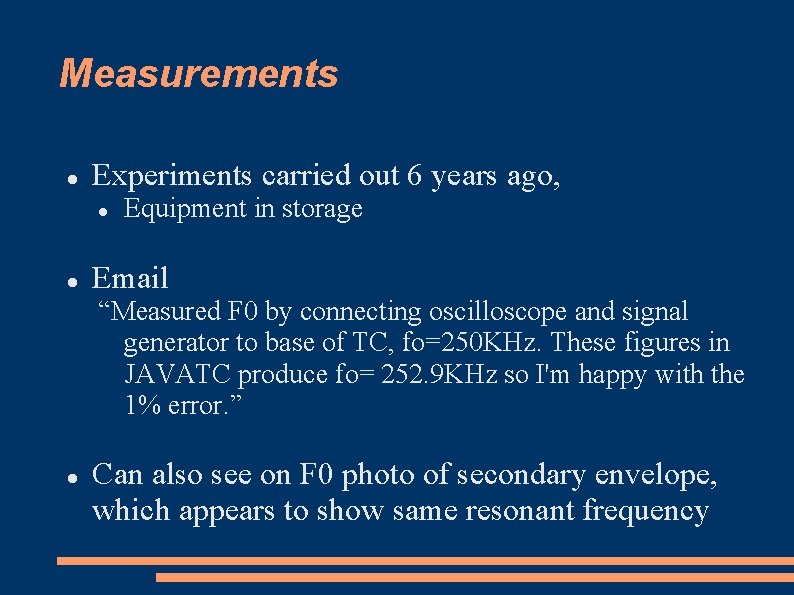
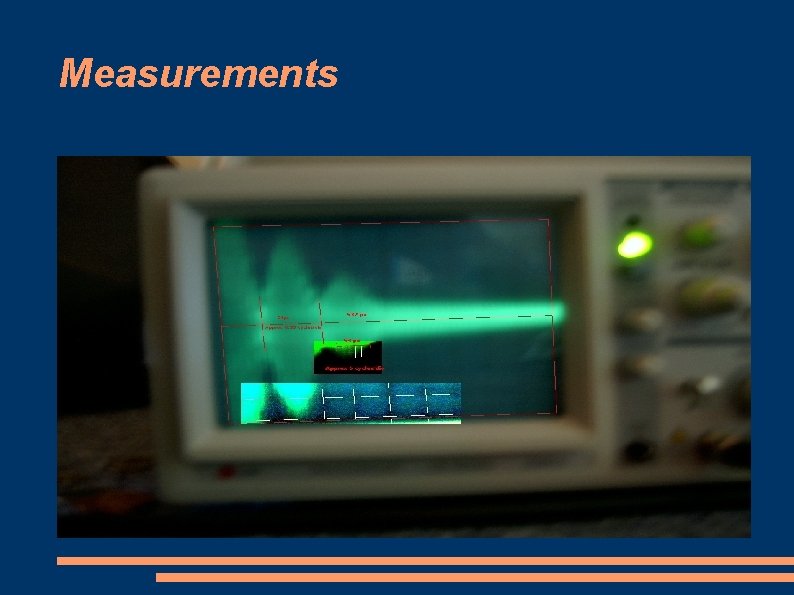
Measurements Experiments carried out 6 years ago, Equipment in storage Email “Measured F 0 by connecting oscilloscope and signal generator to base of TC, fo=250 KHz. These figures in JAVATC produce fo= 252. 9 KHz so I'm happy with the 1% error. ” Can also see on F 0 photo of secondary envelope, which appears to show same resonant frequency
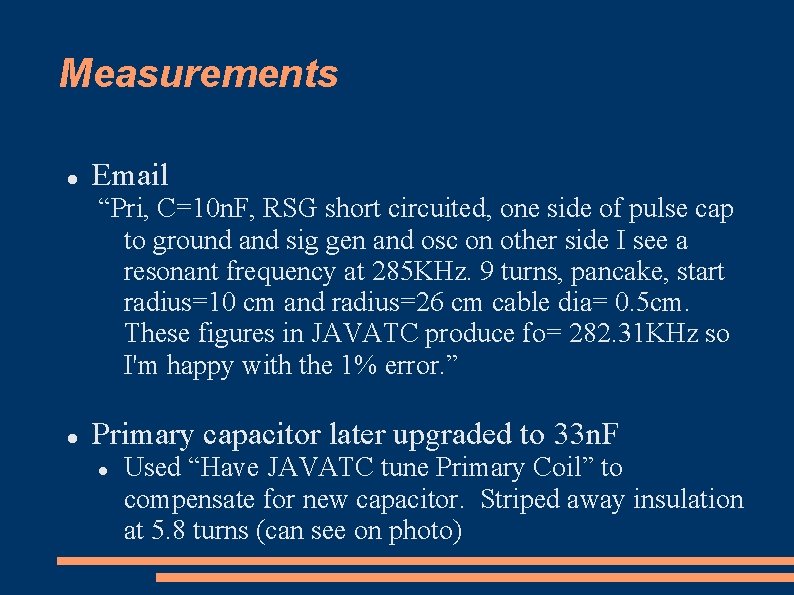
Measurements Email “Pri, C=10 n. F, RSG short circuited, one side of pulse cap to ground and sig gen and osc on other side I see a resonant frequency at 285 KHz. 9 turns, pancake, start radius=10 cm and radius=26 cm cable dia= 0. 5 cm. These figures in JAVATC produce fo= 282. 31 KHz so I'm happy with the 1% error. ” Primary capacitor later upgraded to 33 n. F Used “Have JAVATC tune Primary Coil” to compensate for new capacitor. Striped away insulation at 5. 8 turns (can see on photo)
Measurements
Measurements
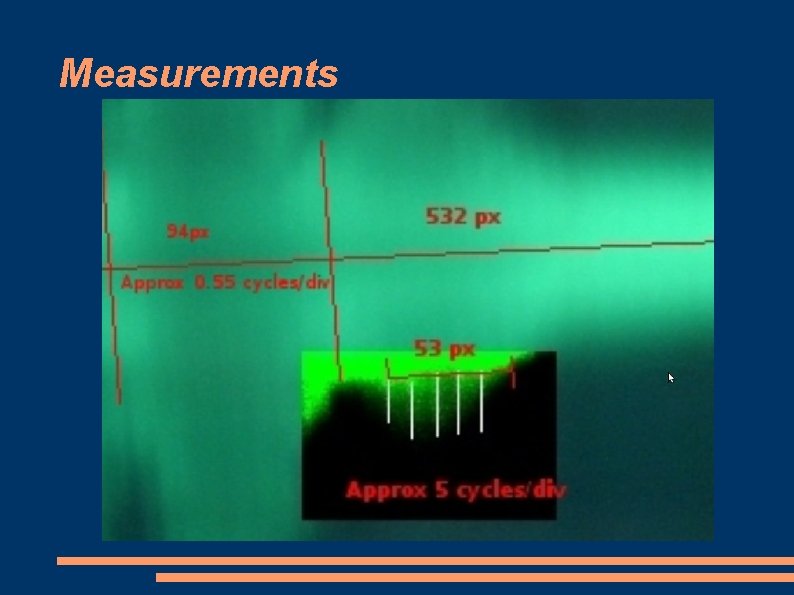
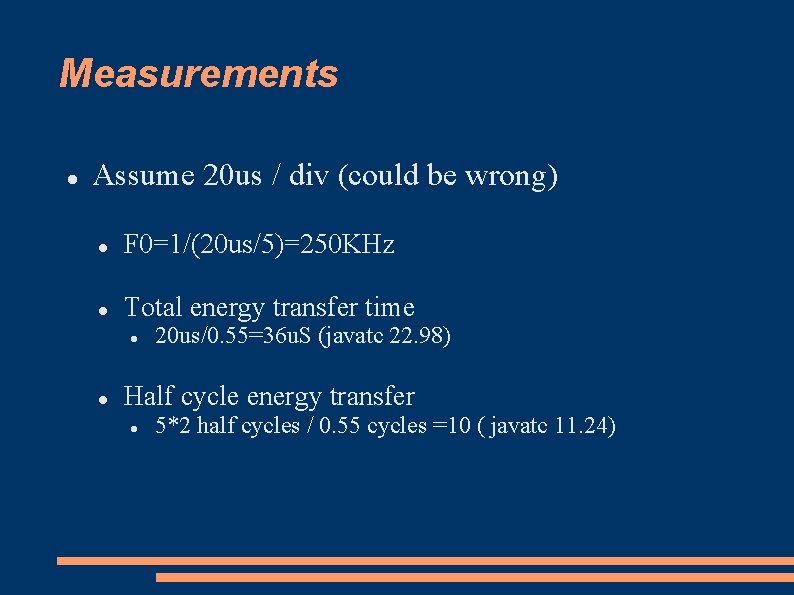
Measurements Assume 20 us / div (could be wrong) F 0=1/(20 us/5)=250 KHz Total energy transfer time 20 us/0. 55=36 u. S (javatc 22. 98) Half cycle energy transfer 5*2 half cycles / 0. 55 cycles =10 ( javatc 11. 24)
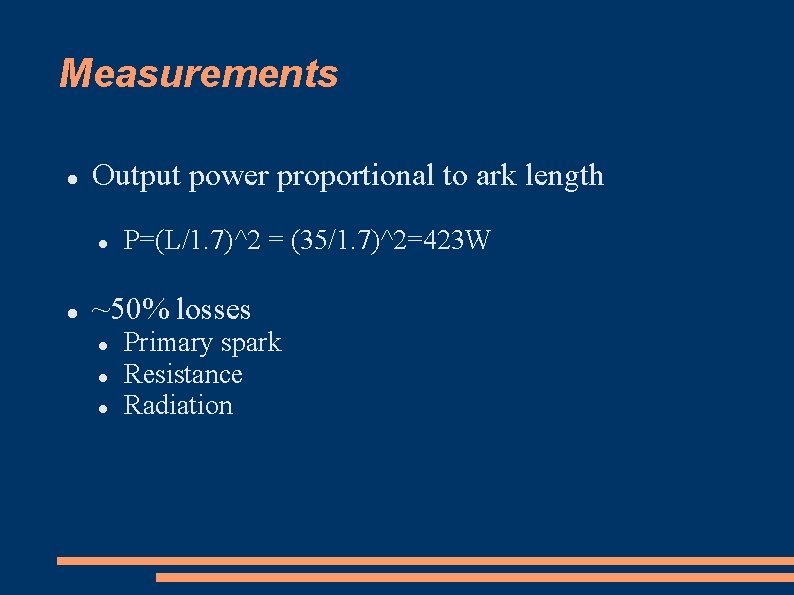
Measurements Output power proportional to ark length P=(L/1. 7)^2 = (35/1. 7)^2=423 W ~50% losses Primary spark Resistance Radiation
Conclusions Observation Tesla coils follow known principles (To a certain extent) Performance Improvements Higher/Tight coupling (k=0. 6) Lower height to width ratio Lower losses in secondary
Conclusions Future investigation More analysis at low power Solid state Tertiary coils Higher break rate (power proportional to break rate)
Questions / Answers