
Design and implementation of a Routing Control Platform





- Slides: 24
Design and implementation of a Routing Control Platform Matthew Caesar, Donald Caldwell, Nick Feamster, Jennifer Rexford, Aman Shaikh, Jacobus van der Merwe 1
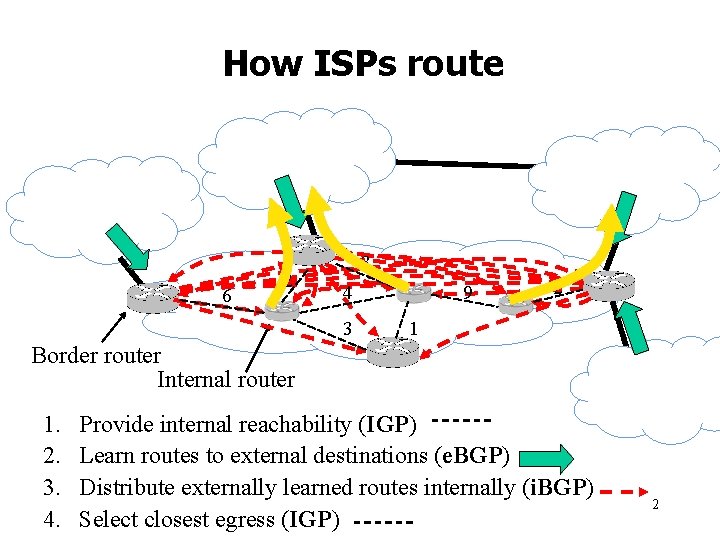
How ISPs route 6 2 3 4 3 9 2 1 Border router Internal router 1. 2. 3. 4. Provide internal reachability (IGP) Learn routes to external destinations (e. BGP) Distribute externally learned routes internally (i. BGP) Select closest egress (IGP) 2
What’s wrong with Internet routing? • Full-mesh i. BGP doesn’t scale – # sessions, control traffic, router memory/cpu – Route-reflectors help by introducing hierarchy • but introduce configuration complexity, protocol oscillations/loops • Hard to manage – Many highly configurable mechanisms – Difficult to model effects of configuration changes – Hard to diagnose when things go wrong • Hard to evolve – Hard to provide new services, improve upon protocols 3
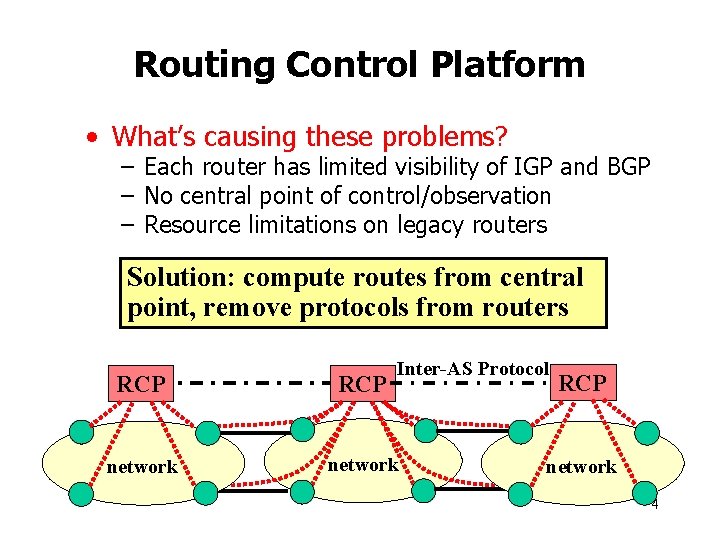
Routing Control Platform • What’s causing these problems? – Each router has limited visibility of IGP and BGP – No central point of control/observation – Resource limitations on legacy routers Solution: compute routes from central point, remove protocols from routers Inter-AS Protocol RCP network 4
RCP in a single ISP RCP i. BGP • Better scalability: reduces load on routers • Easier management: configuration from a single point • Easier evolvability: freedom from router software 5
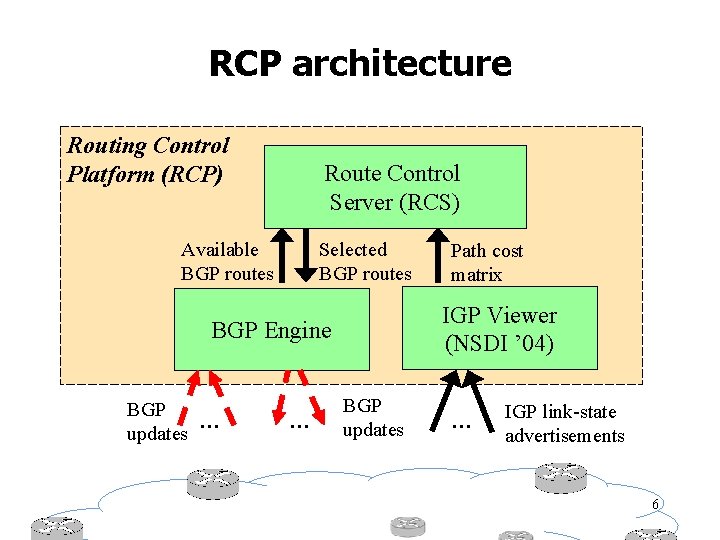
RCP architecture Routing Control Platform (RCP) Route Control Server (RCS) Available BGP routes Selected BGP routes IGP Viewer (NSDI ’ 04) BGP Engine BGP updates … … Path cost matrix BGP updates … IGP link-state advertisements 6
Challenges and contributions • Reliability – Problem: single point of failure – Contribution: simple replication of RCP components • Consistency – Problem: inconsistent decisions by replicas – Contribution: guaranteed consistency without inter-replica protocol • Scalability – Problem: storing all routes increases cpu/memory usage – Contribution : can support large ISP in one computer Building this system is feasible 7
Potential consistency problem RCP 1 “Use egress D (hence use B as A your next-hop)” C RCP 2 “Use egress C (hence use A as your next-hop)” B D • Need to ensure routes are consistently assigned – Even in presence of failures/partitions 8
Consistent assignment Single RCP, single partition RCP 1 “Use egress A” A “Use egress B” B • Solution: Assign all routers along the shortest IGP path the same exit router – Ensures forwarding loops don’t arise 9
Consistent assignment Single RCP, multiple partitions RCP 1 Partition 2 • Solution: Only use state from router’s partition in assigning its routes – Ensures next hop is reachable 10
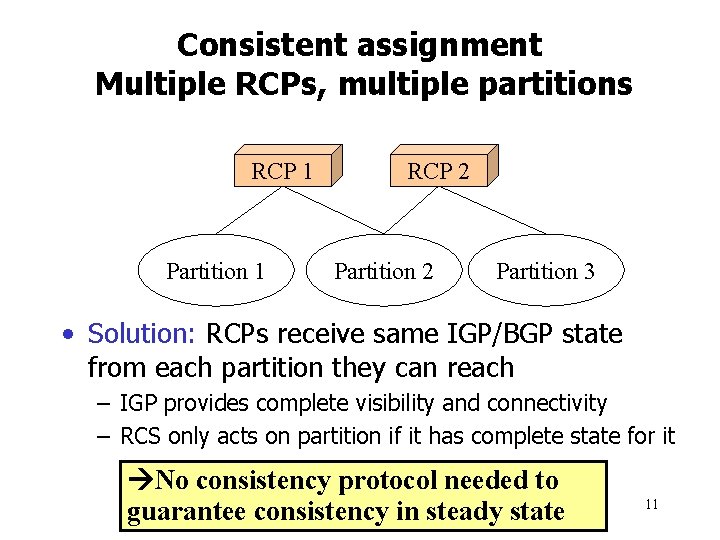
Consistent assignment Multiple RCPs, multiple partitions RCP 1 Partition 1 RCP 2 Partition 3 • Solution: RCPs receive same IGP/BGP state from each partition they can reach – IGP provides complete visibility and connectivity – RCS only acts on partition if it has complete state for it No consistency protocol needed to guarantee consistency in steady state 11
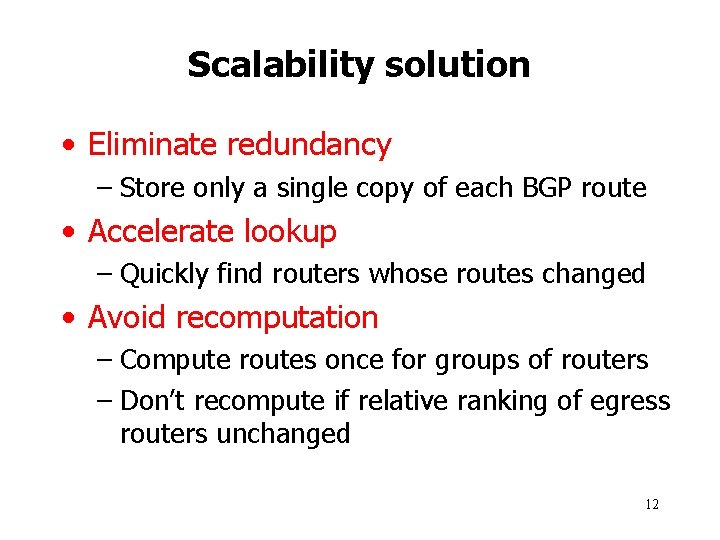
Scalability solution • Eliminate redundancy – Store only a single copy of each BGP route • Accelerate lookup – Quickly find routers whose routes changed • Avoid recomputation – Compute routes once for groups of routers – Don’t recompute if relative ranking of egress routers unchanged 12
RCS data structures Global route table (stores copies of routes) RIB-Out shadow tables (points to currently used route for each router) rtr 1 rtr 2 rtr 3 Prefixes BGP routes BGP updates (from egress routers) BGP updates (to routers) Egress lists (points to routes that use each egress) rtr 1 eg 1 rtr 2 eg 1 eg 2 eg 3 IGP updates 13
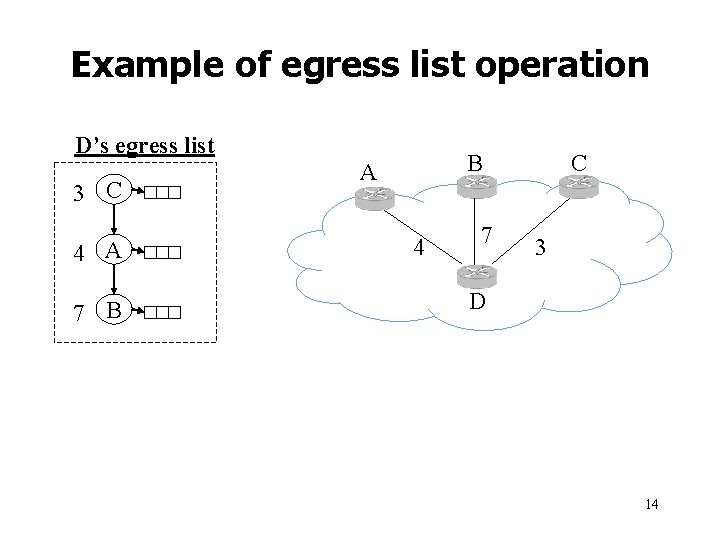
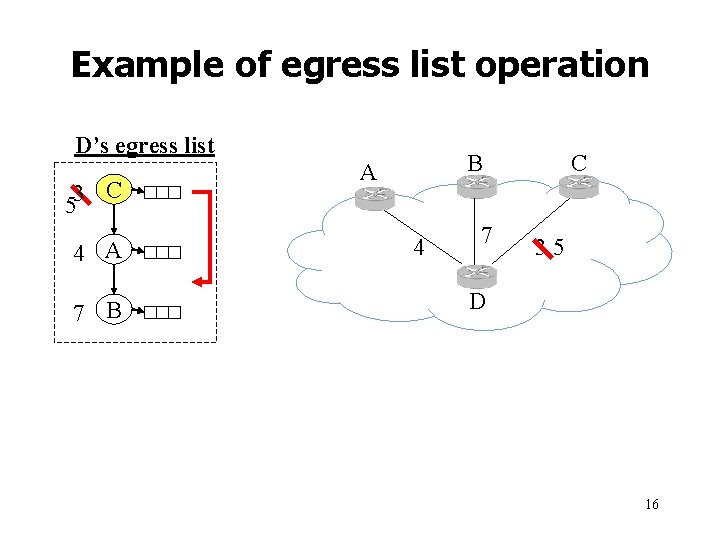
Example of egress list operation D’s egress list 3 C 4 A 7 B B A 4 7 C 3 D 14
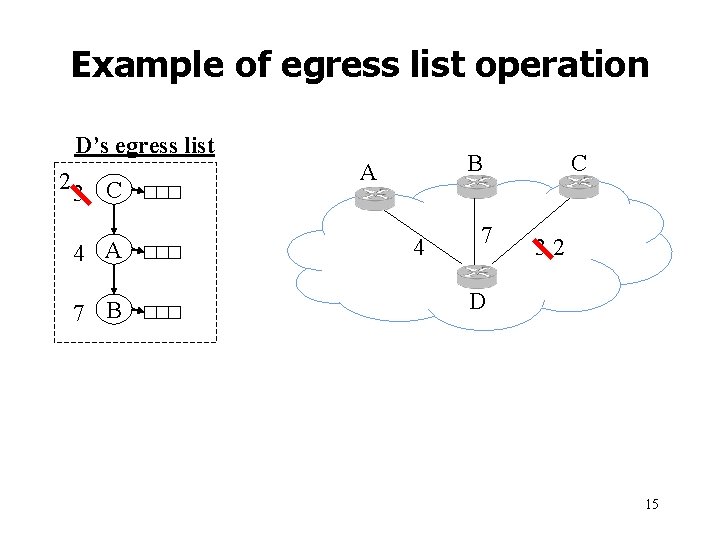
Example of egress list operation D’s egress list 23 C 4 A 7 B B A 4 7 C 32 D 15
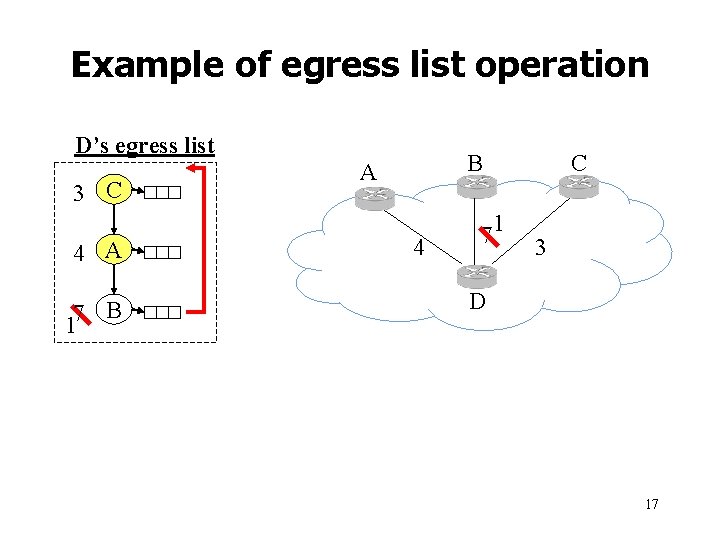
Example of egress list operation D’s egress list C 3 5 4 A 7 B B A 4 7 C 35 D 16
Example of egress list operation D’s egress list 3 C 4 A B 7 1 B A 4 71 C 3 D 17
Performance evaluation • BGP and OSPF logs from Tier-1 ISP backbone – collected on Aug 1 2004, ~500 routers • Metrics: memory usage, update processing time • Measurement techniques: – Whitebox (instrument code with timers) – Blackbox (workload generator on separate machine) • no-queuing (one update at a time) • real-time (allow updates to queue) • 3. 2 Ghz P 4, 4 GB memory, Linux 2. 6. 5 18
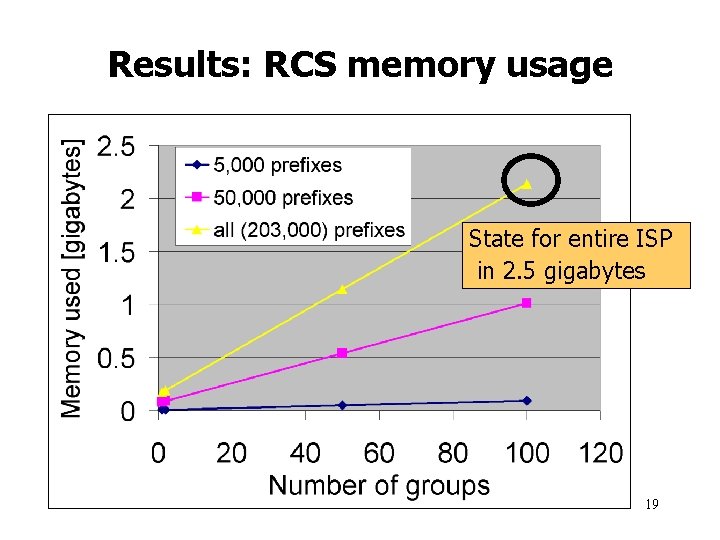
Results: RCS memory usage State for entire ISP in 2. 5 gigabytes 19
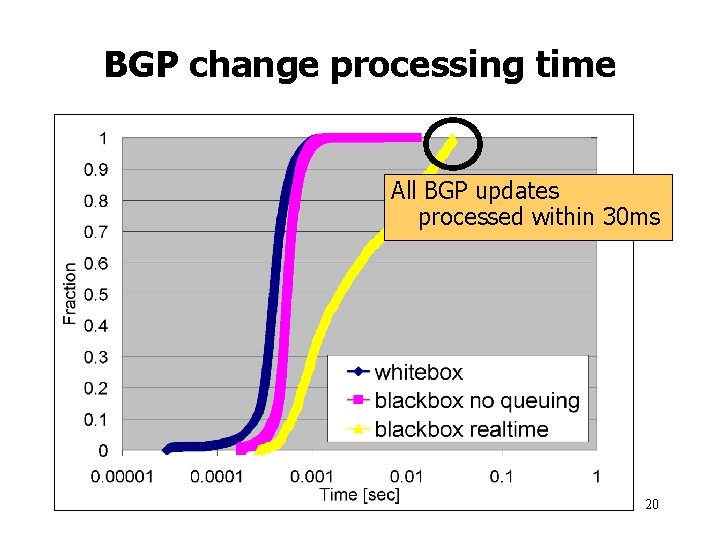
BGP change processing time All BGP updates processed within 30 ms 20
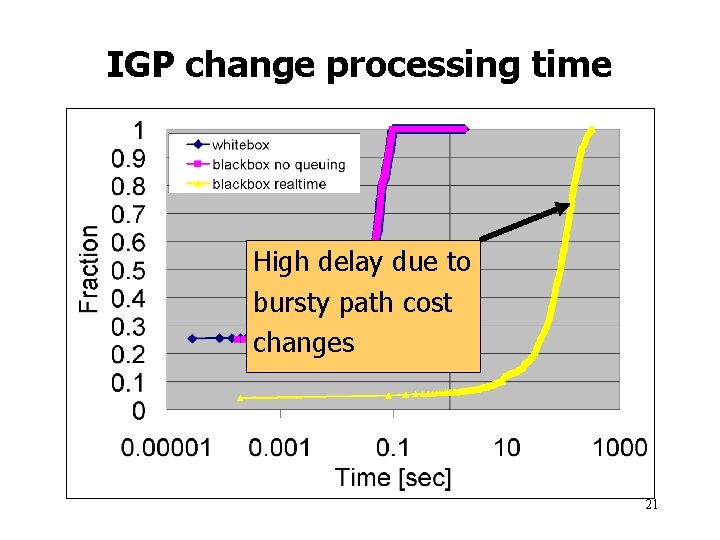
IGP change processing time High delay due to bursty path cost changes 21
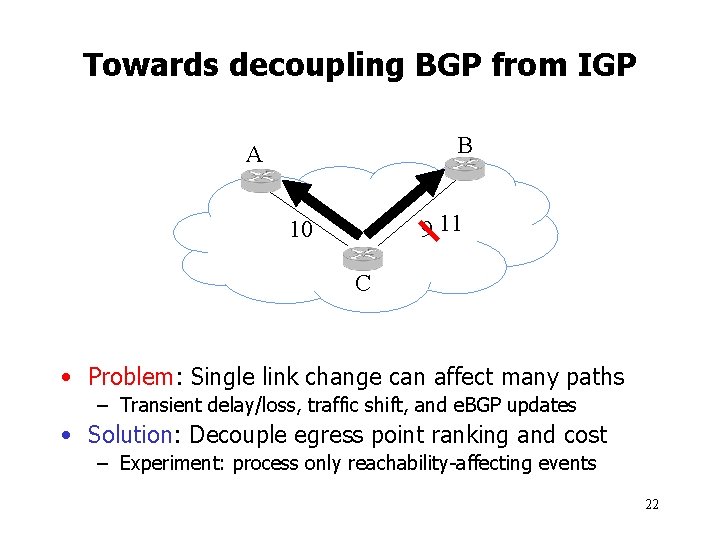
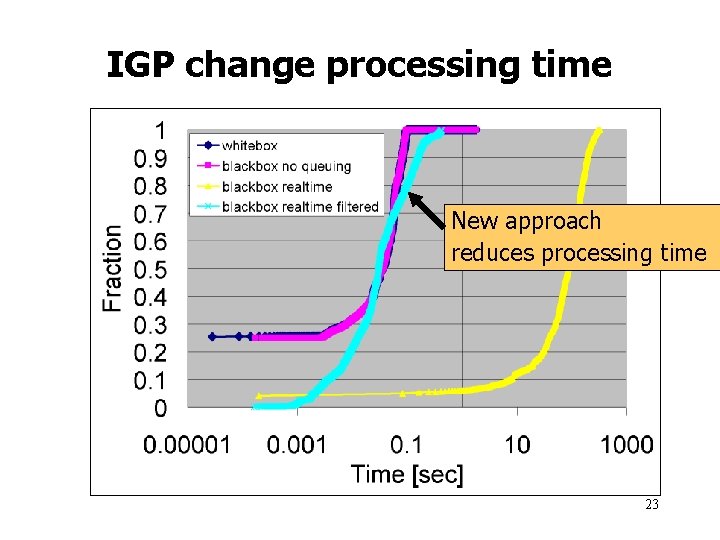
Towards decoupling BGP from IGP B A 9 11 10 C • Problem: Single link change can affect many paths – Transient delay/loss, traffic shift, and e. BGP updates • Solution: Decouple egress point ranking and cost – Experiment: process only reachability-affecting events 22
IGP change processing time New approach reduces processing time 23
Conclusions • RCP improves routing – Correct, scalable route distribution – Eases management and evolvability • RCP is feasible – Reliability, scalability, deployability, consistency • Many open problems: – How to simplify network management – How to enable new services – RCP cooperation between ISPs 24