
Design and fabrication of Vacuum Jacketed Transfer Line
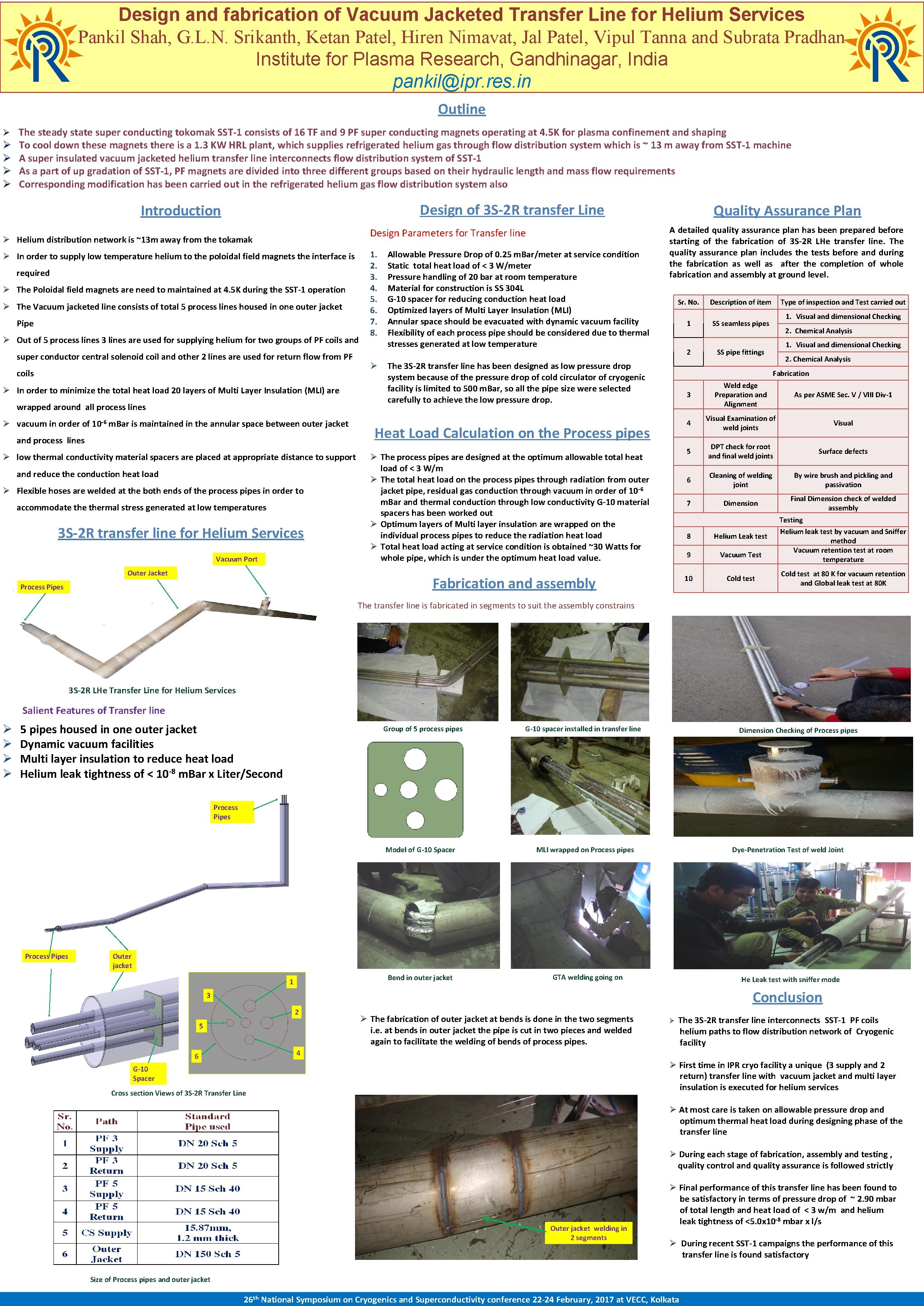
Design and fabrication of Vacuum Jacketed Transfer Line for Helium Services Pankil Shah, G. L. N. Srikanth, Ketan Patel, Hiren Nimavat, Jal Patel, Vipul Tanna and Subrata Pradhan Institute for Plasma Research, Gandhinagar, India pankil@ipr. res. in Outline Ø The steady state super conducting tokomak SST-1 consists of 16 TF and 9 PF super conducting magnets operating at 4. 5 K for plasma confinement and shaping Ø Ø To cool down these magnets there is a 1. 3 KW HRL plant, which supplies refrigerated helium gas through flow distribution system which is ~ 13 m away from SST-1 machine A super insulated vacuum jacketed helium transfer line interconnects flow distribution system of SST-1 As a part of up gradation of SST-1, PF magnets are divided into three different groups based on their hydraulic length and mass flow requirements Corresponding modification has been carried out in the refrigerated helium gas flow distribution system also Design of 3 S-2 R transfer Line Introduction Design Parameters for Transfer line Ø Helium distribution network is ~13 m away from the tokamak Ø In order to supply low temperature helium to the poloidal field magnets the interface is required Ø The Poloidal field magnets are need to maintained at 4. 5 K during the SST-1 operation Ø The Vacuum jacketed line consists of total 5 process lines housed in one outer jacket Pipe Ø Out of 5 process lines 3 lines are used for supplying helium for two groups of PF coils and super conductor central solenoid coil and other 2 lines are used for return flow from PF coils Ø In order to minimize the total heat load 20 layers of Multi Layer Insulation (MLI) are wrapped around all process lines Ø vacuum in order of 10 -6 m. Bar is maintained in the annular space between outer jacket and process lines Ø low thermal conductivity material spacers are placed at appropriate distance to support and reduce the conduction heat load Ø Flexible hoses are welded at the both ends of the process pipes in order to accommodate thermal stress generated at low temperatures 3 S-2 R transfer line for Helium Services Vacuum Port Outer Jacket 1. 2. 3. 4. 5. 6. 7. 8. Ø Allowable Pressure Drop of 0. 25 m. Bar/meter at service condition Static total heat load of < 3 W/meter Pressure handling of 20 bar at room temperature Material for construction is SS 304 L G-10 spacer for reducing conduction heat load Optimized layers of Multi Layer Insulation (MLI) Annular space should be evacuated with dynamic vacuum facility Flexibility of each process pipe should be considered due to thermal stresses generated at low temperature Quality Assurance Plan A detailed quality assurance plan has been prepared before starting of the fabrication of 3 S-2 R LHe transfer line. The quality assurance plan includes the tests before and during the fabrication as well as after the completion of whole fabrication and assembly at ground level. Sr. No. 1 2 The 3 S-2 R transfer line has been designed as low pressure drop system because of the pressure drop of cold circulator of cryogenic facility is limited to 500 m. Bar, so all the pipe size were selected carefully to achieve the low pressure drop. Type of inspection and Test carried out 1. Visual and dimensional Checking SS seamless pipes 2. Chemical Analysis 1. Visual and dimensional Checking SS pipe fittings 2. Chemical Analysis Fabrication Heat Load Calculation on the Process pipes Ø The process pipes are designed at the optimum allowable total heat load of < 3 W/m Ø The total heat load on the process pipes through radiation from outer jacket pipe, residual gas conduction through vacuum in order of 10 -6 m. Bar and thermal conduction through low conductivity G-10 material spacers has been worked out Ø Optimum layers of Multi layer insulation are wrapped on the individual process pipes to reduce the radiation heat load Ø Total heat load acting at service condition is obtained ~30 Watts for whole pipe, which is under the optimum heat load value. 3 Weld edge Preparation and Alignment As per ASME Sec. V / VIII Div-1 4 Visual Examination of weld joints Visual 5 DPT check for root and final weld joints Surface defects 6 Cleaning of welding joint By wire brush and pickling and passivation 7 Dimension Final Dimension check of welded assembly Testing Fabrication and assembly Process Pipes Description of item 8 Helium Leak test 9 Vacuum Test 10 Cold test Helium leak test by vacuum and Sniffer method Vacuum retention test at room temperature Cold test at 80 K for vacuum retention and Global leak test at 80 K The transfer line is fabricated in segments to suit the assembly constrains 3 S-2 R LHe Transfer Line for Helium Services Salient Features of Transfer line Ø Ø 5 pipes housed in one outer jacket Dynamic vacuum facilities Multi layer insulation to reduce heat load Helium leak tightness of < 10 -8 m. Bar x Liter/Second Group of 5 process pipes G-10 spacer installed in transfer line Dimension Checking of Process pipes Process Model of 3 S-2 R transfer Line Pipes Model of G-10 Spacer Process Pipes MLI wrapped on Process pipes Dye-Penetration Test of weld Joint Outer jacket Bend in outer jacket 1 GTA welding going on He Leak test with sniffer mode Conclusion 3 2 5 Ø The fabrication of outer jacket at bends is done in the two segments i. e. at bends in outer jacket the pipe is cut in two pieces and welded again to facilitate the welding of bends of process pipes. Ø The 3 S-2 R transfer line interconnects SST-1 PF coils helium paths to flow distribution network of Cryogenic facility 4 6 Ø First time in IPR cryo facility a unique (3 supply and 2 return) transfer line with vacuum jacket and multi layer insulation is executed for helium services G-10 Spacer Cross section Views of 3 S-2 R Transfer Line Ø At most care is taken on allowable pressure drop and optimum thermal heat load during designing phase of the transfer line Ø During each stage of fabrication, assembly and testing , quality control and quality assurance is followed strictly Outer jacket welding in 2 segments Ø Final performance of this transfer line has been found to be satisfactory in terms of pressure drop of ~ 2. 90 mbar of total length and heat load of < 3 w/m and helium leak tightness of <5. 0 x 10 -8 mbar x l/s Ø During recent SST-1 campaigns the performance of this transfer line is found satisfactory Size of Process pipes and outer jacket 26 th National Symposium on Cryogenics and Superconductivity conference 22 -24 February, 2017 at VECC, Kolkata
- Slides: 1