
Design and Evaluation of Flow Mapping Systems for
![Methodology – Network Models II ● Fading Model [Kelif 2014] J. Kelif, S. Senecal,](https://slidetodoc.com/presentation_image_h2/be3bb3967a0ae7a857d02f7ae35a3d68/image-7.jpg "Methodology – Network Models II ● Fading Model [Kelif 2014] J. Kelif, S. Senecal,")
![Reference • [1] Rajesh Mahindra, Hari Viswanathan, Karthik Sundaresan, Mustafa Y. Arslan, and Sampath](https://slidetodoc.com/presentation_image_h2/be3bb3967a0ae7a857d02f7ae35a3d68/image-33.jpg "Reference • [1] Rajesh Mahindra, Hari Viswanathan, Karthik Sundaresan, Mustafa Y. Arslan, and Sampath")
- Slides: 41
Design and Evaluation of Flow Mapping Systems for Heterogeneous Wireless Networks Jianwei Liu
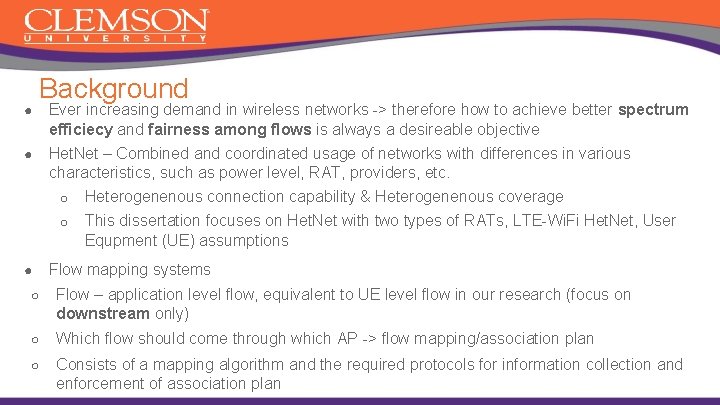
● Background ● ● Ever increasing demand in wireless networks -> therefore how to achieve better spectrum efficiecy and fairness among flows is always a desireable objective Het. Net – Combined and coordinated usage of networks with differences in various characteristics, such as power level, RAT, providers, etc. o Heterogenenous connection capability & Heterogenenous coverage o This dissertation focuses on Het. Net with two types of RATs, LTE-Wi. Fi Het. Net, User Equpment (UE) assumptions Flow mapping systems ○ Flow – application level flow, equivalent to UE level flow in our research (focus on downstream only) ○ Which flow should come through which AP -> flow mapping/association plan ○ Consists of a mapping algorithm and the required protocols for information collection and enforcement of association plan
● Flow Mapping Systems in Use and in Literature Three types of Flow Mapping Systems o Local Information based Flow Mapping Systems (LIFMS) – local policy based, e. g. connect to the Wi. Fi AP with the strongest signal strength; do not switch until it breaks o Global Information based Flow Mapping Systems (GIFMS) – a conceptually centralized scheduling server, e. g. [Mahindra 2014], [Bu 2006] o Semi-GIFMS – use AP level information, e. g. Event-based greedy algorithm in [Bu 2006], Distributed algorithm in [Ye 2009] [Bu 2006] T. Bu, L. Li, and R. Ramjee. Generalized proportional fair scheduling in third generation wireless data networks. In Proc. of INFOCOM, 2006. [Mahindra 2014] R. Mahindra, H. Viswanathan, etc. A practical traffic management system for integrated lte-wifi networks. In Proc. of Mobi. Com, pages 189 -200. ACM, 2014. [Ye 2013] Q. Ye, J. G. Andrews, etc. User association for load balancing in heterogeneous cellular networks. , IEEE Transactions on Wireless Communications, 12(6): 2706 -2716, June 2013. ● GIFMS and S-GIFMS have explicit objective (system level, AP level); LIFMS -> no ● Common objectives in GIFMS and S-GIFMS literature -> Generalized Proportional Fairness
Research Motivation & Objective ● Problem: The mapping systems proposed which optimize GPF for Het. Nets in the three types of Flow Mapping Systems are not evaluated and compared with similar settings and the optimal with various system parametes. Therefore, difficult to answer – “whether it is worthwhile constructing a GIFMS or S-GIFMS for Het. Nets under various scenarios” ● Objective: - Evaluation - Tradeoff Discussion(performance, enforced handovers, control overhead)
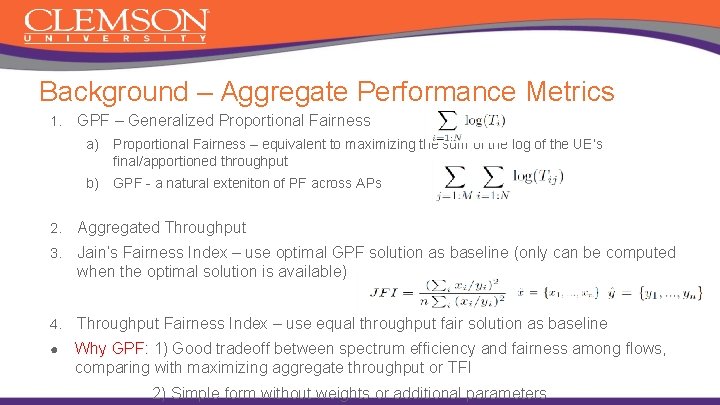
Background – Aggregate Performance Metrics 1. GPF – Generalized Proportional Fairness a) Proportional Fairness – equivalent to maximizing the sum of the log of the UE’s final/apportioned throughput b) GPF - a natural exteniton of PF across APs 2. Aggregated Throughput 3. Jain’s Fairness Index – use optimal GPF solution as baseline (only can be computed when the optimal solution is available) 4. Throughput Fairness Index – use equal throughput fair solution as baseline ● Why GPF: 1) Good tradeoff between spectrum efficiency and fairness among flows, comparing with maximizing aggregate throughput or TFI 2) Simple form without weights or additional parameters
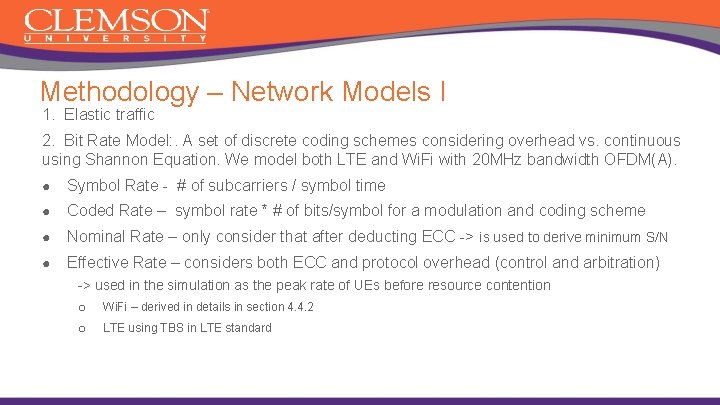
Methodology – Network Models I 1. Elastic traffic 2. Bit Rate Model: . A set of discrete coding schemes considering overhead vs. continuous using Shannon Equation. We model both LTE and Wi. Fi with 20 MHz bandwidth OFDM(A). ● Symbol Rate - # of subcarriers / symbol time ● Coded Rate – symbol rate * # of bits/symbol for a modulation and coding scheme ● Nominal Rate – only consider that after deducting ECC -> is used to derive minimum S/N ● Effective Rate – considers both ECC and protocol overhead (control and arbitration) -> used in the simulation as the peak rate of UEs before resource contention o Wi. Fi – derived in details in section 4. 4. 2 o LTE using TBS in LTE standard
Methodology – Network Models II ● Fading Model [Kelif 2014] J. Kelif, S. Senecal, etc. Analytical performance model for poisson wireless networks with pathloss and shadowing propagation. In 2014 IEEE Globecom, 2014. ● Distance to MCS index – S/N -> MCS index ● If S/N = 31 index =2
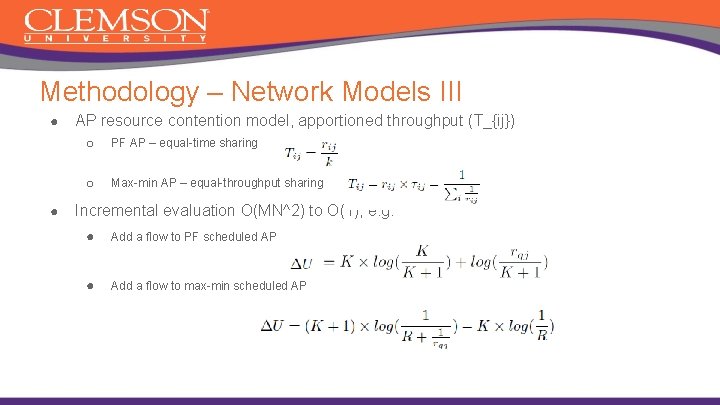
Methodology – Network Models III ● ● AP resource contention model, apportioned throughput (T_{ij}) o PF AP – equal-time sharing o Max-min AP – equal-throughput sharing Incremental evaluation O(MN^2) to O(1), e. g. ● Add a flow to PF scheduled AP ● Add a flow to max-min scheduled AP
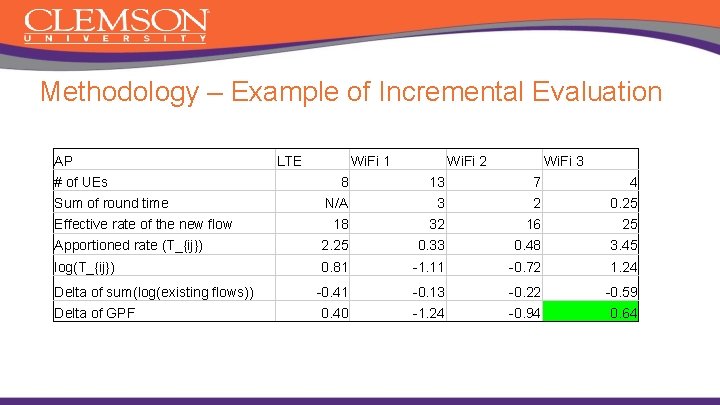
Methodology – Example of Incremental Evaluation AP # of UEs LTE Wi. Fi 1 Wi. Fi 2 Wi. Fi 3 8 13 7 4 N/A 3 2 0. 25 18 32 16 25 Apportioned rate (T_{ij}) 2. 25 0. 33 0. 48 3. 45 log(T_{ij}) 0. 81 -1. 11 -0. 72 1. 24 -0. 41 -0. 13 -0. 22 -0. 59 0. 40 -1. 24 -0. 94 0. 64 Sum of round time Effective rate of the new flow Delta of sum(log(existing flows)) Delta of GPF
Methodology – Static vs. Dynamic Simulations ● Static - replacement of all UEs at each step, can be considered as periodically global remapping ● Dynamic – event driven, {on/off event, mobility event, timer event}, o Certain event can trigger remapping, in our evaluation only on event
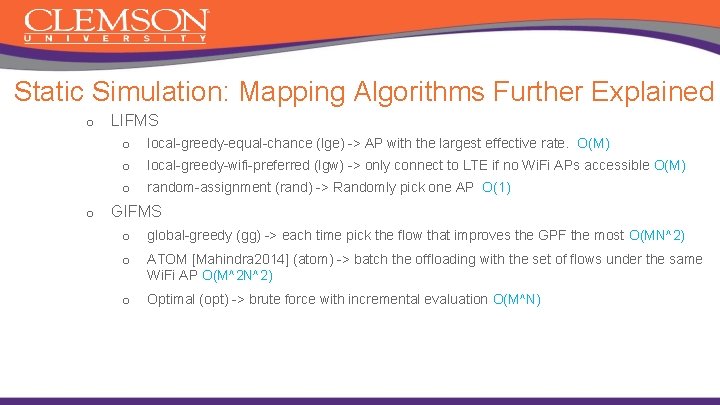
Static Simulation: Mapping Algorithms Further Explained o o LIFMS o local-greedy-equal-chance (lge) -> AP with the largest effective rate. O(M) o local-greedy-wifi-preferred (lgw) -> only connect to LTE if no Wi. Fi APs accessible O(M) o random-assignment (rand) -> Randomly pick one AP O(1) GIFMS o global-greedy (gg) -> each time pick the flow that improves the GPF the most O(MN^2) o ATOM [Mahindra 2014] (atom) -> batch the offloading with the set of flows under the same Wi. Fi AP O(M^2 N^2) o Optimal (opt) -> brute force with incremental evaluation O(M^N)
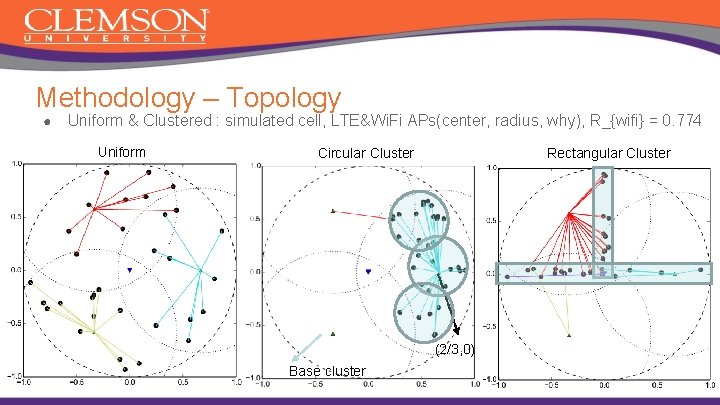
Methodology – Topology ● Uniform & Clustered : simulated cell, LTE&Wi. Fi APs(center, radius, why), R_{wifi} = 0. 774 Uniform Rectangular Cluster Circular Cluster (2/3, 0) Base cluster
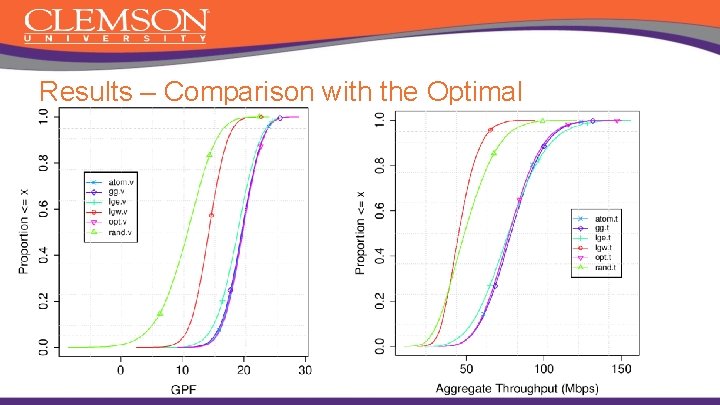
Results – Comparison with the Optimal ● This is conducted in the static simulation with small number of UE, N=12; # of runs=16384, with uniform UE topology ● Flow mapping systems to evaluate: All listed in the previous slides
Results – Comparison with the Optimal
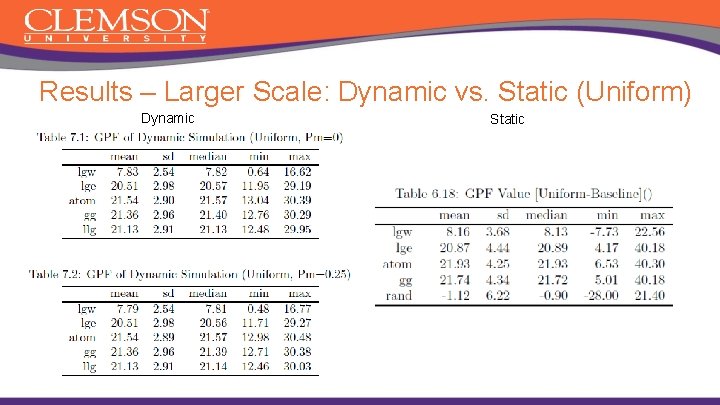
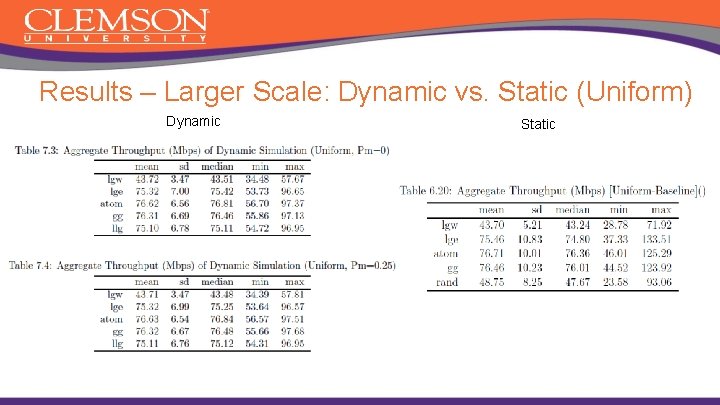
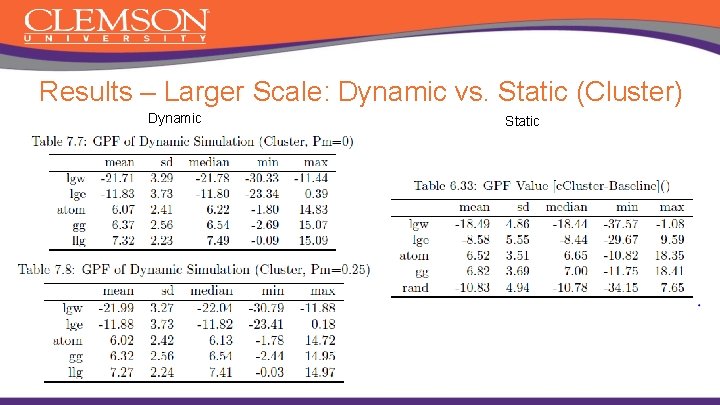
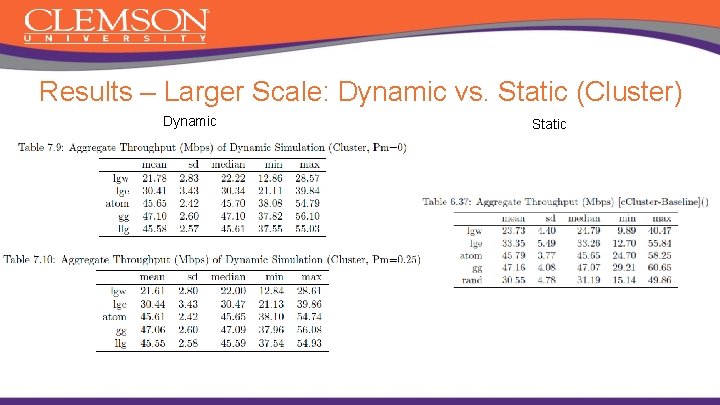
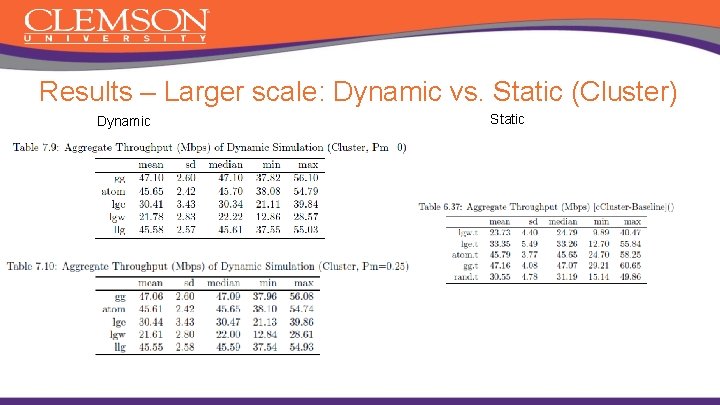
Larger Scale: Static vs. Dynamic Simulation ● Static: N = 32, still 16384 runs ● Dynamic: {on/off event, mobility event}, only remap at on events o o o ● N=64, # of runs=1250, each run has 32768 events On/off exponential distribution, both with a mean of 1 nominal time unit Mobility is modelled using a Bernoulli process (if rand < P then move), will show results with P = 1/4 load-aware local greedy (llg) [AP level, event triggered] O(M) o o Will not remap all the UEs as GIFMS, therefore eliminate enforced handovers. It optimizes the GPF objective with the constraint of not moving existing flows.
Results – Larger Scale: Dynamic vs. Static (Uniform) Dynamic Static
Results – Larger Scale: Dynamic vs. Static (Uniform) Dynamic Static
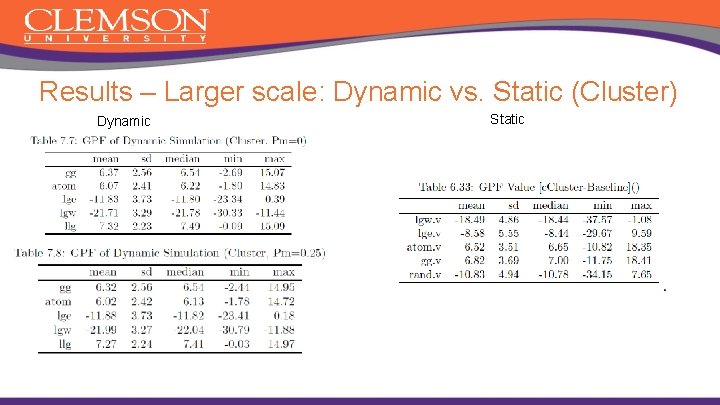
Results – Larger Scale: Dynamic vs. Static (Cluster) Dynamic Static
Results – Larger Scale: Dynamic vs. Static (Cluster) Dynamic Static
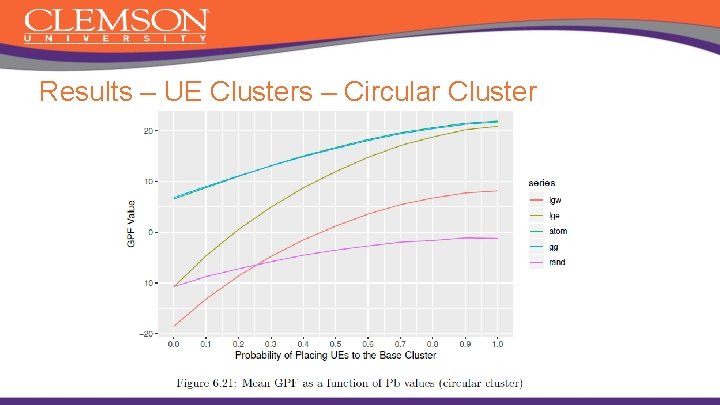
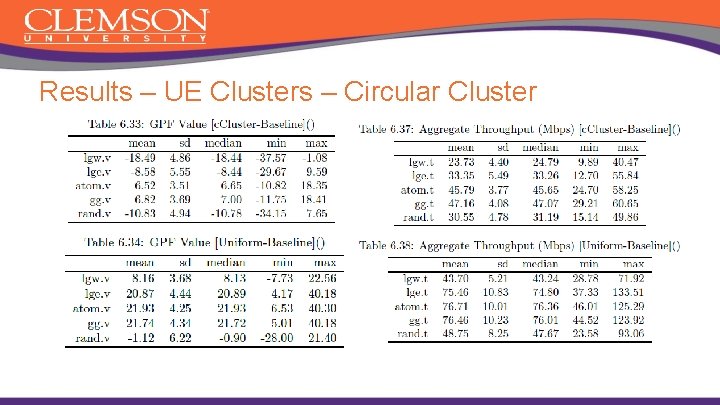
Results – UE Clusters – Circular Cluster
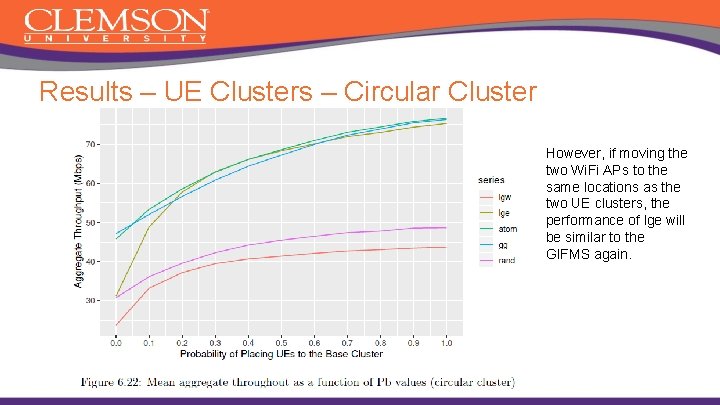
Results – UE Clusters – Circular Cluster However, if moving the two Wi. Fi APs to the same locations as the two UE clusters, the performance of lge will be similar to the GIFMS again.
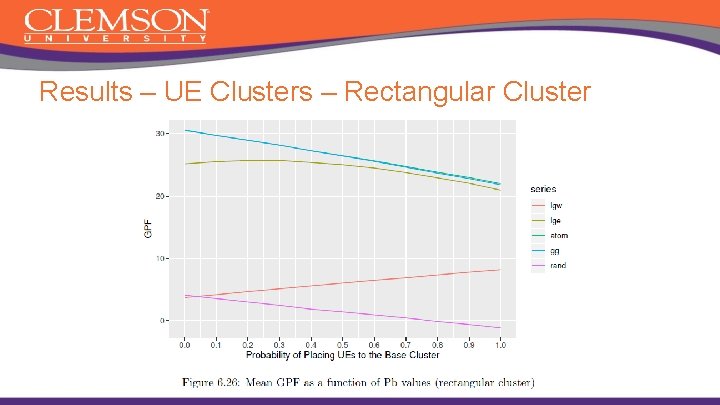
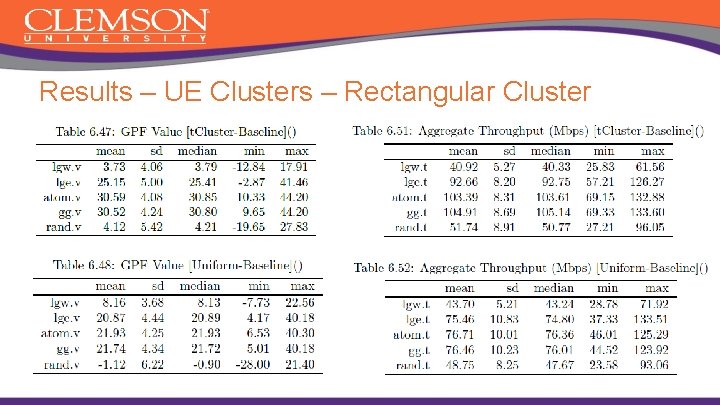
Results – UE Clusters – Rectangular Cluster
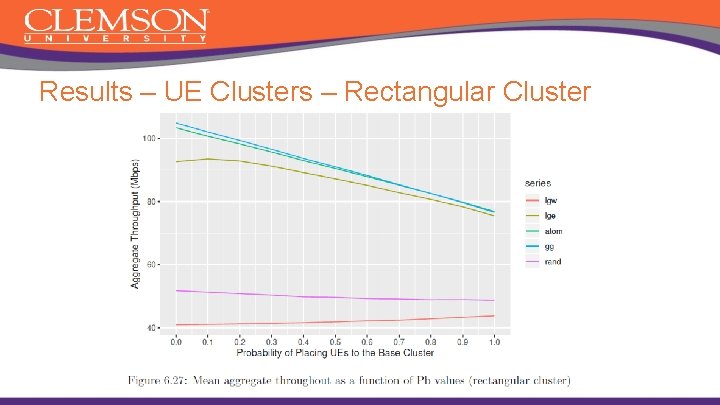
Results – UE Clusters – Rectangular Cluster
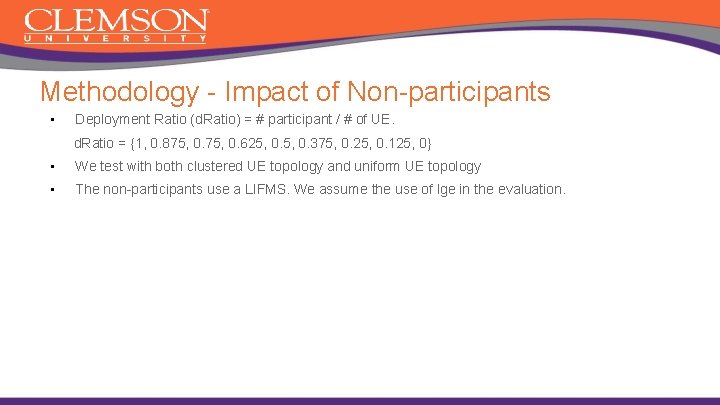
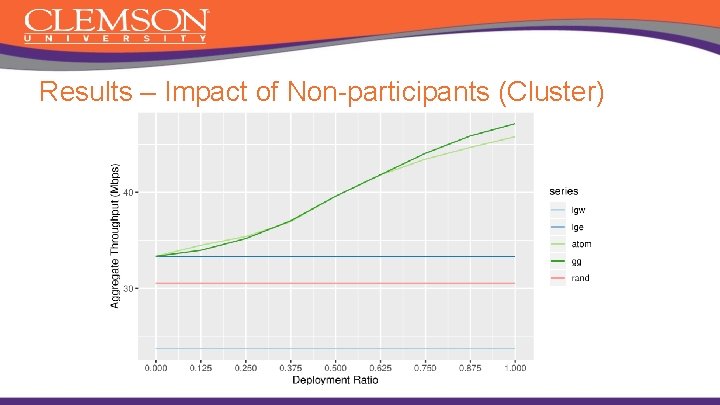
Methodology - Impact of Non-participants • Deployment Ratio (d. Ratio) = # participant / # of UE. d. Ratio = {1, 0. 875, 0. 625, 0. 375, 0. 25, 0. 125, 0} • We test with both clustered UE topology and uniform UE topology • The non-participants use a LIFMS. We assume the use of lge in the evaluation.
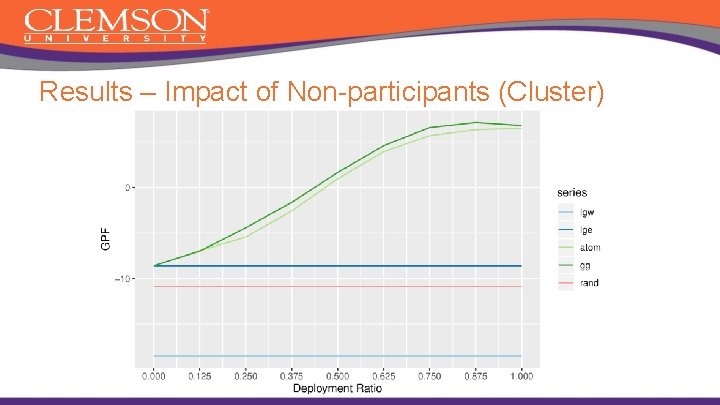
Results – Impact of Non-participants (Cluster)
Results – Impact of Non-participants (Cluster)
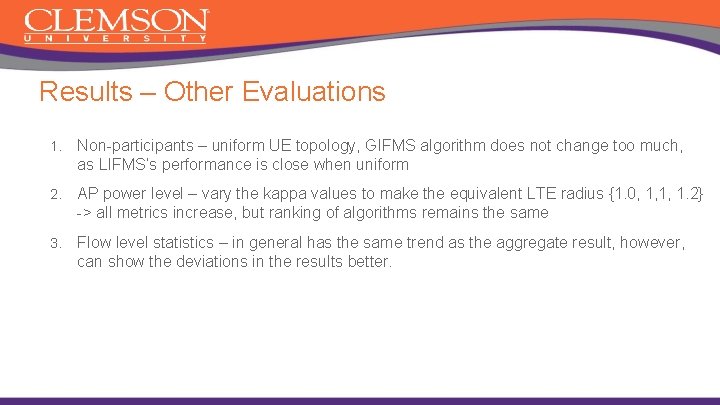
Results – Other Evaluations 1. Non-participants – uniform UE topology, GIFMS algorithm does not change too much, as LIFMS’s performance is close when uniform 2. AP power level – vary the kappa values to make the equivalent LTE radius {1. 0, 1, 1, 1. 2} -> all metrics increase, but ranking of algorithms remains the same 3. Flow level statistics – in general has the same trend as the aggregate result, however, can show the deviations in the results better.
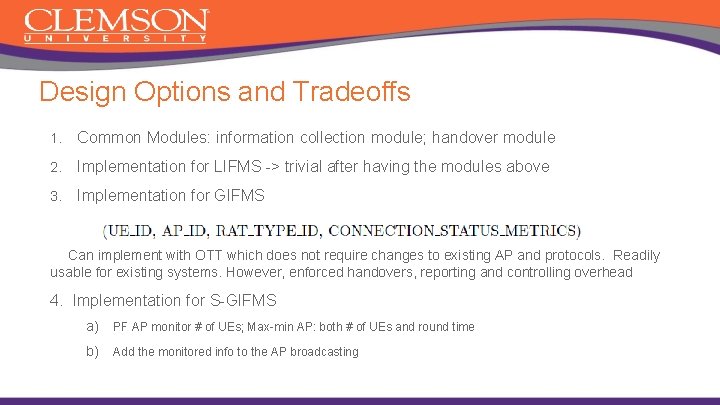
Design Options and Tradeoffs 1. Common Modules: information collection module; handover module 2. Implementation for LIFMS -> trivial after having the modules above 3. Implementation for GIFMS Can implement with OTT which does not require changes to existing AP and protocols. Readily usable for existing systems. However, enforced handovers, reporting and controlling overhead 4. Implementation for S-GIFMS a) PF AP monitor # of UEs; Max-min AP: both # of UEs and round time b) Add the monitored info to the AP broadcasting
Conclusion • Currently-in-use Wi. Fi preferred local-greedy is far worse than the other mapping algorithms, which means there is a large room for improvement. • lge is close to GIFMS algorithms when UEs are distributed evenly relative to AP locations. However, significantly worse than GIFMS under scenarios that can introduce extreme load imbalance • GIFMS has more consistent system improvement over various system settings comparing with LIFMS; low deploy ratio can also have benefits; benefit is linear to deploy ratio. • S-GIFMS or llg, if APs can be modified to monitor the required information and broadcast them, has similar or sometimes better performance than the GIFMS algorithms while having no enforced handover and low overhead (information collection & control). Guide for minimum information for next generation Het. Nets. • System parameters like AP power levels, Wi. Fi using PF, can boost the overall system performance in terms of both GPF and aggregate throughput. However, the relative difference between the three types of flow mapping systems will not change. • Tested on-off dynamics and mobility patterns do not have major impacts to performance
Future Directions • To use other types of fairness as the objective; • To use non-elastic traffic; • To evaluate the cases when flow splitting is allowed; • To evaluate systems with MIMO; • To evaluate systems with channel bonding or carrier aggregation; • To evaluate the impact of increasing level of upstream traffic; • To evaluate the impact of various on-off session dynamics to the UE reassertion policies for llg; • To evaluate the impact of not-fully-synced information as the GIFMS becomes more distributed.
Acknowledgement • Thanks for all the committee members • Thanks for other students and postdoc in the lab: Anjan, Manveen, Kang, etc. • Thanks for the support from my family • Thanks for the support from the colleagues from Ship. Chain
Thanks!
Reference • [1] Rajesh Mahindra, Hari Viswanathan, Karthik Sundaresan, Mustafa Y. Arslan, and Sampath Rangarajan. A practical trac management system for integrated lte-wifi networks. In Proc. of Mobi. Com, pages 189 -200. ACM, 2014. • [2] T. Bu, Li Li, and R. Ramjee. Generalized proportional fair scheduling in third generation wireless data networks. In Proc. of INFOCOM, pages 1 -12, April 2006. • [3] Jean-Marc Kelif, Stephane Senecal, Marceau Coupechoux, and Constant Bridon. Analytical performance model for poisson wireless networks with pathloss and shadowing propagation. In 2014 IEEE Globecom Workshopsp, ages 1528 -1532. IEEE, 2014. • [4] Qiaoyang Ye, Beiyu Rong, Yudong Chen, M. Al-Shalash, C. Caramanis, and J. G. Andrews. User association for load balancing in heterogeneous cellular networks. Wireless Communications, IEEE Transactions on, 12(6): 2706 -2716, June 2013.
Flow level results Among the 16 K run, the proportion of runs that one flow gets better performance than that achieved by a baseline algorithm.
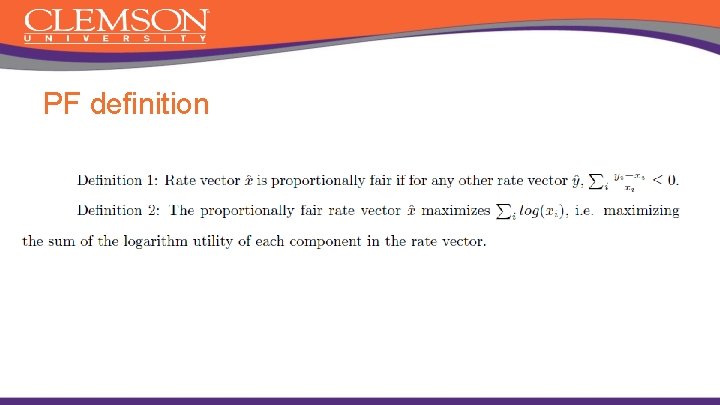
PF definition
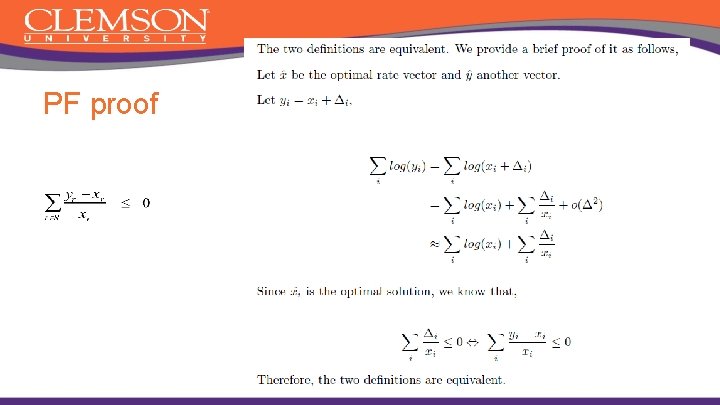
PF proof
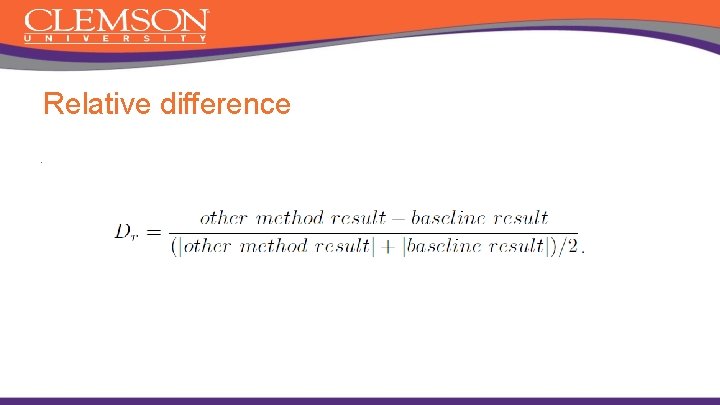
Relative difference.
Results – Larger scale: Dynamic vs. Static (Cluster) Dynamic Static
Results – Larger scale: Dynamic vs. Static (Cluster) Dynamic Static
Results – UE Clusters – Circular Cluster
Results – UE Clusters – Rectangular Cluster