
Design and Calculation of a Magnetic Field Probe
Design and Calculation of a Magnetic Field Probe for Half-Wave Resonators Nathan Prins Supervisor: Dr. Zachary Conway Physics Division, Argonne National Laboratory August 6 th, 2015
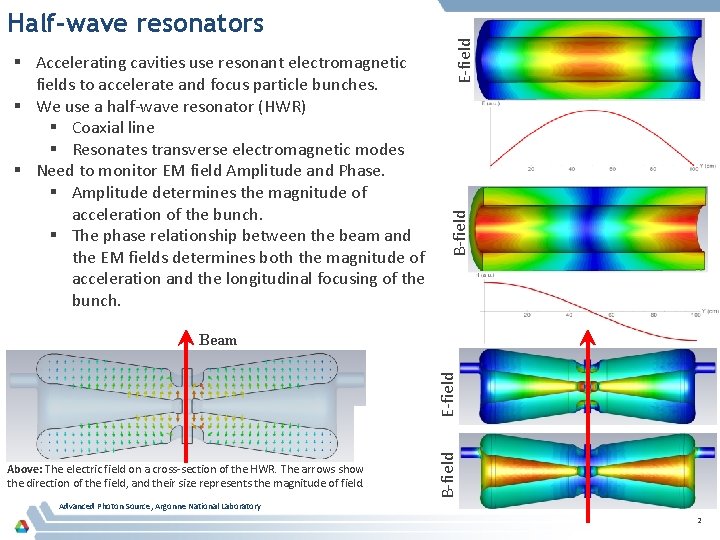
E-field § Accelerating cavities use resonant electromagnetic fields to accelerate and focus particle bunches. § We use a half-wave resonator (HWR) § Coaxial line § Resonates transverse electromagnetic modes § Need to monitor EM field Amplitude and Phase. § Amplitude determines the magnitude of acceleration of the bunch. § The phase relationship between the beam and the EM fields determines both the magnitude of acceleration and the longitudinal focusing of the bunch. B-field Half-wave resonators Above: The electric field on a cross-section of the HWR. The arrows show the direction of the field, and their size represents the magnitude of field. B-field E-field Beam Advanced Photon Source, Argonne National Laboratory 2
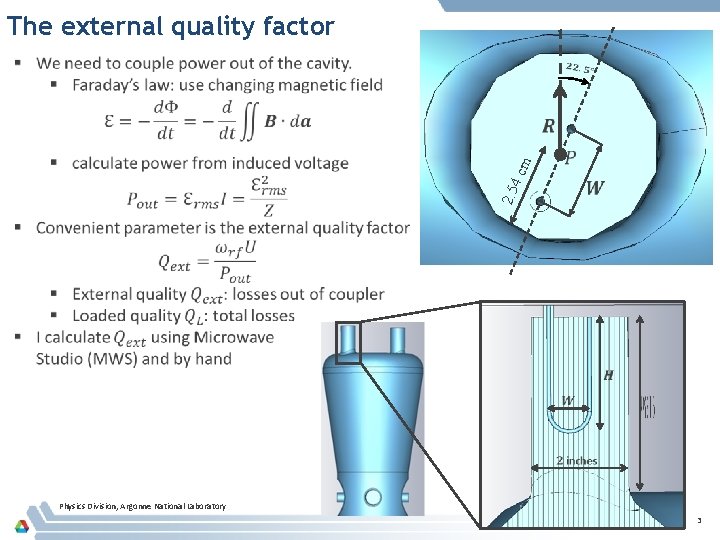
2. 5 4 cm The external quality factor Physics Division, Argonne National Laboratory 3
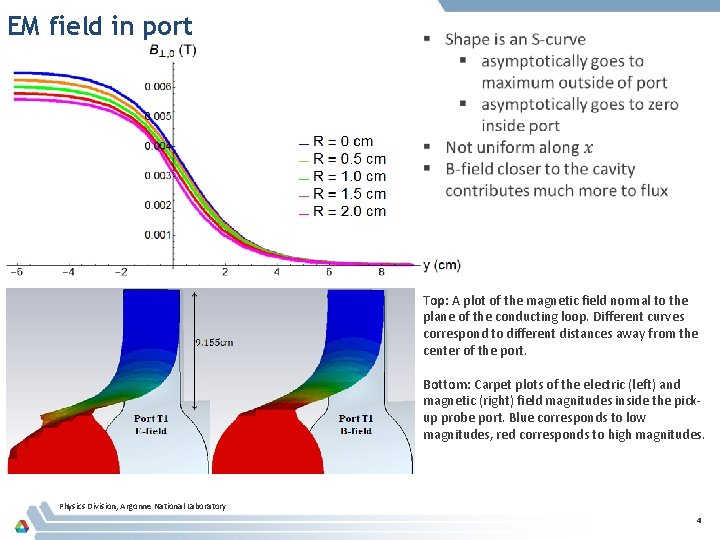
EM field in port Top: A plot of the magnetic field normal to the plane of the conducting loop. Different curves correspond to different distances away from the center of the port. Bottom: Carpet plots of the electric (left) and magnetic (right) field magnitudes inside the pickup probe port. Blue corresponds to low magnitudes, red corresponds to high magnitudes. Physics Division, Argonne National Laboratory 4
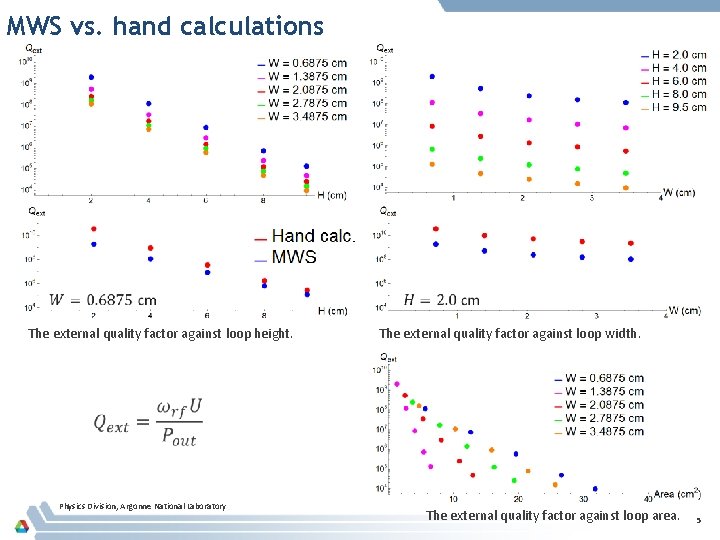
MWS vs. hand calculations The external quality factor against loop height. Physics Division, Argonne National Laboratory The external quality factor against loop width. The external quality factor against loop area. 5
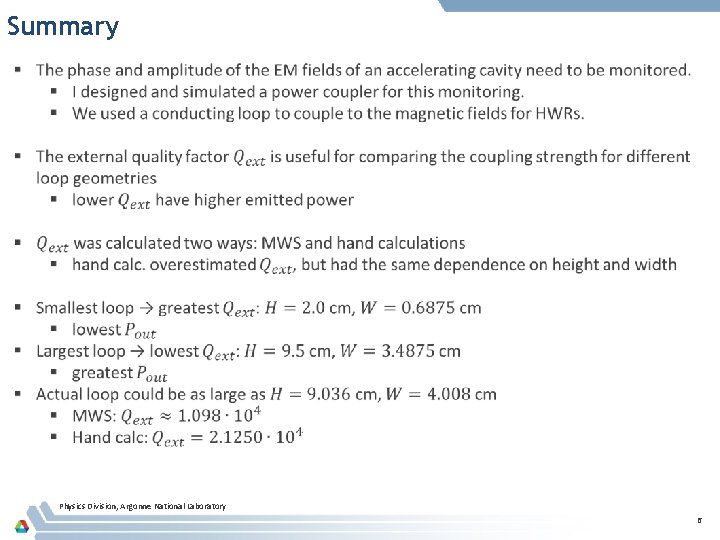
Summary Physics Division, Argonne National Laboratory 6
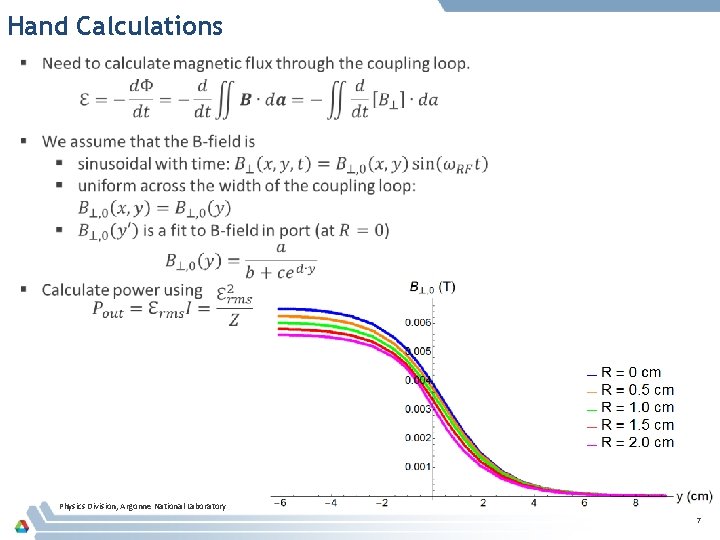
Hand Calculations Physics Division, Argonne National Laboratory 7
- Slides: 7