
Design and Analysis of Double Sided Linear Induction
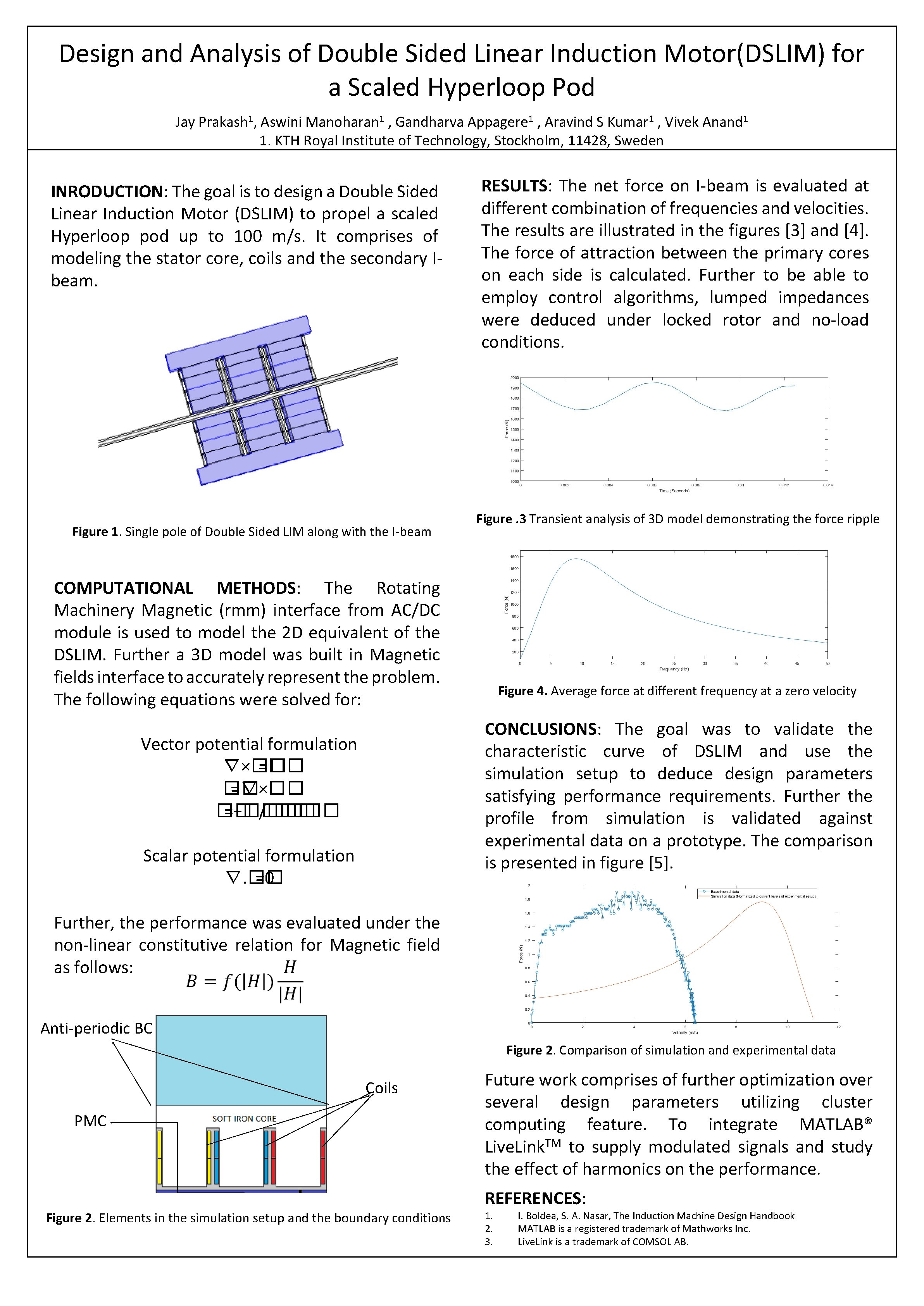
Design and Analysis of Double Sided Linear Induction Motor(DSLIM) for a Scaled Hyperloop Pod Jay Prakash 1, Aswini Manoharan 1 , Gandharva Appagere 1 , Aravind S Kumar 1 , Vivek Anand 1 1. KTH Royal Institute of Technology, Stockholm, 11428, Sweden INRODUCTION: The goal is to design a Double Sided Linear Induction Motor (DSLIM) to propel a scaled Hyperloop pod up to 100 m/s. It comprises of modeling the stator core, coils and the secondary Ibeam. Figure 1. Single pole of Double Sided LIM along with the I-beam RESULTS: The net force on I-beam is evaluated at different combination of frequencies and velocities. The results are illustrated in the figures [3] and [4]. The force of attraction between the primary cores on each side is calculated. Further to be able to employ control algorithms, lumped impedances were deduced under locked rotor and no-load conditions. Figure. 3 Transient analysis of 3 D model demonstrating the force ripple COMPUTATIONAL METHODS: The Rotating Machinery Magnetic (rmm) interface from AC/DC module is used to model the 2 D equivalent of the DSLIM. Further a 3 D model was built in Magnetic fields interface to accurately represent the problem. The following equations were solved for: Figure 4. Average force at different frequency at a zero velocity CONCLUSIONS: The goal was to validate the characteristic curve of DSLIM and use the simulation setup to deduce design parameters satisfying performance requirements. Further the profile from simulation is validated against experimental data on a prototype. The comparison is presented in figure [5]. Vector potential formulation ∇×�� =�� �� =∇×�� �� =−���� /���� Scalar potential formulation ∇. �� =0 Further, the performance was evaluated under the non-linear constitutive relation for Magnetic field as follows: Anti-periodic BC Figure 2. Comparison of simulation and experimental data Coils PMC Figure 2. Elements in the simulation setup and the boundary conditions Future work comprises of further optimization over several design parameters utilizing cluster computing feature. To integrate MATLAB® TM Live. Link to supply modulated signals and study the effect of harmonics on the performance. REFERENCES: 1. 2. 3. I. Boldea, S. A. Nasar, The Induction Machine Design Handbook MATLAB is a registered trademark of Mathworks Inc. Live. Link is a trademark of COMSOL AB.
- Slides: 1