
Design Alternatives for SAS The Beauty of Mobile
Design Alternatives for SAS: The Beauty of Mobile Homes CS 258, Spring 99 David E. Culler Computer Science Division U. C. Berkeley CS 258 S 99
Some Questions you might ask • Can all unnecessary communication be eliminated? – capacity-related communication? – false-sharing? • How much hardware support can be eliminated? • Can weak consistency models be exploited to reduce communication? • Can we simplify hardware coherence mechanisms while avoiding capacity-related communication? 12/19/2021 CS 258 S 99 2
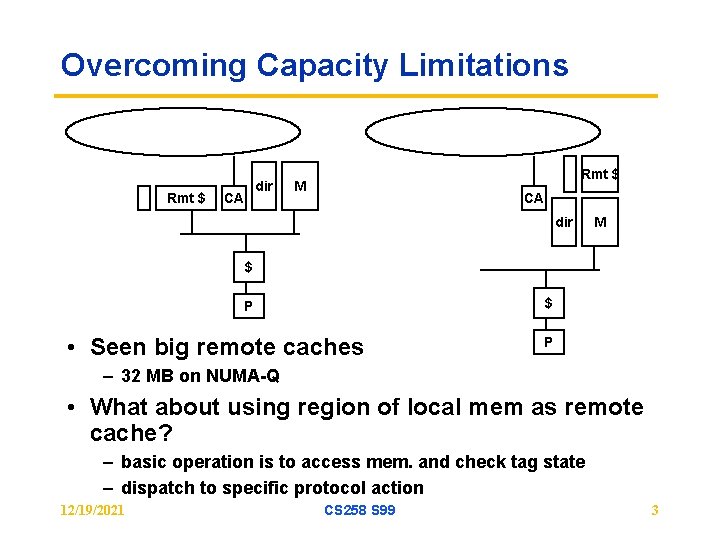
Overcoming Capacity Limitations Rmt $ dir CA Rmt $ M CA dir M $ $ P • Seen big remote caches P – 32 MB on NUMA-Q • What about using region of local mem as remote cache? – basic operation is to access mem. and check tag state – dispatch to specific protocol action 12/19/2021 CS 258 S 99 3
Well? • Does it eliminate communication on capacity misses? • How much of memory is wasted? • Do we need a home memory at all? 12/19/2021 CS 258 S 99 4
Cache-Only Memory Arch (COMA) • View entire local memory as ‘attraction memory’ • Associate tag with every memory block • Whenever a block as access and brought into cache, also bring it into local AMem. – keep cache consistent with AMem – keep Amem’s consistent • Location decoupled from physical address • What new issues arise? • Recall: basic components – find state information – find copies – communication with copies 12/19/2021 CS 258 S 99 5
Finding a block on a miss? • Hierarchical Snooping COMA? • Hierarchical Directory COMA? • Flat Directory COMA? 12/19/2021 CS 258 S 99 6
Last Copy Replacement Problem • How to avoid discarding the only copy of a block? • Hierarchical? • Flat? 12/19/2021 CS 258 S 99 7
Hardware/Software Tradeoffs? • What aspects of SW are simplified? • What extra HW support is required? – memory tags and comparators – memory for replication • Why is HW support more complicated? – discover location on miss – no space preallocated 12/19/2021 CS 258 S 99 8
Performance Trade-Offs • Artrifactual Communiation? • Remote access latency? • Local memory access latency? 12/19/2021 CS 258 S 99 9
Which access patterns win/lose • Miss rate low? • Miss rate ~low – mostly coherence misses » true sharing » false sharing – mostly capacity misses or poor initial data placement » course grained • blocking » fine grained • unpredictable 12/19/2021 CS 258 S 99 10
Plenty of replication memory • Why is it important for performance? 12/19/2021 CS 258 S 99 11
Hardware support • Four fundamental components of the comm assist – – access control checks per-block tags and state used in the check protocol processing network interface • Case for tight integration – access control check must see every load/store miss to shared data – requires checking per mem. block tag – protocol processing involves update cache/dir state – move small data items to/from NI • Case against – L 1 and L 2 cache controller’s on chip, closest you can get is the memory controller 12/19/2021 CS 258 S 99 12
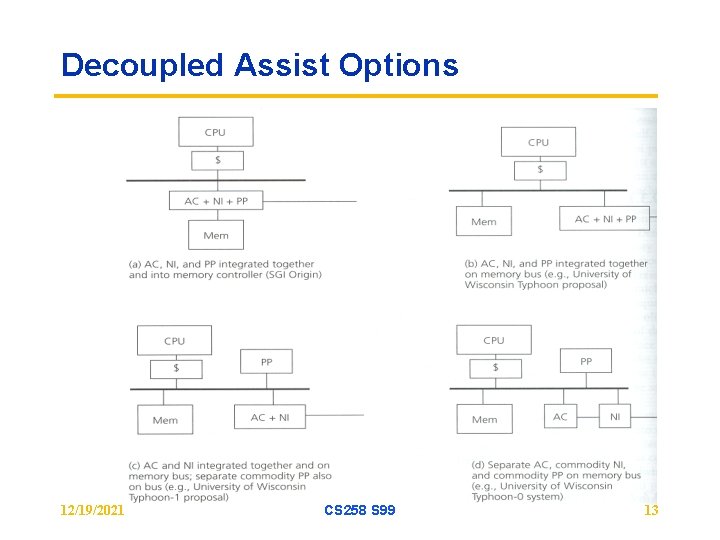
Decoupled Assist Options 12/19/2021 CS 258 S 99 13
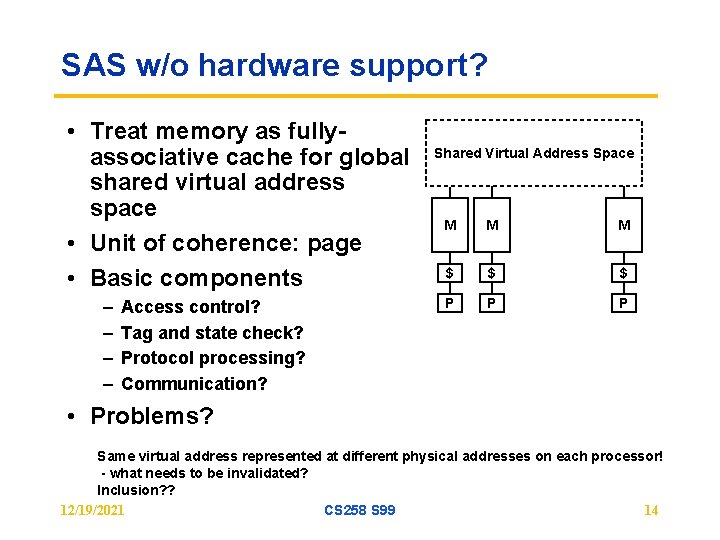
SAS w/o hardware support? • Treat memory as fullyassociative cache for global shared virtual address space • Unit of coherence: page • Basic components – – Access control? Tag and state check? Protocol processing? Communication? Shared Virtual Address Space M M M $ $ $ P P P • Problems? Same virtual address represented at different physical addresses on each processor! - what needs to be invalidated? Inclusion? ? 12/19/2021 14 CS 258 S 99
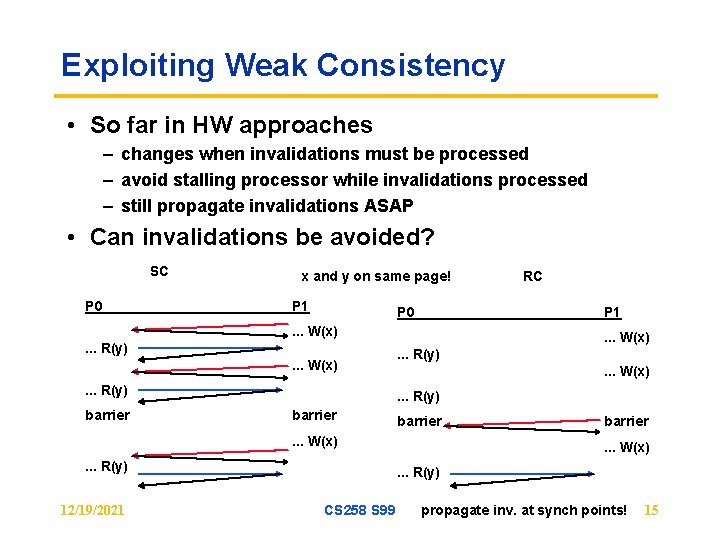
Exploiting Weak Consistency • So far in HW approaches – changes when invalidations must be processed – avoid stalling processor while invalidations processed – still propagate invalidations ASAP • Can invalidations be avoided? SC P 0 x and y on same page! P 1 P 0 P 1 . . . W(x). . . R(y) barrier . . . W(x). . . R(y) 12/19/2021 RC barrier. . . W(x) . . . R(y) CS 258 S 99 propagate inv. at synch points! 15
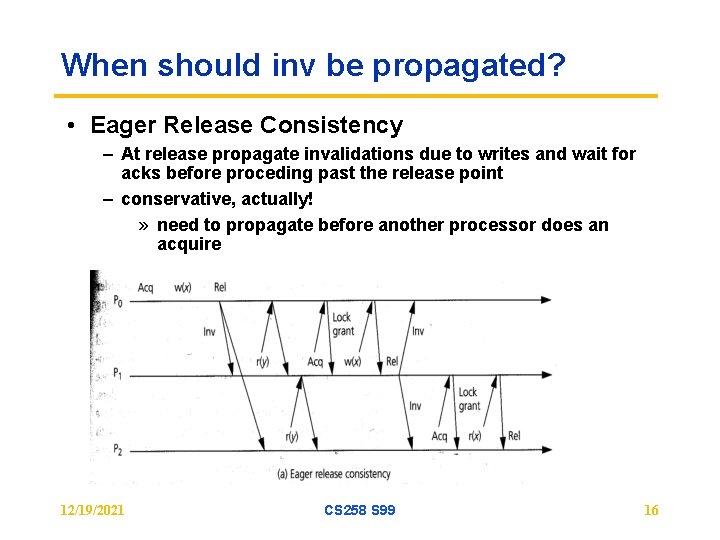
When should inv be propagated? • Eager Release Consistency – At release propagate invalidations due to writes and wait for acks before proceding past the release point – conservative, actually! » need to propagate before another processor does an acquire 12/19/2021 CS 258 S 99 16
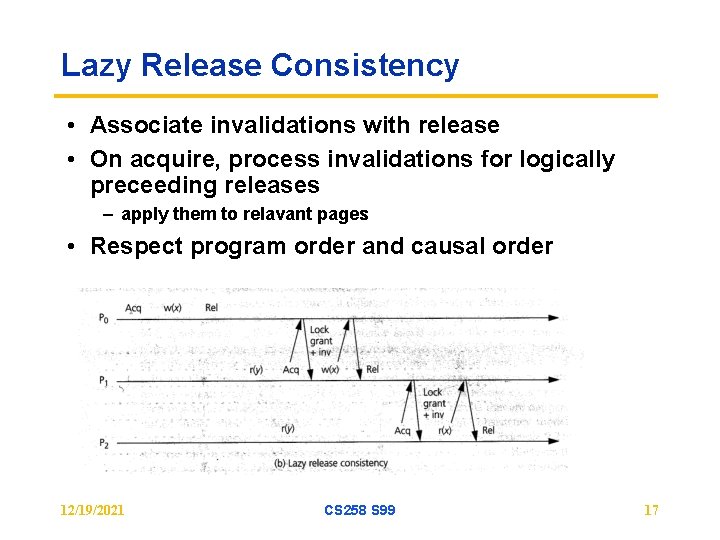
Lazy Release Consistency • Associate invalidations with release • On acquire, process invalidations for logically preceeding releases – apply them to relavant pages • Respect program order and causal order 12/19/2021 CS 258 S 99 17
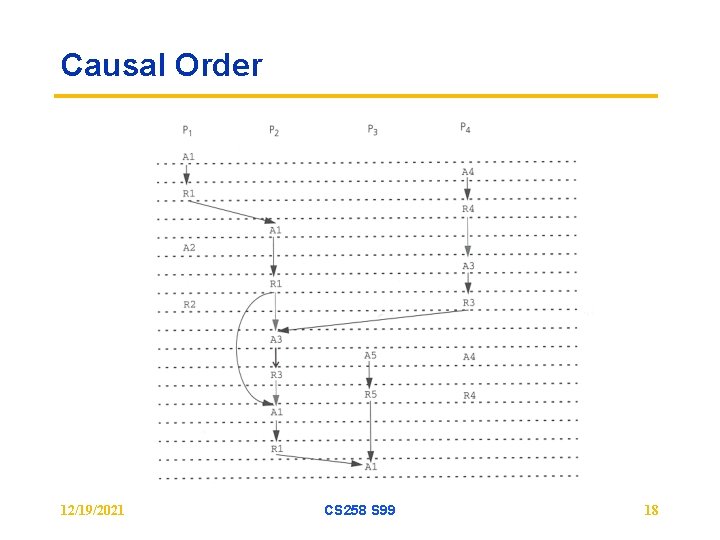
Causal Order 12/19/2021 CS 258 S 99 18
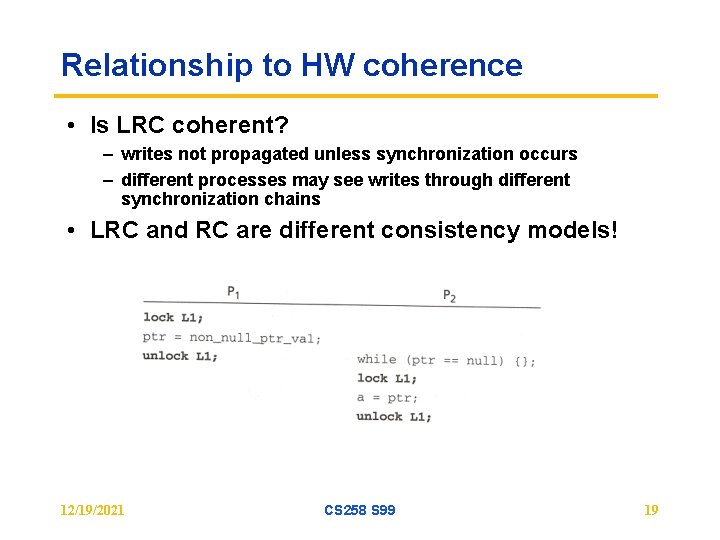
Relationship to HW coherence • Is LRC coherent? – writes not propagated unless synchronization occurs – different processes may see writes through different synchronization chains • LRC and RC are different consistency models! 12/19/2021 CS 258 S 99 19
Multiple Writer Protocols • How do we avoid false sharing traffic when two processors write to different locations in a page? 12/19/2021 CS 258 S 99 20
Options • Treadmarks: – protect page till first write – make twin at first write from processor – at release, compute diff. » propagate at release, when demanded at acquire, . . . – on page fault, collect and merge diffs from all copies – storage reclamation for diffs? • Home based protocol – propagate diffs into home at release – on fault, get full page • write-thru to other pages (Shrimp, Memory channel) 12/19/2021 CS 258 S 99 21
Further Weakening • Entry consistency – associated regions with each synch variable – only propagate invalidations for associated region • Jade – similar, but language construct • Scope consistency 12/19/2021 CS 258 S 99 22
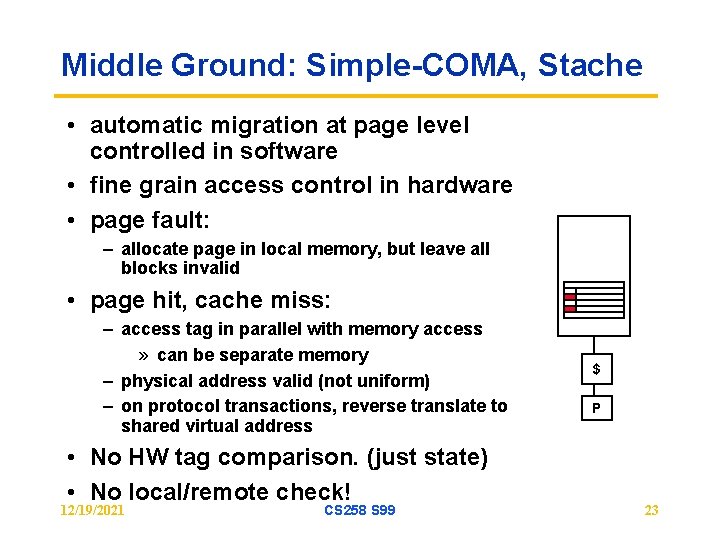
Middle Ground: Simple-COMA, Stache • automatic migration at page level controlled in software • fine grain access control in hardware • page fault: – allocate page in local memory, but leave all blocks invalid • page hit, cache miss: – access tag in parallel with memory access » can be separate memory – physical address valid (not uniform) – on protocol transactions, reverse translate to shared virtual address • No HW tag comparison. (just state) • No local/remote check! 12/19/2021 CS 258 S 99 $ P 23
Conclusions • Memory is a binding of names to values • Modern shared address space designs deeply separate NAMES from LOCATIONS • Share virtual addresses • COMA has uniform virtual->’physical’, but physical can migrate • SVM use distinct virtual->physical to achieve page-level sharing – must exploit weak consistency models so artifactual communication doesn’t dominate • Simple-COMA uses mapping to simplify HW while providing migration! 12/19/2021 CS 258 S 99 24
- Slides: 24