
Descriptions of a few land surface models VIC


- Slides: 29
Descriptions of a few land surface models VIC: large-scale land surface hydrology Col. Sim: reservoir operations Crop. Syst: cropping systems
Variable Infiltration Capacity (VIC) Model Large-scale land surface hydrology
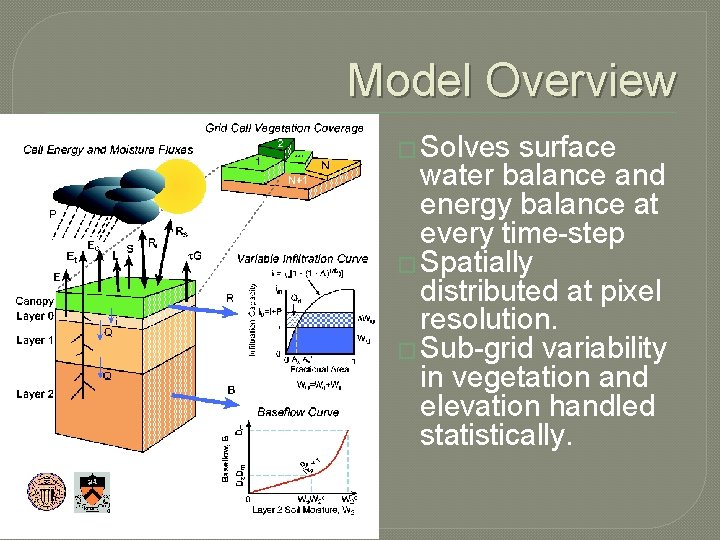
Model Overview � Solves surface water balance and energy balance at every time-step � Spatially distributed at pixel resolution. � Sub-grid variability in vegetation and elevation handled statistically.
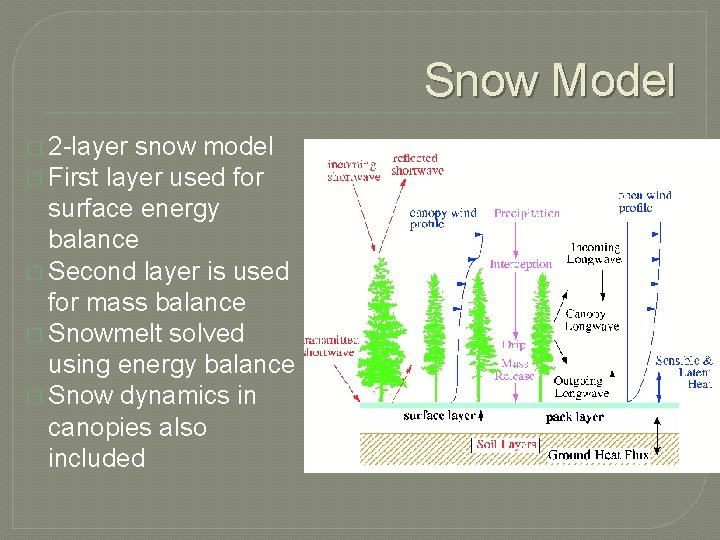
Snow Model � 2 -layer snow model � First layer used for surface energy balance � Second layer is used for mass balance � Snowmelt solved using energy balance � Snow dynamics in canopies also included
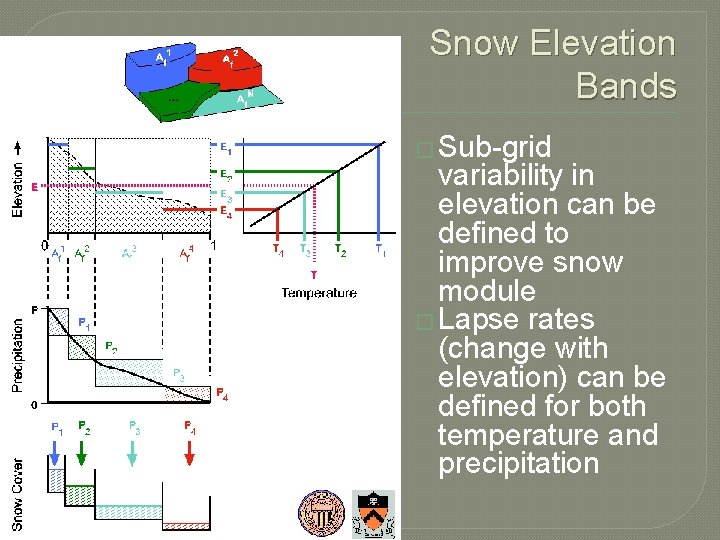
Snow Elevation Bands � Sub-grid variability in elevation can be defined to improve snow module � Lapse rates (change with elevation) can be defined for both temperature and precipitation
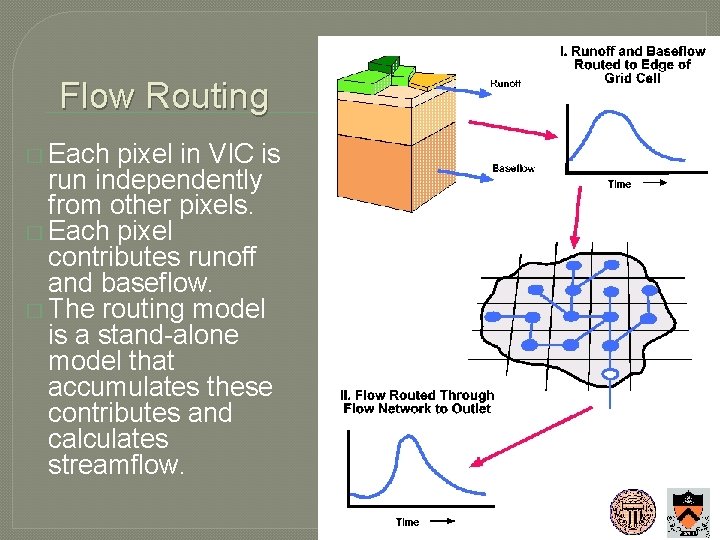
Flow Routing � Each pixel in VIC is run independently from other pixels. � Each pixel contributes runoff and baseflow. � The routing model is a stand-alone model that accumulates these contributes and calculates streamflow.
Spatial/Temporal Scales � Spatial: • Finest application: 1/16 th degree (each pixel is about 6 km on a side) • Coarsest application: 2 degree (each pixel is about 200 km on a side) • Resolution (on the fine side) is limited by the assumption that there is no lateral subsurface transport between pixels • Spatial extent applications: moderately large to continental scale � Temporal • Resolution is 1 hr to 24 hr • Period is unlimited (usually run for >30 years)
VIC Inputs/Outputs �Inputs: • Transient: precipitation, temperature, wind speed, radiation, relative humidity • Static: vegetation, soil, and elevation properties �Outputs: • Fluxes: runoff, baseflow, evapotranspiration, sublimation, energy fluxes, … • States: soil moisture, snow depth, snow density, intercepted water, surface/subsurface temperatures, …
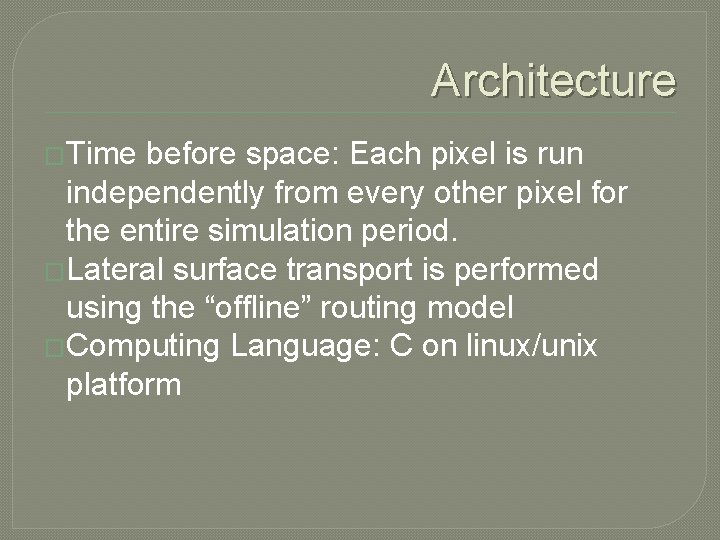
Architecture �Time before space: Each pixel is run independently from every other pixel for the entire simulation period. �Lateral surface transport is performed using the “offline” routing model �Computing Language: C on linux/unix platform
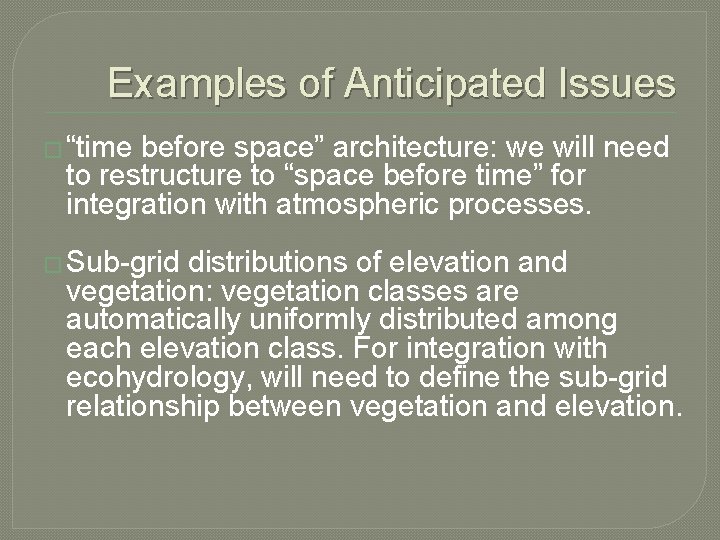
Examples of Anticipated Issues � “time before space” architecture: we will need to restructure to “space before time” for integration with atmospheric processes. � Sub-grid distributions of elevation and vegetation: vegetation classes are automatically uniformly distributed among each elevation class. For integration with ecohydrology, will need to define the sub-grid relationship between vegetation and elevation.
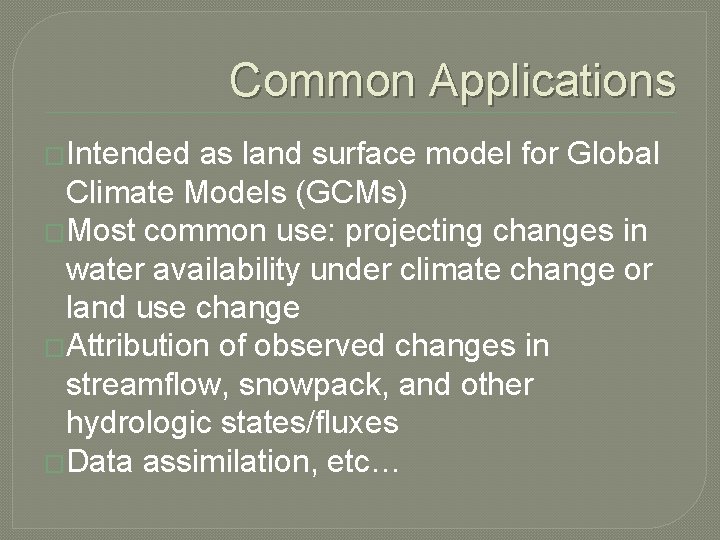
Common Applications �Intended as land surface model for Global Climate Models (GCMs) �Most common use: projecting changes in water availability under climate change or land use change �Attribution of observed changes in streamflow, snowpack, and other hydrologic states/fluxes �Data assimilation, etc…
Col. Sim Reservoir Operations
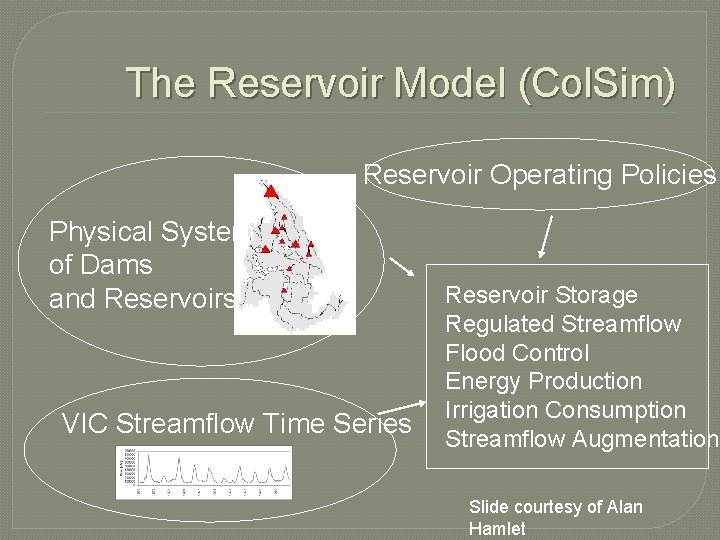
The Reservoir Model (Col. Sim) Reservoir Operating Policies Physical System of Dams and Reservoirs VIC Streamflow Time Series Reservoir Storage Regulated Streamflow Flood Control Energy Production Irrigation Consumption Streamflow Augmentation Slide courtesy of Alan Hamlet
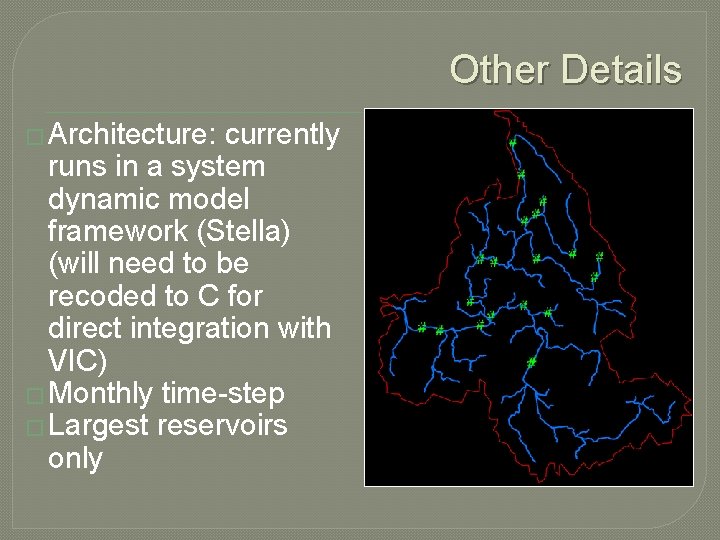
Other Details � Architecture: currently runs in a system dynamic model framework (Stella) (will need to be recoded to C for direct integration with VIC) � Monthly time-step � Largest reservoirs only
Crop. Syst Cropping Systems
Crop. Syst Description � Developed by Claudio Stockle at WSU � Multi-year, multi-crop, daily time-step crop simulation model � Operates at the point scale � Available for Windows, Unix, Linux � Accessible via Internet: • manuals, programs, documentation • listserver • related programs
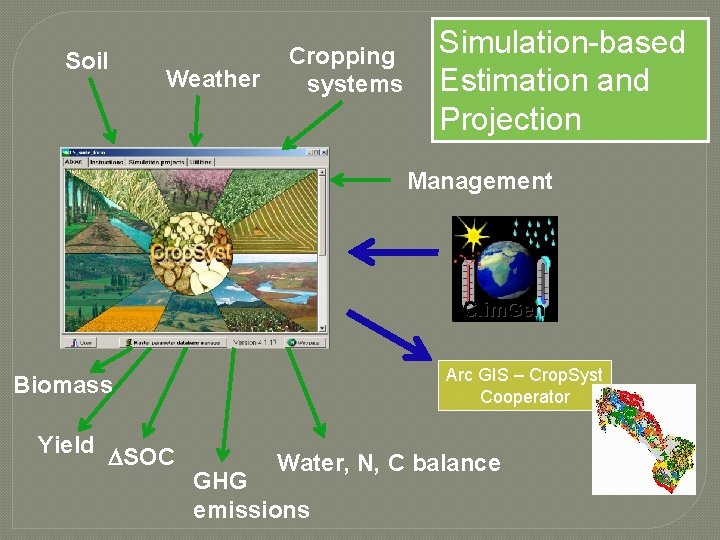
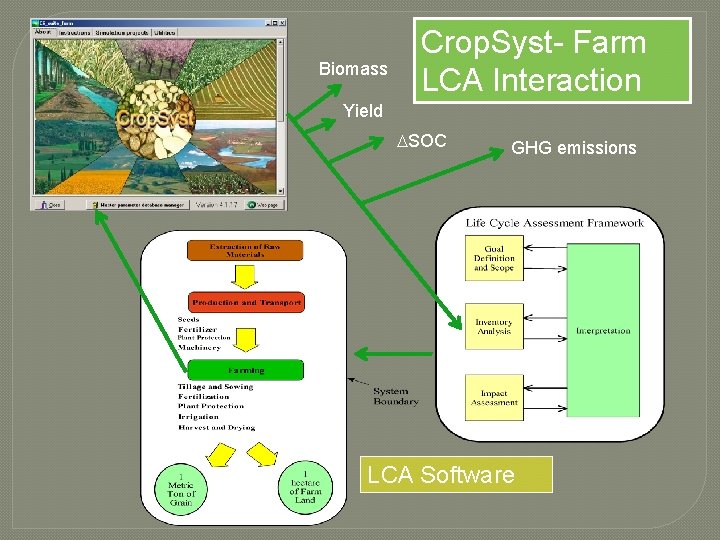
Soil Weather Cropping systems Simulation-based Estimation and Projection Management Clim. Gen Arc GIS – Crop. Syst Cooperator Biomass Yield DSOC Water, N, C balance GHG emissions
Biomass Crop. Syst- Farm LCA Interaction Yield DSOC GHG emissions LCA Software
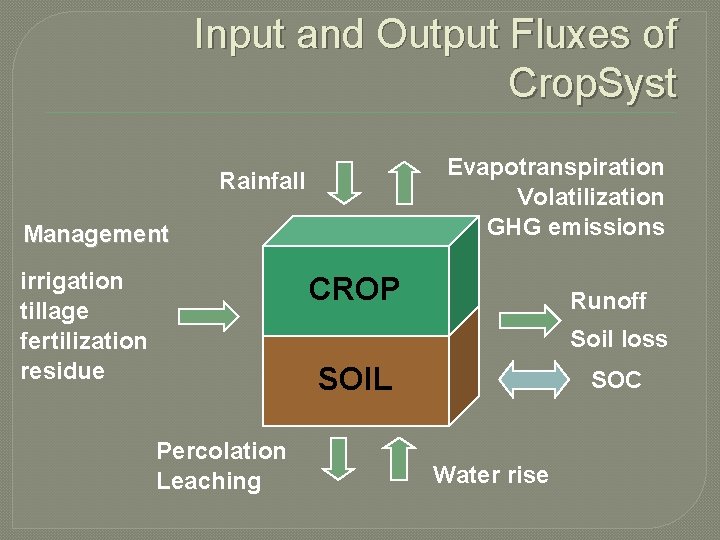
Input and Output Fluxes of Crop. Syst Evapotranspiration Volatilization GHG emissions Rainfall Management irrigation tillage fertilization residue CROP Runoff Soil loss SOIL Percolation Leaching SOC Water rise
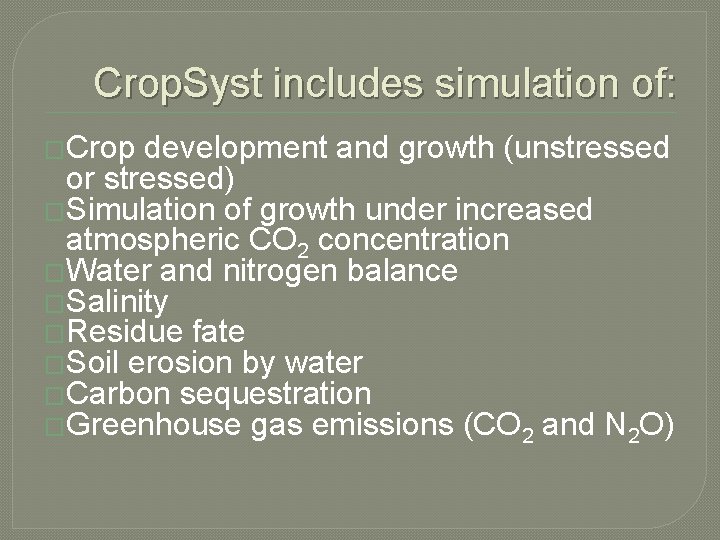
Crop. Syst includes simulation of: �Crop development and growth (unstressed or stressed) �Simulation of growth under increased atmospheric CO 2 concentration �Water and nitrogen balance �Salinity �Residue fate �Soil erosion by water �Carbon sequestration �Greenhouse gas emissions (CO 2 and N 2 O)
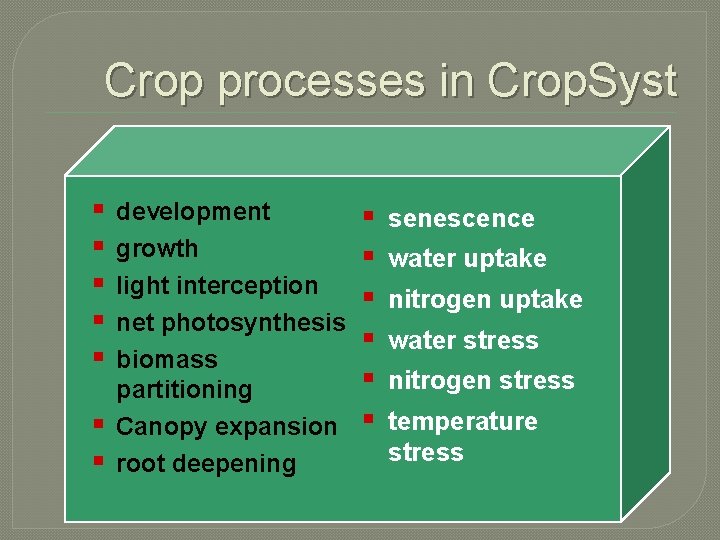
Crop processes in Crop. Syst § § § § development growth light interception net photosynthesis biomass partitioning Canopy expansion root deepening § § § senescence water uptake nitrogen uptake water stress nitrogen stress temperature stress
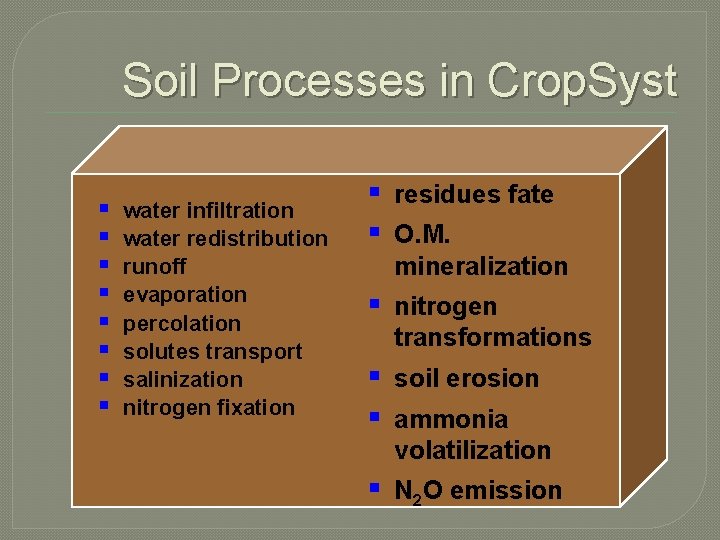
Soil Processes in Crop. Syst § § § § water infiltration water redistribution runoff evaporation percolation solutes transport salinization nitrogen fixation § residues fate § O. M. mineralization § nitrogen transformations § soil erosion § ammonia volatilization § N 2 O emission
VIC/Crop. Syst Integration
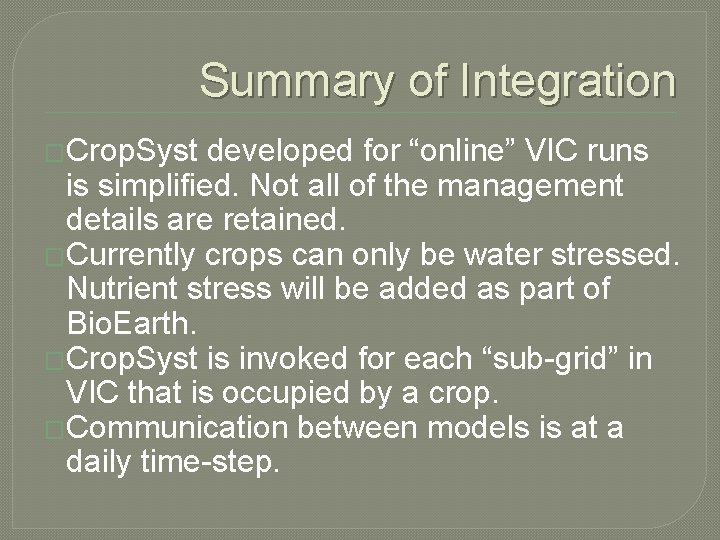
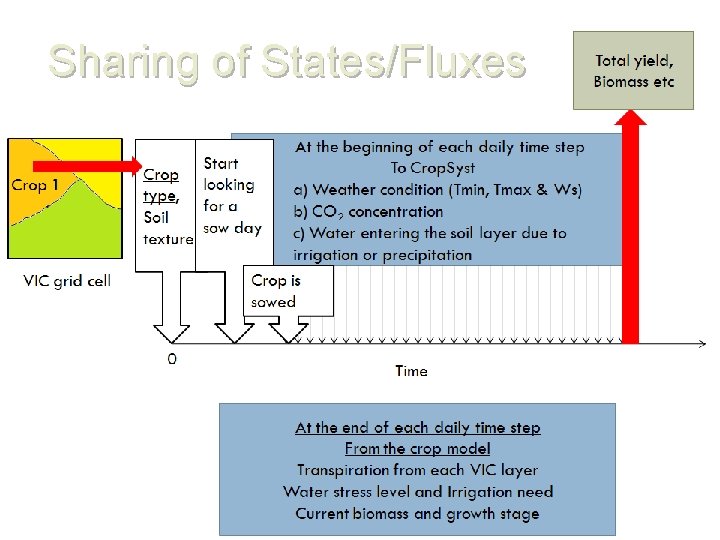
Summary of Integration �Crop. Syst developed for “online” VIC runs is simplified. Not all of the management details are retained. �Currently crops can only be water stressed. Nutrient stress will be added as part of Bio. Earth. �Crop. Syst is invoked for each “sub-grid” in VIC that is occupied by a crop. �Communication between models is at a daily time-step.
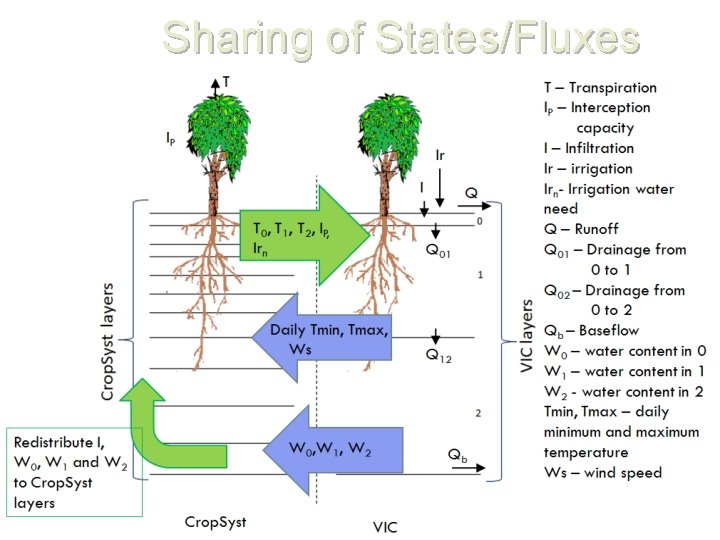
Sharing of States/Fluxes
Questions?
Sharing of States/Fluxes
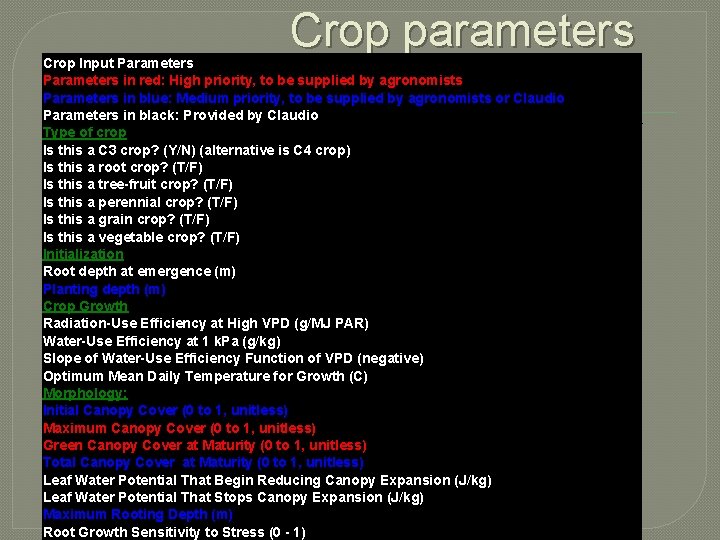
Crop parameters Crop Input Parameters in red: High priority, to be supplied by agronomists Parameters in blue: Medium priority, to be supplied by agronomists or Claudio Parameters in black: Provided by Claudio Type of crop Is this a C 3 crop? (Y/N) (alternative is C 4 crop) Is this a root crop? (T/F) Is this a tree-fruit crop? (T/F) Is this a perennial crop? (T/F) Is this a grain crop? (T/F) Is this a vegetable crop? (T/F) Initialization Root depth at emergence (m) Planting depth (m) Crop Growth Radiation-Use Efficiency at High VPD (g/MJ PAR) Water-Use Efficiency at 1 k. Pa (g/kg) Slope of Water-Use Efficiency Function of VPD (negative) Optimum Mean Daily Temperature for Growth (C) Morphology: Initial Canopy Cover (0 to 1, unitless) Maximum Canopy Cover (0 to 1, unitless) Green Canopy Cover at Maturity (0 to 1, unitless) Total Canopy Cover at Maturity (0 to 1, unitless) Leaf Water Potential That Begin Reducing Canopy Expansion (J/kg) Leaf Water Potential That Stops Canopy Expansion (J/kg) Maximum Rooting Depth (m) Root Growth Sensitivity to Stress (0 - 1)
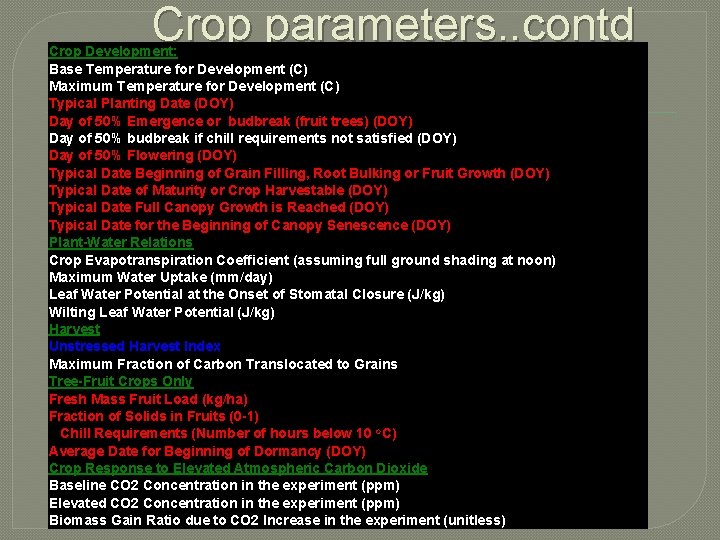
Crop parameters. . contd Crop Development: Base Temperature for Development (C) Maximum Temperature for Development (C) Typical Planting Date (DOY) Day of 50% Emergence or budbreak (fruit trees) (DOY) Day of 50% budbreak if chill requirements not satisfied (DOY) Day of 50% Flowering (DOY) Typical Date Beginning of Grain Filling, Root Bulking or Fruit Growth (DOY) Typical Date of Maturity or Crop Harvestable (DOY) Typical Date Full Canopy Growth is Reached (DOY) Typical Date for the Beginning of Canopy Senescence (DOY) Plant-Water Relations Crop Evapotranspiration Coefficient (assuming full ground shading at noon) Maximum Water Uptake (mm/day) Leaf Water Potential at the Onset of Stomatal Closure (J/kg) Wilting Leaf Water Potential (J/kg) Harvest Unstressed Harvest Index Maximum Fraction of Carbon Translocated to Grains Tree-Fruit Crops Only Fresh Mass Fruit Load (kg/ha) Fraction of Solids in Fruits (0 -1) Chill Requirements (Number of hours below 10 o. C) Average Date for Beginning of Dormancy (DOY) Crop Response to Elevated Atmospheric Carbon Dioxide Baseline CO 2 Concentration in the experiment (ppm) Elevated CO 2 Concentration in the experiment (ppm) Biomass Gain Ratio due to CO 2 Increase in the experiment (unitless)