
Description of a Process for Enhancing Preservice Programs
- Slides: 17
Description of a Process for Enhancing Pre-service Programs to Better Prepare General Education Teachers to Teach Students with Disabilities 2016 CEEDAR Cross-State Convening Stacie B. Whinnery, Ed. D. swhinnery@uwf. edu
Florida Blueprint • Increase the knowledge and skills of all teachers working with SWDs – Provide guidance to institutions of higher education to revise teacher preparation programs
Project Goals 1. Develop a collaborative faculty-led process to enhance teacher preparation curricula 2. Use the collaborative process to strengthen UDL content coverage in undergraduate teacher preparation programs
Guiding Question #1 What challenges might you encounter when integrating EBPs and HLPs into pre-service programs?
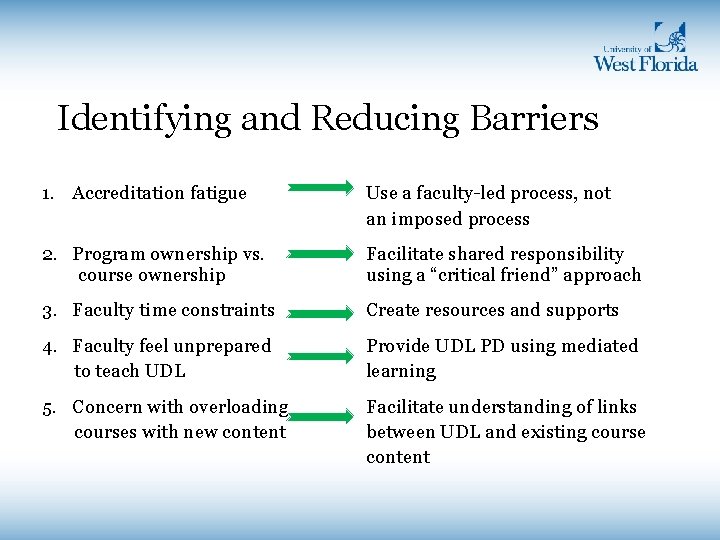
Identifying and Reducing Barriers 1. Accreditation fatigue Use a faculty-led process, not an imposed process 2. Program ownership vs. course ownership Facilitate shared responsibility using a “critical friend” approach 3. Faculty time constraints Create resources and supports 4. Faculty feel unprepared to teach UDL Provide UDL PD using mediated learning 5. Concern with overloading courses with new content Facilitate understanding of links between UDL and existing course content
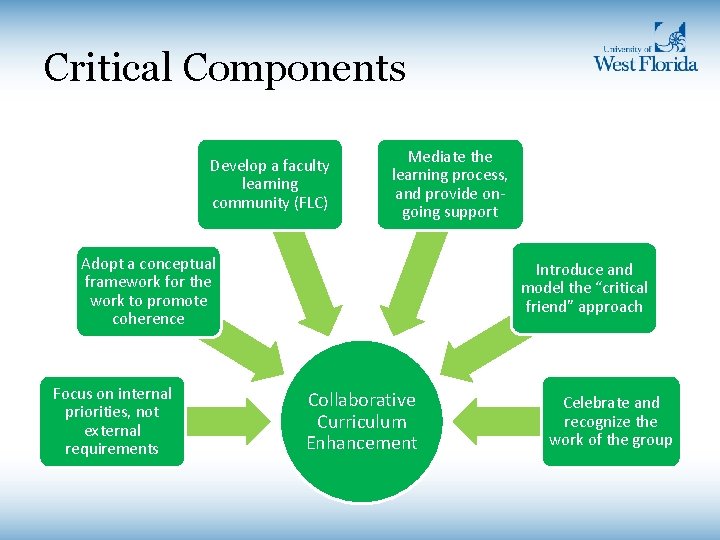
Critical Components Develop a faculty learning community (FLC) Mediate the learning process, and provide ongoing support Adopt a conceptual framework for the work to promote coherence Focus on internal priorities, not external requirements Introduce and model the “critical friend” approach Collaborative Curriculum Enhancement Celebrate and recognize the work of the group
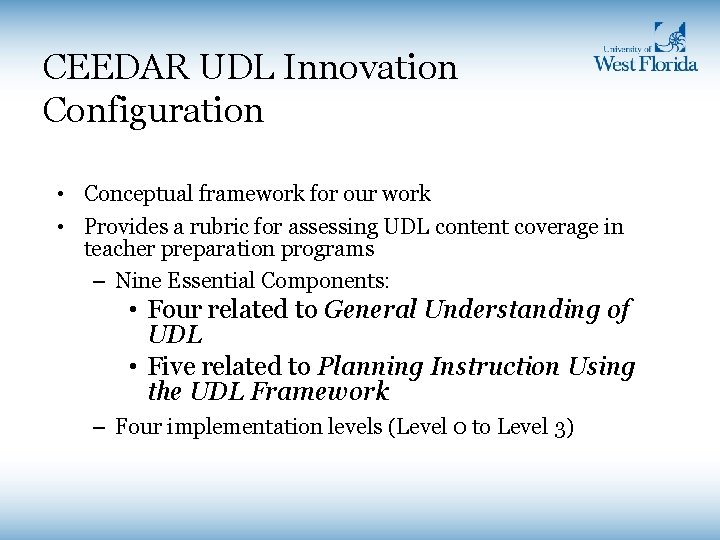
CEEDAR UDL Innovation Configuration • Conceptual framework for our work • Provides a rubric for assessing UDL content coverage in teacher preparation programs – Nine Essential Components: • Four related to General Understanding of UDL • Five related to Planning Instruction Using the UDL Framework – Four implementation levels (Level 0 to Level 3)
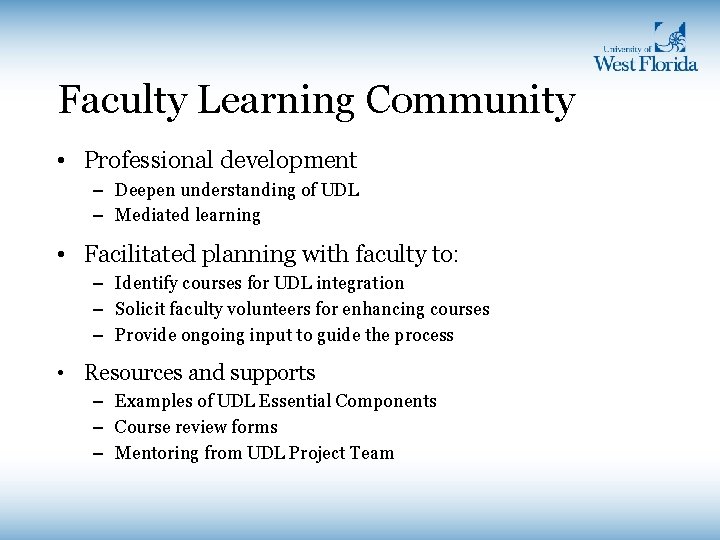
Faculty Learning Community • Professional development – Deepen understanding of UDL – Mediated learning • Facilitated planning with faculty to: – Identify courses for UDL integration – Solicit faculty volunteers for enhancing courses – Provide ongoing input to guide the process • Resources and supports – Examples of UDL Essential Components – Course review forms – Mentoring from UDL Project Team
“Critical Friend” Approach • • Faculty worked in teams during: – Curriculum review – Development of the curriculum enhancement map – Curriculum enhancement workshops Goal: To establish culture of shared responsibility for content coverage across the programs – General and special education – Course work and clinical experiences
Lessons Learned • Faculty-led process increased buy-in and ownership • Faculty Learning Community facilitated: – shared goals – group learning and planning – coordination across courses and clinical experiences • Faculty valued the scaffolded presentation of new material • Curriculum Review phase led to multiple positive outcomes – Exploration of UDL Essential Components (EC) at a deeper level – Identified current coverage of UDL content – Recognition of possible ways to integrate UDL into existing courses
Lessons Learned Part 2 • Faculty-led process increased buy-in and ownership • Rating Form served multiple purposes – Initially intended to document course enhancements – Faculty valued the structure for planning – Led to increased discussions about alignment of UDL content across the programs • Shared decision-making led to positive outcomes – Early hesitancy to integrate more than one EC was replaced with comprehensive integration across courses
Impact on Programs/Department • Increased coverage of UDL content across the program • Development of a collaborative process that can be replicated with other curriculum enhancement efforts • Building capacity for collaborative teacher education – Coordination between general education and special education – Strengthening connections between course work and clinical experiences
Guiding Question #2 Considering the information presented today and your own experiences, share ideas for enhancing pre-service programs to better prepare general education teachers to teach students with disabilities.
Course Enhancement Examples University of West Florida Teacher Education
Applied Foundations (course enhancement example) • Syllabus enhancements: – SLOs • Define Universal Design for Learning (UDL) and identify major principles – Topics • Universal Design for Learning framework • Progress Monitoring – Assignment • UDL Quiz • Enhancement example: – IRIS UDL Module – UDL quiz based on IRIS module
Methods of Inclusion and Collaboration (course enhancement example) • Syllabus enhancement: – SLOs • Define UDL and identify learning barriers for students with disabilities • Identify effective UDL strategies for instructing students with disabilities – Topics • UDL, Learning Barriers, Assistive Technology, Progress Monitoring • Enhancement example: – Introduction to UDL • Video – “UDL At a Glance” (CAST ) • Article – “Using a Universal Design Approach to Find Barriers and Solutions in the Curriculum” • Discussion Groups – Groups respond to guided questions related to above material • Quiz – over concepts covered
Teaching Science in the Elementary School (course enhancement example) • Syllabus enhancements: – SLOs • Design flexible formative assessments to determine student learning in science, and identify possible alternative conceptions/misconceptions • Using the UDL framework, identify inclusive strategies for promoting equitable participation of underrepresented populations – Topic • UDL Framework – Assignments • Next Generation Science Unit Plan • Enhancement example: – UDL Review Module (available as needed) – Research and design an inquiry science unit that engages elementary students with diverse learning needs