
DESCRIBING YOURSELF ARE YOU GOOD AT GETTING UP
DESCRIBING YOURSELF ARE YOU GOOD AT GETTING UP EARLY IN THE MORNINGS TO GO TO CLASS? WHAT IS YOUR RITUAL? DO YOU STUDY BETTER AT LATE NIGHT OR ERALY MORNINGS? WHAT´S YOUR RITUAL?
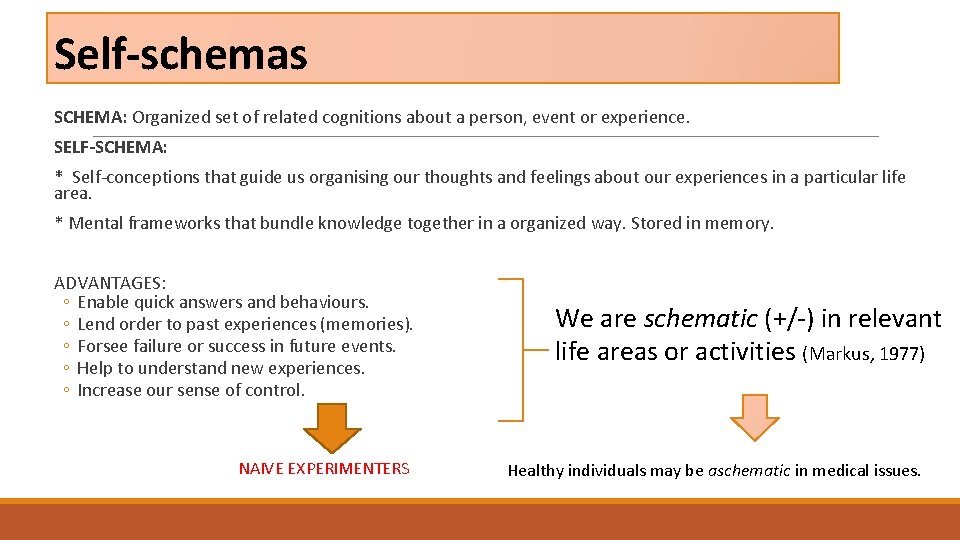
Self-schemas SCHEMA: Organized set of related cognitions about a person, event or experience. SELF-SCHEMA: * Self-conceptions that guide us organising our thoughts and feelings about our experiences in a particular life area. * Mental frameworks that bundle knowledge together in a organized way. Stored in memory. ADVANTAGES: ◦ Enable quick answers and behaviours. ◦ Lend order to past experiences (memories). ◦ Forsee failure or success in future events. ◦ Help to understand new experiences. ◦ Increase our sense of control. NAIVE EXPERIMENTERS We are schematic (+/-) in relevant life areas or activities (Markus, 1977) Healthy individuals may be aschematic in medical issues.
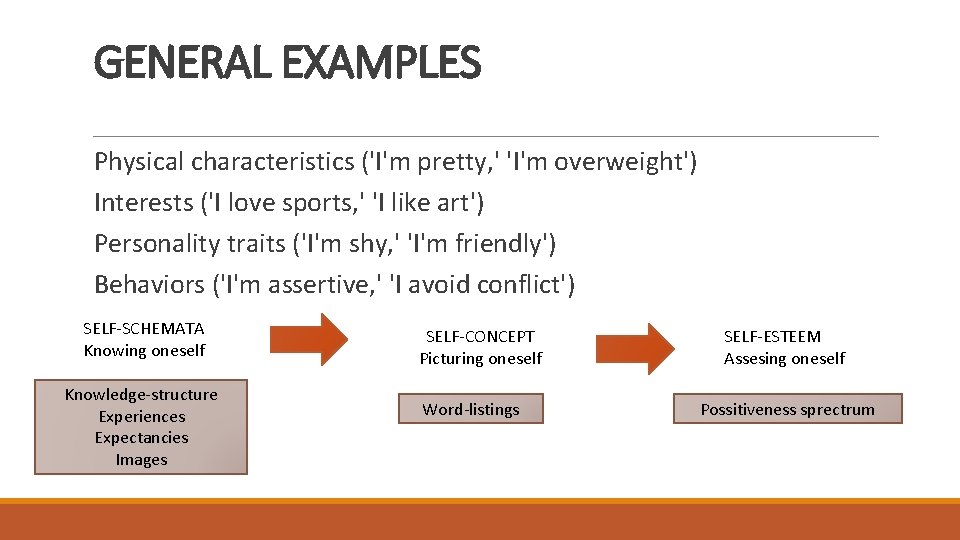
GENERAL EXAMPLES Physical characteristics ('I'm pretty, ' 'I'm overweight') Interests ('I love sports, ' 'I like art') Personality traits ('I'm shy, ' 'I'm friendly') Behaviors ('I'm assertive, ' 'I avoid conflict') SELF-SCHEMATA Knowing oneself Knowledge-structure Experiences Expectancies Images SELF-CONCEPT Picturing oneself Word-listings SELF-ESTEEM Assesing oneself Possitiveness sprectrum
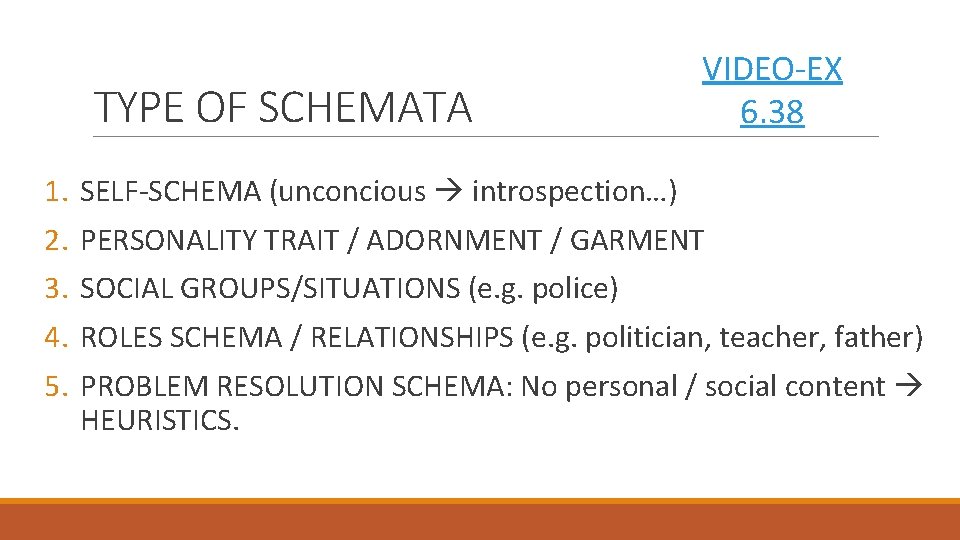
TYPE OF SCHEMATA 1. 2. 3. 4. 5. VIDEO-EX 6. 38 SELF-SCHEMA (unconcious introspection…) PERSONALITY TRAIT / ADORNMENT / GARMENT SOCIAL GROUPS/SITUATIONS (e. g. police) ROLES SCHEMA / RELATIONSHIPS (e. g. politician, teacher, father) PROBLEM RESOLUTION SCHEMA: No personal / social content HEURISTICS.

Sexual self-schemas YOUNG SCHEMA QUESTIONNAIRE Type of women Features Positive More previous sexual relationships Higher passionate attachments Current sexual relationship Negative Co-schematic (both pos and neg) Aschematic (Andersen et al. , 1999) Avoidance of intimacy and passion Higher anxiety about sexual activity Open, passionate, romantic Negative self-views Anxiety about being abandoned Fewer romantic attachments Less passionate emotions of love Avoid sexual encounters
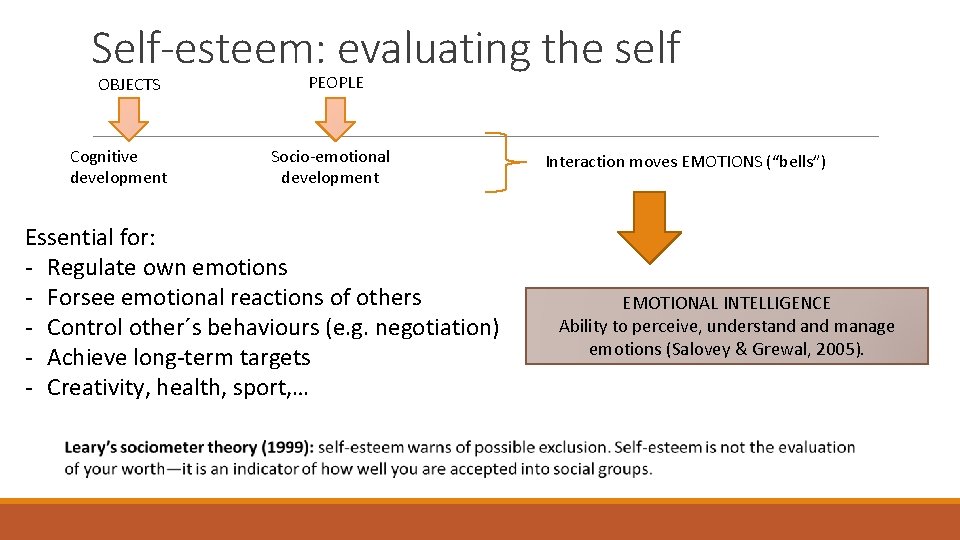
Self-esteem: evaluating the self OBJECTS Cognitive development PEOPLE Socio-emotional development Essential for: - Regulate own emotions - Forsee emotional reactions of others - Control other´s behaviours (e. g. negotiation) - Achieve long-term targets - Creativity, health, sport, … Interaction moves EMOTIONS (“bells”) EMOTIONAL INTELLIGENCE Ability to perceive, understand manage emotions (Salovey & Grewal, 2005).
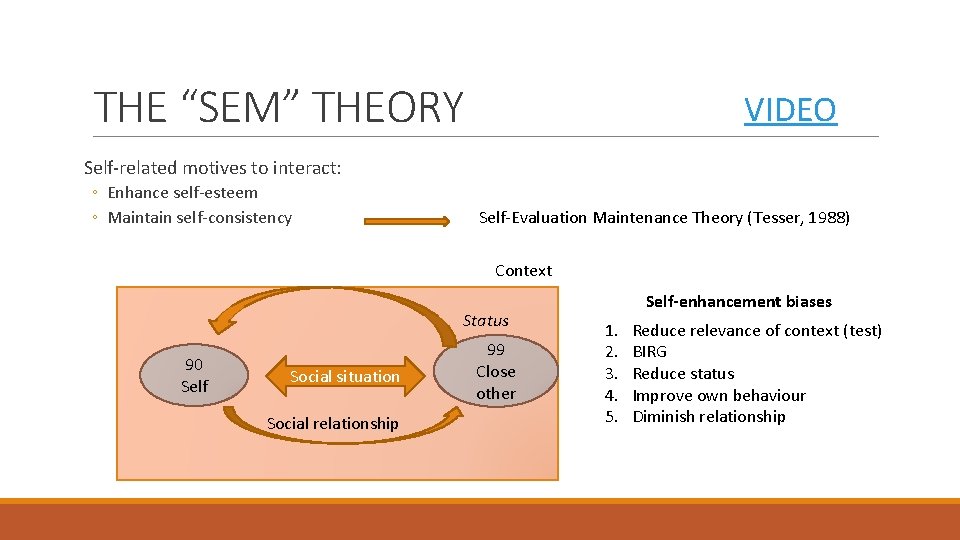
THE “SEM” THEORY VIDEO Self-related motives to interact: ◦ Enhance self-esteem ◦ Maintain self-consistency Self-Evaluation Maintenance Theory (Tesser, 1988) Context Status 90 Self Social situation Social relationship 99 Close other Self-enhancement biases 1. 2. 3. 4. 5. Reduce relevance of context (test) BIRG Reduce status Improve own behaviour Diminish relationship
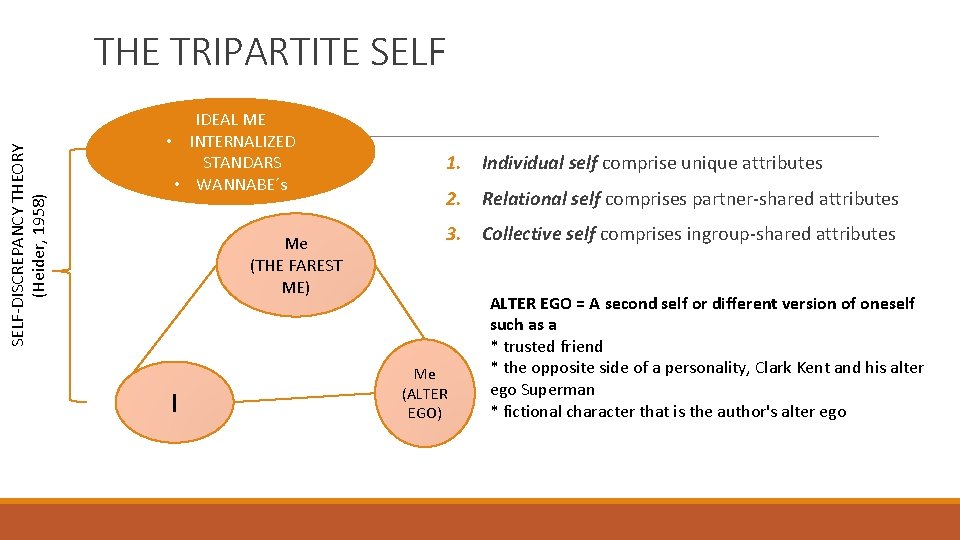
SELF-DISCREPANCY THEORY (Heider, 1958) THE TRIPARTITE SELF IDEAL ME • INTERNALIZED STANDARS • WANNABE´s Me (THE FAREST ME) I 1. Individual self comprise unique attributes 2. Relational self comprises partner-shared attributes 3. Collective self comprises ingroup-shared attributes Me (ALTER EGO) ALTER EGO = A second self or different version of oneself such as a * trusted friend * the opposite side of a personality, Clark Kent and his alter ego Superman * fictional character that is the author's alter ego
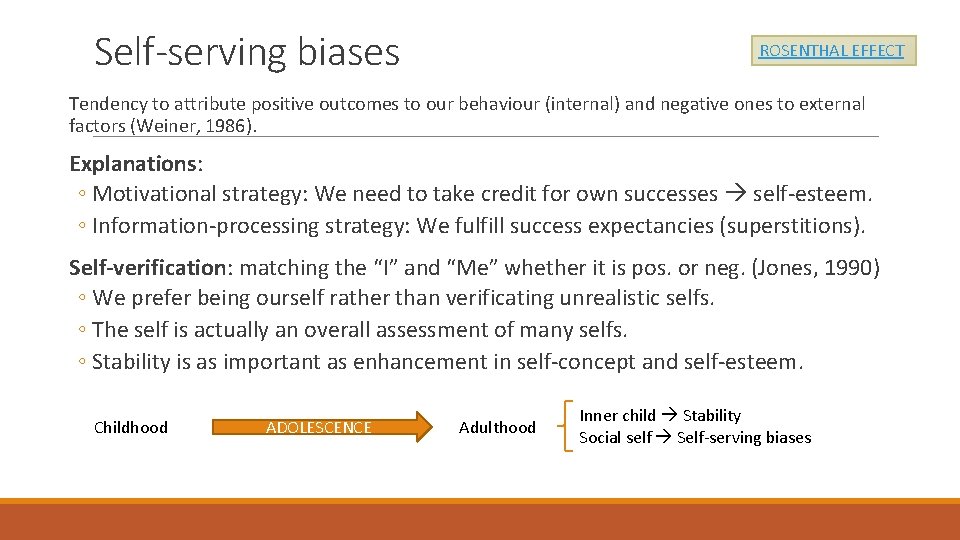
Self-serving biases ROSENTHAL EFFECT Tendency to attribute positive outcomes to our behaviour (internal) and negative ones to external factors (Weiner, 1986). Explanations: ◦ Motivational strategy: We need to take credit for own successes self-esteem. ◦ Information-processing strategy: We fulfill success expectancies (superstitions). Self-verification: matching the “I” and “Me” whether it is pos. or neg. (Jones, 1990) ◦ We prefer being ourself rather than verificating unrealistic selfs. ◦ The self is actually an overall assessment of many selfs. ◦ Stability is as important as enhancement in self-concept and self-esteem. Childhood ADOLESCENCE Adulthood Inner child Stability Social self Self-serving biases
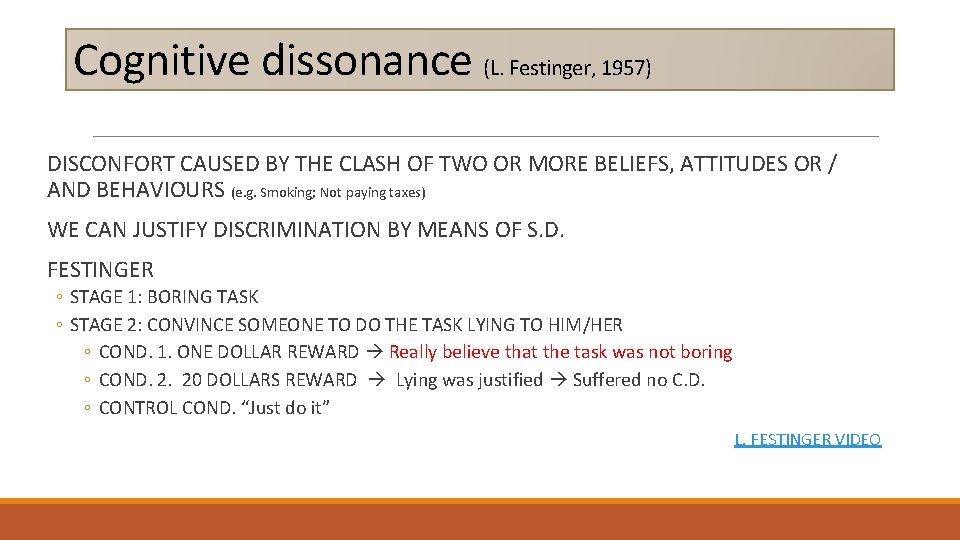
Cognitive dissonance (L. Festinger, 1957) DISCONFORT CAUSED BY THE CLASH OF TWO OR MORE BELIEFS, ATTITUDES OR / AND BEHAVIOURS (e. g. Smoking; Not paying taxes) WE CAN JUSTIFY DISCRIMINATION BY MEANS OF S. D. FESTINGER ◦ STAGE 1: BORING TASK ◦ STAGE 2: CONVINCE SOMEONE TO DO THE TASK LYING TO HIM/HER ◦ COND. 1. ONE DOLLAR REWARD Really believe that the task was not boring ◦ COND. 2. 20 DOLLARS REWARD Lying was justified Suffered no C. D. ◦ CONTROL COND. “Just do it” L. FESTINGER VIDEO
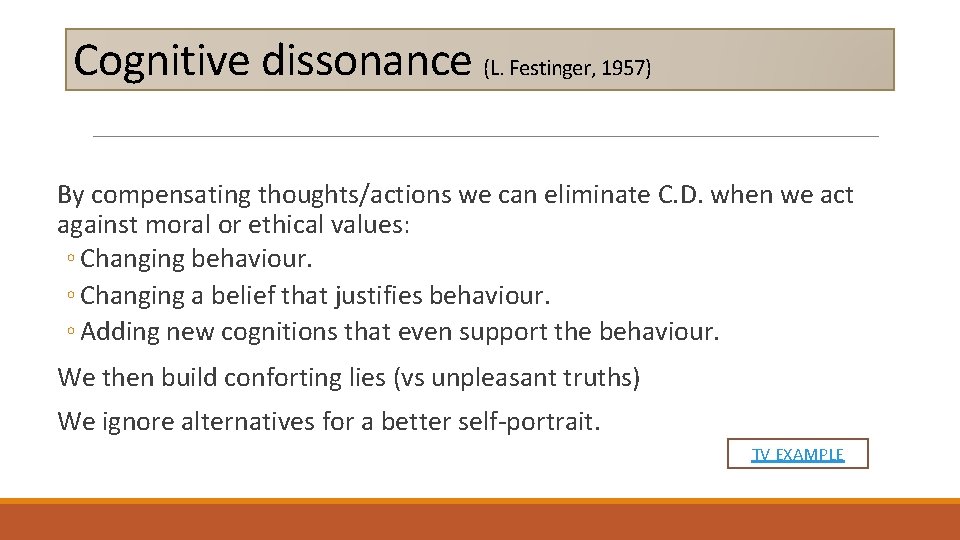
Cognitive dissonance (L. Festinger, 1957) By compensating thoughts/actions we can eliminate C. D. when we act against moral or ethical values: ◦ Changing behaviour. ◦ Changing a belief that justifies behaviour. ◦ Adding new cognitions that even support the behaviour. We then build conforting lies (vs unpleasant truths) We ignore alternatives for a better self-portrait. TV EXAMPLE
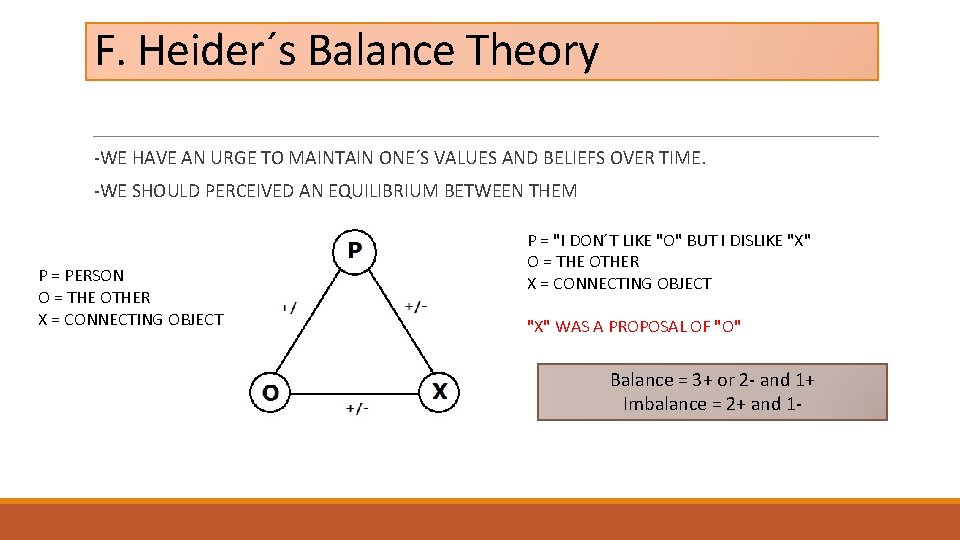
F. Heider´s Balance Theory -WE HAVE AN URGE TO MAINTAIN ONE´S VALUES AND BELIEFS OVER TIME. -WE SHOULD PERCEIVED AN EQUILIBRIUM BETWEEN THEM P = PERSON O = THE OTHER X = CONNECTING OBJECT P = "I DON´T LIKE "O" BUT I DISLIKE "X" O = THE OTHER X = CONNECTING OBJECT "X" WAS A PROPOSAL OF "O" Balance = 3+ or 2 - and 1+ Imbalance = 2+ and 1 -
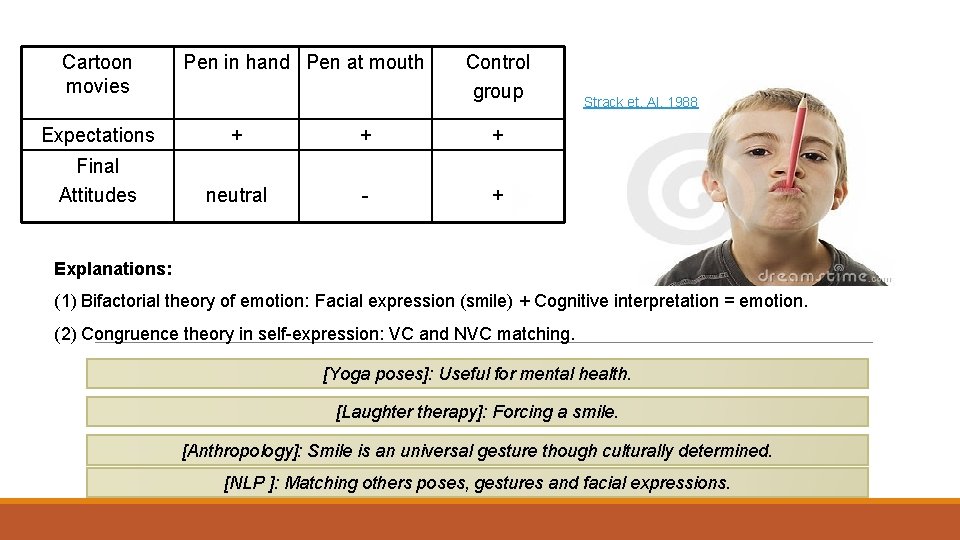
Cartoon movies Pen in hand Pen at mouth Control group Expectations + + + Final Attitudes neutral - + Strack et. Al. 1988 Explanations: (1) Bifactorial theory of emotion: Facial expression (smile) + Cognitive interpretation = emotion. (2) Congruence theory in self-expression: VC and NVC matching. [Yoga poses]: Useful for mental health. [Laughter therapy]: Forcing a smile. [Anthropology]: Smile is an universal gesture though culturally determined. [NLP ]: Matching others poses, gestures and facial expressions.
- Slides: 13