
Describing roles in the roman army You have
Describing roles in the roman army
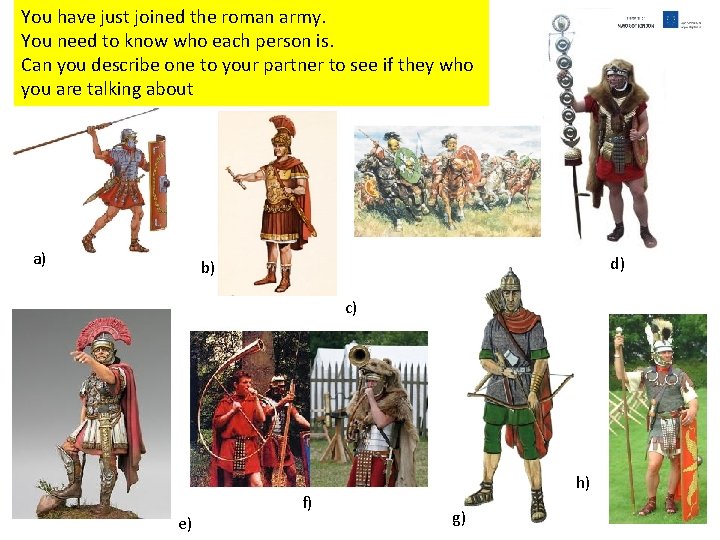
You have just joined the roman army. You need to know who each person is. Can you describe one to your partner to see if they who you are talking about a) d) b) c) e) f) h) g)
Here are some descriptions of the men you can see. Can you match the descriptions to each man. The man in light armour and a green shield on a horse is an auxiliary. The man wearing a plume across the helmet is the centurion. The man wearing the black and white plume along his helmet is the optio. The man holding a pole and wearing a bearskin over his head is the standard bearer. The man in green holding the bow and arrow is another auxiliary. The important man on the horse with the large red plume is the legate. The man with the javelin, short sword, shield but no crest on his helmet is a legionary just like you. The man playing the horn is the horn player.
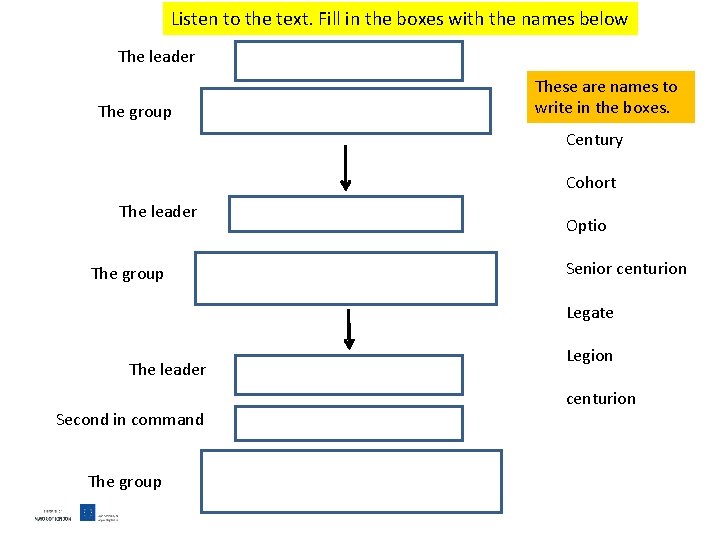
Listen to the text. Fill in the boxes with the names below The leader The group These are names to write in the boxes. Century Cohort The leader The group Optio Senior centurion Legate The leader Second in command The group Legion centurion
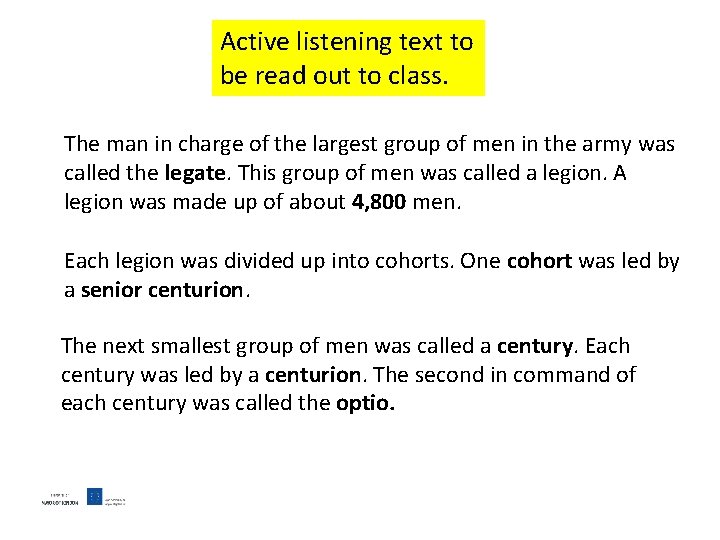
Active listening text to be read out to class. The man in charge of the largest group of men in the army was called the legate. This group of men was called a legion. A legion was made up of about 4, 800 men. Each legion was divided up into cohorts. One cohort was led by a senior centurion. The next smallest group of men was called a century. Each century was led by a centurion. The second in command of each century was called the optio.
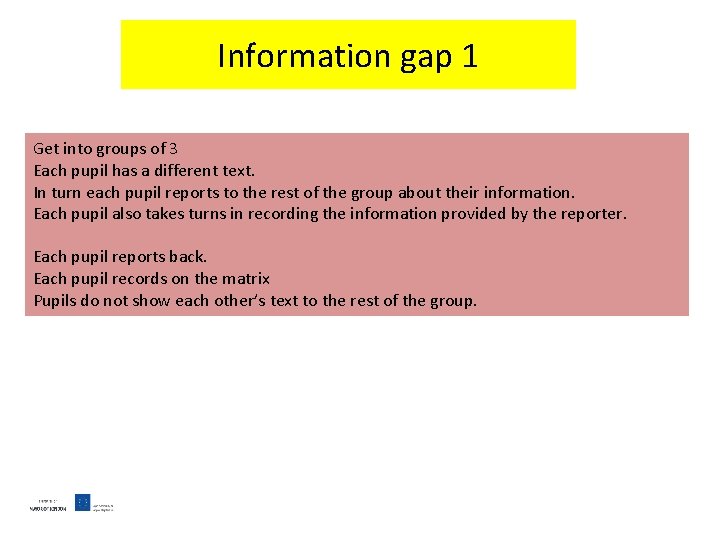
Information gap 1 Get into groups of 3 Each pupil has a different text. In turn each pupil reports to the rest of the group about their information. Each pupil also takes turns in recording the information provided by the reporter. Each pupil reports back. Each pupil records on the matrix Pupils do not show each other’s text to the rest of the group.
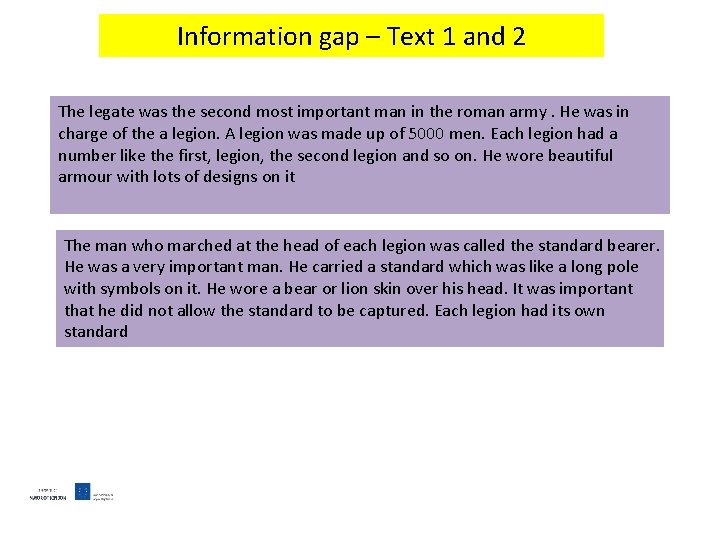
Information gap – Text 1 and 2 The legate was the second most important man in the roman army. He was in charge of the a legion. A legion was made up of 5000 men. Each legion had a number like the first, legion, the second legion and so on. He wore beautiful armour with lots of designs on it The man who marched at the head of each legion was called the standard bearer. He was a very important man. He carried a standard which was like a long pole with symbols on it. He wore a bear or lion skin over his head. It was important that he did not allow the standard to be captured. Each legion had its own standard
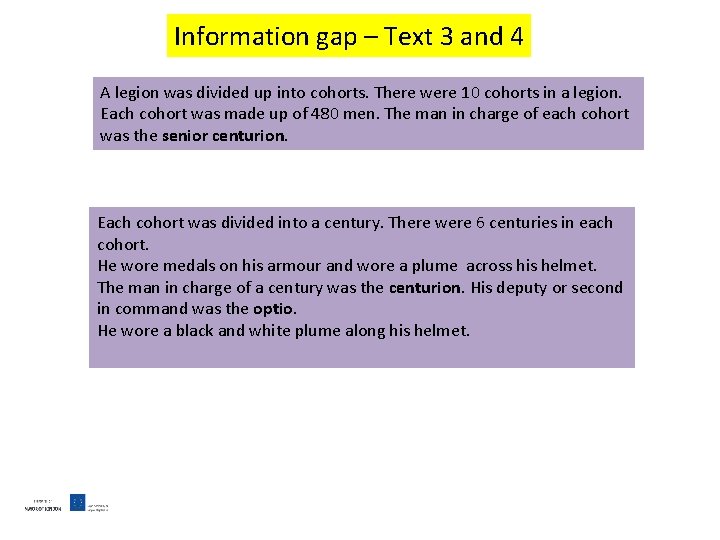
Information gap – Text 3 and 4 A legion was divided up into cohorts. There were 10 cohorts in a legion. Each cohort was made up of 480 men. The man in charge of each cohort was the senior centurion. Each cohort was divided into a century. There were 6 centuries in each cohort. He wore medals on his armour and wore a plume across his helmet. The man in charge of a century was the centurion. His deputy or second in command was the optio. He wore a black and white plume along his helmet.
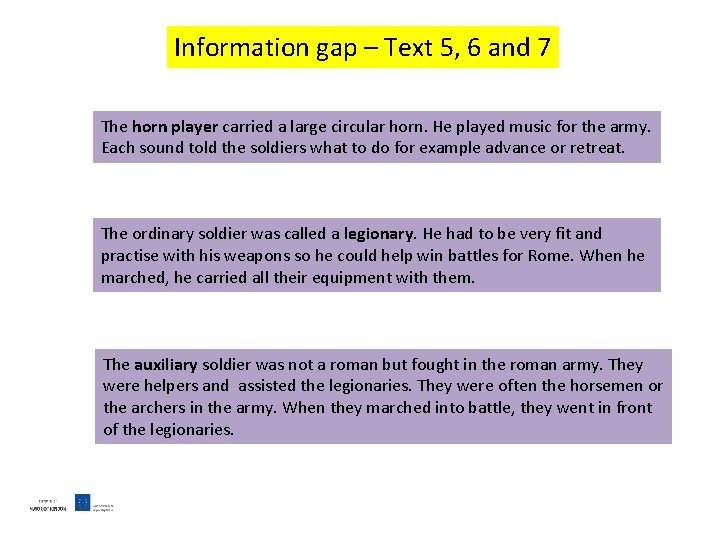
Information gap – Text 5, 6 and 7 The horn player carried a large circular horn. He played music for the army. Each sound told the soldiers what to do for example advance or retreat. The ordinary soldier was called a legionary. He had to be very fit and practise with his weapons so he could help win battles for Rome. When he marched, he carried all their equipment with them. The auxiliary soldier was not a roman but fought in the roman army. They were helpers and assisted the legionaries. They were often the horsemen or the archers in the army. When they marched into battle, they went in front of the legionaries.
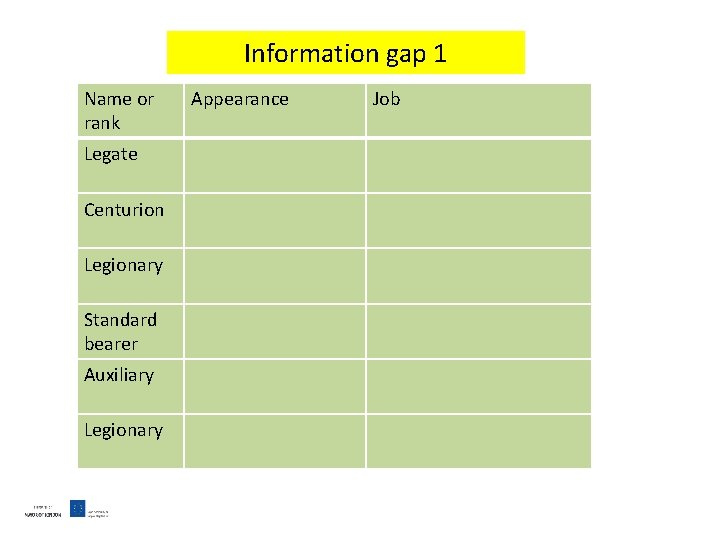
Information gap 1 Name or rank Legate Centurion Legionary Standard bearer Auxiliary Legionary Appearance Job
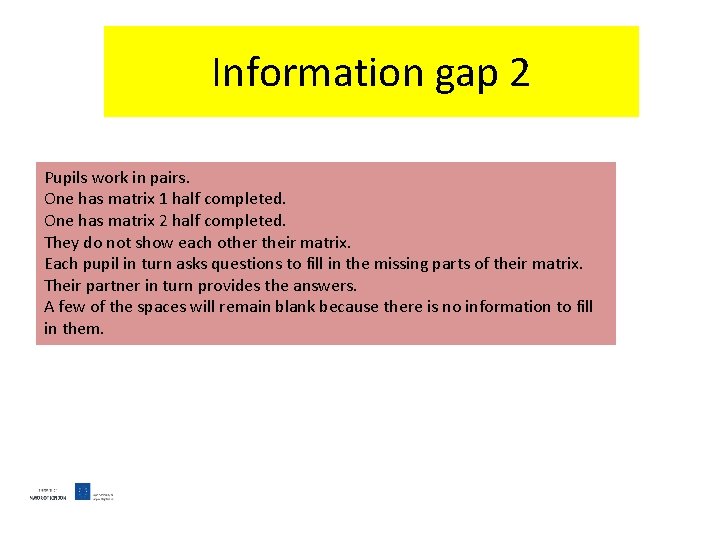
Information gap 2 Pupils work in pairs. One has matrix 1 half completed. One has matrix 2 half completed. They do not show each other their matrix. Each pupil in turn asks questions to fill in the missing parts of their matrix. Their partner in turn provides the answers. A few of the spaces will remain blank because there is no information to fill in them.
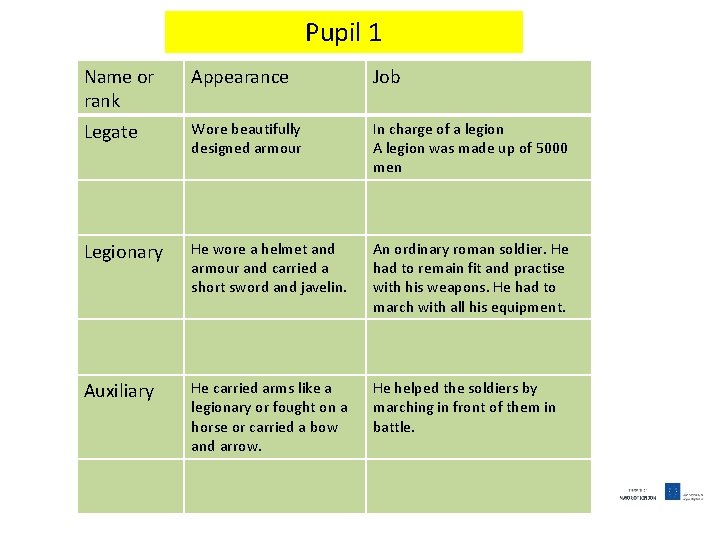
Pupil 1 Name or rank Appearance Job Legate Wore beautifully designed armour In charge of a legion A legion was made up of 5000 men Legionary He wore a helmet and armour and carried a short sword and javelin. An ordinary roman soldier. He had to remain fit and practise with his weapons. He had to march with all his equipment. Auxiliary He carried arms like a legionary or fought on a horse or carried a bow and arrow. He helped the soldiers by marching in front of them in battle.
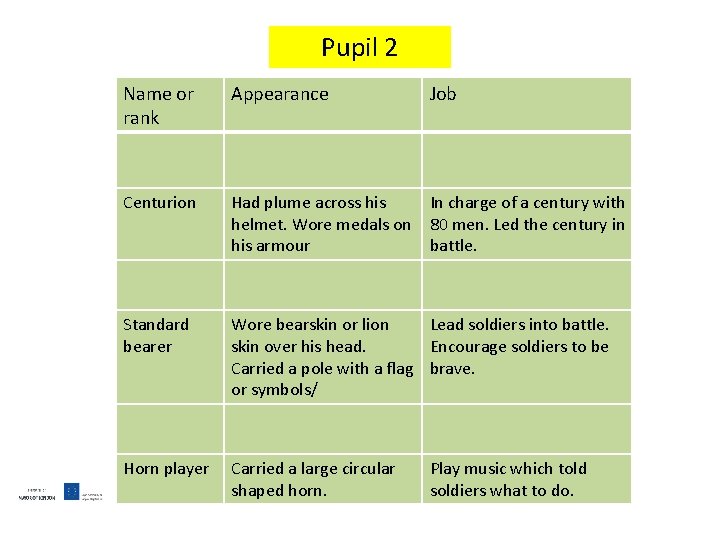
Pupil 2 Name or rank Appearance Job Centurion Had plume across his In charge of a century with helmet. Wore medals on 80 men. Led the century in his armour battle. Standard bearer Wore bearskin or lion Lead soldiers into battle. skin over his head. Encourage soldiers to be Carried a pole with a flag brave. or symbols/ Horn player Carried a large circular shaped horn. Play music which told soldiers what to do.
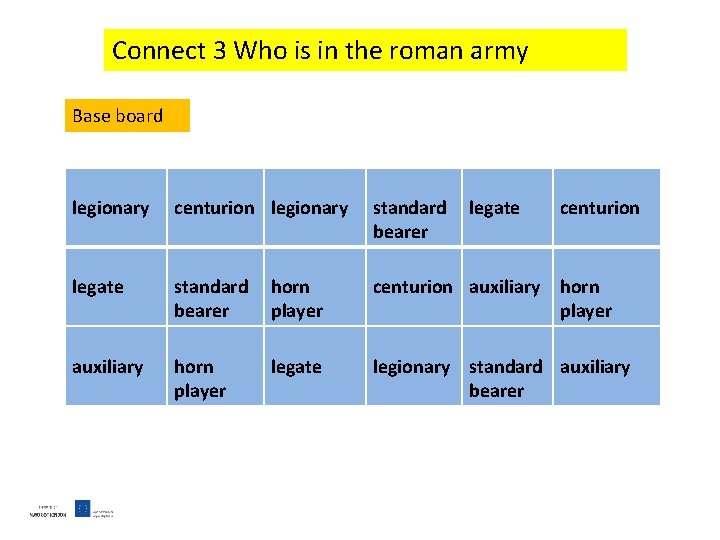
Connect 3 Who is in the roman army Base board legionary centurion legionary standard bearer legate centurion legate standard bearer horn player centurion auxiliary horn player legate legionary standard auxiliary bearer
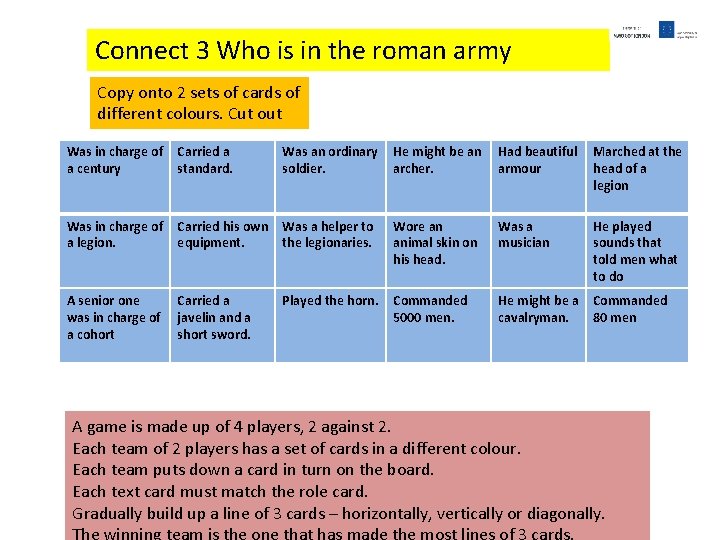
Connect 3 Who is in the roman army Copy onto 2 sets of cards of different colours. Cut out Was in charge of a century Carried a standard. Was an ordinary soldier. He might be an archer. Had beautiful armour Marched at the head of a legion Was in charge of a legion. Carried his own equipment. Was a helper to the legionaries. Wore an animal skin on his head. Was a musician He played sounds that told men what to do A senior one was in charge of a cohort Carried a javelin and a short sword. Played the horn. Commanded 5000 men. He might be a cavalryman. Commanded 80 men A game is made up of 4 players, 2 against 2. Each team of 2 players has a set of cards in a different colour. Each team puts down a card in turn on the board. Each text card must match the role card. Gradually build up a line of 3 cards – horizontally, vertically or diagonally.
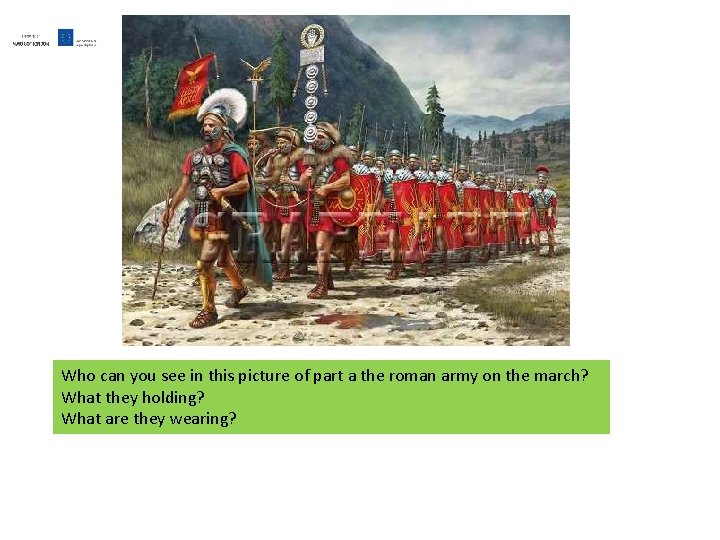
Who can you see in this picture of part a the roman army on the march? What they holding? What are they wearing?
- Slides: 16