
Describing resources I MARC CERNUNESCO School on Digital
Describing resources I: MARC CERN-UNESCO School on Digital Libraries Rabat, Nov 22 -26, 2010 Annette Holtkamp CERN
Metadata • • • data about data structured, descriptive information about a resource key to resource discovery useful for records management, archiving metadata element: – field for storing specific information (like title) • metadata value: – content of one metadata element – may be taken from predefined vocabulary
Metadata types • descriptive – identification and retrieval • title, author, abstract… • structural – presentation • chapters of a book, … • administrative – management and preservation • version, technical info, access control
Metadata schema • defined set of metadata elements • serving a specific purpose – e. g. specific discipline, type of resource • specify name and meaning of its elements • optional rules – content, representation, element values, syntax… • metadata standards – MARC, Dublin Core…

MARC MAchine Readable Cataloguing • international standard for representing and communicating bibliographic records • developed in the 60 s • catalogue card oriented • high degree of complexity – all purpose • basis of most library catalogs, huge user base http: //www. loc. gov/marc

MARC 21 • • evolution of MARC combination of US and Canadian MARC formats internationalization Unicode – standard for encoding and representing text in multilingual environments – > 100 k characters – 93 scripts
Formats • bibliographic – books, periodicals, computer files, maps, music, visual materials, mixed materials • authority – authorized forms of names and subjects • classification – classification numbers or index terms • holdings – single-part, multi-part and serial items – copy-specific information • community information – non-bibliographic ressources of a community • scientists, institutions, conferences
Bibliographic record - structure Leader basic information about the item e. g. type of material information for the processing of the record length, status, character coding scheme… fixed field, first 24 character positions of each bibl record directory Computer-generated index to location of control and data fields 12 characters at position 24 control fields 00 x 001 – control number / system nr 003 – control number identifier, MARC code of organization 005 – date and time of latest transaction, version identifier 008 – general information on material 003 Sz. Ge. CERN e. g. 1 -character alphabetic code at pos 23 specifying form of material (b: microfiche) data fields
Data fields - structure three-character numeric tags often repeatable up to 2 indicators interpret or supplement the data found in the field lowercase alphabetic or numeric character numerous subfields lowercase alphabetic or numeric character independently defined for each field sometimes repeatable
Data fields - classes 0 xx – control, number and code fields 1 xx – main entry fields 2 xx – title/publication fields 3 xx – physical descriptions 4 xx – series fields 5 xx – note fields 6 xx – subject fields 7 xx – added entry fields 8 xx – series, holdings, location… 9 xx – reserved for local implementation complete list at http: //www. loc. gov/marc/bibliographic/
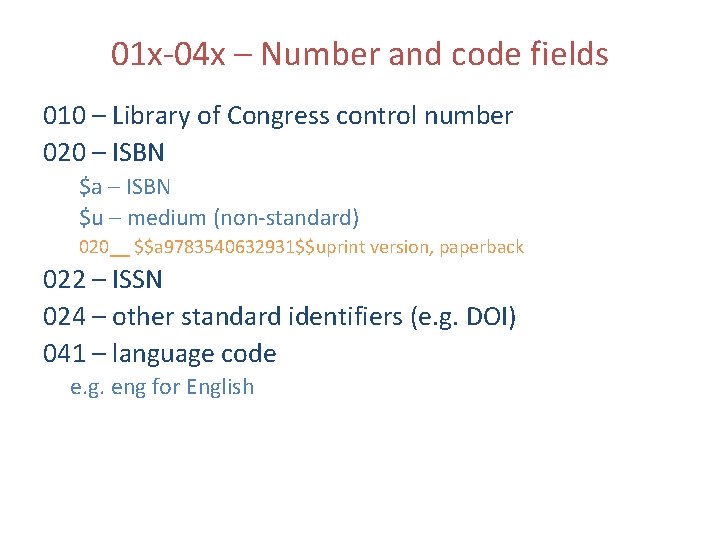
01 x-04 x – Number and code fields 010 – Library of Congress control number 020 – ISBN $a – ISBN $u – medium (non-standard) 020__ $$a 9783540632931$$uprint version, paperback 022 – ISSN 024 – other standard identifiers (e. g. DOI) 041 – language code e. g. eng for English
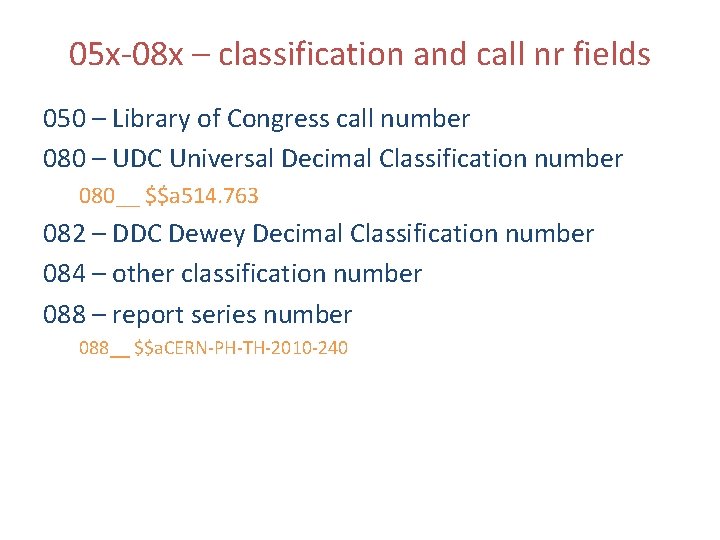
05 x-08 x – classification and call nr fields 050 – Library of Congress call number 080 – UDC Universal Decimal Classification number 080__ $$a 514. 763 082 – DDC Dewey Decimal Classification number 084 – other classification number 088 – report series number 088__ $$a. CERN-PH-TH-2010 -240
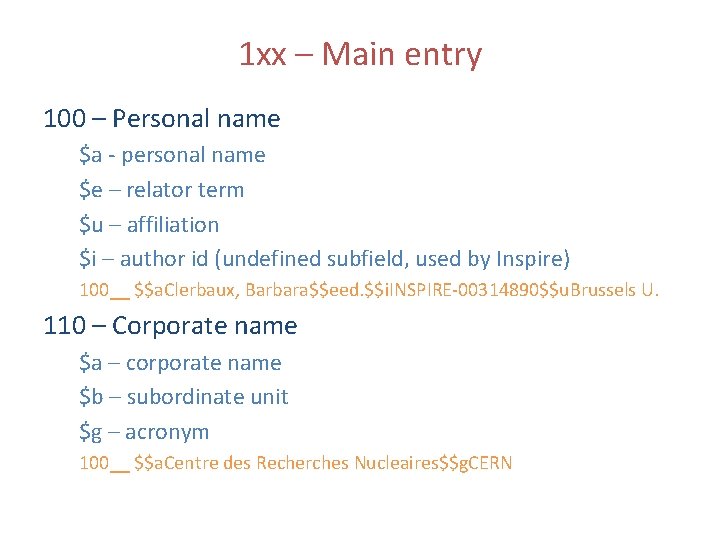
1 xx – Main entry 100 – Personal name $a - personal name $e – relator term $u – affiliation $i – author id (undefined subfield, used by Inspire) 100__ $$a. Clerbaux, Barbara$$eed. $$i. INSPIRE-00314890$$u. Brussels U. 110 – Corporate name $a – corporate name $b – subordinate unit $g – acronym 100__ $$a. Centre des Recherches Nucleaires$$g. CERN
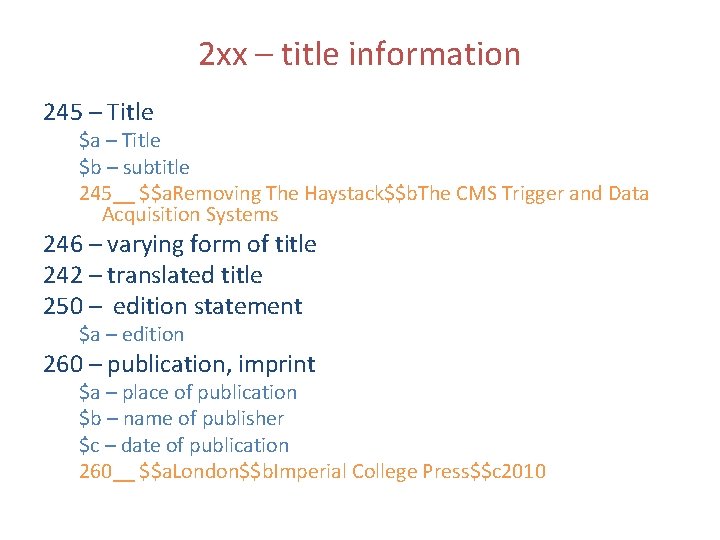
2 xx – title information 245 – Title $a – Title $b – subtitle 245__ $$a. Removing The Haystack$$b. The CMS Trigger and Data Acquisition Systems 246 – varying form of title 242 – translated title 250 – edition statement $a – edition 260 – publication, imprint $a – place of publication $b – name of publisher $c – date of publication 260__ $$a. London$$b. Imperial College Press$$c 2010
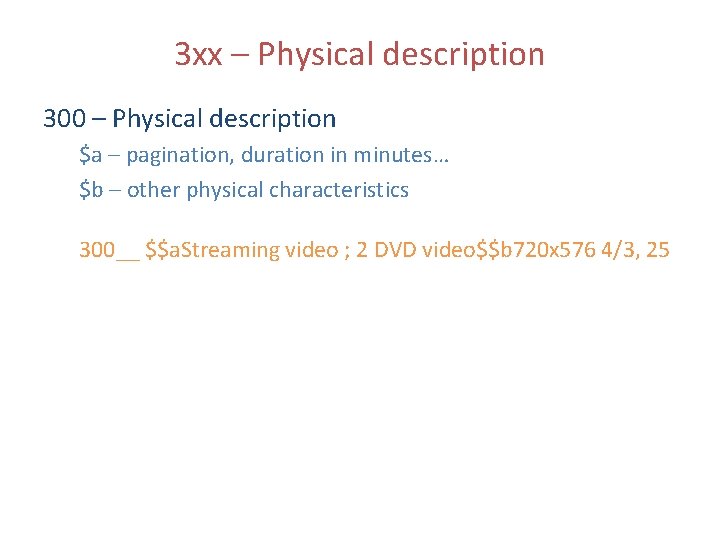
3 xx – Physical description 300 – Physical description $a – pagination, duration in minutes… $b – other physical characteristics 300__ $$a. Streaming video ; 2 DVD video$$b 720 x 576 4/3, 25
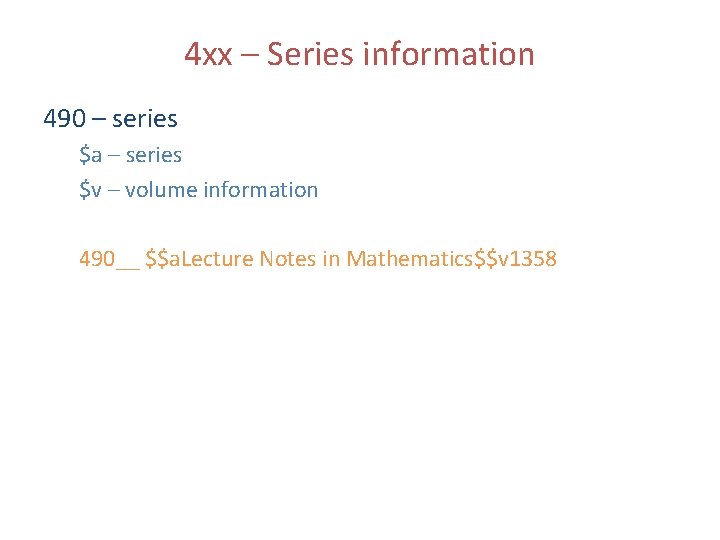
4 xx – Series information 490 – series $a – series $v – volume information 490__ $$a. Lecture Notes in Mathematics$$v 1358
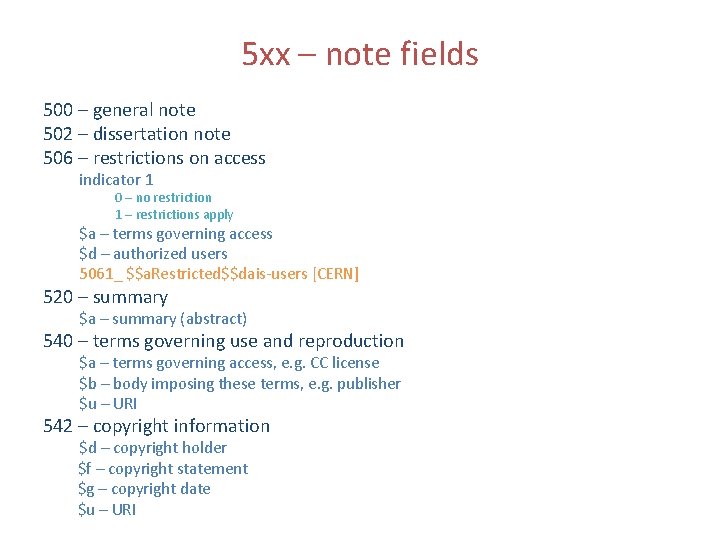
5 xx – note fields 500 – general note 502 – dissertation note 506 – restrictions on access indicator 1 0 – no restriction 1 – restrictions apply $a – terms governing access $d – authorized users 5061_ $$a. Restricted$$dais-users [CERN] 520 – summary $a – summary (abstract) 540 – terms governing use and reproduction $a – terms governing access, e. g. CC license $b – body imposing these terms, e. g. publisher $u – URI 542 – copyright information $d – copyright holder $f – copyright statement $g – copyright date $u – URI
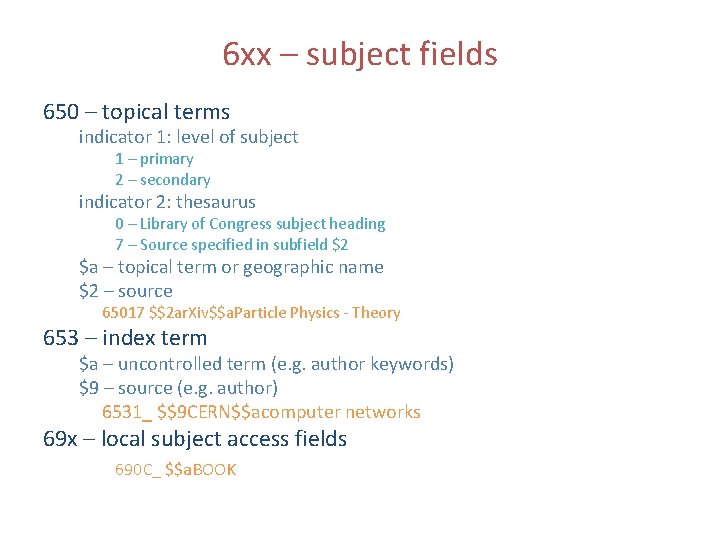
6 xx – subject fields 650 – topical terms indicator 1: level of subject 1 – primary 2 – secondary indicator 2: thesaurus 0 – Library of Congress subject heading 7 – Source specified in subfield $2 $a – topical term or geographic name $2 – source 65017 $$2 ar. Xiv$$a. Particle Physics - Theory 653 – index term $a – uncontrolled term (e. g. author keywords) $9 – source (e. g. author) 6531_ $$9 CERN$$acomputer networks 69 x – local subject access fields 690 C_ $$a. BOOK
7 xx – added entry fields 700 – additional authors 710 – additional corporate names
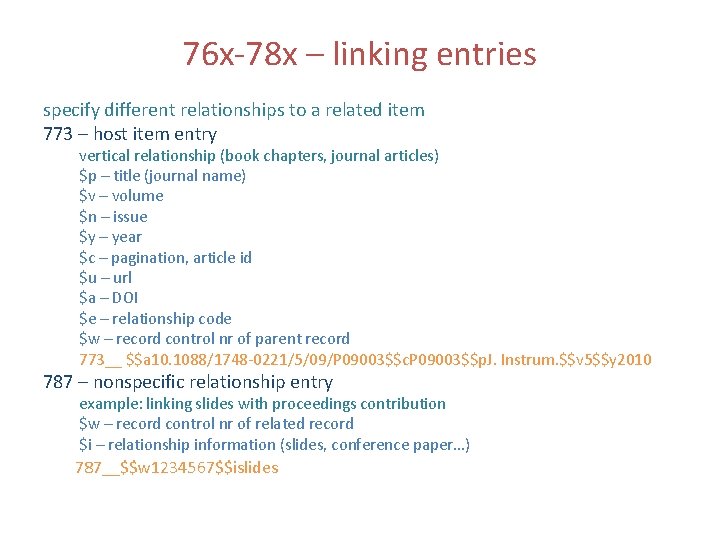
76 x-78 x – linking entries specify different relationships to a related item 773 – host item entry vertical relationship (book chapters, journal articles) $p – title (journal name) $v – volume $n – issue $y – year $c – pagination, article id $u – url $a – DOI $e – relationship code $w – record control nr of parent record 773__ $$a 10. 1088/1748 -0221/5/09/P 09003$$c. P 09003$$p. J. Instrum. $$v 5$$y 2010 787 – nonspecific relationship entry example: linking slides with proceedings contribution $w – record control nr of related record $i – relationship information (slides, conference paper…) 787__$$w 1234567$$islides
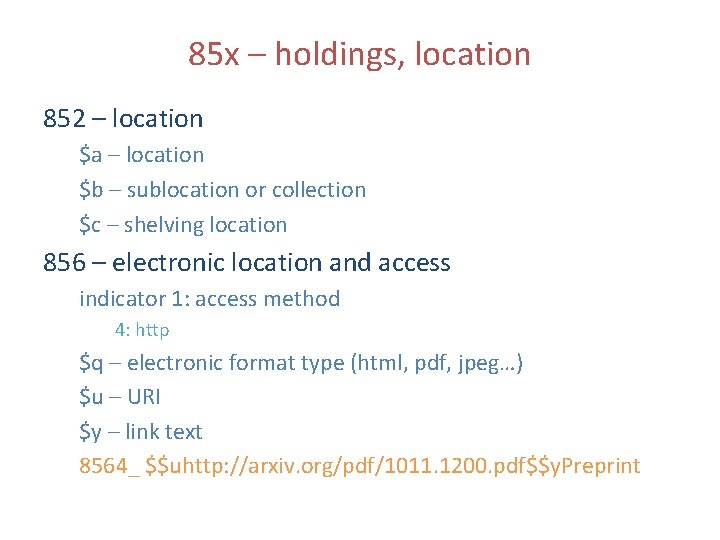
85 x – holdings, location 852 – location $a – location $b – sublocation or collection $c – shelving location 856 – electronic location and access indicator 1: access method 4: http $q – electronic format type (html, pdf, jpeg…) $u – URI $y – link text 8564_ $$uhttp: //arxiv. org/pdf/1011. 1200. pdf$$y. Preprint
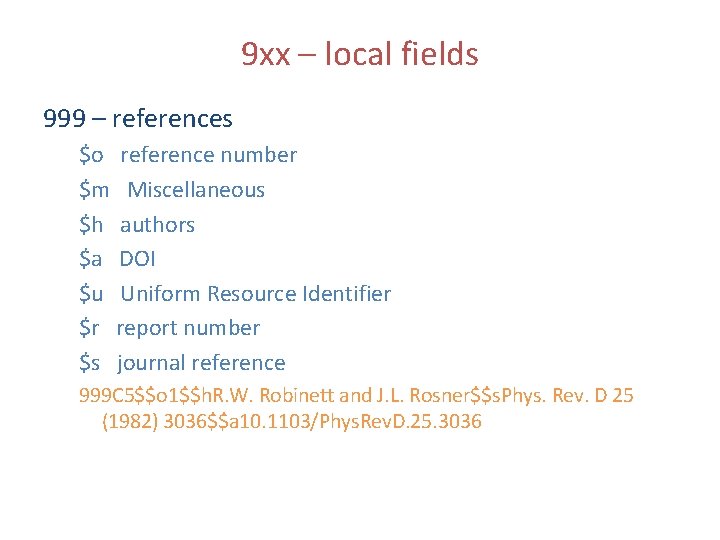
9 xx – local fields 999 – references $o reference number $m Miscellaneous $h authors $a DOI $u Uniform Resource Identifier $r report number $s journal reference 999 C 5$$o 1$$h. R. W. Robinett and J. L. Rosner$$s. Phys. Rev. D 25 (1982) 3036$$a 10. 1103/Phys. Rev. D. 25. 3036
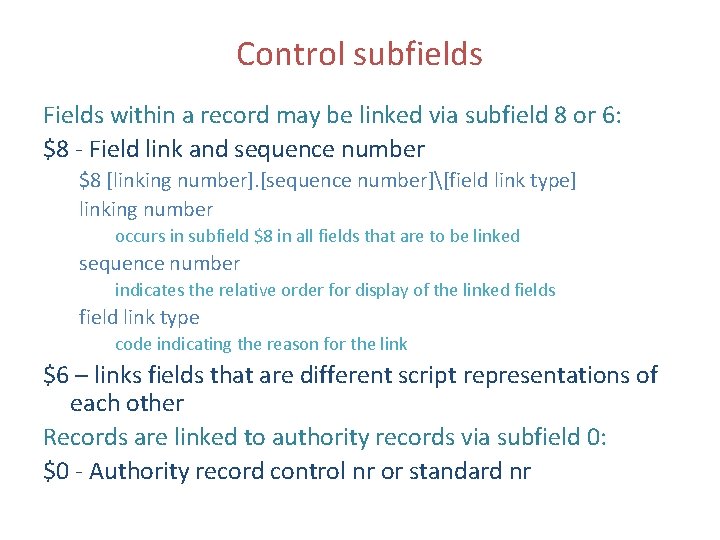
Control subfields Fields within a record may be linked via subfield 8 or 6: $8 - Field link and sequence number $8 [linking number]. [sequence number][field link type] linking number occurs in subfield $8 in all fields that are to be linked sequence number indicates the relative order for display of the linked fields field link type code indicating the reason for the link $6 – links fields that are different script representations of each other Records are linked to authority records via subfield 0: $0 - Authority record control nr or standard nr
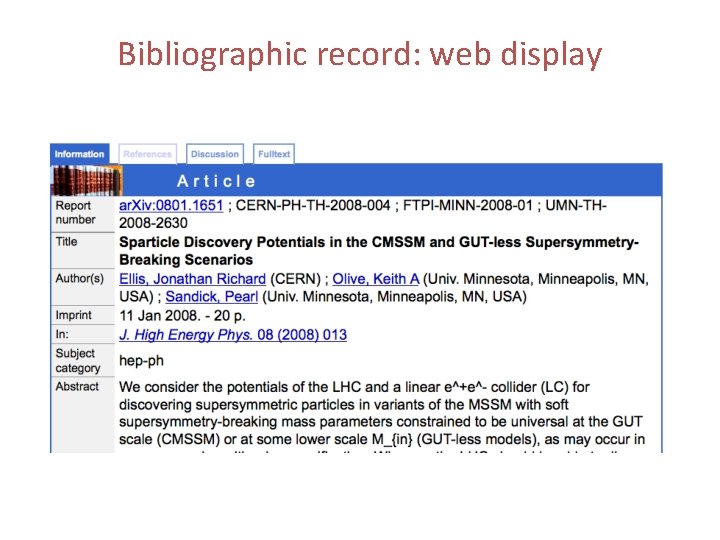
Bibliographic record: web display
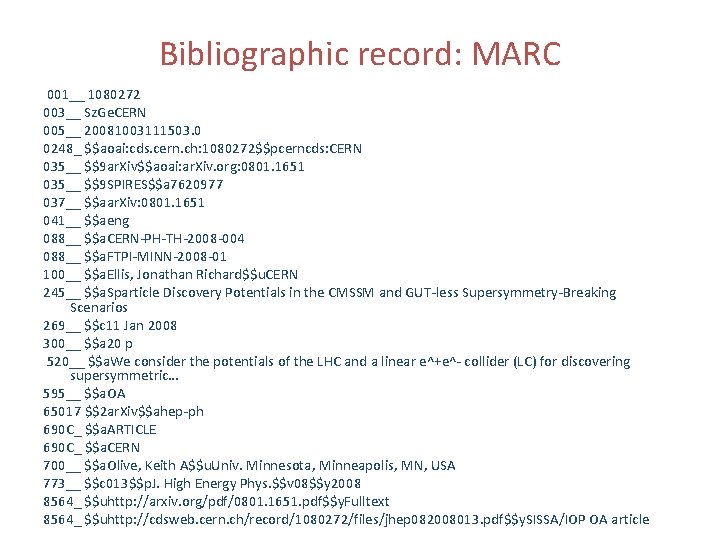
Bibliographic record: MARC 001__ 1080272 003__ Sz. Ge. CERN 005__ 20081003111503. 0 0248_ $$aoai: cds. cern. ch: 1080272$$pcerncds: CERN 035__ $$9 ar. Xiv$$aoai: ar. Xiv. org: 0801. 1651 035__ $$9 SPIRES$$a 7620977 037__ $$aar. Xiv: 0801. 1651 041__ $$aeng 088__ $$a. CERN-PH-TH-2008 -004 088__ $$a. FTPI-MINN-2008 -01 100__ $$a. Ellis, Jonathan Richard$$u. CERN 245__ $$a. Sparticle Discovery Potentials in the CMSSM and GUT-less Supersymmetry-Breaking Scenarios 269__ $$c 11 Jan 2008 300__ $$a 20 p 520__ $$a. We consider the potentials of the LHC and a linear e^+e^- collider (LC) for discovering supersymmetric… 595__ $$a. OA 65017 $$2 ar. Xiv$$ahep-ph 690 C_ $$a. ARTICLE 690 C_ $$a. CERN 700__ $$a. Olive, Keith A$$u. Univ. Minnesota, Minneapolis, MN, USA 773__ $$c 013$$p. J. High Energy Phys. $$v 08$$y 2008 8564_ $$uhttp: //arxiv. org/pdf/0801. 1651. pdf$$y. Fulltext 8564_ $$uhttp: //cdsweb. cern. ch/record/1080272/files/jhep 082008013. pdf$$y. SISSA/IOP OA article
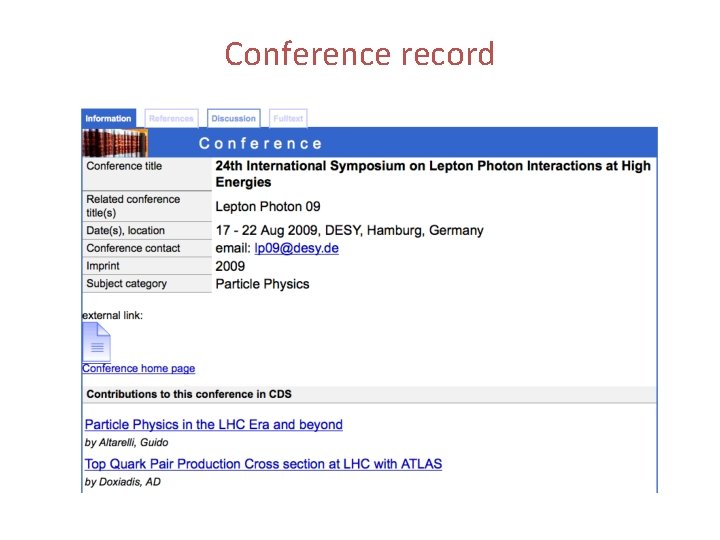
Conference record
MARC XML • XML schema based on MARC 21 • developed by Library of Congress • XML: Extensible Markup Language – set of rules for encoding arbitrary data structures – separates content (metadata) from presentation
MARC XML: elements • <collection> – file of several records • <record> – delineates records within a collection • <leader> – MARC leader data string • <control field> – MARC control field data string • <data field> • <subfield>
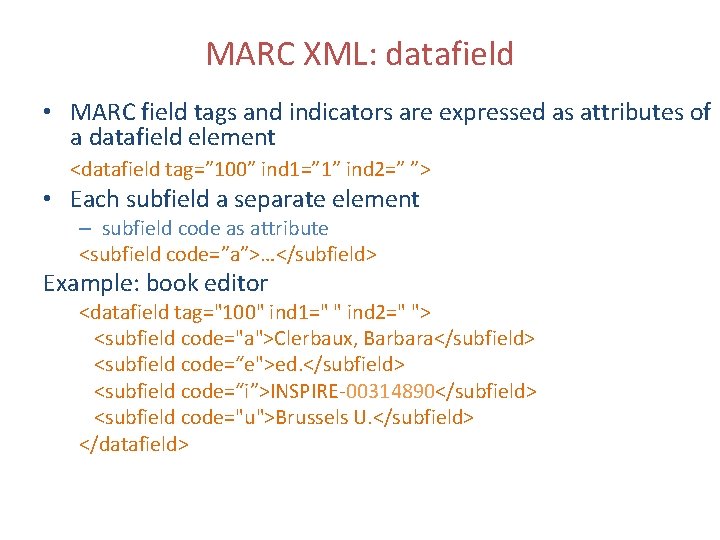
MARC XML: datafield • MARC field tags and indicators are expressed as attributes of a datafield element <datafield tag=” 100” ind 1=” 1” ind 2=” ”> • Each subfield a separate element – subfield code as attribute <subfield code=”a”>…</subfield> Example: book editor <datafield tag="100" ind 1=" " ind 2=" "> <subfield code="a">Clerbaux, Barbara</subfield> <subfield code=“e">ed. </subfield> <subfield code=“i”>INSPIRE-00314890</subfield> <subfield code="u">Brussels U. </subfield> </datafield>
MARC XML • • aim: easy sharing of bibl info easy access at subfield level lossless conversion from MARC 21 manipulated and transformed via XSL stylesheets – Extensible Stylesheet Language • “bus” for conversion between different standards
- Slides: 30