
Describing ONE Variable What is the typical value
Describing ONE Variable • What is the typical value? • Central Tendency Measures Mode Median Mean How Typical is the typical value? Measures of Variation Range Inter. Quartile Range IQR Variance/Standard Deviation
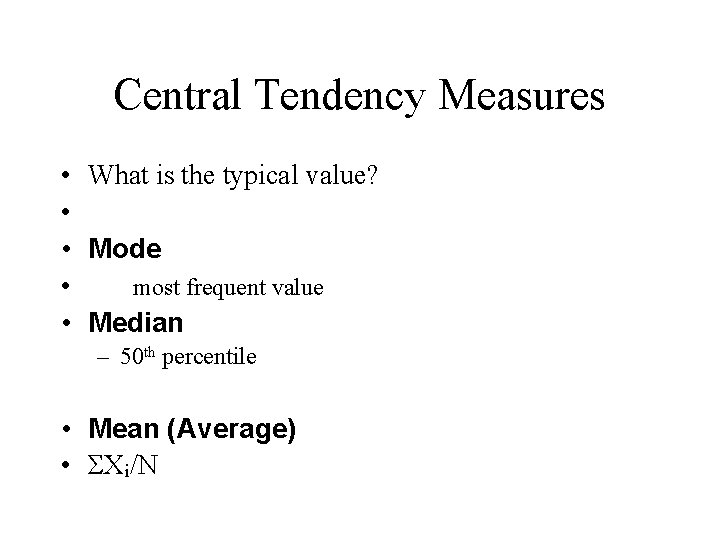
Central Tendency Measures • • • What is the typical value? Mode most frequent value Median – 50 th percentile • Mean (Average) • ΣXi/N
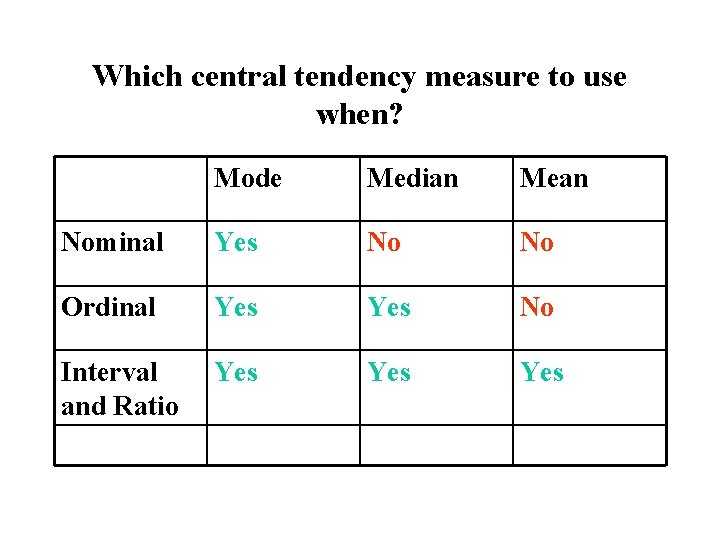
Which central tendency measure to use when? Mode Median Mean Nominal Yes No No Ordinal Yes No Interval and Ratio Yes Yes
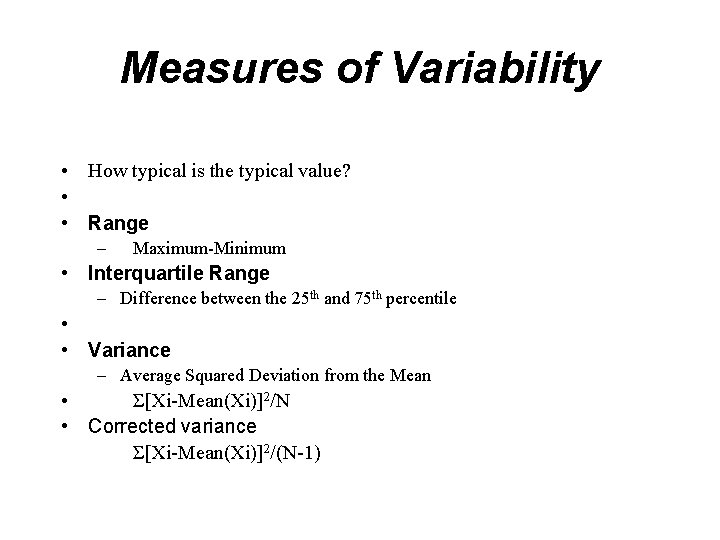
Measures of Variability • How typical is the typical value? • • Range – Maximum-Minimum • Interquartile Range – Difference between the 25 th and 75 th percentile • • Variance – Average Squared Deviation from the Mean • Σ[Xi-Mean(Xi)]2/N • Corrected variance Σ[Xi-Mean(Xi)]2/(N-1)
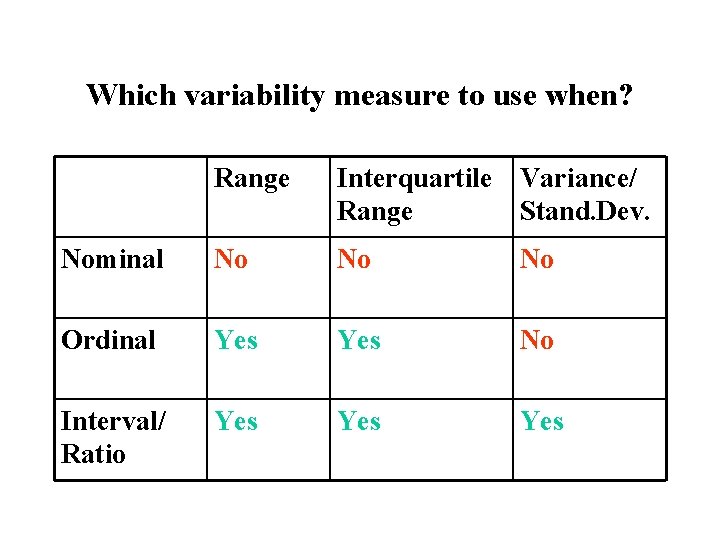
Which variability measure to use when? Range Interquartile Variance/ Range Stand. Dev. Nominal No No No Ordinal Yes No Interval/ Ratio Yes Yes
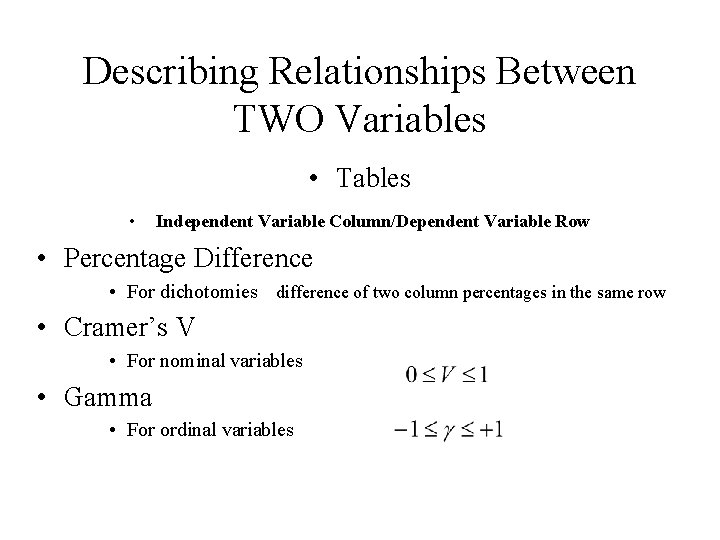
Describing Relationships Between TWO Variables • Tables • Independent Variable Column/Dependent Variable Row • Percentage Difference • For dichotomies difference of two column percentages in the same row • Cramer’s V • For nominal variables • Gamma • For ordinal variables
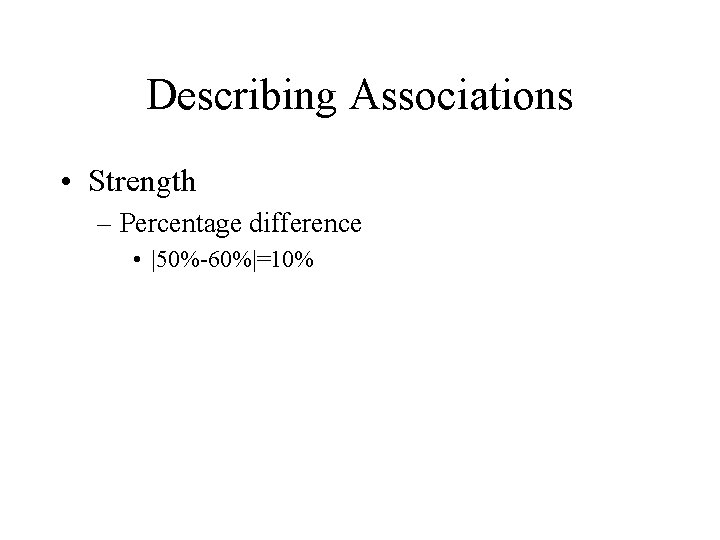
Describing Associations • Strength – Percentage difference • |50%-60%|=10%
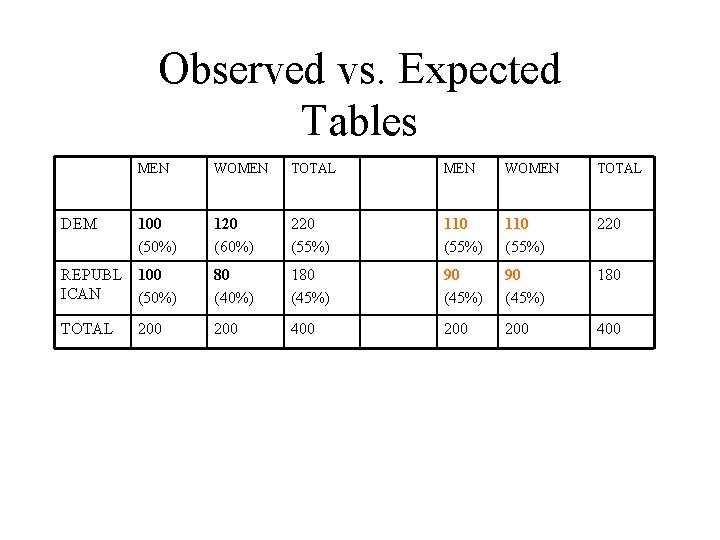
Observed vs. Expected Tables MEN WOMEN TOTAL 100 (50%) 120 (60%) 220 (55%) 110 (55%) 220 REPUBL 100 ICAN (50%) 80 (40%) 180 (45%) 90 (45%) 180 TOTAL 200 400 DEM 200
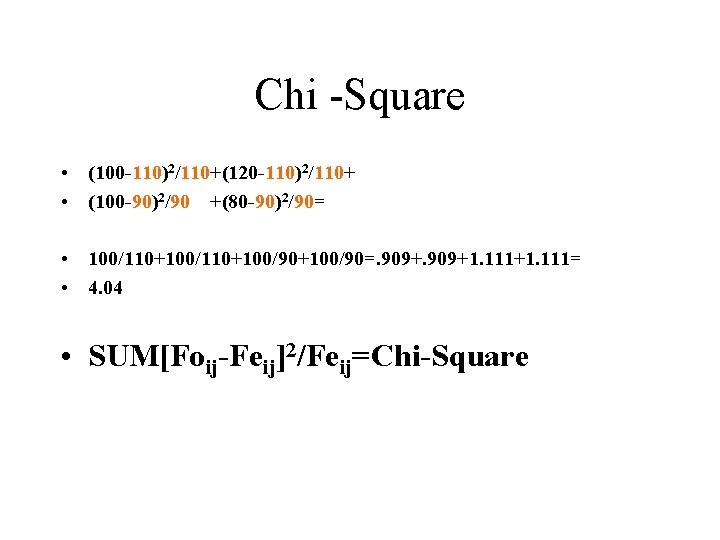
Chi -Square • (100 -110)2/110+(120 -110)2/110+ • (100 -90)2/90 +(80 -90)2/90= • 100/110+100/90+100/90=. 909+1. 111+1. 111= • 4. 04 • SUM[Foij-Feij]2/Feij=Chi-Square
![Cramer’s V • Cramer’s V=SQRT[Chi-Square/(N*Min(c-1, r-1)] • Cramer’s V is between 0 (no relationship)](http://slidetodoc.com/presentation_image/99f04f810b1d67a082599510f177b99f/image-10.jpg "Cramer’s V • Cramer’s V=SQRT[Chi-Square/(N*Min(c-1, r-1)] • Cramer’s V is between 0 (no relationship)")
Cramer’s V • Cramer’s V=SQRT[Chi-Square/(N*Min(c-1, r-1)] • Cramer’s V is between 0 (no relationship) • and 1 (perfect relationship) • V=SQRT[4. 04/400*1]=. 1005
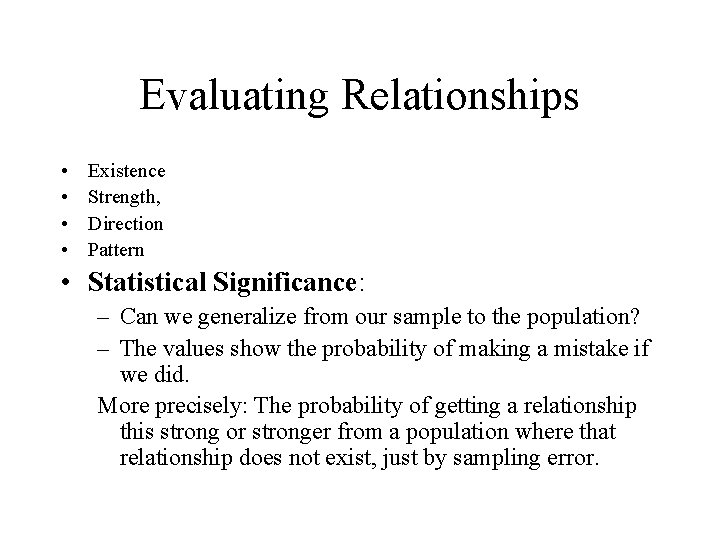
Evaluating Relationships • • Existence Strength, Direction Pattern • Statistical Significance: – Can we generalize from our sample to the population? – The values show the probability of making a mistake if we did. More precisely: The probability of getting a relationship this strong or stronger from a population where that relationship does not exist, just by sampling error.
- Slides: 11