
Describing Motions Kinematics A branch of physics that
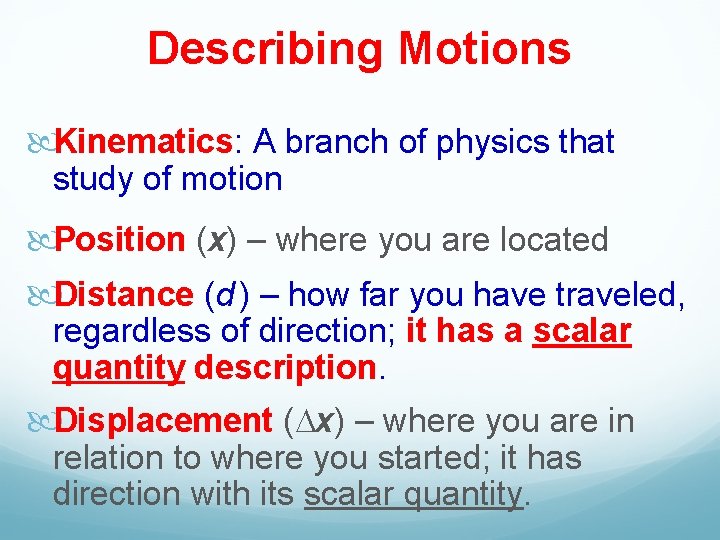
Describing Motions Kinematics: A branch of physics that study of motion Position (x) – where you are located Distance (d ) – how far you have traveled, regardless of direction; it has a scalar quantity description. Displacement ( x) – where you are in relation to where you started; it has direction with its scalar quantity.
Two Types of Quantities in Physics • 1. Scalar quantities: • 2. Vector quantities Remember: a quantity in the first place is an amount or number of something
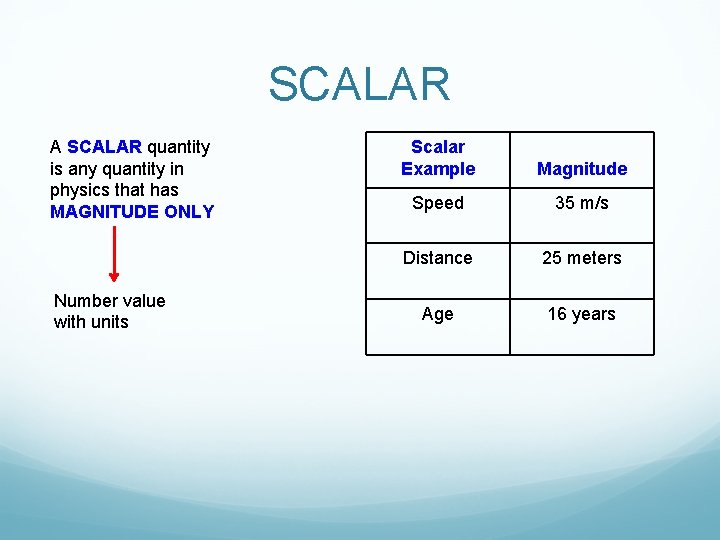
SCALAR A SCALAR quantity is any quantity in physics that has MAGNITUDE ONLY Number value with units Scalar Example Magnitude Speed 35 m/s Distance 25 meters Age 16 years
Scalar Quantities: • Have a size with a unit called a Magnitude but NO DIRECTION. • Examples: a distance of: (10 m) a time of : (6 s) a speed of : (12. 3 km/h)
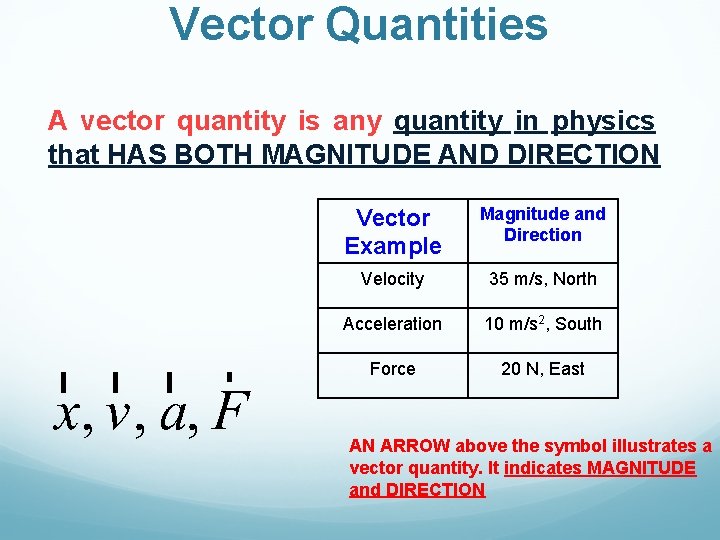
Vector Quantities A vector quantity is any quantity in physics that HAS BOTH MAGNITUDE AND DIRECTION Vector Example Magnitude and Direction Velocity 35 m/s, North Acceleration 10 m/s 2, South Force 20 N, East AN ARROW above the symbol illustrates a vector quantity. It indicates MAGNITUDE and DIRECTION
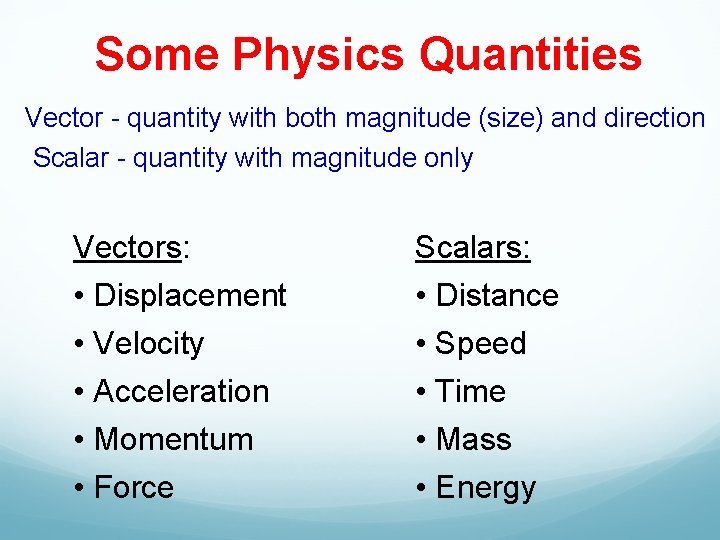
Some Physics Quantities Vector - quantity with both magnitude (size) and direction Scalar - quantity with magnitude only Vectors: • Displacement Scalars: • Distance • Velocity • Acceleration • Momentum • Force • Speed • Time • Mass • Energy
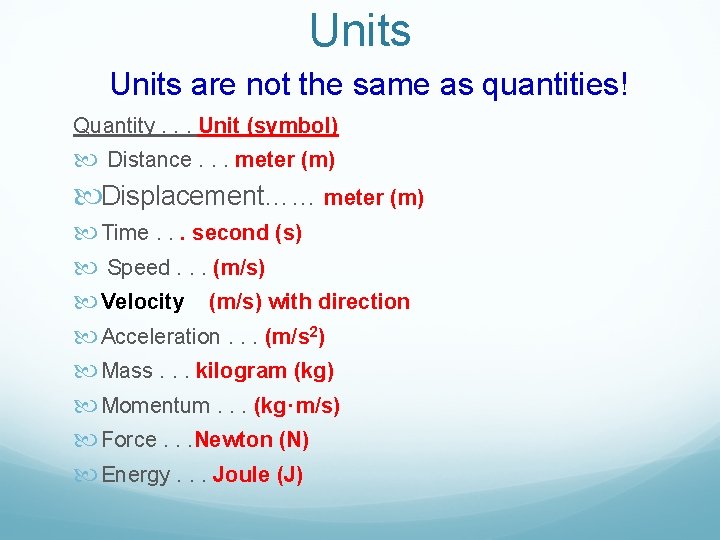
Units are not the same as quantities! Quantity. . . Unit (symbol) Distance. . . meter (m) Displacement…… meter (m) Time. . . second (s) Speed. . . (m/s) Velocity (m/s) with direction Acceleration. . . (m/s 2) Mass. . . kilogram (kg) Momentum. . . (kg · m/s) Force. . . Newton (N) Energy. . . Joule (J)
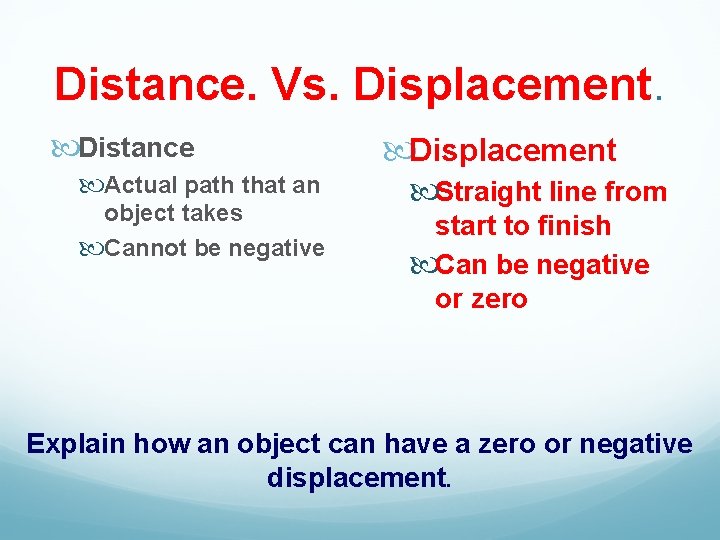
Distance. Vs. Displacement. Distance Actual path that an object takes Cannot be negative Displacement Straight line from start to finish Can be negative or zero Explain how an object can have a zero or negative displacement.
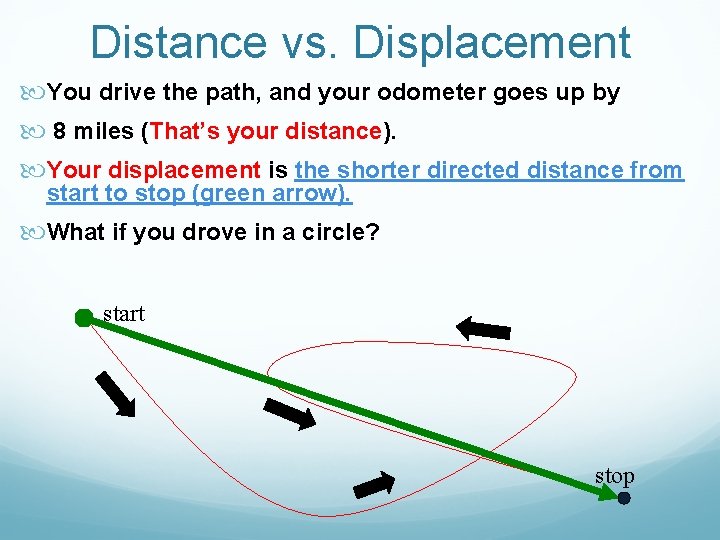
Distance vs. Displacement You drive the path, and your odometer goes up by 8 miles (That’s your distance). Your displacement is the shorter directed distance from start to stop (green arrow). What if you drove in a circle? start stop
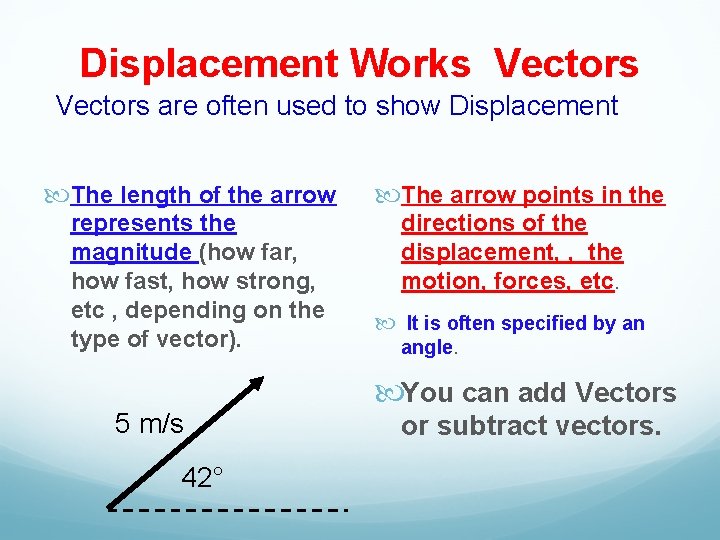
Displacement Works Vectors are often used to show Displacement The length of the arrow represents the magnitude (how far, how fast, how strong, etc , depending on the type of vector). 5 m/s 42° The arrow points in the directions of the displacement, , the motion, forces, etc. It is often specified by an angle. You can add Vectors or subtract vectors.
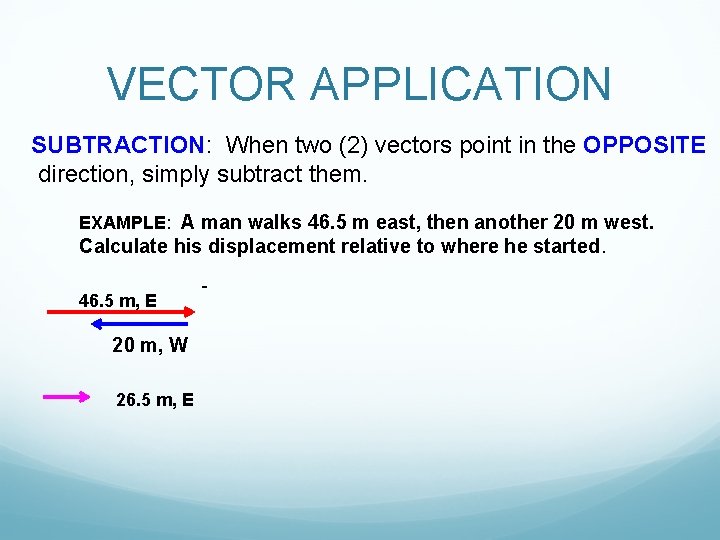
VECTOR APPLICATION SUBTRACTION: When two (2) vectors point in the OPPOSITE direction, simply subtract them. EXAMPLE: A man walks 46. 5 m east, then another 20 m west. Calculate his displacement relative to where he started. 46. 5 m, E 20 m, W 26. 5 m, E -
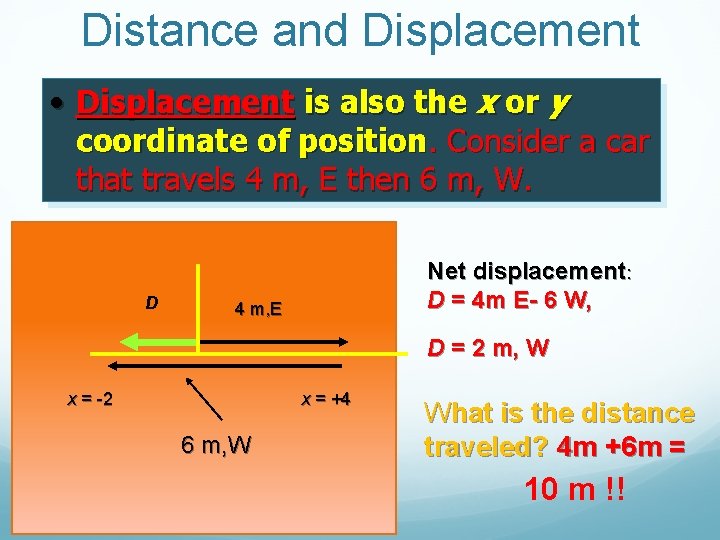
Distance and Displacement • Displacement is also the x or y coordinate of position. Consider a car that travels 4 m, E then 6 m, W. D Net displacement: D = 4 m E- 6 W, 4 m, E D = 2 m, W x = -2 x = +4 6 m, W What is the distance traveled? 4 m +6 m = 10 m !!
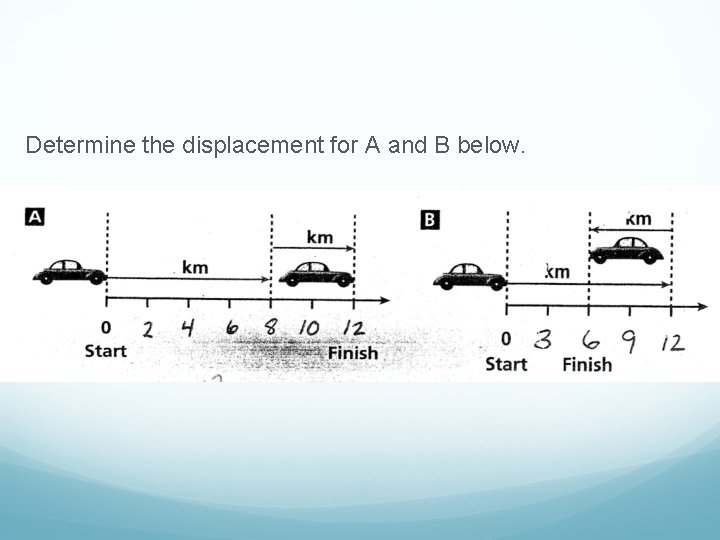
Determine the displacement for A and B below.
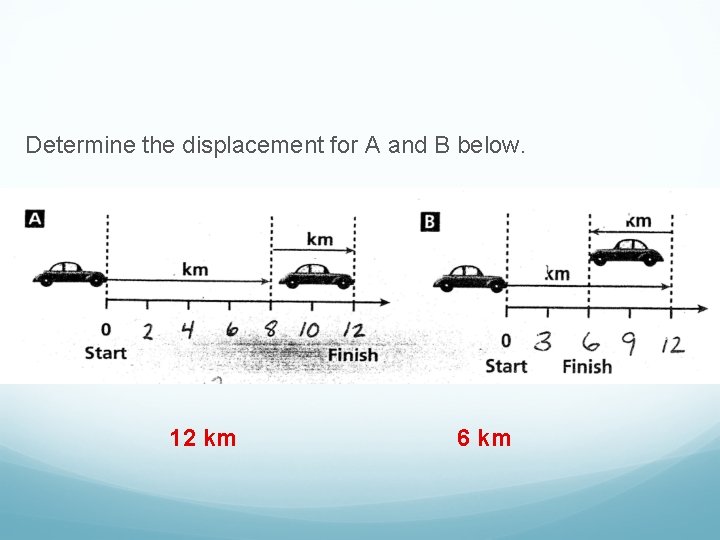
Determine the displacement for A and B below. 12 km 6 km
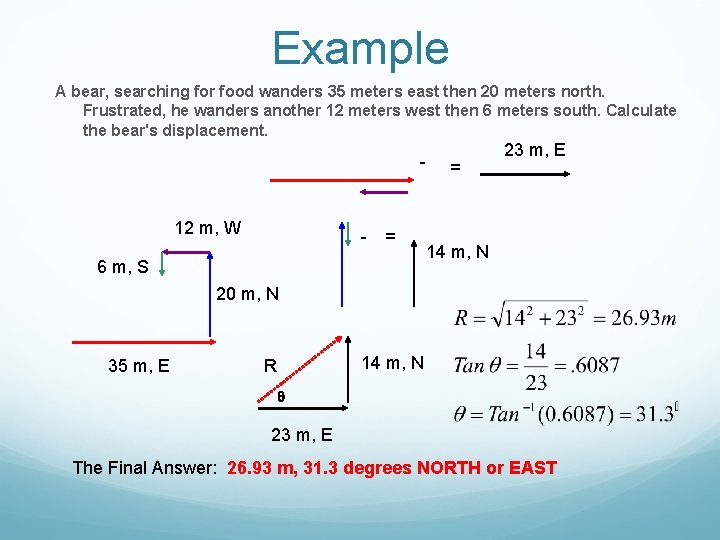
Example A bear, searching for food wanders 35 meters east then 20 meters north. Frustrated, he wanders another 12 meters west then 6 meters south. Calculate the bear's displacement. - 12 m, W - = 6 m, S = 23 m, E 14 m, N 20 m, N 35 m, E 14 m, N R q 23 m, E The Final Answer: 26. 93 m, 31. 3 degrees NORTH or EAST
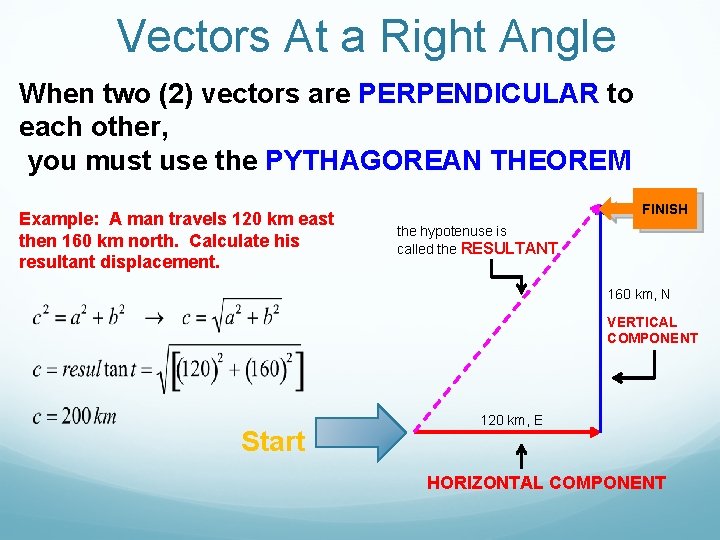
Vectors At a Right Angle When two (2) vectors are PERPENDICULAR to each other, you must use the PYTHAGOREAN THEOREM Example: A man travels 120 km east then 160 km north. Calculate his resultant displacement. FINISH the hypotenuse is called the RESULTANT 160 km, N VERTICAL COMPONENT Start 120 km, E HORIZONTAL COMPONENT
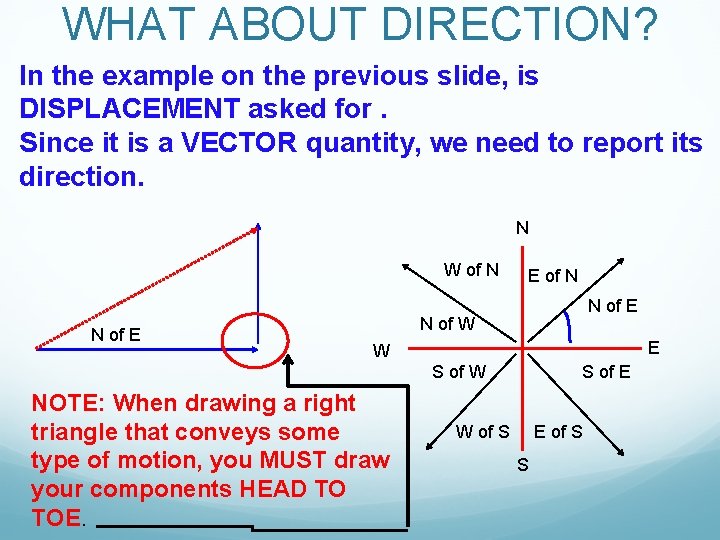
WHAT ABOUT DIRECTION? In the example on the previous slide, is DISPLACEMENT asked for. Since it is a VECTOR quantity, we need to report its direction. N W of N N of E E of N N of E N of W E W S of W NOTE: When drawing a right triangle that conveys some type of motion, you MUST draw your components HEAD TO TOE. S of E W of S E of S S
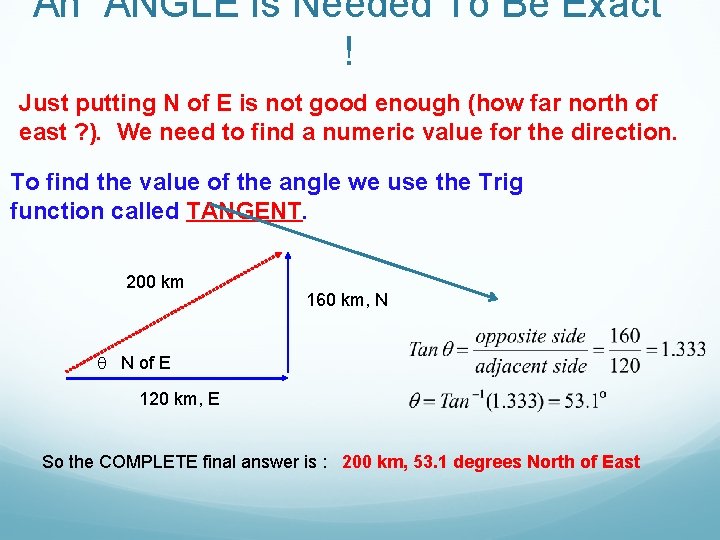
An ANGLE Is Needed To Be Exact ! Just putting N of E is not good enough (how far north of east ? ). We need to find a numeric value for the direction. To find the value of the angle we use the Trig function called TANGENT. 200 km 160 km, N q N of E 120 km, E So the COMPLETE final answer is : 200 km, 53. 1 degrees North of East
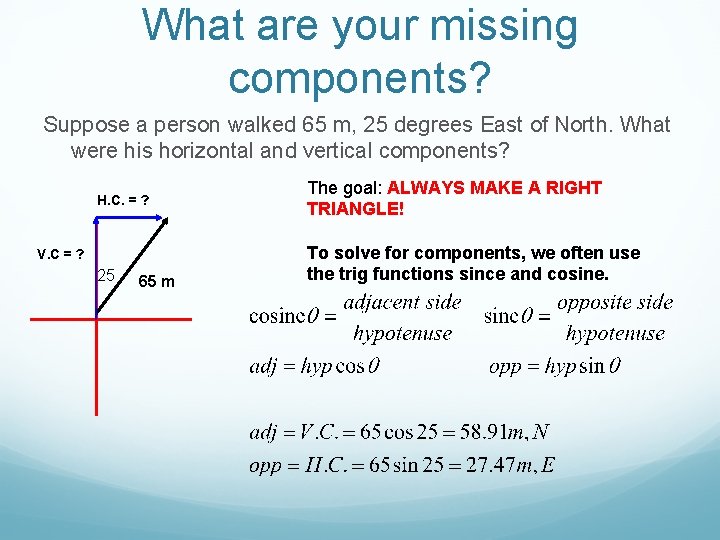
What are your missing components? Suppose a person walked 65 m, 25 degrees East of North. What were his horizontal and vertical components? H. C. = ? V. C = ? 25 65 m The goal: ALWAYS MAKE A RIGHT TRIANGLE! To solve for components, we often use the trig functions since and cosine.
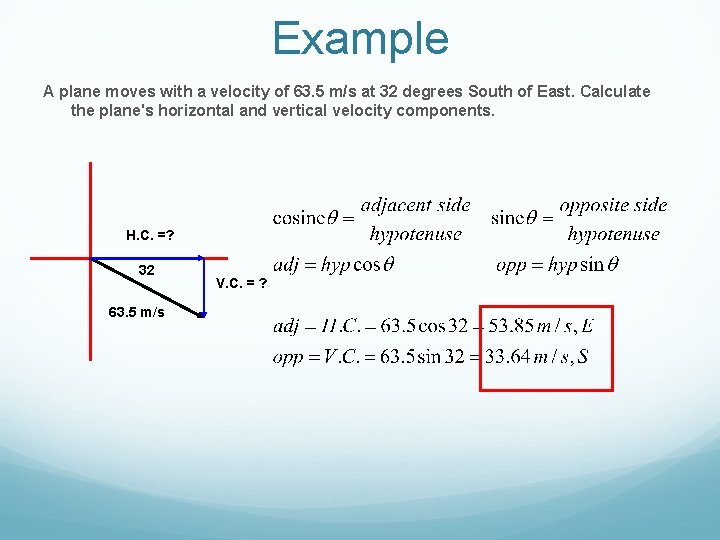
Example A plane moves with a velocity of 63. 5 m/s at 32 degrees South of East. Calculate the plane's horizontal and vertical velocity components. H. C. =? 32 63. 5 m/s V. C. = ?
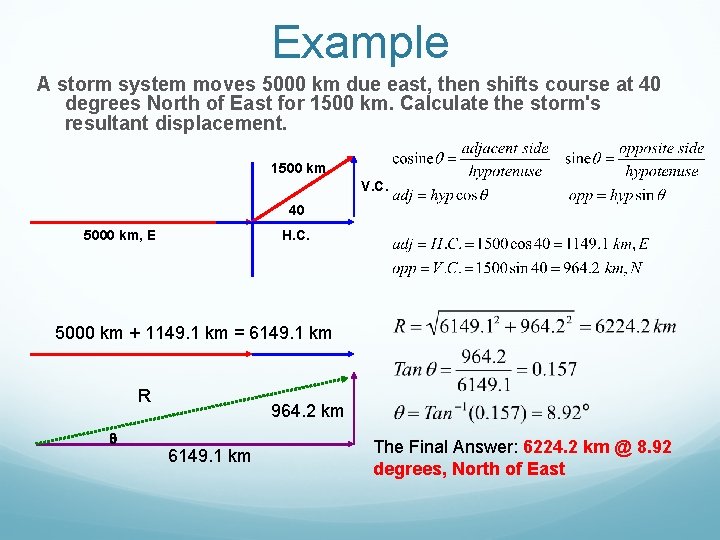
Example A storm system moves 5000 km due east, then shifts course at 40 degrees North of East for 1500 km. Calculate the storm's resultant displacement. 1500 km V. C. 40 5000 km, E H. C. 5000 km + 1149. 1 km = 6149. 1 km R q 964. 2 km 6149. 1 km The Final Answer: 6224. 2 km @ 8. 92 degrees, North of East
- Slides: 21