
Describing Motion Objective By the end of Chapter
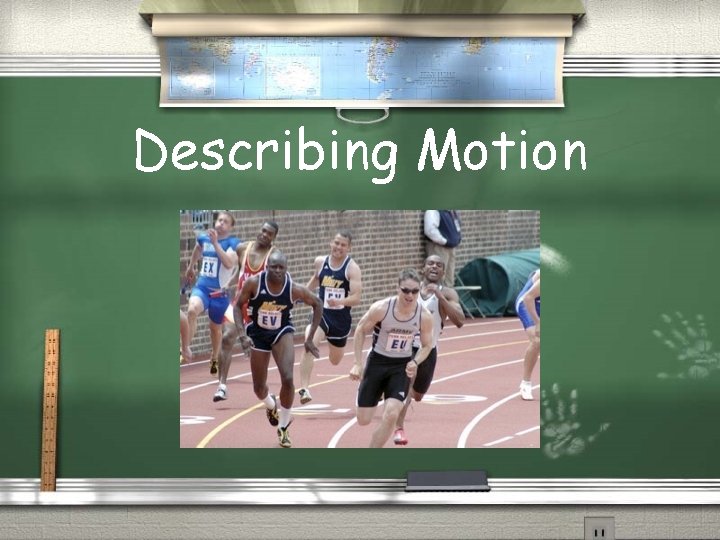
Describing Motion
Objective: By the end of Chapter 2 we will know the concepts of motion; position, displacement, velocity, and acceleration.

Warm Up: Think-Pair-Share: How would you describe motion to another person? ü ü ü Football play Futbol play Basketball play Baseball play Movie Scene
Picturing Motion
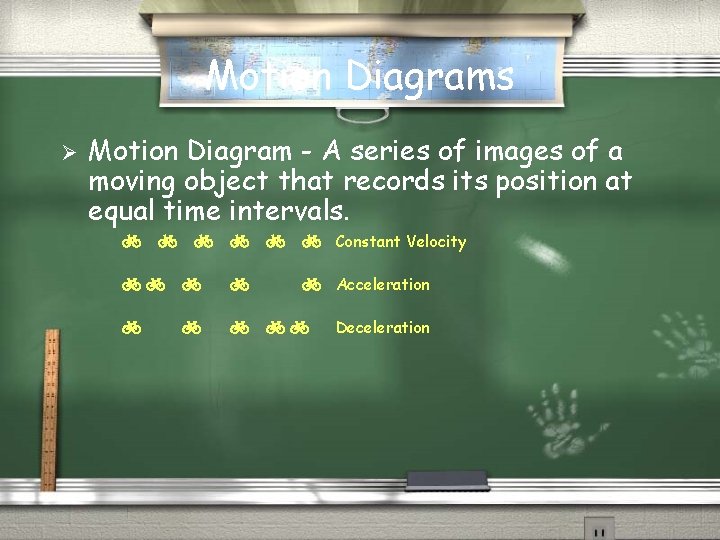
Motion Diagrams Motion Diagram - A series of images of a moving object that records its position at equal time intervals. b b b Constant Velocity bb b b b Acceleration b b b bb Deceleration
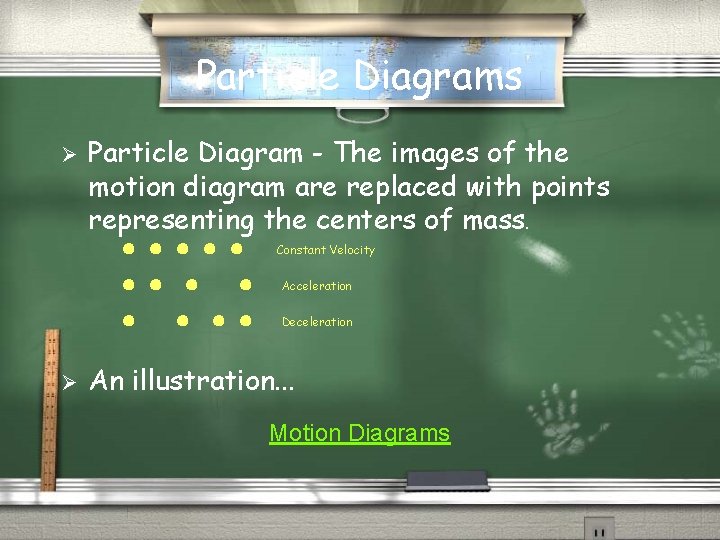
Particle Diagrams Particle Diagram - The images of the motion diagram are replaced with points representing the centers of mass. Constant Velocity Acceleration Deceleration An illustration. . . Motion Diagrams
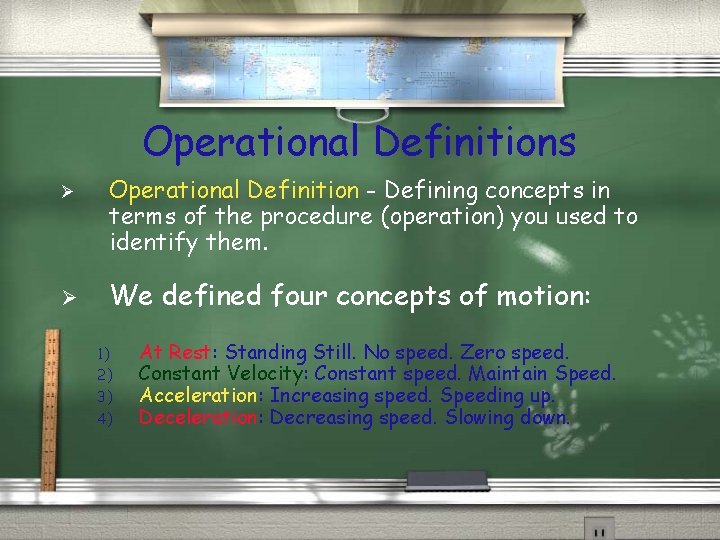
Operational Definitions Operational Definition - Defining concepts in terms of the procedure (operation) you used to identify them. We defined four concepts of motion: 1) 2) 3) 4) At Rest: Standing Still. No speed. Zero speed. Constant Velocity: Constant speed. Maintain Speed. Acceleration: Increasing speed. Speeding up. Deceleration: Decreasing speed. Slowing down.
How does it feel? How does constant velocity in a car "feel"? Why? How does acceleration in a car "feel"? Why? How does deceleration in a car "feel"? Why? Advanced thoughts… How does taking a curve in a car "feel"? Why?

Where and When?
Coordinate System - Deciding where to place the measuring tape and when to start the timer. Origin - Point where both variables are of value zero.
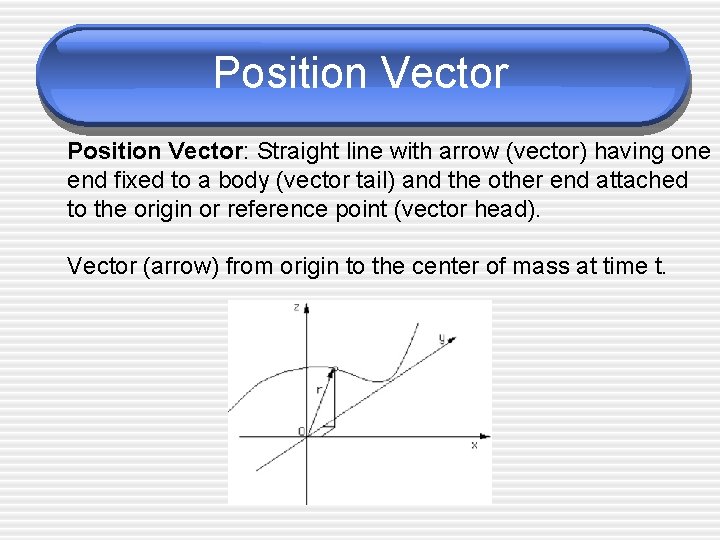
Position Vector: Straight line with arrow (vector) having one end fixed to a body (vector tail) and the other end attached to the origin or reference point (vector head). Vector (arrow) from origin to the center of mass at time t.
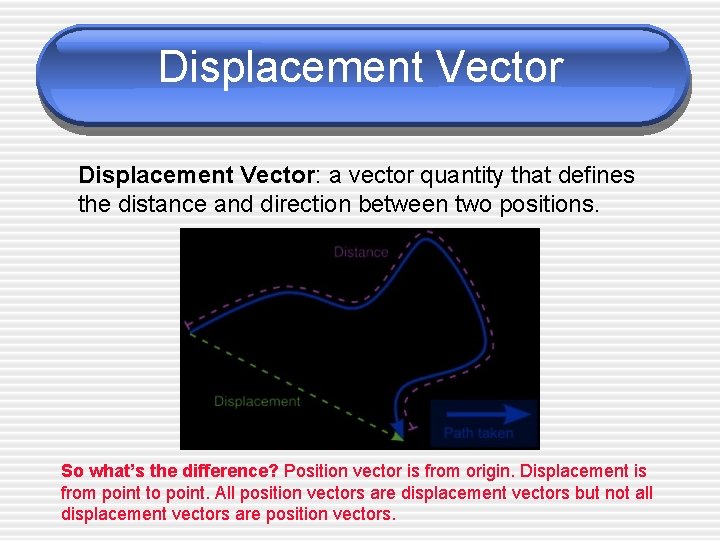
Displacement Vector: a vector quantity that defines the distance and direction between two positions. So what’s the difference? Position vector is from origin. Displacement is from point to point. All position vectors are displacement vectors but not all displacement vectors are position vectors.
Vectors versus Scalar Quantity - A quantity that tells you only the magnitude of something (e. g. temperature, mass, time. ) Vector Quantity - A quantity that tells you not only the magnitude of something but also the direction.
Velocity & Acceleration
Warm Up: Think-Pair-Share; What about motion makes you feel “jerky” or nauseous?
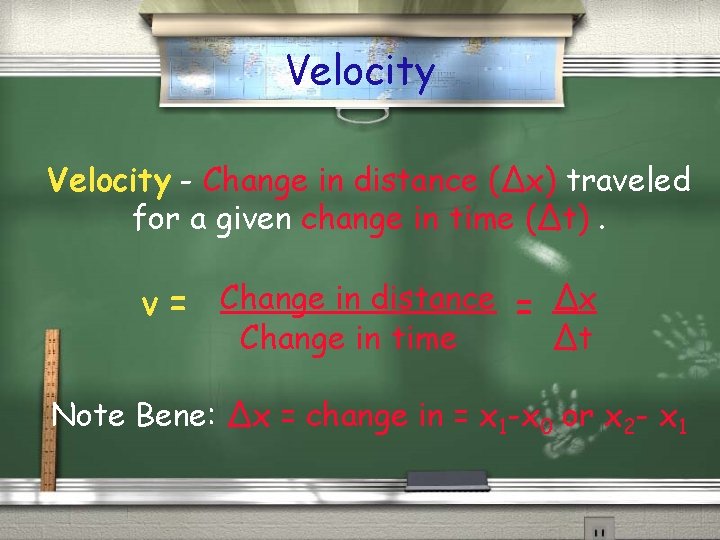
Velocity - Change in distance (∆x) traveled for a given change in time (∆t). v = Change in distance = ∆x Change in time ∆t Note Bene: ∆x = change in = x 1 -x 0 or x 2 - x 1
Average Velocity - Change in distance (∆x) traveled for a given change in time (∆t). ** Will not show fluctuations in speed during travel
Average Speed - Ratio of total change in distance (∆x) traveled to the total change in time (∆t).
Speed versus Velocity What is the difference? Vector = Magnitude + Direction Velocity = Magnitude + Direction + V=V Scalar = Magnitude Speed = Magnitude S=S
Instantaneous Velocity Instantaneous velocity - Velocity at a particular “instant” of time. This is a point on the distance - time graph. (A. k. a. Velocity at time “t”). Tangent to curve at time “t”.
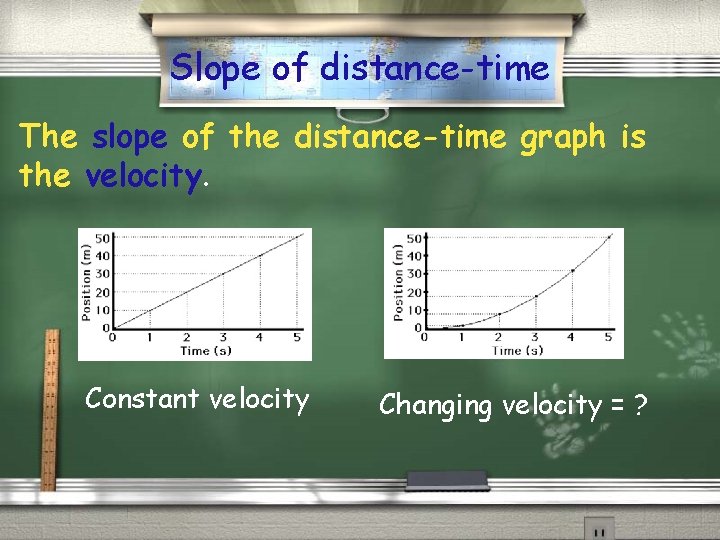
Slope of distance-time The slope of the distance-time graph is the velocity. Constant velocity Changing velocity = ?
Average Acceleration - Change in velocity (∆ ) traveled for a given change in time (∆t).
Instantaneous Acceleration Instantaneous acceleration - Acceleration at a particular “instant” of time. This is a point on the velocity-time graph. (A. k. a. acceleration at time “t”). Tangent to curve at time “t”.
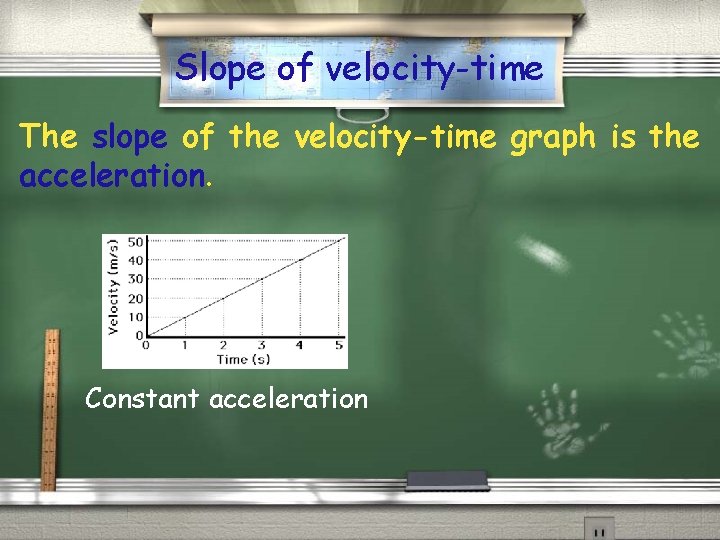
Slope of velocity-time The slope of the velocity-time graph is the acceleration. Constant acceleration
Problem Solving Follow these steps to solve problems: 1. 2. 3. 4. 5. 6. Read problem Make Diagram Identify Knowns Identify Unknowns Choose Formula Solve (and check) ***Acronym R&D Kufs
Chapter 2 Study Guide Section 2. 3 – Velocity and Acceleration
Homework and Quiz Chapter 2 Review – 1 -23 all, p. 60 -61
- Slides: 27