
Describing motion Distance Displacement Speed and Velocity State
Describing motion: Distance, Displacement, Speed and Velocity
State the obvious… motion When something has changed position, motion must have occurred. Some motion is obvious. The delivery truck is at your house. Later the delivery truck is down the street. Obviously, motion has occurred. So, what is relative motion?
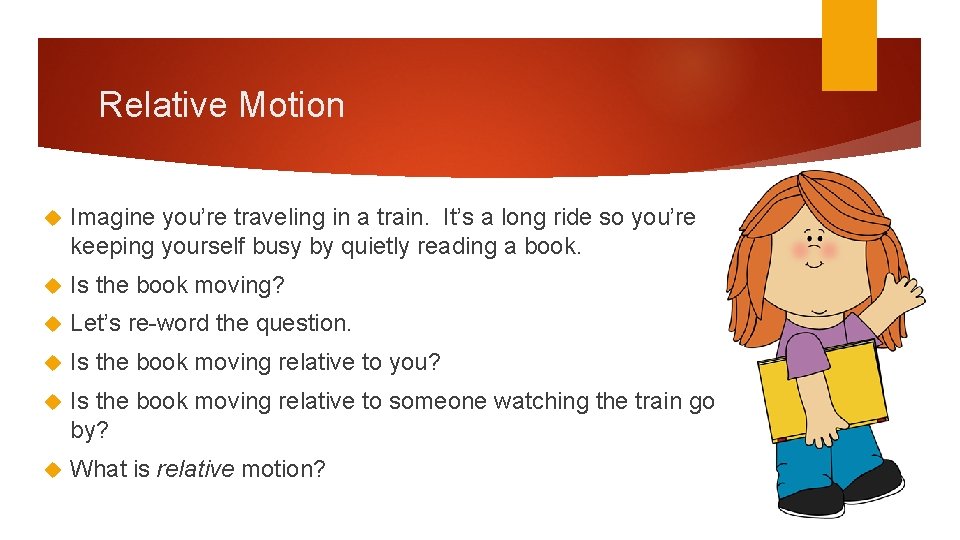
Relative Motion Imagine you’re traveling in a train. It’s a long ride so you’re keeping yourself busy by quietly reading a book. Is the book moving? Let’s re-word the question. Is the book moving relative to you? Is the book moving relative to someone watching the train go by? What is relative motion?
Relative Motion Relative means ‘as it relates to. ’ The book is moving relative to the person watching the train go by. The book is not moving relative to you.
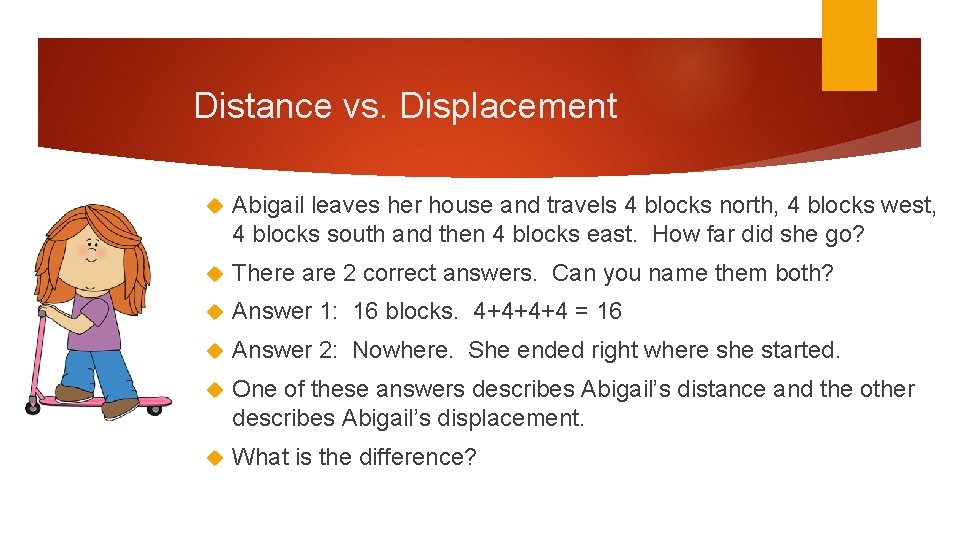
Distance vs. Displacement Abigail leaves her house and travels 4 blocks north, 4 blocks west, 4 blocks south and then 4 blocks east. How far did she go? There are 2 correct answers. Can you name them both? Answer 1: 16 blocks. 4+4+4+4 = 16 Answer 2: Nowhere. She ended right where she started. One of these answers describes Abigail’s distance and the other describes Abigail’s displacement. What is the difference?
Distance vs. Displacement Distance = How far an objected has moved Abigail’s distance was 16 blocks. Displacement = The distance and direction an object has moved from its starting point to its ending point Abigail’s displacement was 0 blocks. From her beginning location to her ending location was a distance of 0 blocks. We won’t add a direction because the difference is 0.
Distance vs. Displacement In a football game, the ball is placed on the line of scrimmage. It’s hiked back and the quarterback drops back 7 yards from the line of scrimmage. He then throws the ball 29 yards where it is caught by the wide receiver. The ball is carried an additional 4 yards where the wide receiver is pushed back 6 yards and tackled. What distance did the ball travel from the line of scrimmage? How far was the ball displaced from the line of scrimmage?
Distance vs. Displacement The ball travels a distance of 7 + 29 + 4 + 6 = 46 yards. When we calculate distance, direction doesn’t matter! The ball is displaced -7 + 29 + 4 + – 6 = 20 yards. When we calculate displacement, direction matters! Part of displacement is labeling the direction in which something was displaced. In this case it would just be down the football field and direction wasn’t given in traditional terms. Let’s try another!
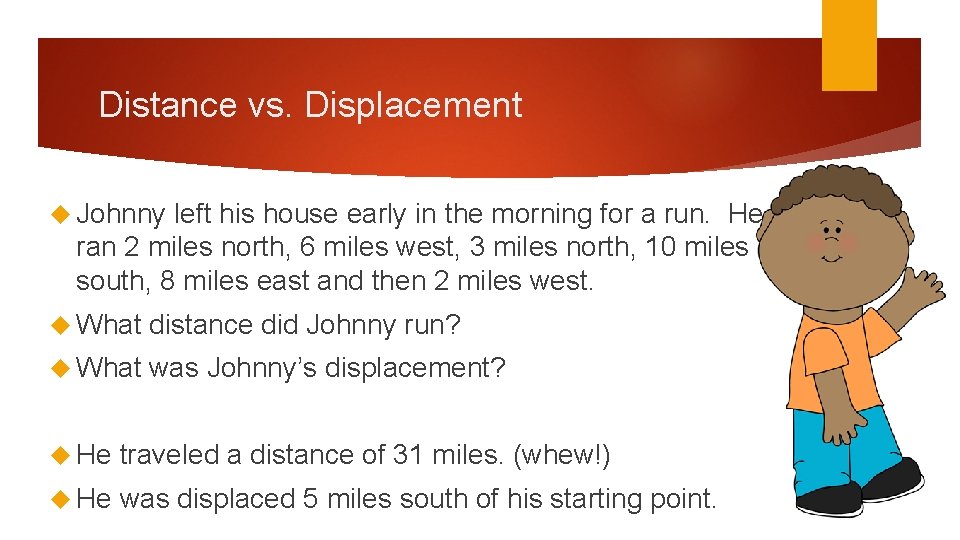
Distance vs. Displacement Johnny left his house early in the morning for a run. He ran 2 miles north, 6 miles west, 3 miles north, 10 miles south, 8 miles east and then 2 miles west. What distance did Johnny run? What was Johnny’s displacement? He traveled a distance of 31 miles. (whew!) He was displaced 5 miles south of his starting point.
Distance vs. Displacement Is it possible for the distance to be greater than the displacement? Explain. Is it possible for the displacement to be greater than the distance traveled? Explain.
Speed What are some common speed limits? What units are used to describe speed? What types of information do those units describe? In the United States, speed limits are stated in mph. What does that stand for? Miles per hour. Miles: describes a distance Hour: describes an amount of time So what IS speed?
Speed is the distance an object travels per unit of time. Speed = Distance ÷ Time Let’s calculate some speeds! Paul drove 80 miles in 2 hours. What was his average speed? 80 miles ÷ 2 hours = 40 miles/hour This makes sense, because when we say “miles per hour” we are really saying “miles per 1 hour. ” So if Paul drove 80 miles in 2 hours, he drove 40 miles per 1 hour.
Speed Baby Zeke crawled 6 meters in 45 seconds. What was his average speed? (Watch those units!) 6 meters÷ 45 seconds = 0. 13 meters per second One more! Dad mows the lawn. He mows a length of 156 meters in 856 seconds. At was speed was he moving? 156 meters ÷ 856 seconds = 0. 18 meters per second
Average vs. Instantaneous Speed In the previous problems, we calculated the average speed something or someone was moving. It’s rare for anything to move at a constant speed. If Paul drove an average of 40 mph, this most likely contained periods of speeding up, slowing down and even stopping. The speed an object is moving at any given moment in time is it’s instantaneous speed.
Average vs. Instantaneous Speed Is it possible for the average speed to be greater than the instantaneous speed? Explain. Is it possible for the instantaneous speed to be greater than the average speed? Explain.
Speed vs. Velocity Speed tells us how fast something is moving. Have you ever gone on a roller coaster? What if I told you that the average speed of a roller coaster was 30 meters per second… but the velocity was constantly changing? What do you think velocity is? Velocity tells us both the speed and direction an object is moving. Can you name another time when speed might be constant but velocity is changing? Why would velocity be important when meteorologists report on a hurricane?
- Slides: 16