
Describing Data Lesson 3 Psychology Statistics Goals of
Describing Data Lesson 3
Psychology & Statistics Goals of Psychology l Describe, predict, influence behavior & cognitive processes n Role of statistics l Descriptive statistics n u. Describe, organize & summarize data u. Efficient communication l Inferential statistics u. Draw conclusions about data u. Aid decision making ~
Organizing Data Describing distribution of variables l enumeration: list raw data n Frequency distributions l organize tables or graphs l highlight important characteristics n urange, most frequent value ~
Distributions as Tables f = Frequency l # of times a value of variable occurs l Sf = n l calculate proportions & percentages n Tabular frequency distributions l ordered list of all values of variable & their frequencies l logical order (usually descending) ~ n
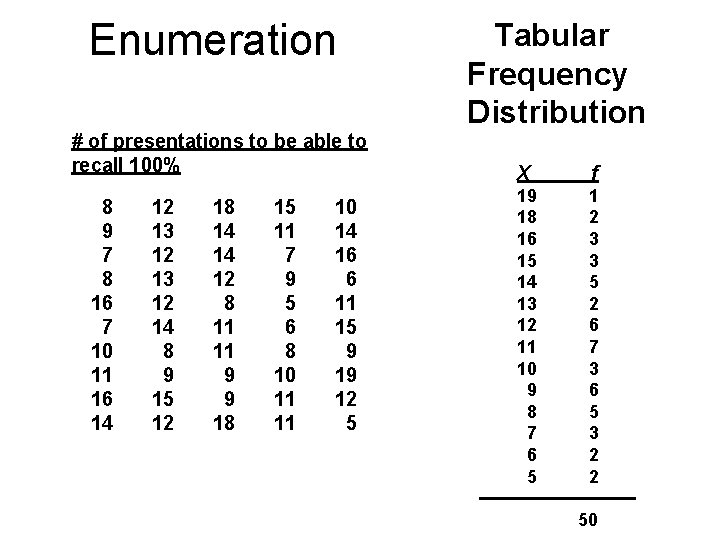
Enumeration # of presentations to be able to recall 100% 8 9 7 8 16 7 10 11 16 14 12 13 12 14 8 9 15 12 18 14 14 12 8 11 11 9 9 18 15 11 7 9 5 6 8 10 11 11 10 14 16 6 11 15 9 19 12 5 Tabular Frequency Distribution X f 19 18 16 15 14 13 12 11 10 9 8 7 6 5 1 2 3 3 5 2 6 7 3 6 5 3 2 2 50
Grouped Frequency Distribution Group by class intervals l report f for intervals l Lose information: exact values n General rules l each interval same width l consecutive & do not overlap ~ n
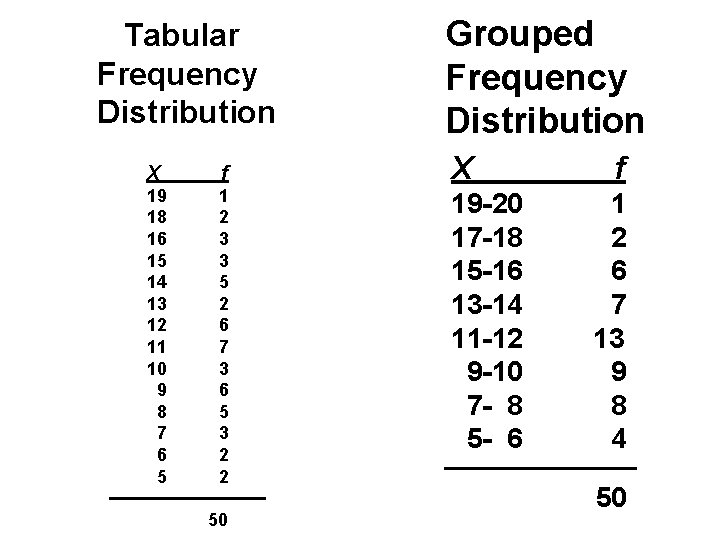
Tabular Frequency Distribution X f 19 18 16 15 14 13 12 11 10 9 8 7 6 5 1 2 3 3 5 2 6 7 3 6 5 3 2 2 50 Grouped Frequency Distribution X 19 -20 17 -18 15 -16 13 -14 11 -12 9 -10 7 - 8 5 - 6 f 1 2 6 7 13 9 8 4 50
Distributions as graphs Summarizes data l focus on clear communication n Bar Graphs l nominal or ordinal data n Histograms & Frequency Polygons l Interval/ratio data n ucontinuous & discrete variables ~
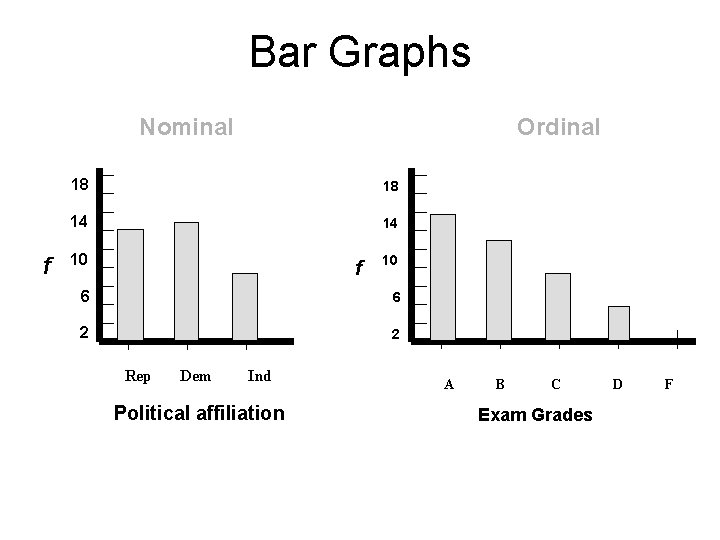
Bar Graphs Nominal f Ordinal 18 18 14 14 10 f 10 6 6 2 2 Rep Dem Ind Political affiliation A B C Exam Grades D F
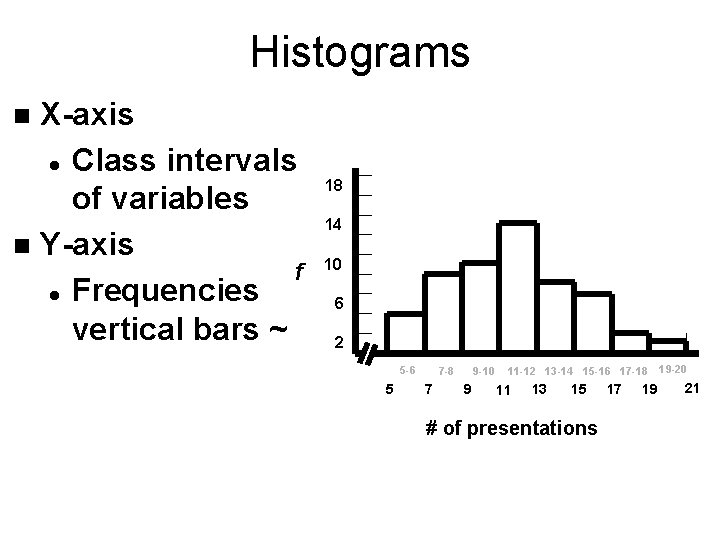
Histograms X-axis l Class intervals of variables n Y-axis f l Frequencies vertical bars ~ n 18 14 10 6 2 5 -6 5 7 -8 7 9 -10 9 11 -12 13 -14 15 -16 17 -18 11 13 15 # of presentations 17 19 19 -20 21
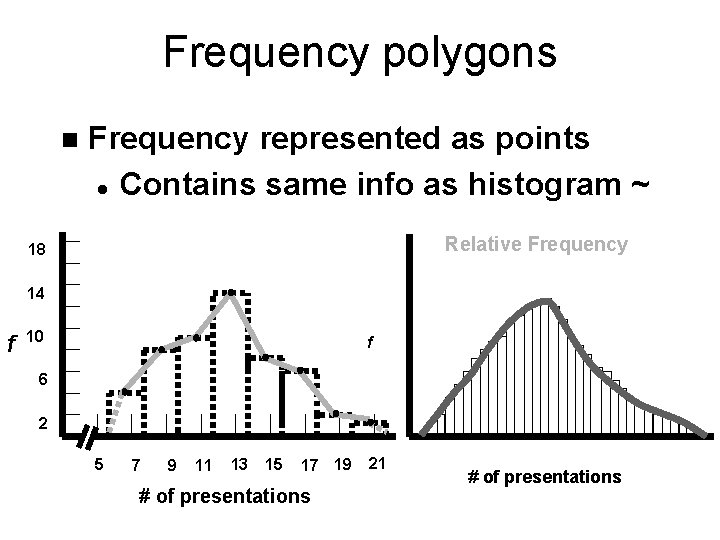
Frequency polygons n Frequency represented as points l Contains same info as histogram ~ Relative Frequency 18 14 f 10 f 6 2 5 7 9 11 13 15 17 19 # of presentations 21 # of presentations
Distributions: 3 useful features n Summarizes important characteristics of data 1. What is shape of the distribution? 2. Where is middle of distribution? 3. How wide is distribution?

Shapes of distributions n Unimodal distribution l single value is most frequent f X n Bimodal (or multimodal ) l 2 most frequently occurring values l May indicate relevant subgroups ~ f X
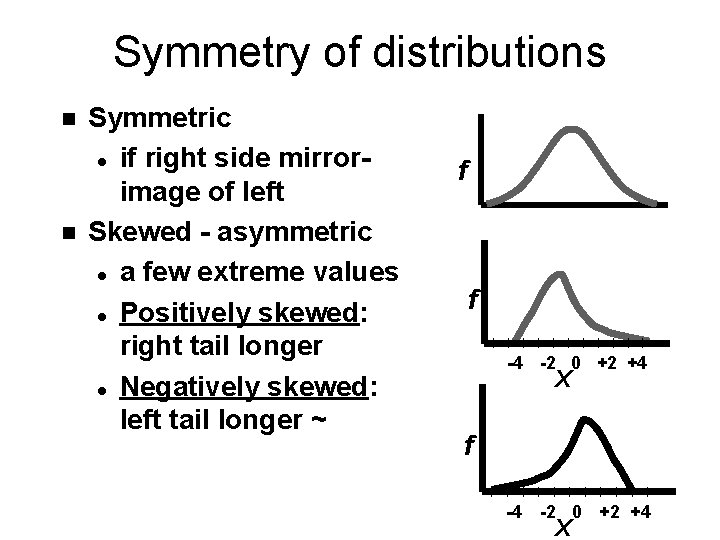
Symmetry of distributions n n Symmetric l if right side mirrorimage of left Skewed - asymmetric l a few extreme values l Positively skewed: right tail longer l Negatively skewed: left tail longer ~ f f -4 -2 0 +2 +4 X
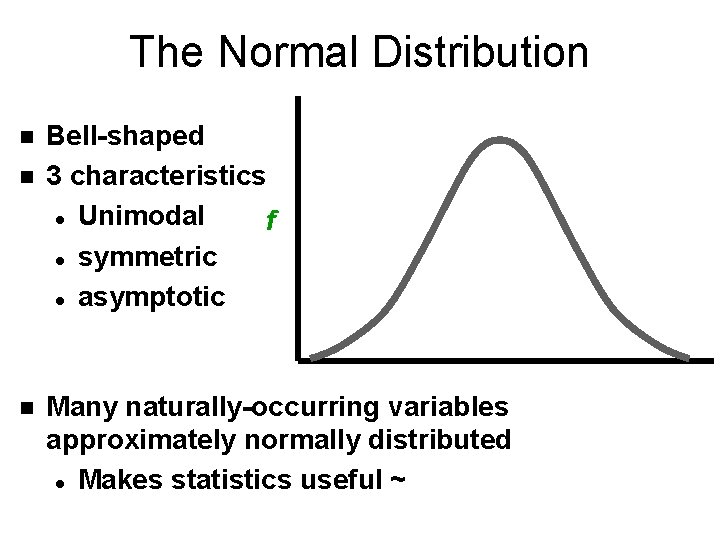
The Normal Distribution n Bell-shaped 3 characteristics l Unimodal f l symmetric l asymptotic Many naturally-occurring variables approximately normally distributed l Makes statistics useful ~
Central Tendency Describes most typical values l Depends on level of measurement n Mode (all levels) l Most frequently occurring value n Median (only ordinal & interval/ratio) l value where ½ observations above & ½ below n Mean (only interval/ratio) l Arithmetic average ~ n
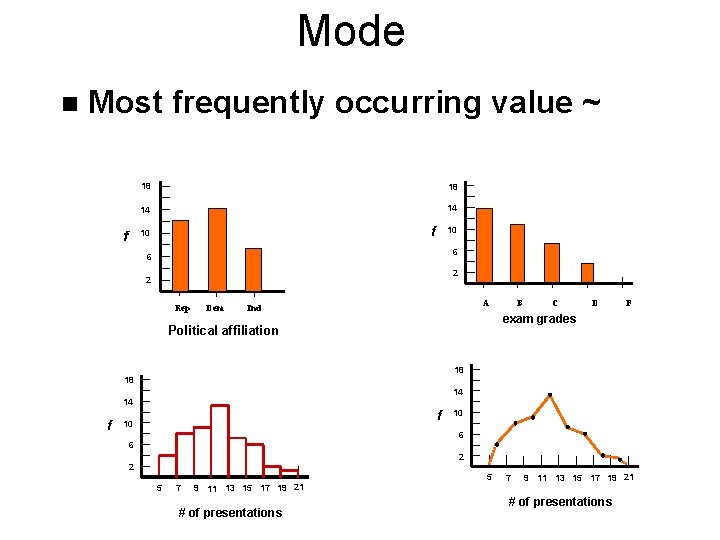
Mode n Most frequently occurring value ~ f 18 18 14 14 f 10 10 6 6 2 2 Rep Dem A Ind B C D F exam grades Political affiliation 18 18 14 14 f f 10 10 6 6 2 2 5 7 9 11 13 15 17 19 21 # of presentations
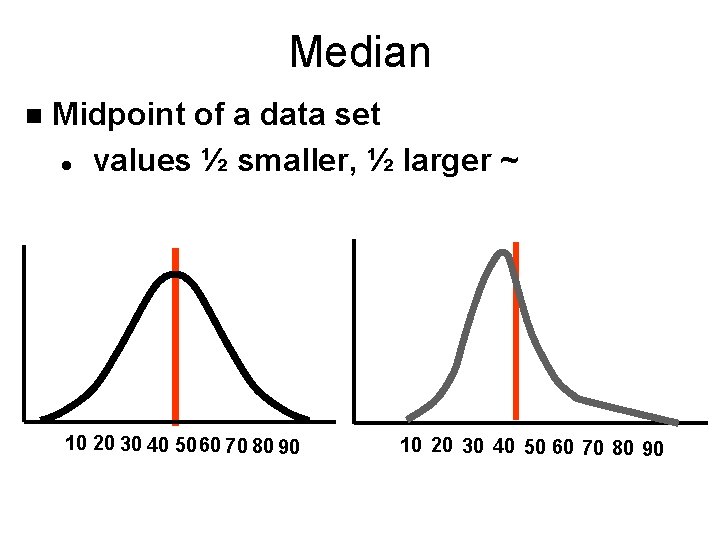
Median n Midpoint of a data set l values ½ smaller, ½ larger ~ 10 20 30 40 50 60 70 80 90
Finding the Median 1. List all values from largest smallest if f=3, then list 3 times 2. Odd # entries median = middle value 3. Even # entries = half way b/n middle 2 values ~
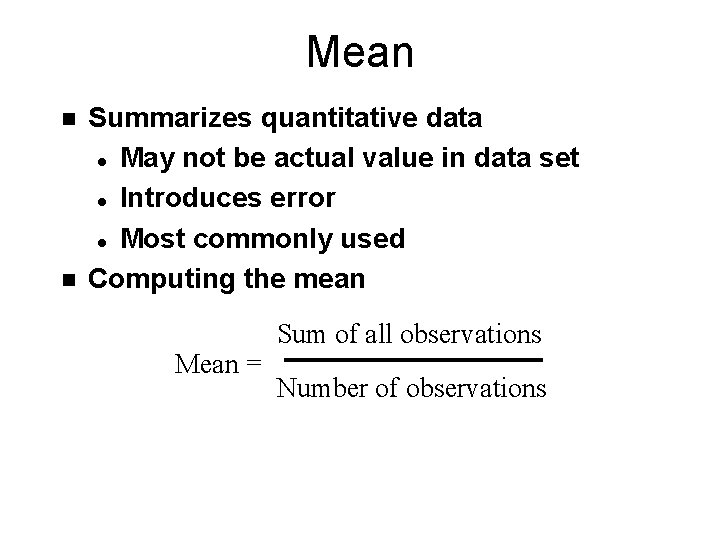
Mean n n Summarizes quantitative data l May not be actual value in data set l Introduces error l Most commonly used Computing the mean Mean = Sum of all observations Number of observations
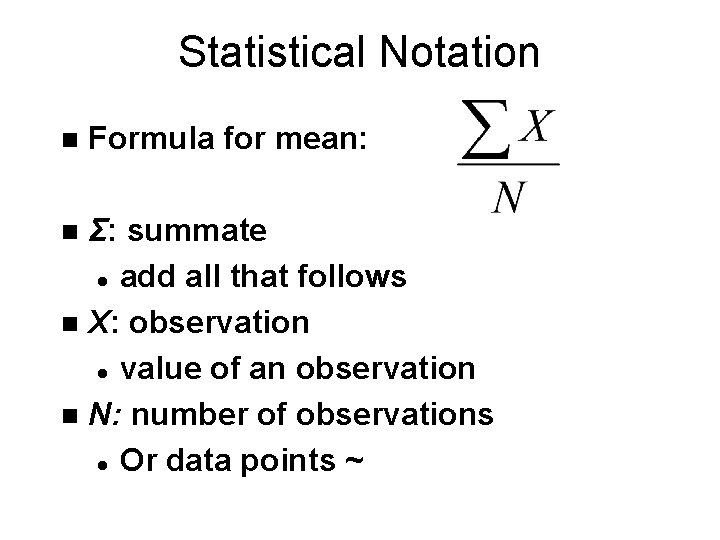
Statistical Notation n Formula for mean: Σ: summate l add all that follows n X: observation l value of an observation n N: number of observations l Or data points ~ n
Populations & Samples Population: all individuals of interest l Depends on goal of researchers n Parameter: value describing population l all observations used in calculation l an exact value – no error n Sample: a portion of group of interest l represents the whole population n Statistic: value describing sample l. Estimate of parameter l. Error introduced ~ n
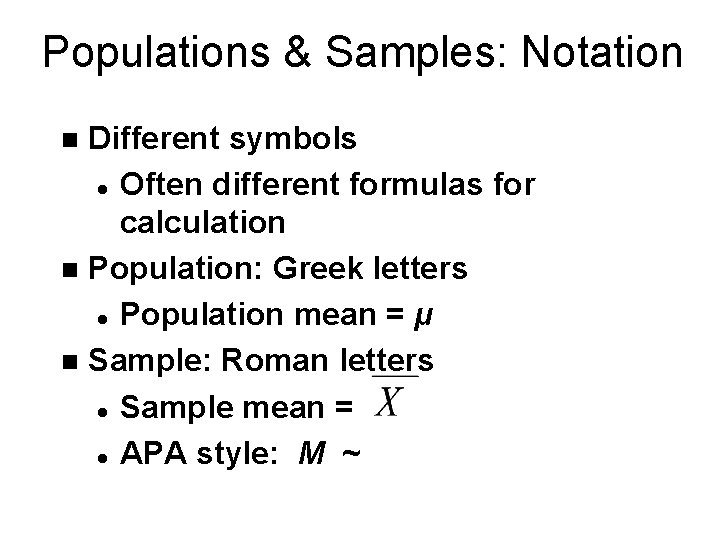
Populations & Samples: Notation Different symbols l Often different formulas for calculation n Population: Greek letters l Population mean = μ n Sample: Roman letters l Sample mean = l APA style: M ~ n
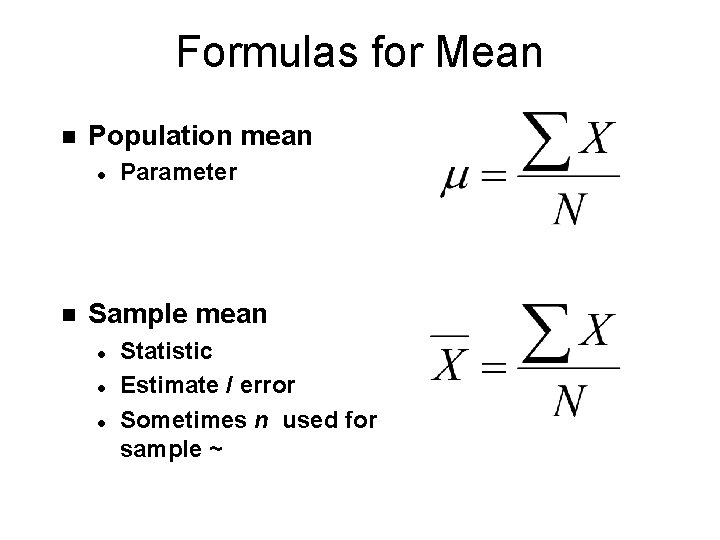
Formulas for Mean n Population mean l n Parameter Sample mean l l l Statistic Estimate / error Sometimes n used for sample ~
- Slides: 24