
Describing and Measuring Motion Section 1 Reference Point
Describing and Measuring Motion Section 1
Reference Point In order to observe an object in motion you must observe the object in relation to another object that appears to stay in the same place. – Common reference points: Earth’s Surface Buildings Trees Mountains
Speed: the distance an object travels in one unit of time – Common units: Time- seconds, minutes and hours. Distance- meters, kilometers and centimeters. – Formula: Speed = Distance Time – SI unit for speed is meters per second (m/s)
Try it out… If you walk for 1. 5 hours and travel 7. 5 km, what is your speed? S= D T S= 7. 5 km 1. 5 hrs S= 5 km/h
Average Speed Since objects do not travel at a constant speed the average speed is usually calculated. Formula: Average speed= Total Distance (m) Total Time (s)
Try it out… A car travels 30 km in the first 30 minutes of a trip and 20 km in the second 30 minutes, what is the average speed the car travels? Average speed = total distance total time Average speed = 50 km 60 min Average speed =. 83 km/min
Instantaneous Speed The rate at which an object is moving at a given instant in time.
Velocity is the speed of an object in a particular direction. – The only difference from speed is that velocity includes direction. – Which of the following is an example(s) of velocity? a. 25 m/s forward c. 55 m/h south b. 1, 500 km/h d. all of the above.
Acceleration Section 2
Acceleration is the rate at which velocity changes. – Acceleration is not just how much velocity changes. It is also how fast velocity changes.
Acceleration Since velocity involves both speed and direction acceleration refers to: Increasing speed- running to catch a bus, throwing a baseball etc. Decreasing speed- a car coming to a red light. Sometimes this is called deceleration. Changing direction- a car changing lanes or going around a curve. Can a car driving at constant speed be accelerating?
Calculating Acceleration= final velocity- initial velocity Time It is expressed in m/s/s or m/s 2 – Suppose you get on your bicycle and accelerate southward at a rate of 1 m/s/s. – This means that every second, your southward velocity increased by 1 m/s.
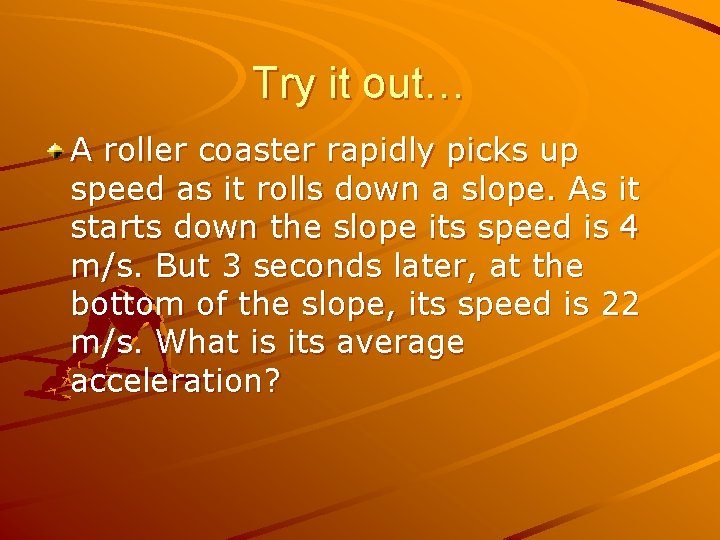
Try it out… A roller coaster rapidly picks up speed as it rolls down a slope. As it starts down the slope its speed is 4 m/s. But 3 seconds later, at the bottom of the slope, its speed is 22 m/s. What is its average acceleration?
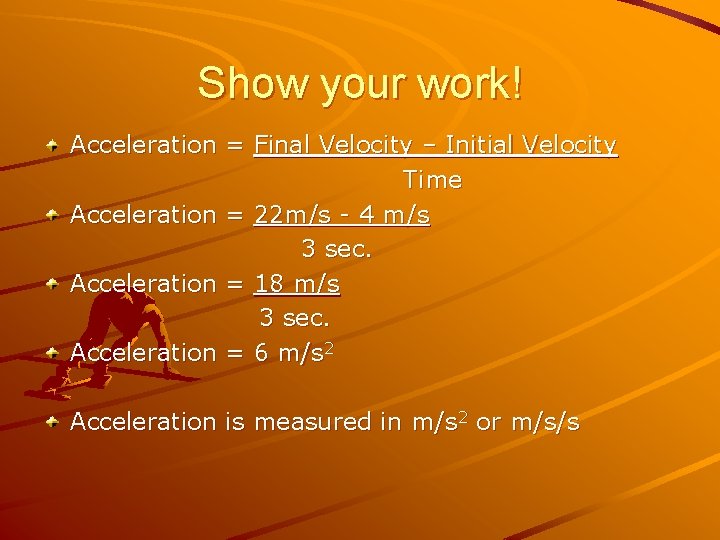
Show your work! Acceleration = Final Velocity – Initial Velocity Time Acceleration = 22 m/s - 4 m/s 3 sec. Acceleration = 18 m/s 3 sec. Acceleration = 6 m/s 2 Acceleration is measured in m/s 2 or m/s/s
- Slides: 14