
DESCRIBING A DARK SETTING DESCRIPTIVE AND IMAGINATIVE WRITING
DESCRIBING A DARK SETTING DESCRIPTIVE AND IMAGINATIVE WRITING
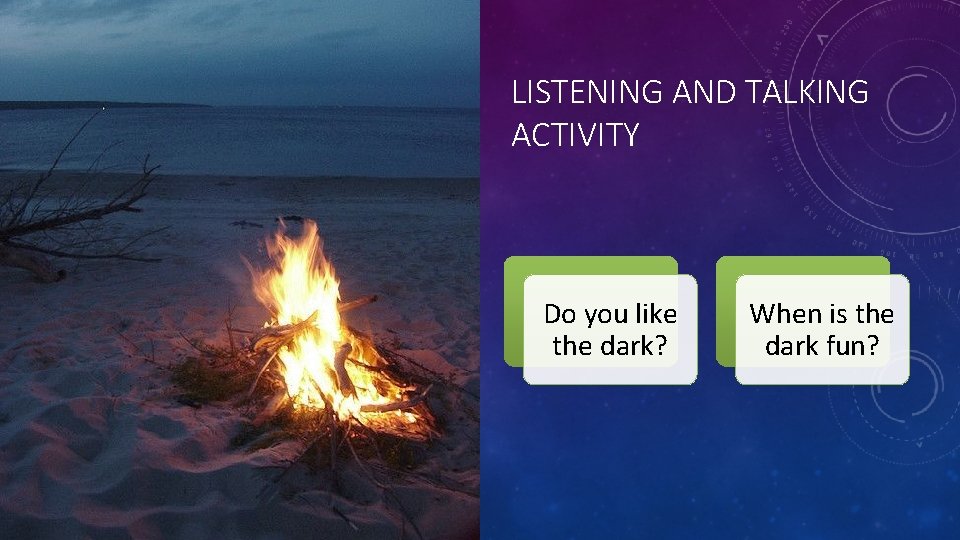
LISTENING AND TALKING ACTIVITY Do you like the dark? When is the dark fun?
LISTENING AND TALKING ACTIVITY Can you think of a time you were scared in the dark? Can you think of why someone might find the dark scary?
NOW FOR SOME WRITING We are going to do a piece of writing where we use our senses to describe a setting in the dark Then you have the choice to use your imagination to develop your writing to describe something that might happen in that dark place.
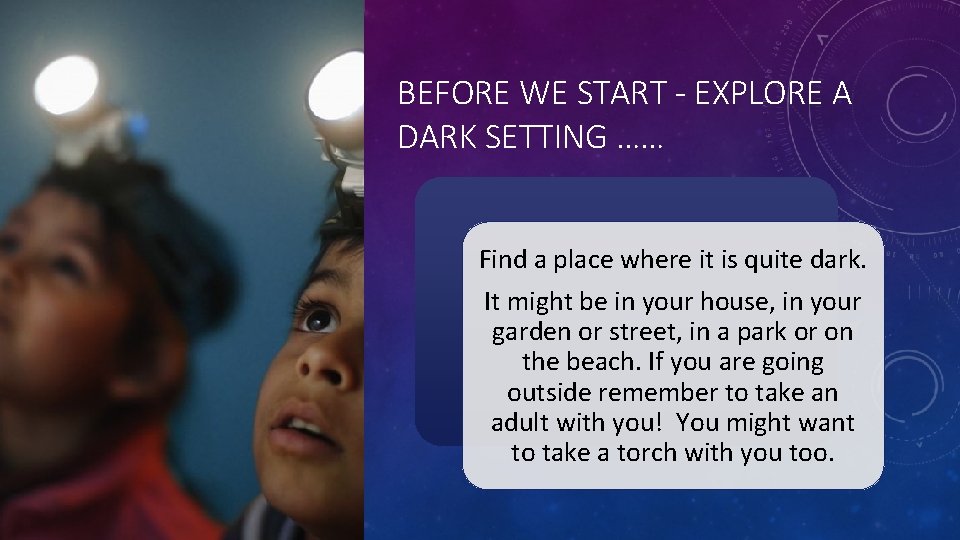
BEFORE WE START - EXPLORE A DARK SETTING …… Find a place where it is quite dark. It might be in your house, in your garden or street, in a park or on the beach. If you are going outside remember to take an adult with you! You might want to take a torch with you too.
THINK ABOUT AND TALK ABOUT • What does the place look like? Can you describe it? • What colours can you see? Try and make a list of all the dark colours you saw and add wow words to make them great – e. g. inky black or midnight blue • What shapes can you see? Describe them: lumpy bumpy pebbles • What can you hear? Do you know what the sounds are? How could you describe then - use wow words. Try to include some alliteration: whooshing wild waves • Can you smell anything? : smoky bonfire air, damp dusty leaves • Is the weather affecting what you hear? Is it windy or rainy? Whistling wind , pattering rain • How do you feel?
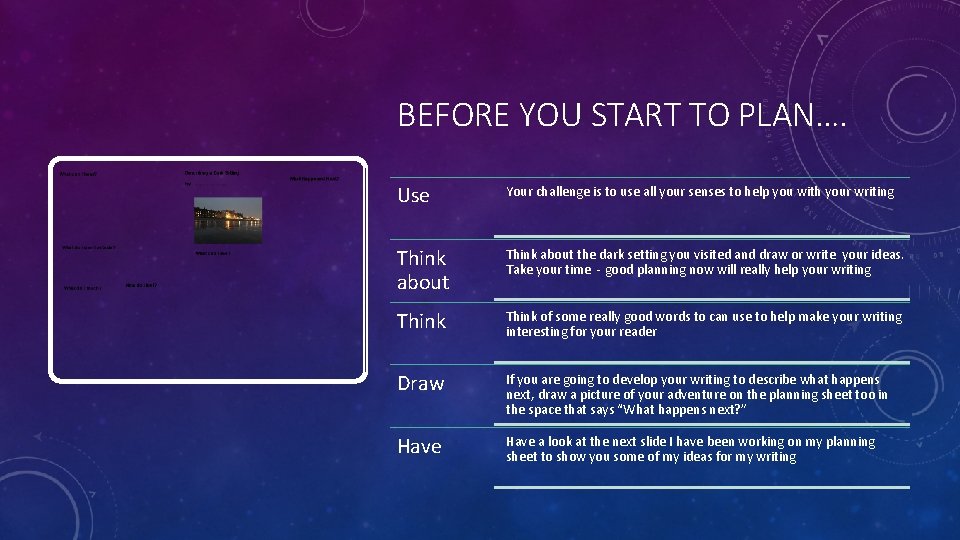
BEFORE YOU START TO PLAN…. Use Your challenge is to use all your senses to help you with your writing Think about the dark setting you visited and draw or write your ideas. Take your time - good planning now will really help your writing Think of some really good words to can use to help make your writing interesting for your reader Draw If you are going to develop your writing to describe what happens next, draw a picture of your adventure on the planning sheet too in the space that says “What happens next? ” Have a look at the next slide I have been working on my planning sheet to show you some of my ideas for my writing
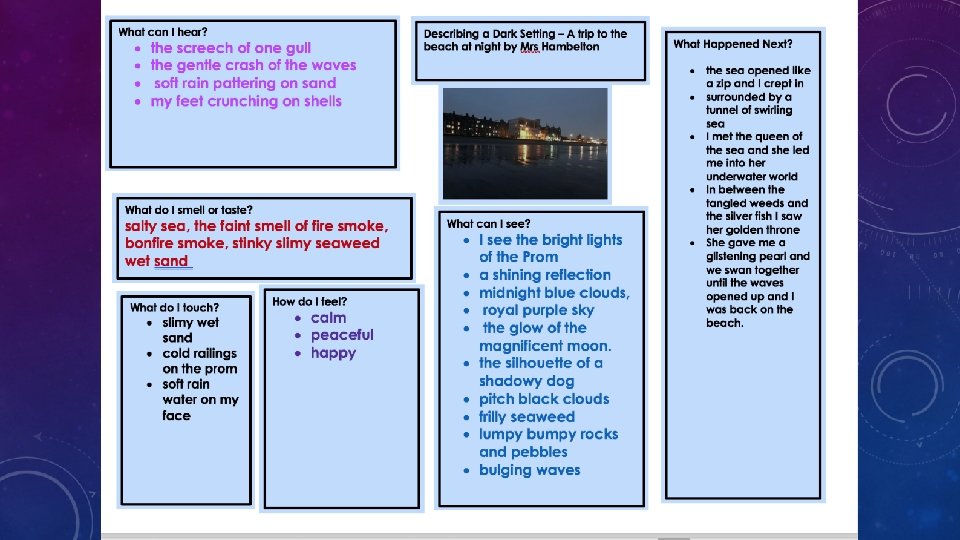
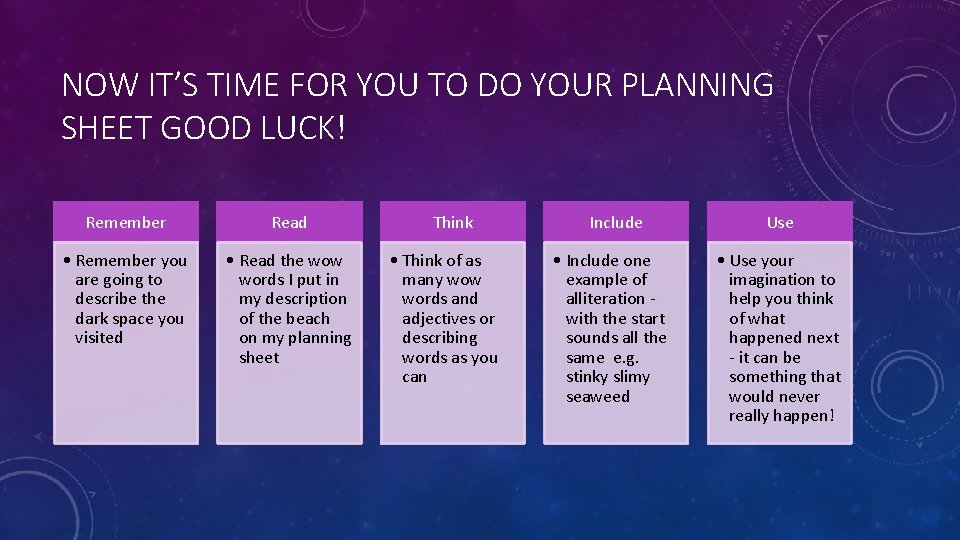
NOW IT’S TIME FOR YOU TO DO YOUR PLANNING SHEET GOOD LUCK! Remember Read • Remember you are going to describe the dark space you visited • Read the wow words I put in my description of the beach on my planning sheet Think • Think of as many wow words and adjectives or describing words as you can Include • Include one example of alliteration with the start sounds all the same e. g. stinky slimy seaweed Use • Use your imagination to help you think of what happened next - it can be something that would never really happen!
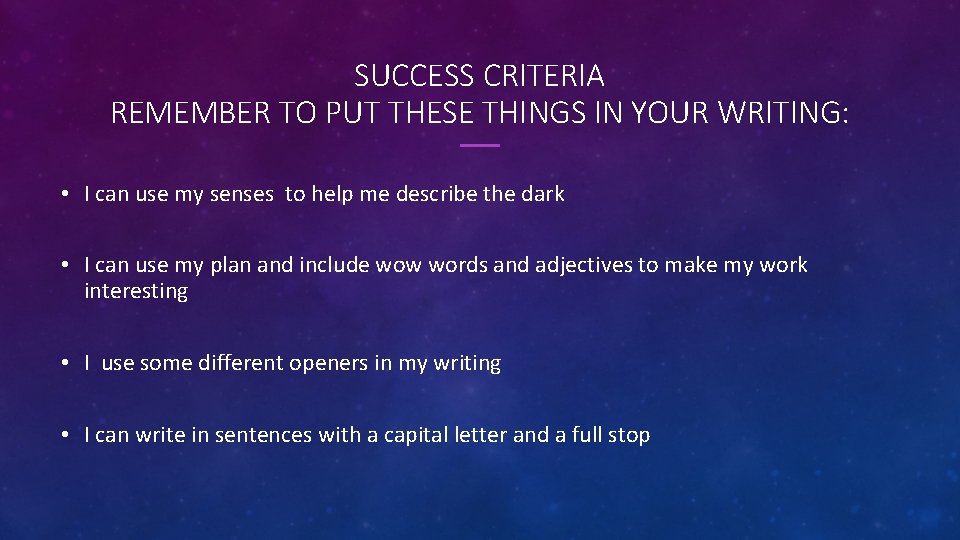
SUCCESS CRITERIA REMEMBER TO PUT THESE THINGS IN YOUR WRITING: • I can use my senses to help me describe the dark • I can use my plan and include wow words and adjectives to make my work interesting • I use some different openers in my writing • I can write in sentences with a capital letter and a full stop
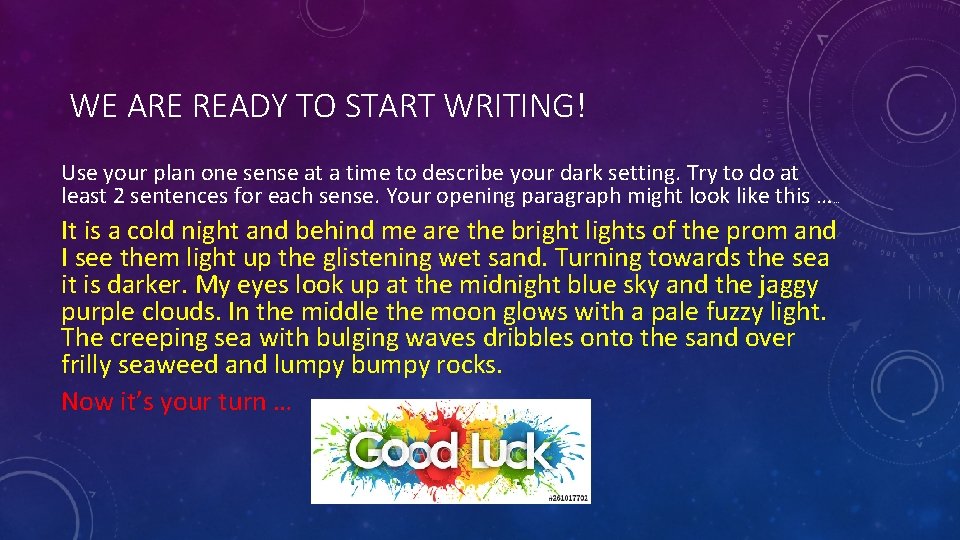
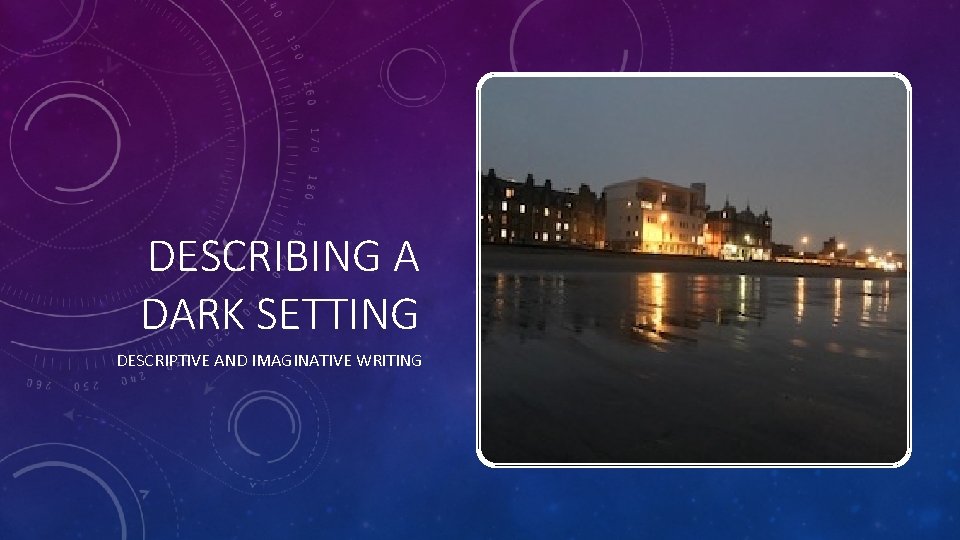
WE ARE READY TO START WRITING! Use your plan one sense at a time to describe your dark setting. Try to do at least 2 sentences for each sense. Your opening paragraph might look like this … … It is a cold night and behind me are the bright lights of the prom and I see them light up the glistening wet sand. Turning towards the sea it is darker. My eyes look up at the midnight blue sky and the jaggy purple clouds. In the middle the moon glows with a pale fuzzy light. The creeping sea with bulging waves dribbles onto the sand over frilly seaweed and lumpy bumpy rocks. Now it’s your turn …
DO YOUR BEST! • Take each part of your plan and write a new paragraph (start on a new line) for each time you start a new part. • Leave a line between each line you write, like you do in your jotter at school • Keep looking at your plan to help you and remember our Success Criteria • Finally, if you want to, you can carry on with a small story about what happened next – like I did in my plan • Check you have followed the Success Criteria • Be Proud of your hard work. We can’t wait to see your stories
- Slides: 12