
Describing a CustomerDriven Strategy and Mix Pricing Strategies
Describing a Customer-Driven Strategy and Mix Pricing Strategies � New-Product Pricing Strategies � Product Mix Pricing Strategies � Price Adjustment Strategies � Price Changes
Pricing Strategies: New Product q Market-Skimming Pricing q Market-Penetration Pricing
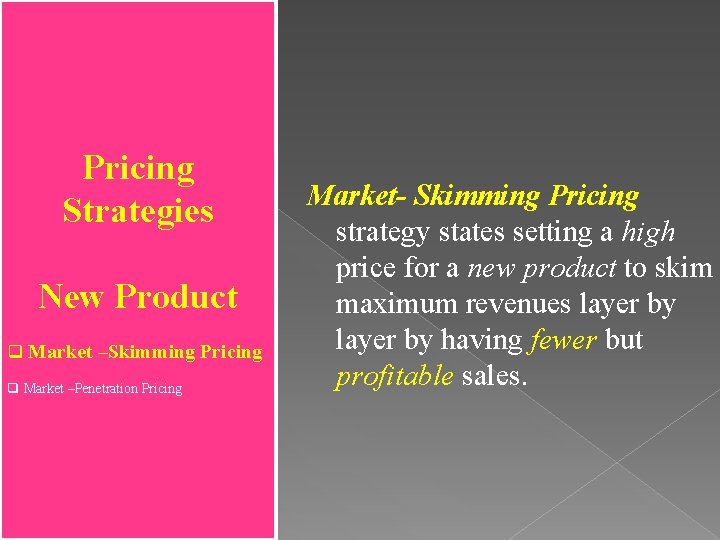
Pricing Strategies New Product q Market –Skimming Pricing q Market –Penetration Pricing Market- Skimming Pricing strategy states setting a high price for a new product to skim maximum revenues layer by having fewer but profitable sales.
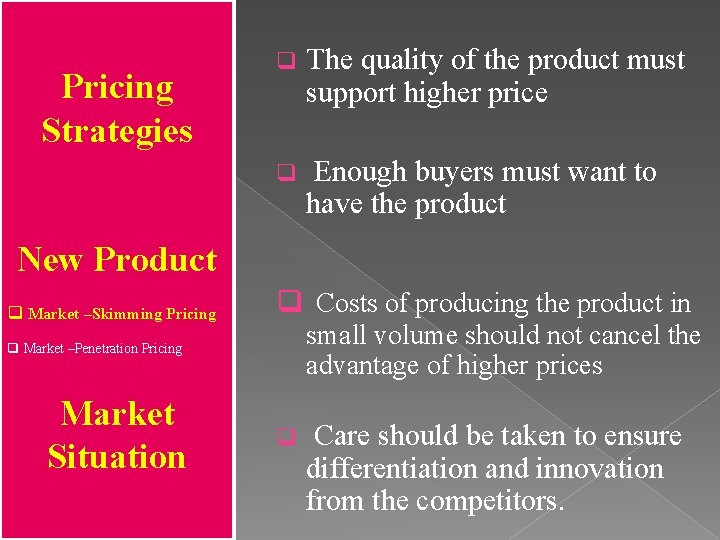
Pricing Strategies q The quality of the product must support higher price q Enough buyers must want to have the product New Product q Market –Skimming Pricing q Costs of producing the product in small volume should not cancel the advantage of higher prices q Market –Penetration Pricing Market Situation q Care should be taken to ensure differentiation and innovation from the competitors.
Pricing Strategies: New Product q Market –Skimming Pricing q Market –Penetration Pricing Market- Penetration Pricing states setting a low price for a new product in order to penetrate the market quickly and deeply to attract a large number of buyers and a large market share.
Pricing Strategies New Product q The Market being highly pricesensitive q With the increase of Sales Volume, production and distribution costs must fall q The low price must help keep the competition alive for a long time in the market q Market –Skimming Pricing q Market –Penetration Pricing Market Situation
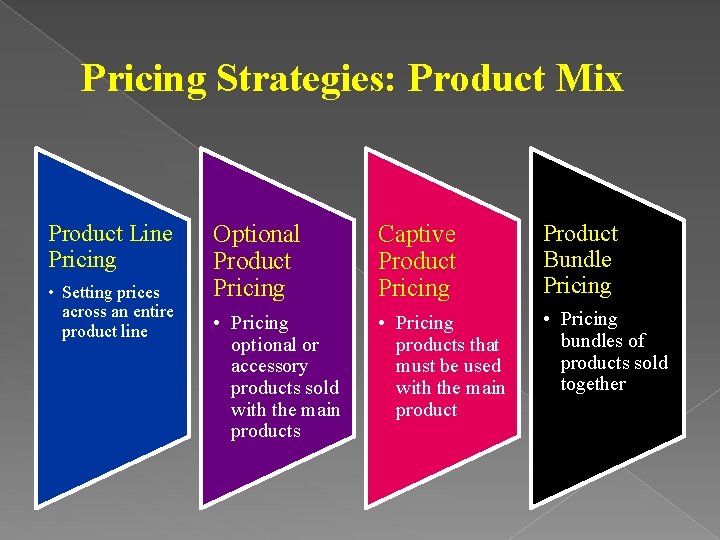
Pricing Strategies: Product Mix Product Line Pricing • Setting prices across an entire product line Optional Product Pricing Captive Product Pricing Product Bundle Pricing • Pricing optional or accessory products sold with the main products • Pricing products that must be used with the main product • Pricing bundles of products sold together
Product Mix Pricing Strategies q Product Line Pricing q Optional Product Pricing q Captive-Product Pricing q. Product-Bundle Pricing Product Line Pricing takes into account the cost differences between products in the line, customer evaluation of their features, and competitors’ prices
Product Mix Pricing Strategies q Product Line Pricing q Optional Product Pricing q Captive-Product Pricing q Product-Bundle Pricing Optional Product Pricing takes into account optional or accessory products along with the main product
Product Mix Pricing Strategies q Product Line Pricing q Optional Product Pricing q Captive-Product Pricing q Product-Bundle Pricing Captive- Product Pricing involves products that must be used along with the main product � Two- Part Pricing involves breaking the price into: › Fixed fee › Variable usage fee
Product Mix Pricing Strategies q Product Line Pricing q Optional Product Pricing q Captive-Product Pricing q Product-Bundle Pricing Product Bundle Pricing combines several products at a reduced price
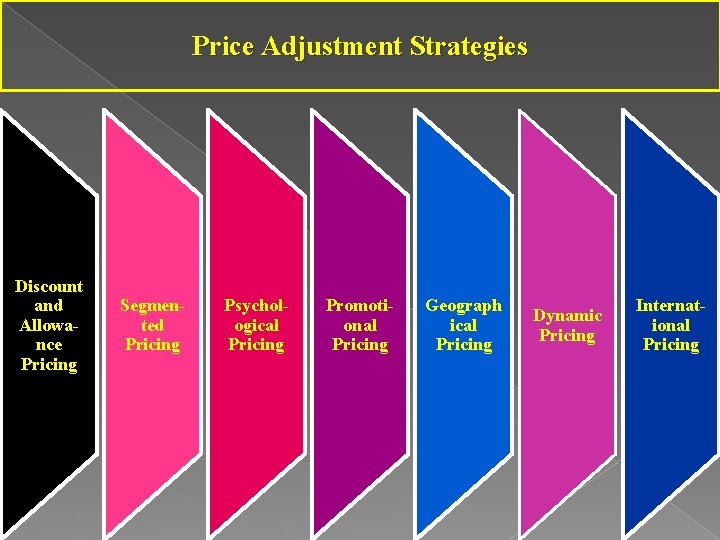
Price Adjustment Strategies Discount and Allowance Pricing Segmented Pricing Psychological Pricing Promotional Pricing Geograph ical Pricing Dynamic Pricing International Pricing
Price Adjustment Strategies q Discount and Allowance Pricing q Segmented Pricing q Psychological Pricing q Promotional Pricing q Geographical Pricing q Dynamic Pricing q Internat-ional Pricing Discount And Allowance Pricing reduces prices to reward customer responses such as paying early or promoting the product q Discounts q Allowances
Price Adjustment Strategies q Discount and Allowance Pricing q Segmented Pricing q Psychological Pricing q Promotional Pricing q Geographical Pricing q Dynamic Pricing q Internat-ional Pricing Segmented Pricing is used when a company sells a product at two or more prices even though the difference is not based on cost
Price Adjustment Strategies q Discount and Allowance Pricing q Segmented Pricing q Psychological Pricing q Promotional Pricing q Geographical Pricing q Dynamic Pricing q Internat-ional Pricing To be effective: � Market must be segmentable � Segments must show different degrees of demand � Watching the market cannot exceed the extra revenue obtained from the price difference � Must be legal
Price Adjustment Strategies q Discount and Allowance Pricing q Segmented Pricing q Psychological Pricing q Promotional Pricing q Geographical Pricing q Dynamic Pricing q Internat-ional Pricing Psychological Pricing occurs when sellers consider the psychology of prices and not simply the economics � Reference prices are prices that buyers carry in their minds and refer to when looking at a given product
Price Adjustment Strategies q Discount and Allowance Pricing q Segmented Pricing q Psychological Pricing q Promotional Pricing q Geographical Pricing q Dynamic Pricing q Internat-ional Pricing Promotional Pricing is when prices are temporarily priced below list price or cost to increase demand � Loss Leaders � Special Event Pricing � Cash Rebates � Low- Interest Financing � Longer Warrantees � Free Maintenance
Price Adjustment Strategies q Discount and Allowance Pricing q Segmented Pricing q Psychological Pricing q Promotional Pricing q Geographical Pricing q Dynamic Pricing q Internat-ional Pricing Risks Of Promotional Pricing � Used too frequently, and copies by competitors can create “dealprone” customers who will wait for promotions and avoid buying at regular price � Creates price wars
Price Adjustment Strategies q Discount and Allowance Pricing q Segmented Pricing q Psychological Pricing q Promotional Pricing q Geographical Pricing q Dynamic Pricing q Internat-ional Pricing Geographical Pricing is used for customers in different parts of the country or the world. FOB pricing Uniformed-delivery pricing Zone pricing Basing-point pricing Freight-absorption pricing
Price Adjustment Strategies q Discount and Allowance Pricing q Segmented Pricing q Psychological Pricing q Promotional Pricing q Geographical Pricing q Dynamic Pricing q Internat-ional Pricing � FOB (Free On Board) Pricing means that the goods are delivered to the carrier and the title and responsibility passes to the customer � Uniformed Delivery Pricing means the company charges the same price plus freight to all customers, regardless of location
Price Adjustment Strategies q Discount and Allowance Pricing q Segmented Pricing q Psychological Pricing q Promotional Pricing q Geographical Pricing q Dynamic Pricing q Internat-ional Pricing � Zone Pricing means that the company sets up two or more zones where customers within a given zone pay a single total price � Basing Point Pricing means that a seller selects a given city as a “basing point” and charges all customers the freight cost associated from that city to the customer location, regardless of the city from which the goods are actually shipped
Price Adjustment Strategies q Discount and Allowance Pricing q Segmented Pricing q Psychological Pricing q Promotional Pricing q Geographical Pricing q Dynamic Pricing q Internat-ional Pricing Freight Absorption Pricing means the seller absorbs all or part of the actual freight charge as an incentive to attract business in competitive markets.
Price Adjustment Strategies q Discount and Allowance Pricing q Segmented Pricing q Psychological Pricing q Promotional Pricing q Geographical Pricing q Dynamic Pricing q Internat-ional Pricing Dynamic Pricing is when prices are adjusted continually to meet the characteristics and needs of the individual customer and situations.
Price Adjustment Strategies q Discount and Allowance Pricing q Segmented Pricing q Psychological Pricing q Promotional Pricing q Geographical Pricing q Dynamic Pricing q International Pricing is when prices are set in a specific country based on countryspecific factors � Economic conditions � Competitive conditions � Laws and regulations � Infrastructure � Company marketing objective
DESCRIBING A CUSTOMERDRIVEN STRATEGY AND MIX PRICING STRATEGIES Price Change Types PRICE CHANGES q PRICE CUTS q PRICE INCREASES
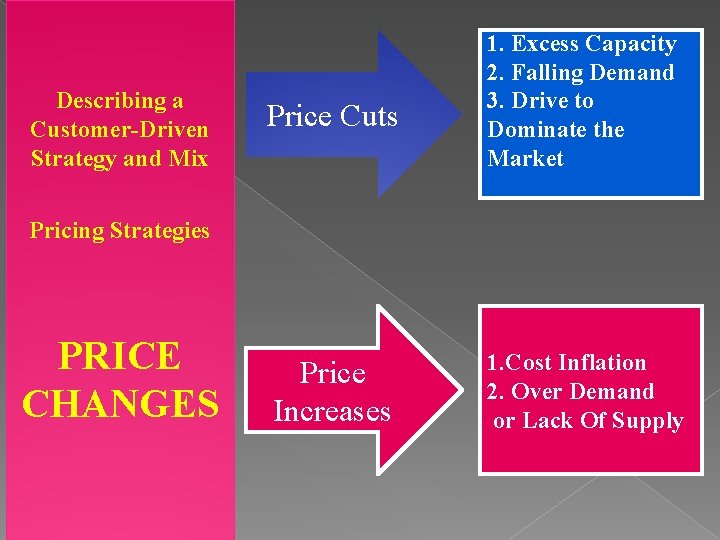
Describing a Customer-Driven Strategy and Mix Price Cuts 1. Excess Capacity 2. Falling Demand 3. Drive to Dominate the Market Pricing Strategies PRICE CHANGES Price Increases 1. Cost Inflation 2. Over Demand or Lack Of Supply
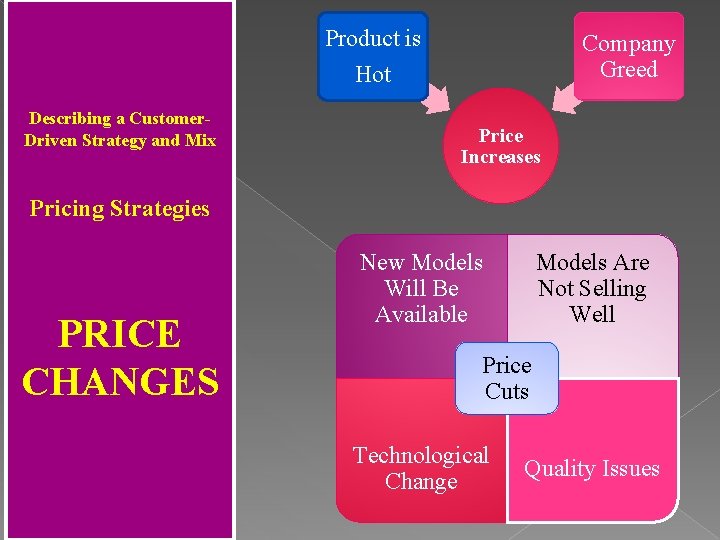
Product is Company Greed Hot Describing a Customer. Driven Strategy and Mix Price Increases Pricing Strategies PRICE CHANGES New Models Will Be Available Models Are Not Selling Well Price Cuts Technological Change Quality Issues
Describing a Customer. Driven Strategy and Mix Pricing Strategies PRICE CHANGES Avoiding Price Increase Techniques q Maintain a sense of fairness surrounding q Making Low Visibility
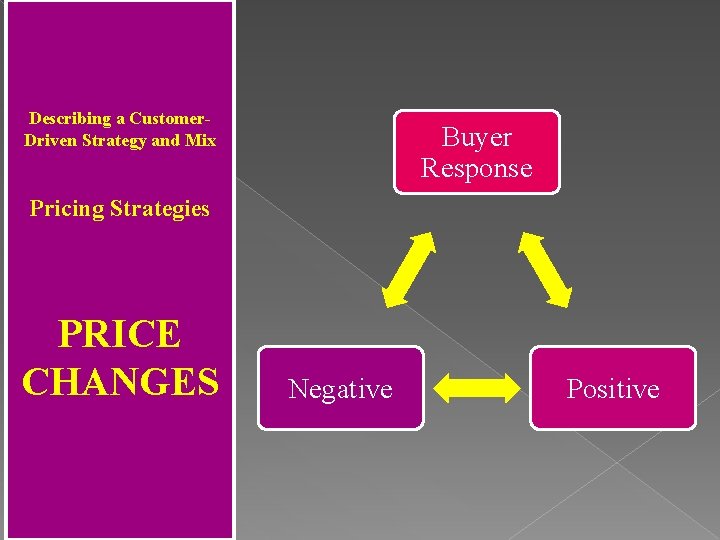
Describing a Customer. Driven Strategy and Mix Buyer Response Pricing Strategies PRICE CHANGES Negative Positive
- Slides: 29