
Describe some early management examples Explain the various


• Describe some early management examples • Explain the various theories in the classical approach • Discuss the development and uses of the behavioral approach • Describe the quantitative approach • Explain the various theories in the contemporary approach Copyright © 2012 Pearson Education, Inc. Publishing as Prentice Hall MH-2
Historical Background of Management • Ancient Management – Egypt (pyramids) and China (Great Wall) – Venetians (floating warship assembly lines) • Adam Smith The Wealth of Nations in 1776 • Industrial Revolution – Substituted machine power for human labor – Created large organizations in need of management Copyright © 2012 Pearson Education, Inc. Publishing as Prentice Hall MH-3
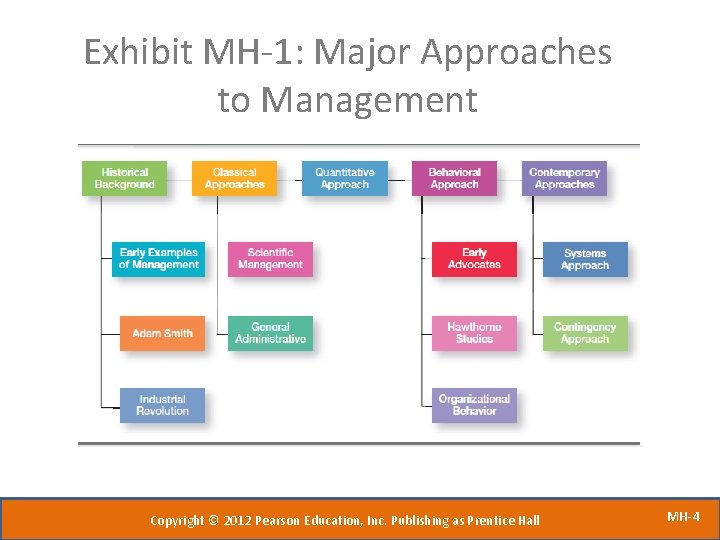
Exhibit MH-1: Major Approaches to Management Copyright © 2012 Pearson Education, Inc. Publishing as Prentice Hall MH-4
Scientific Management • Fredrick Winslow Taylor – The “father” of scientific management • The theory of scientific management – Using scientific methods to define the “one best way” for a job to be done: • Putting the right person on the job with the correct tools and equipment • Having a standardized method of doing the job • Providing an economic incentive to the worker Copyright © 2012 Pearson Education, Inc. Publishing as Prentice Hall MH-5
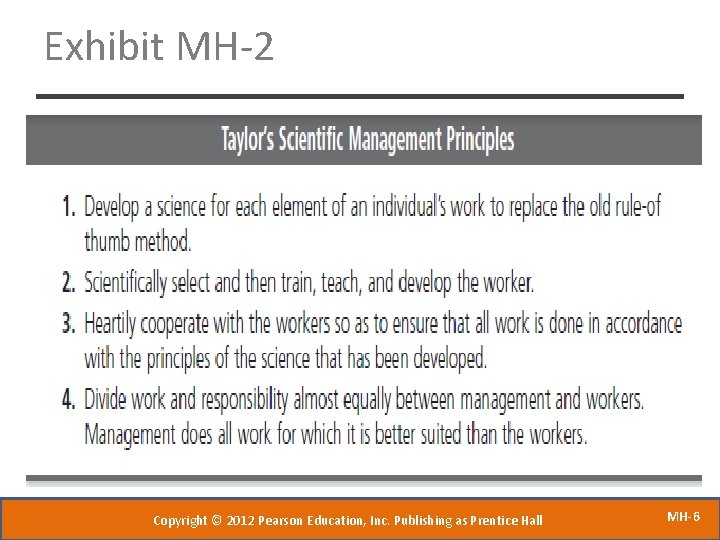
Exhibit MH-2 Copyright © 2012 Pearson Education, Inc. Publishing as Prentice Hall MH-6
General Administrative Theory • Henri Fayol – Believed that the practice of management was distinct from other organizational functions – Developed principles of management that applied to all organizational situations Copyright © 2012 Pearson Education, Inc. Publishing as Prentice Hall MH-7

Administrative principles (Henri Fayol)—rules of management – Foresight—to complete plan of action for the future. – Organization—to provide and mobilize resources to implement the plan. – Command—to lead, select, and evaluate workers to get the best work toward the plan. – Coordination—to fit diverse efforts together, ensure information is shared and problems solved. – Control—to make sure things happen according to plan and to take necessary corrective action. MH-8
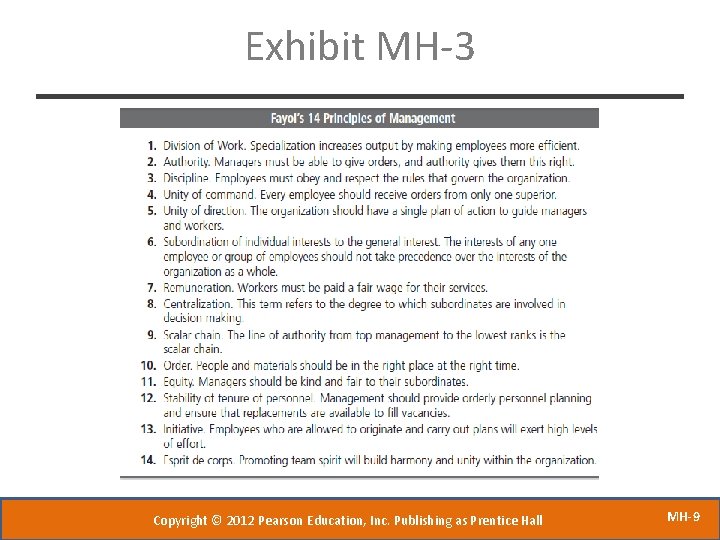
Exhibit MH-3 Copyright © 2012 Pearson Education, Inc. Publishing as Prentice Hall MH-9
General Administrative Theory • Max Weber – Developed a theory of authority based on an ideal type of organization (bureaucracy) • Emphasized rationality, predictability, impersonality, technical competence, and authoritarianism Copyright © 2012 Pearson Education, Inc. Publishing as Prentice Hall MH-10
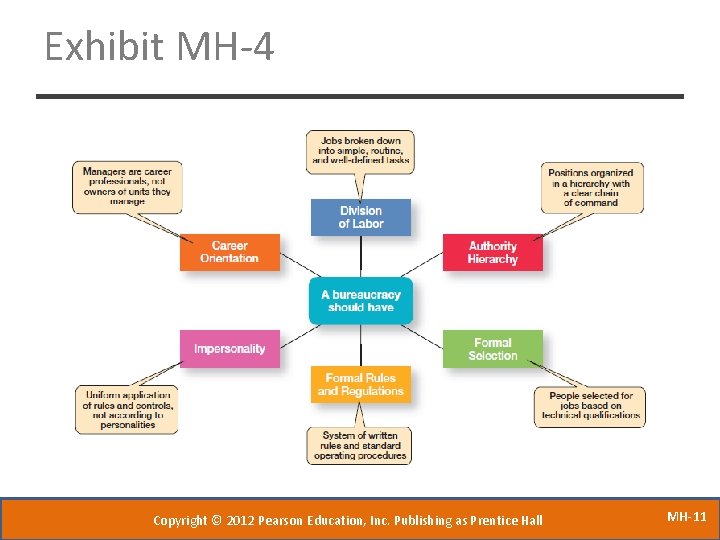
Exhibit MH-4 Copyright © 2012 Pearson Education, Inc. Publishing as Prentice Hall MH-11
Discussion • Is there any similarities in the way of thinking between Fayol and Weber? !! Copyright © 2012 Pearson Education, Inc. Publishing as Prentice Hall MH-12
Quantitative Approach • Quantitative Approach – Also called operations research or management science – Evolved from mathematical and statistical methods developed to solve WWII military logistics and quality control problems – Focuses on improving managerial decision making by applying: • Statistics, optimization models, information models, and computer simulations Copyright © 2012 Pearson Education, Inc. Publishing as Prentice Hall MH-13
Quantitative management – Use of specialists to help managers apply techniques. – Software and hardware developments have expanded potential quantitative applications. – Personal judgment? ! – Techniques and applications include: • • • Mathematical forecasting Inventory modeling Linear programming Queuing theory Network models Simulations MH-14
Organizational Behavior • Organizational Behavior (OB) – The study of the actions of people at work; people are the most important asset of an organization • Early OB Advocates – Robert Owen – Hugo Munsterberg – Mary Parker Follett – Chester Barnard Copyright © 2012 Pearson Education, Inc. Publishing as Prentice Hall MH-15
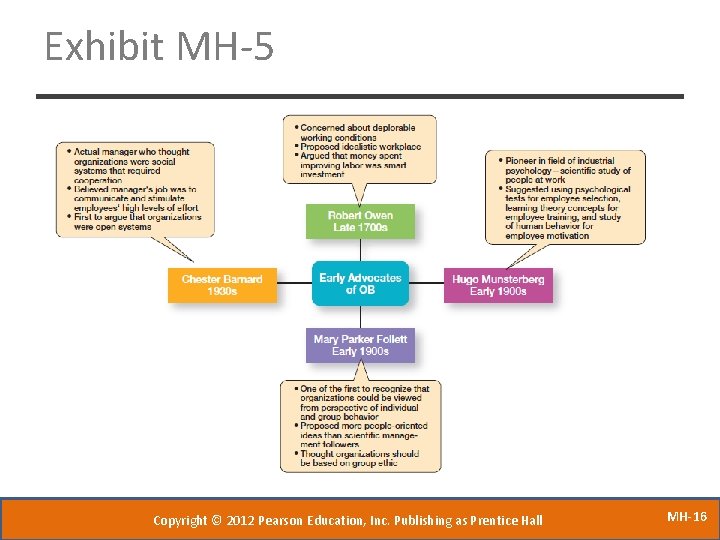
Exhibit MH-5 Copyright © 2012 Pearson Education, Inc. Publishing as Prentice Hall MH-16
Mary Parker Follett – Groups and human cooperation • Groups are mechanisms through which individuals could combine their talents for a greater good. • Organizations as cooperating “communities” of managers and workers. • Manager’s job is to help people in the organization cooperate and achieve an integration of interests. MH-17
Mary Parker Follett – Forward-looking management insights • Employee ownership creates sense of collective responsibility (precursor of employee ownership, profit sharing, and gain-sharing) • Business problems involve variety of inter-related factors (precursor of systems thinking) • Private profits relative to public good (precursor of managerial ethics and social responsibility) MH-18
The Hawthorne Studies • A series of productivity experiments conducted at Western Electric from 1924 to 1932 – Experimental findings • Productivity unexpectedly increased under imposed adverse working conditions. • The effect of incentive plans was less than expected. – Research conclusion • Social norms, group standards and attitudes more strongly influence individual output and work behavior than do monetary incentives. Copyright © 2012 Pearson Education, Inc. Publishing as Prentice Hall MH-19
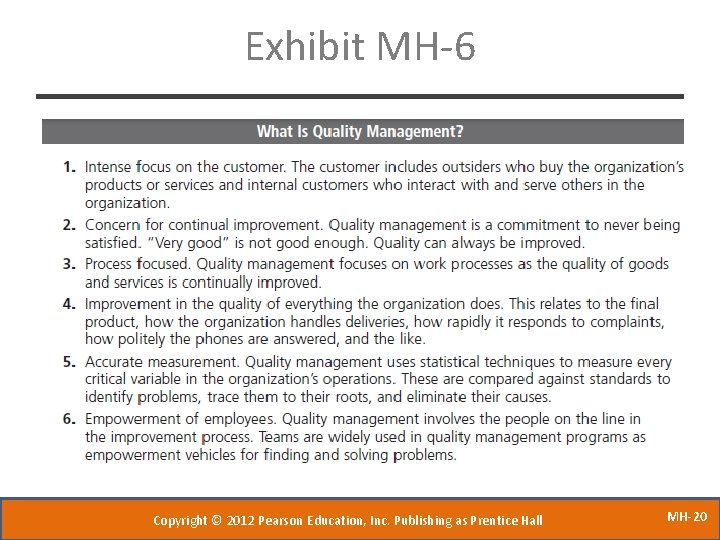
Exhibit MH-6 Copyright © 2012 Pearson Education, Inc. Publishing as Prentice Hall MH-20
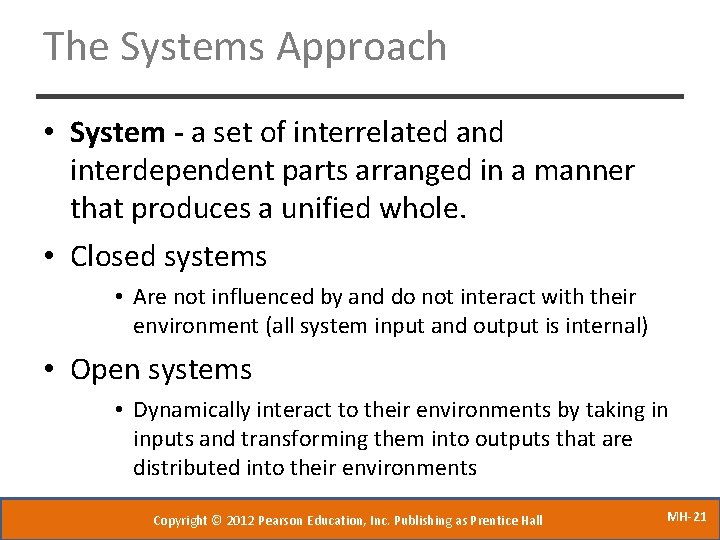
The Systems Approach • System - a set of interrelated and interdependent parts arranged in a manner that produces a unified whole. • Closed systems • Are not influenced by and do not interact with their environment (all system input and output is internal) • Open systems • Dynamically interact to their environments by taking in inputs and transforming them into outputs that are distributed into their environments Copyright © 2012 Pearson Education, Inc. Publishing as Prentice Hall MH-21

Exhibit MH-7 Copyright © 2012 Pearson Education, Inc. Publishing as Prentice Hall MH-22
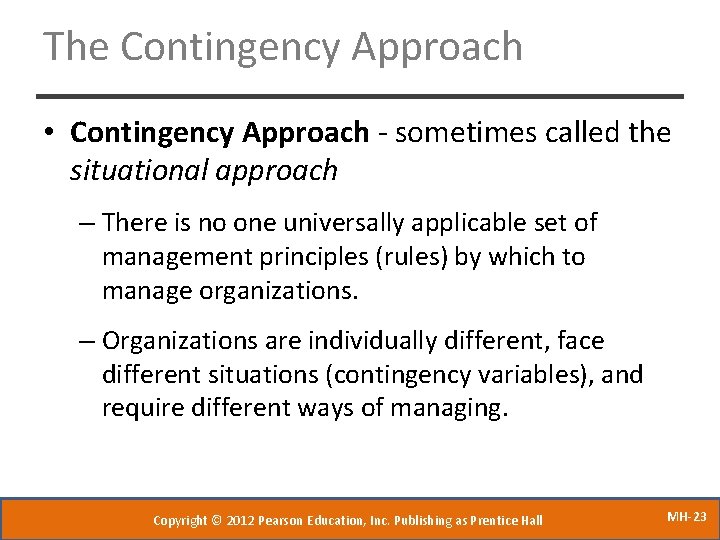
The Contingency Approach • Contingency Approach - sometimes called the situational approach – There is no one universally applicable set of management principles (rules) by which to manage organizations. – Organizations are individually different, face different situations (contingency variables), and require different ways of managing. Copyright © 2012 Pearson Education, Inc. Publishing as Prentice Hall MH-23
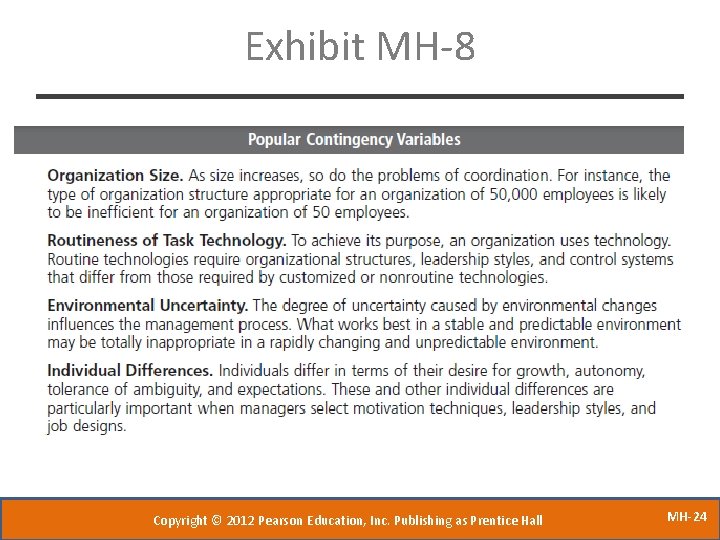
Exhibit MH-8 Copyright © 2012 Pearson Education, Inc. Publishing as Prentice Hall MH-24
Teamwork activity • Assume the identity of one of the following: – Fredrick Taylor – Henri Fayol – Max Weber – Mary Parker Follet – System’s thinking – Contingency theories Answer the following questions (within teams) MH-25
Teamwork activity • Q 1: what are your basic beliefs about good management and organizational practices (according to your school of thoughts)? ! • Q 2: What is the best thing a manager can do to improve productivity in his or her work unit (according to your school of thoughts)? ! • Q 3: Disregard the school of thoughts you have chosen, how can you – as a manger – improve the productivity of a low performance employee in your organization? ! (make use of what you have learned from the different schools of thoughts) MH-26
Terms to Know • division of labor (or job specialization) • Industrial Revolution • scientific management • therbligs • general administrative theory • principles of management • bureaucracy • quantitative approach • organizational behavior (OB) • Hawthorne Studies • system • closed systems • open systems • contingency approach Copyright © 2012 Pearson Education, Inc. Publishing as Prentice Hall MH-27
- Slides: 27