
Descartes The Man Who Would Be Aristotle SCNATS
Descartes The Man Who Would Be Aristotle SC/NATS 1730, XVI 1
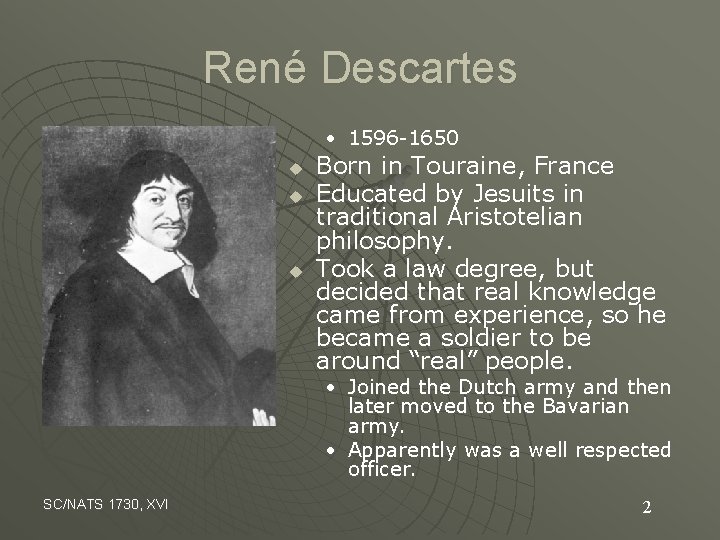
René Descartes • 1596 -1650 u u u Born in Touraine, France Educated by Jesuits in traditional Aristotelian philosophy. Took a law degree, but decided that real knowledge came from experience, so he became a soldier to be around “real” people. • Joined the Dutch army and then later moved to the Bavarian army. • Apparently was a well respected officer. SC/NATS 1730, XVI 2
Descartes gives up on soldiers After some years in the army, Descartes decided that “real” people didn’t know much either. u He retired from the army to devote himself to thinking about mathematics and mechanics, which he believed would lead to true knowledge. u SC/NATS 1730, XVI 3
Descartes a convert to Copernicus u Wrote a book about the Copernican system (The World) akin to Galileo's, but suppressed its publication when Galileo was condemned by the Inquisition. SC/NATS 1730, XVI 4
A Dutch immigrant Settled in Holland where he had more intellectual freedom than in France. u In 1649 moved to Stockholm to join the court of Queen Christina of Sweden, where, after a few months, he caught pneumonia and died. u SC/NATS 1730, XVI 5
Undertook to build a new systematic philosophy In 1628 decided to create a new system of philosophy based on certainty (to replace Aristotle). u Certainty meant mathematics. u Descartes’ goal was to replace Aristotle’s common sense system with something organized like Euclid. u SC/NATS 1730, XVI 6
Descartes’ Principles of Philosophy Published in 1644 u Organized like Euclid. u • Sought to find a starting place, a certainty, which he would take as an axiom, and build up from that. • All his assertions are numbered and justified, just like Euclid’s propositions. SC/NATS 1730, XVI 7
The Principles of Philosophy u Part 1: Of the Principles of Human Knowledge • 1. That whoever is searching after truth must, once in his life, doubt all things; insofar as this is possible. • 2. That doubtful things must further be held to be false. • . . . SC/NATS 1730, XVI 8
Cogito, ergo sum u Part 1: continued • 7. That it is not possible for us to doubt that, while we are doubting, we exist; and that this is the first thing which we know by philosophizing in the correct order. u Accordingly, this knowledge, I think, therefore I am [cogito, ergo sum] is the first and most certain to be acquired by and present itself to anyone who is philosophizing in correct order. SC/NATS 1730, XVI 9
Dualism asserted u Part 1: continued • 8. That from this we understand the distinction between the soul and the body, or between a thinking thing and a corporeal one. u Note that this follows immediately after his “cogito, ergo sum” assertion. SC/NATS 1730, XVI 10
The two worlds u Descartes assertion divides the world into two totally separate compartments: • Res cogitans – the world of the mind. • Res extensa – the world of things that take up space. SC/NATS 1730, XVI 11
Res cogitans The world of the mind. u Descartes wrote extensively about this, what is now considered his psychological and/or philosophical theory. u • The main point for science is that it does not directly affect the physical world. SC/NATS 1730, XVI 12
Res extensa u The world of extension, i. e. , the physical world, was, for Descartes, totally mindless. • Therefore purpose had no place in it. u Res extensa obeyed strictly mechanical laws. • Compare Aristotle’s natural motion. SC/NATS 1730, XVI 13
Motion in Res Extensa u Part II: Of the Principles of Material Objects • 36. That God is the primary cause of motion; and that He always maintains an equal quantity of it in the universe. u This is the principle of conservation of motion – there is a fixed quantity of motion in the universe that is just transferred from one thing to another. SC/NATS 1730, XVI 14
Inertial motion u Part II: continued • 37. The first law of nature: that each thing, as far as is in its power, always remains in the same state; and that consequently, when it is once moved, it always continues to move. This is the principle of inertia, which, along with conservation of motion, asserts that motion is a natural thing requiring no further explanation. u Compare this to Aristotle, for whom all motion required an explanation. u SC/NATS 1730, XVI 15
Projectile motion u Part II: continued • 38. Why bodies which have been thrown continue to move after they leave the hand. . having once begun to move, they continue to do so until they are slowed down by encounter with other bodies. u Descartes here disposes of Aristotle’s antiperistasis problem. A projectile keeps moving because it is natural that it do so. SC/NATS 1730, XVI 16
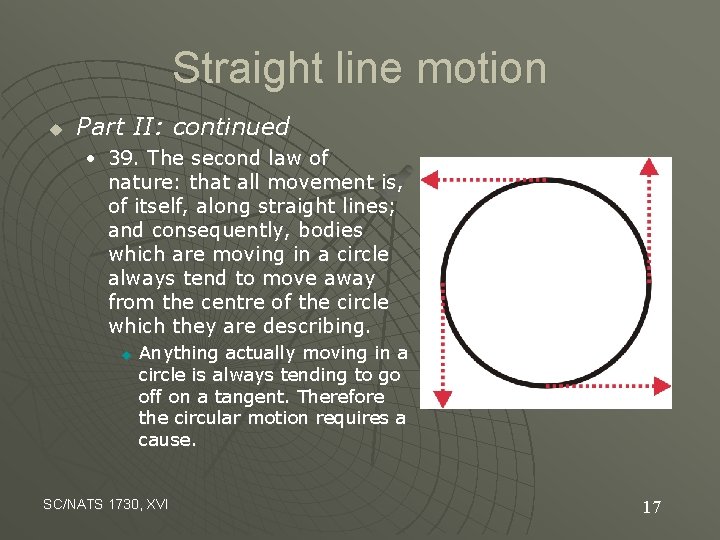
Straight line motion u Part II: continued • 39. The second law of nature: that all movement is, of itself, along straight lines; and consequently, bodies which are moving in a circle always tend to move away from the centre of the circle which they are describing. u Anything actually moving in a circle is always tending to go off on a tangent. Therefore the circular motion requires a cause. SC/NATS 1730, XVI 17
Relentless Mechanism Inertial motion was natural. u Pushes and pulls transferred motion from one body to another. u Everything in Res extensa worked like a machine (e. g. windmill, waterwheel, clock). u Forces were occult – i. e. came from another world, therefore forbidden as an explanation. u SC/NATS 1730, XVI 18
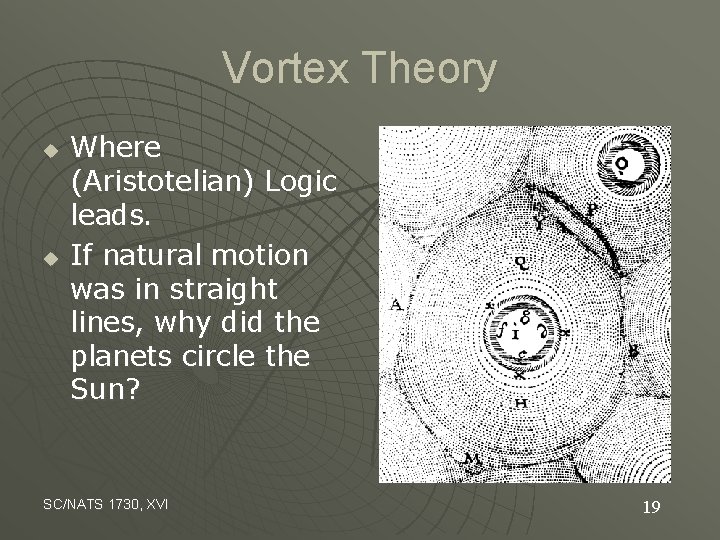
Vortex Theory u u Where (Aristotelian) Logic leads. If natural motion was in straight lines, why did the planets circle the Sun? SC/NATS 1730, XVI 19
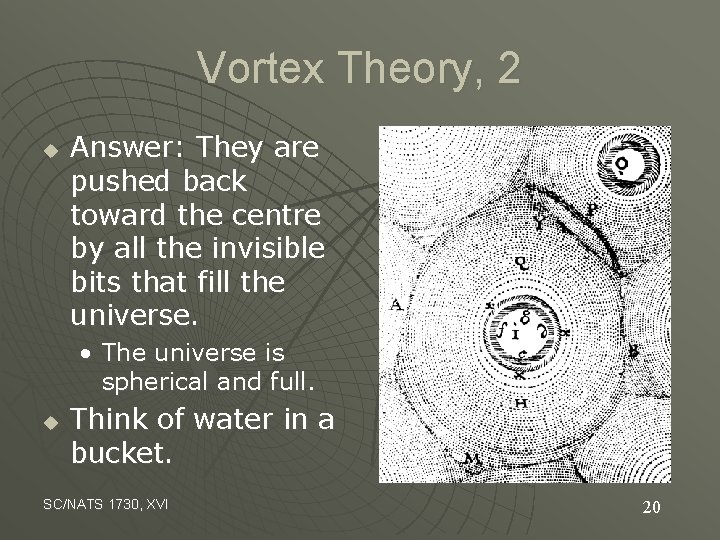
Vortex Theory, 2 u Answer: They are pushed back toward the centre by all the invisible bits that fill the universe. • The universe is spherical and full. u Think of water in a bucket. SC/NATS 1730, XVI 20
Living bodies are machines The soul belongs to Res cogitans. u Anything in the physical world must be mechanical. u All living things are merely complex machines. u • Animals were machines, no matter how much emotion they appeared to show. SC/NATS 1730, XVI 21
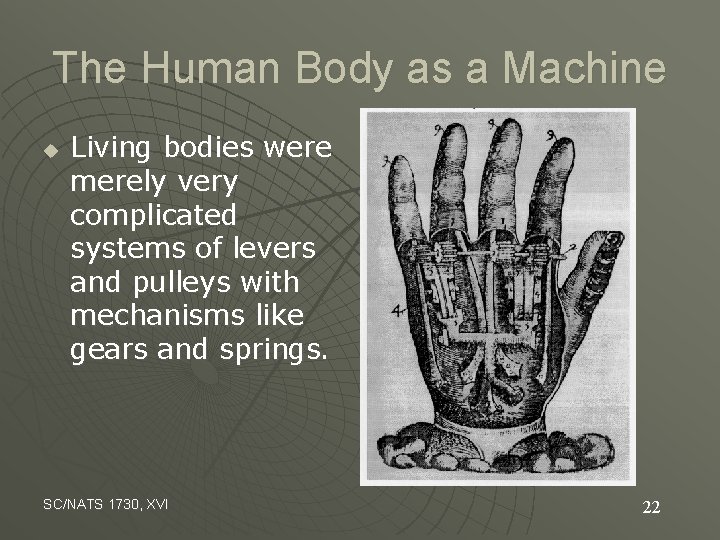
The Human Body as a Machine u Living bodies were merely very complicated systems of levers and pulleys with mechanisms like gears and springs. SC/NATS 1730, XVI 22
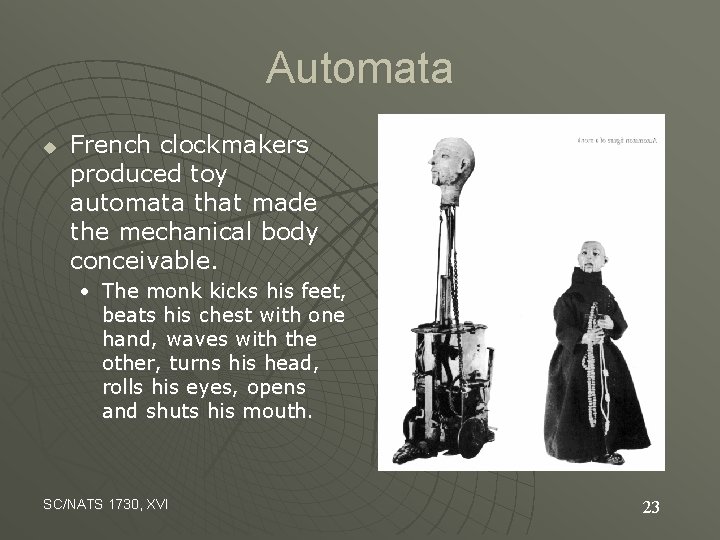
Automata u French clockmakers produced toy automata that made the mechanical body conceivable. • The monk kicks his feet, beats his chest with one hand, waves with the other, turns his head, rolls his eyes, opens and shuts his mouth. SC/NATS 1730, XVI 23
The Human Condition Since human being had souls and also had volition, there must be some communication for them between Res cogitans and Res extensa. u But how is this possible if the worlds are totally separate? u SC/NATS 1730, XVI 24
The Pineal Gland u In Descartes’ time, anatomists had discovered a tiny gland in the human brain for which they knew no purpose. • It was not known to exist in the brains of other animals. (It does. ) • This was the Pineal Gland (it was shaped like a pine cone). u Aha!, thought Descartes. This is the seat of communication for the soul and the body. SC/NATS 1730, XVI 25
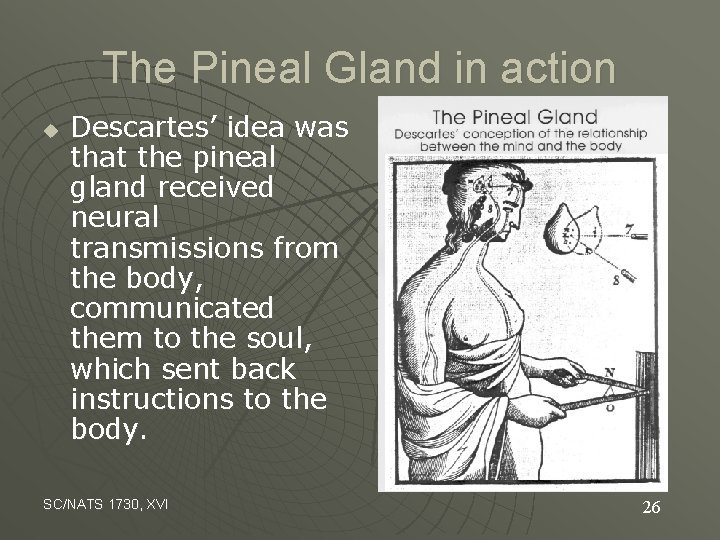
The Pineal Gland in action u Descartes’ idea was that the pineal gland received neural transmissions from the body, communicated them to the soul, which sent back instructions to the body. SC/NATS 1730, XVI 26
God the clockmaker u Descartes, the Jesuit-trained philosopher and lifelong Catholic, saw God’s role as being the creator of the universe and all its mechanisms. • God, the Engineer. • This became a popular theological position for scientists. SC/NATS 1730, XVI 27
The Analysis of Res Extensa Among Descartes’ most useful contributions to science were the tools he developed for studying the physical world. u Most important among these is the development of a new branch of mathematics: Analytic Geometry. u SC/NATS 1730, XVI 28
Analytic Geometry u A combination of geometry, taken from Euclid, and algebra, taken from Arab scholars, and traceable back to ancient Egypt. • Geometry was generally used to solve problems involving lines and shapes. • Algebra was most useful for finding numerical answers to particular problems. u Descartes found a useful way for them to work together. SC/NATS 1730, XVI 29
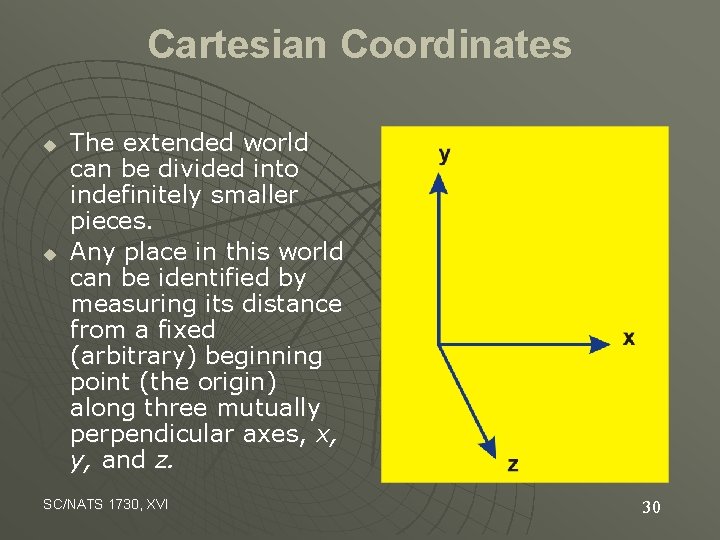
Cartesian Coordinates u u The extended world can be divided into indefinitely smaller pieces. Any place in this world can be identified by measuring its distance from a fixed (arbitrary) beginning point (the origin) along three mutually perpendicular axes, x, y, and z. SC/NATS 1730, XVI 30
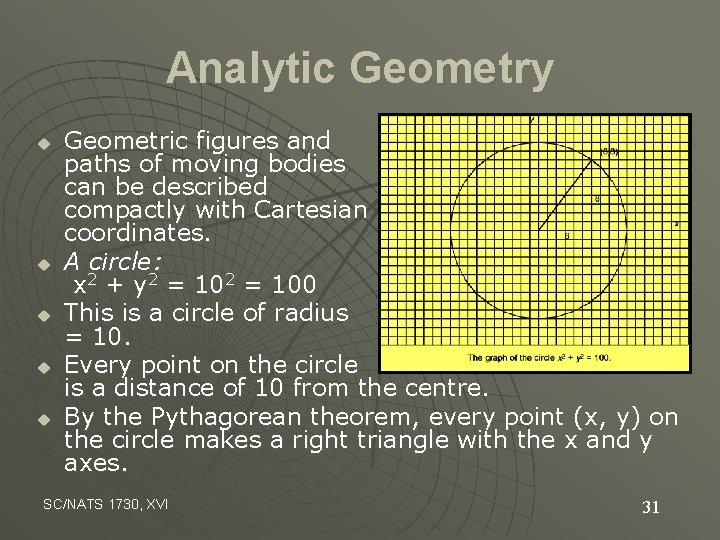
Analytic Geometry u u u Geometric figures and paths of moving bodies can be described compactly with Cartesian coordinates. A circle: x 2 + y 2 = 100 This is a circle of radius = 10. Every point on the circle is a distance of 10 from the centre. By the Pythagorean theorem, every point (x, y) on the circle makes a right triangle with the x and y axes. SC/NATS 1730, XVI 31
Capturing Projectile Motion in an equation SC/NATS 1730, XVI 32
- Slides: 32