
Desarrollo del Vocabulario en Espaol y en Ingls
Desarrollo del Vocabulario en Español y en Inglés Utilizando Movimiento Dr. Karen Weiller Dr. Jennifer Bridges Dr. Rossana Boyd AAHPERD Conference March 31, 2011 San Diego, CA Copyright 2011 Weiller Abels, Bridges, & Boyd
La Bamba! Let’s get ready to share an interactive language and movement session by warming up with music, movement and Spanish lyrics by: Dora and Wyclef Jean singing La Bamba (Used with expressed written permission) Stand up, Sing, Clap and Have Fun!! (2: 40 min: sec) © 2011 Viacom International Inc. All Rights Reserved. Nickelodeon, Mega Music Festival and Dora the Explorer and all related titles, logos and characters are trademarks of Viacom International Inc. Copyright 2011 Weiller Abels, Bridges, & Boyd
PRESENTATION OBJECTIVES Demonstrate to elementary teachers how they can a. build vocabulary in English and in Spanish through b. listening, speaking, and “doing” movement. Demonstrate to elementary teachers how teaching from a movement education perspective can help children a. stay physically active, b. acquire movement success, and c. build English and Spanish vocabulary. Copyright 2011 Weiller Abels, Bridges, & Boyd
National Association of Sport and Physical Education (NASPE) Standards Standard 1: The student demonstrates competency in motor skills and movement patterns needed to perform a variety of physical activities. Standard 2: The student demonstrates understanding of movement concepts, principles, strategies, and tactics as they apply to the learning and performance of physical activities. Copyright 2011 Weiller Abels, Bridges, & Boyd
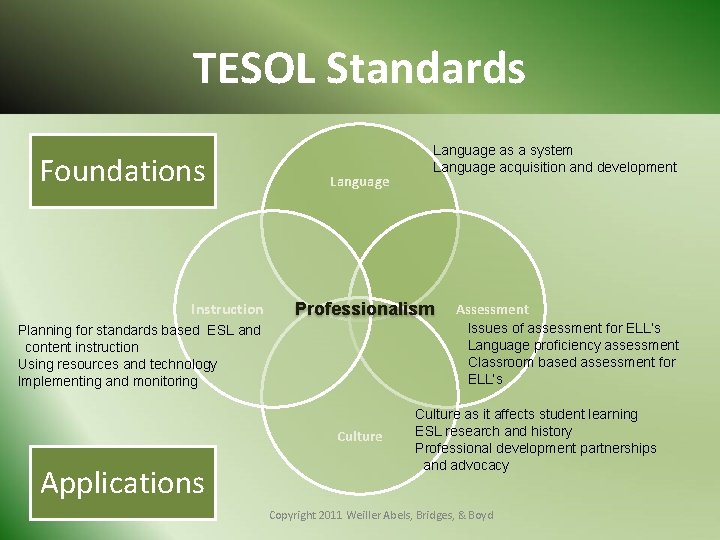
TESOL Standards Foundations Instruction Language Professionalism Assessment Issues of assessment for ELL’s Language proficiency assessment Classroom based assessment for ELL’s Planning for standards based ESL and content instruction Using resources and technology Implementing and monitoring Culture Applications Language as a system Language acquisition and development Culture as it affects student learning ESL research and history Professional development partnerships and advocacy Copyright 2011 Weiller Abels, Bridges, & Boyd
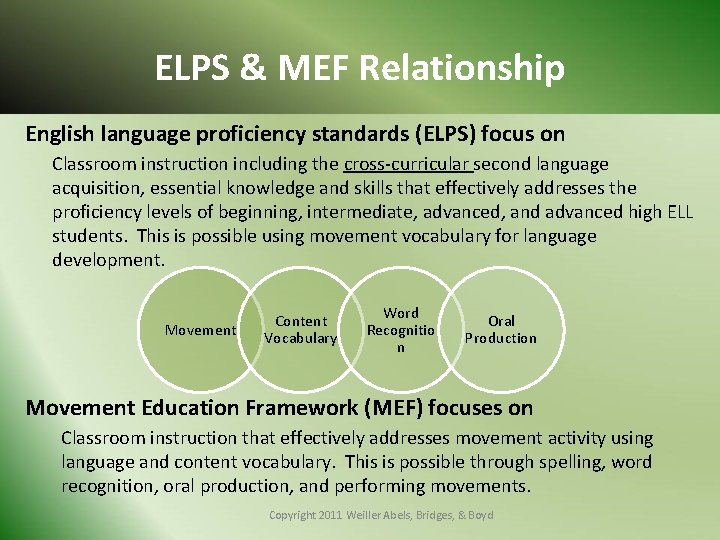
ELPS & MEF Relationship English language proficiency standards (ELPS) focus on Classroom instruction including the cross-curricular second language acquisition, essential knowledge and skills that effectively addresses the proficiency levels of beginning, intermediate, advanced, and advanced high ELL students. This is possible using movement vocabulary for language development. Movement Content Vocabulary Word Recognitio n Oral Production Movement Education Framework (MEF) focuses on Classroom instruction that effectively addresses movement activity using language and content vocabulary. This is possible through spelling, word recognition, oral production, and performing movements. Copyright 2011 Weiller Abels, Bridges, & Boyd
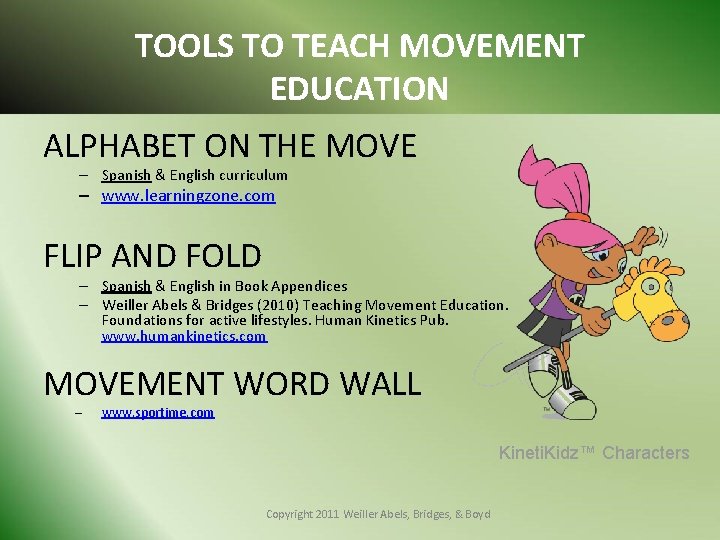
TOOLS TO TEACH MOVEMENT EDUCATION ALPHABET ON THE MOVE – Spanish & English curriculum – www. learningzone. com FLIP AND FOLD – Spanish & English in Book Appendices – Weiller Abels & Bridges (2010) Teaching Movement Education. Foundations for active lifestyles. Human Kinetics Pub. www. humankinetics. com MOVEMENT WORD WALL – www. sportime. com Kineti. Kidz™ Characters Copyright 2011 Weiller Abels, Bridges, & Boyd
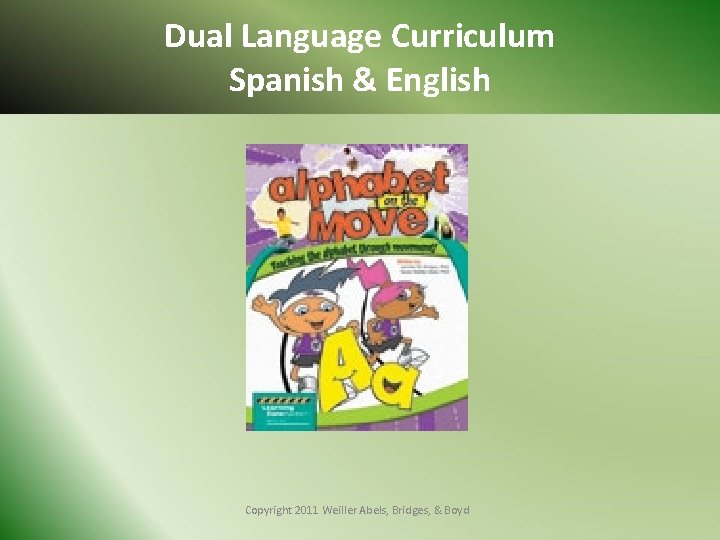
Dual Language Curriculum Spanish & English Copyright 2011 Weiller Abels, Bridges, & Boyd
Movement Flip-n-fold English Spanish Copyright 2011 Weiller Abels, Bridges, & Boyd
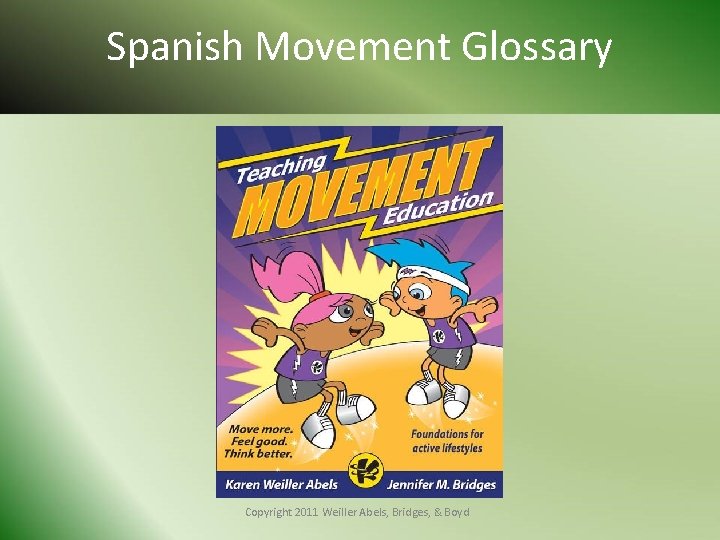
Spanish Movement Glossary Copyright 2011 Weiller Abels, Bridges, & Boyd
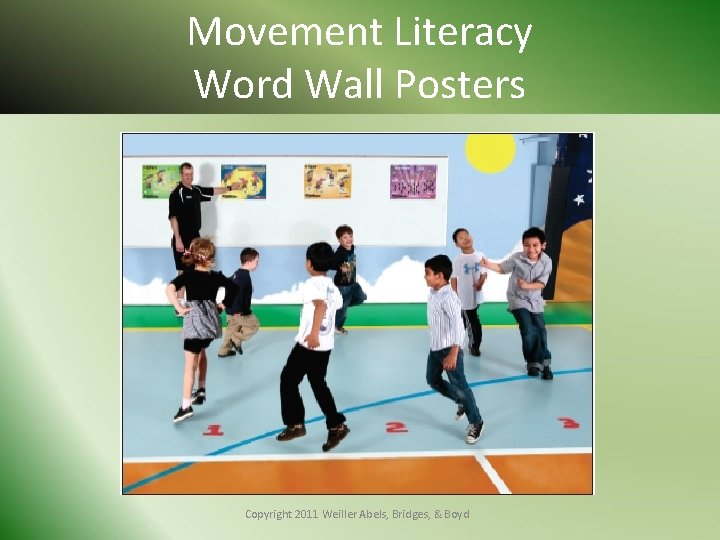
Movement Literacy Word Wall Posters Copyright 2011 Weiller Abels, Bridges, & Boyd
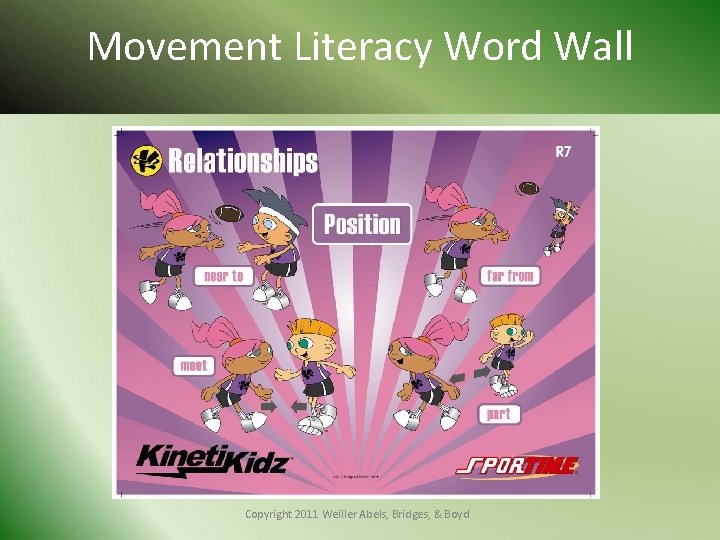
Movement Literacy Word Wall Copyright 2011 Weiller Abels, Bridges, & Boyd
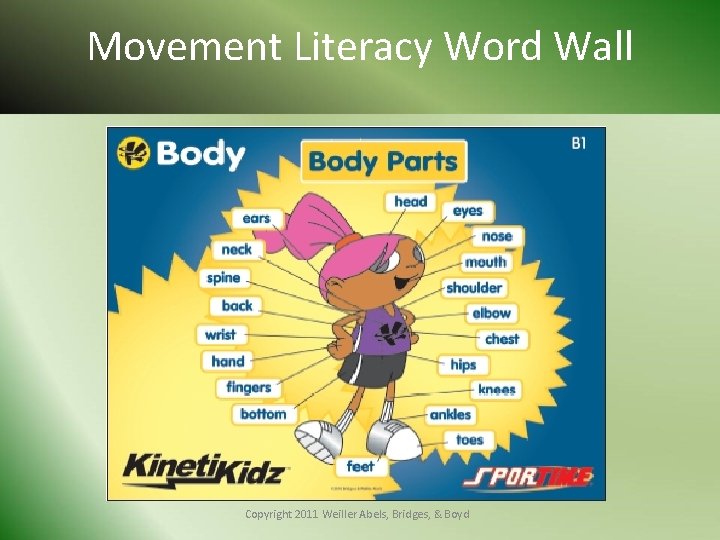
Movement Literacy Word Wall Copyright 2011 Weiller Abels, Bridges, & Boyd
Let’s Do! SAMPLE ACTIVITIES Copyright 2011 Weiller Abels, Bridges, & Boyd
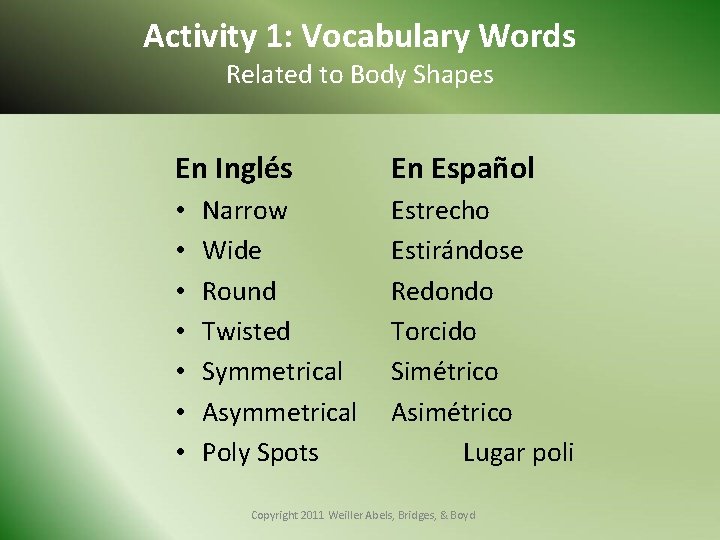
Activity 1: Vocabulary Words Related to Body Shapes En Inglés • • Narrow Wide Round Twisted Symmetrical Asymmetrical Poly Spots En Español Estrecho Estirándose Redondo Torcido Simétrico Asimétrico Lugar poli Copyright 2011 Weiller Abels, Bridges, & Boyd
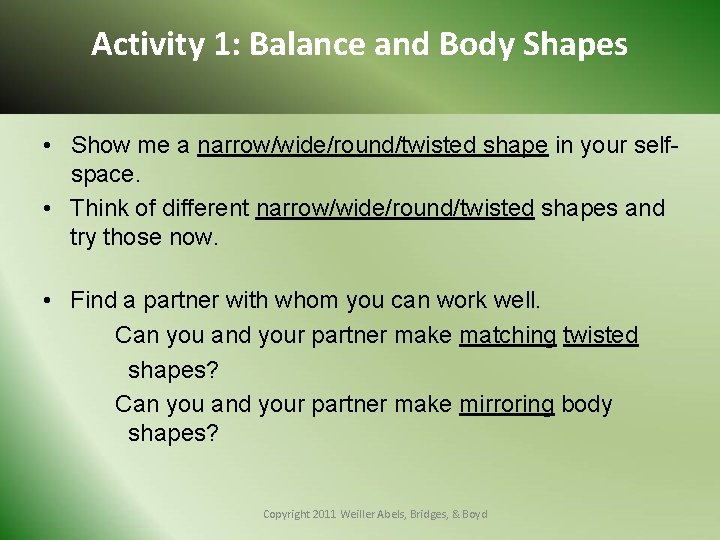
Activity 1: Balance and Body Shapes • Show me a narrow/wide/round/twisted shape in your selfspace. • Think of different narrow/wide/round/twisted shapes and try those now. • Find a partner with whom you can work well. Can you and your partner make matching twisted shapes? Can you and your partner make mirroring body shapes? Copyright 2011 Weiller Abels, Bridges, & Boyd
Actividad 1: Balanceo y Figuras con Partes del Cuerpo • Piensa en diferentes figuras: angostas, anchas, redondas y torcidas • Busca a un compañero(a) con quien puedas trabajar. • Puedes tú y tu compañero(a) hacer figuras torcidas iguales? (y otras figuras corporales? ) • Puedes tú y tu compañero(a) hacer figuras corporales como si estuvieran viéndose en un espejo? • Muéstrame una figura angosta, ancha, redonda y torcida usando tu espacio. Copyright 2011 Weiller Abels, Bridges, & Boyd
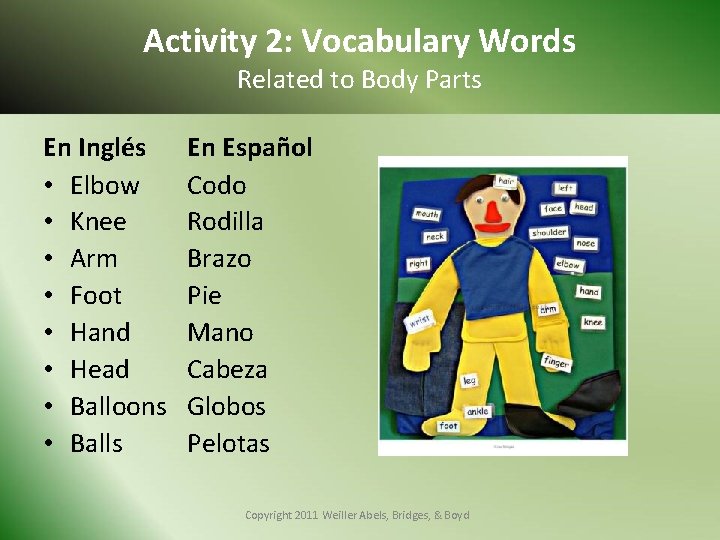
Activity 2: Vocabulary Words Related to Body Parts En Inglés • Elbow • Knee • Arm • Foot • Hand • Head • Balloons • Balls En Español Codo Rodilla Brazo Pie Mano Cabeza Globos Pelotas Copyright 2011 Weiller Abels, Bridges, & Boyd
Activity 2: Parts and Force with Balloons • Use body parts to strike balloons in different ways. • Think about using 4 different body parts to strike the balloon. • What is one body part you can use? Do this 5 times in a row. Count as you are striking with that body part. • Can you now use the paddles to strike the koosh ball or yarn ball? Copyright 2011 Weiller Abels, Bridges, & Boyd
Actividad 2: Partes del Cuerpo y Fuerza Usando Globos • Usa 4 partes del cuerpo diferentes para pegarle al globo. • Cual es una parte del cuerpo que pueden usar? • Vamos a usar las partes del cuerpo para pegarle a los globos de diferentes maneras. • Háganlo 5 veces. Cuenten mientras están pegándole al globo con esa parte del cuerpo. • Pueden usar las raquetas ahora para golpear la pelota de tela o la pelota de lana? Copyright 2011 Weiller Abels, Bridges, & Boyd
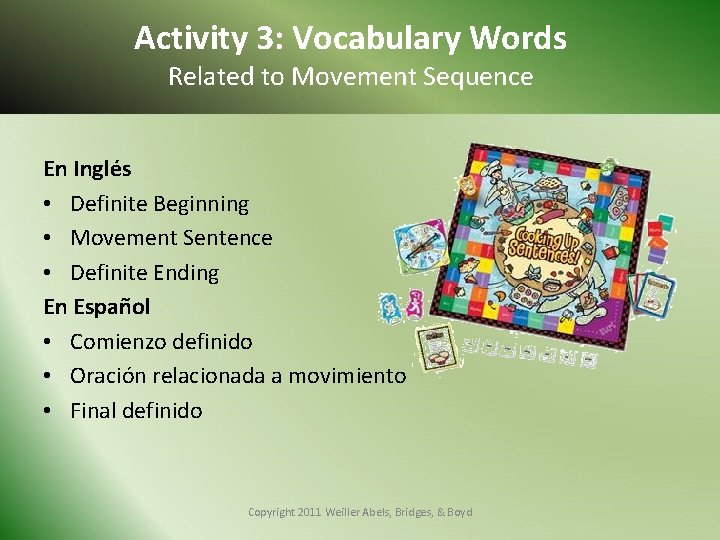
Activity 3: Vocabulary Words Related to Movement Sequence En Inglés • Definite Beginning • Movement Sentence • Definite Ending En Español • Comienzo definido • Oración relacionada a movimiento • Final definido Copyright 2011 Weiller Abels, Bridges, & Boyd
Activity 3: Movement Sequence • In your own self-space, create your own movement sentence. • Talk about a definite beginning and a definite ending. • Show me how you and your partner can create a movement sentence/sequence that uses the – Different movement element cards you selected. – I am looking for a smooth, free flow to your movement sequence. Copyright 2011 Weiller Abels, Bridges, & Boyd
Actividad 3: Secuencias del Movimiento • En su propio espacio, cada quien crea su propia oración sobre movimiento. • Háblame sobre un comienzo y un final definidos. • Muéstrame como tú y tu compañero(a) pueden crear una oración y secuencia de movimiento con las • Diferentes tarjetas sobre los elementos del movimiento que seleccionaste. • Estoy buscando una secuencia de movimiento suave, que fluya libremente. Copyright 2011 Weiller Abels, Bridges, & Boyd
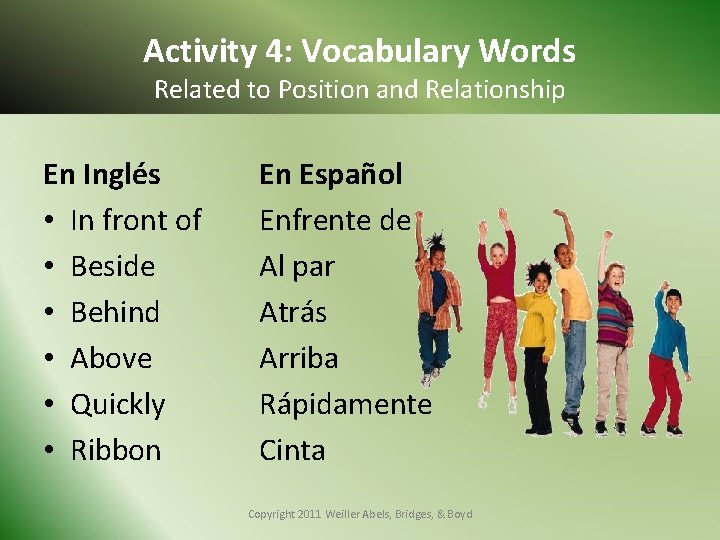
Activity 4: Vocabulary Words Related to Position and Relationship En Inglés • In front of • Beside • Behind • Above • Quickly • Ribbon En Español Enfrente de Al par Atrás Arriba Rápidamente Cinta Copyright 2011 Weiller Abels, Bridges, & Boyd
Activity 4: Position and Relationships • Hold the ribbon in front of you. Can you hold the ribbon behind you? How about beside you? • Make your ribbon move in front of you and behind you. How about beside you? Can you make your ribbon move slowly beside you? How about more quickly? • Can you move the ribbon on lots of ways? How about above you? Below you? In front of you? Copyright 2011 Weiller Abels, Bridges, & Boyd
Actividad 4: Posición and Relaciones • Sosten la cinta enfrente de ti. Puedes sostener la cinta detrás de ti? Y al lado tuyo? • Haz que tu cinta se mueva enfrente de ti y detrás de ti. Y al lado tuyo? • Puedes hacer que tu cinta se mueva despaciosamente al lado tuyo? Puedes moverla mas rápido? • Puedes mover la cinta de diferentes maneras? Sobre ti? Debajo de ti? Enfrente de ti? Copyright 2011 Weiller Abels, Bridges, & Boyd
Activity 5: Vocabulary Words Related to Cooperation En Inglés En Español Cooperation Group to Group Soft (force) Hard (force) Slow Fast Acceleration Hawaiian Parachutes Cooperación De grupo en grupo Suave (fuerza) Fuerte (fuerza) Despacio Rápido Aceleración Paracaídas Hawaianos Copyright 2011 Weiller Abels, Bridges, & Boyd
Activity 5: Cooperation • Your small group will be cooperating to lift the parachute using a soft force. Let’s see if you can raise it to a high level and then back down to a low level. • Now, let’s see if you can show me how you can raise the parachute using a hard force. Can you make the parachute move fast? How about slowly? • Let’s see if you can show a change in speed. • Working together (cooperating) let’s see if you can send the object (s) to different levels. Copyright 2011 Weiller Abels, Bridges, & Boyd
Actividad 5: Cooperación • Tu grupo cooperarápara levantar el paracaídas usando una fuerza suave. Veamos si pueden levantarlo a un nivel alto y después bajarlo a un nivel bajo. • Ahora, veamos so pueden mostrarme como levantan el paracaídas usando una fuerza fuerte. Pueden hacer que el paracaidas se mueva rápido? Y despacio? • Veamos si pueden mostrar algún cambio en la velocidad. • En cooperación, veamos si pueden lanzar los objetos usando diferentes niveles. Copyright 2011 Weiller Abels, Bridges, & Boyd 29
THANK YOU! GRACIAS Karen Weiller Abels, Ph. D. Karen. weiller@unt. edu (940) 565 -2856 Rossana Boyd, Ph. D. rossana. boyd@unt. edu (940) 565 -2933 Jennifer Bridges, Ph. D bridges@svsu. edu (989) 964 -7324 Copyright 2011 Weiller Abels, Bridges, & Boyd
- Slides: 30