
Dermoscopy Colors Depending on the anatomic location and
- Slides: 28
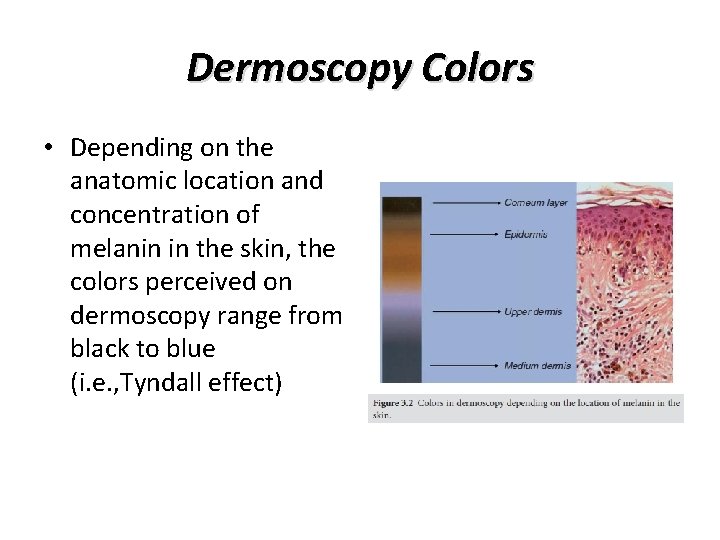
Dermoscopy Colors • Depending on the anatomic location and concentration of melanin in the skin, the colors perceived on dermoscopy range from black to blue (i. e. , Tyndall effect)
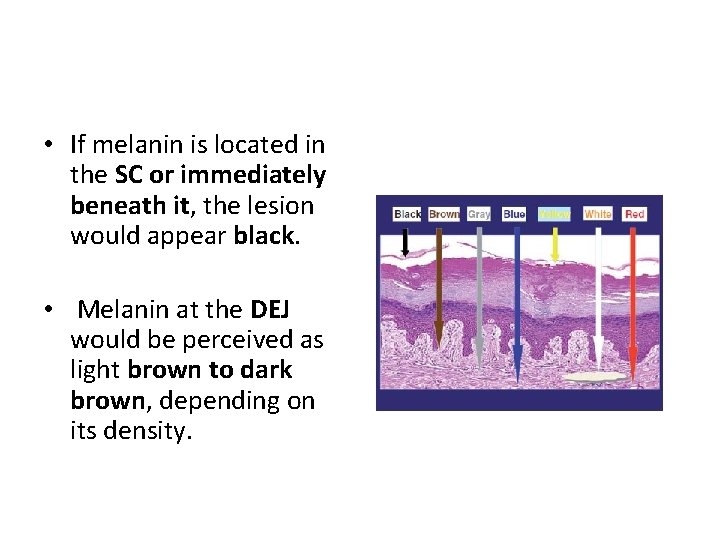
• If melanin is located in the SC or immediately beneath it, the lesion would appear black. • Melanin at the DEJ would be perceived as light brown to dark brown, depending on its density.
• Red : due to vascularity and/or inflammation • White : due to depigmentation and/or scarring • Yellow : due to sebaceous material and/or hyperkeratosis • Orange : due to serum resulting from erosion or superficial ulceration • Jet black : due to congealed blood
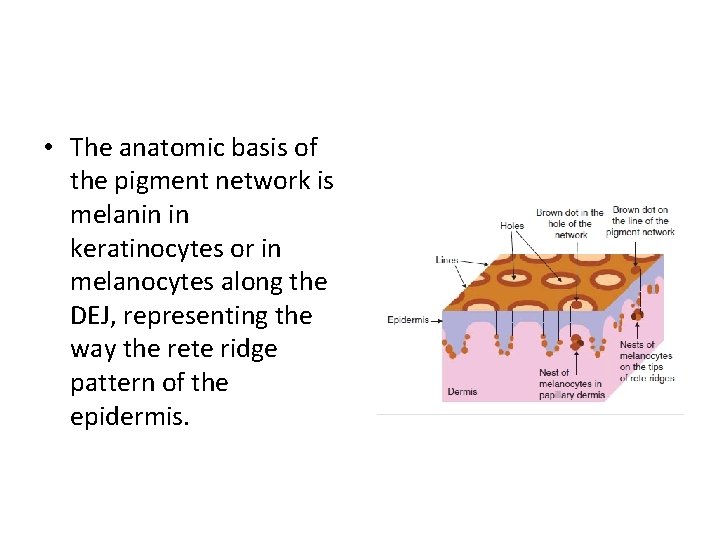
Dermoscopy Structures • Pigment Network: • The pigment network consists of a grid of intersecting pigmented “lines” forming a honeycomb pattern.
• The anatomic basis of the pigment network is melanin in keratinocytes or in melanocytes along the DEJ, representing the way the rete ridge pattern of the epidermis.
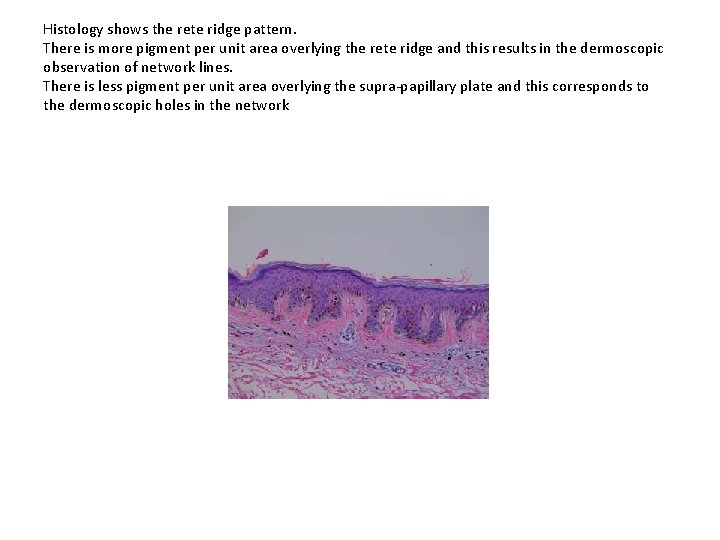
Histology shows the rete ridge pattern. There is more pigment per unit area overlying the rete ridge and this results in the dermoscopic observation of network lines. There is less pigment per unit area overlying the supra-papillary plate and this corresponds to the dermoscopic holes in the network
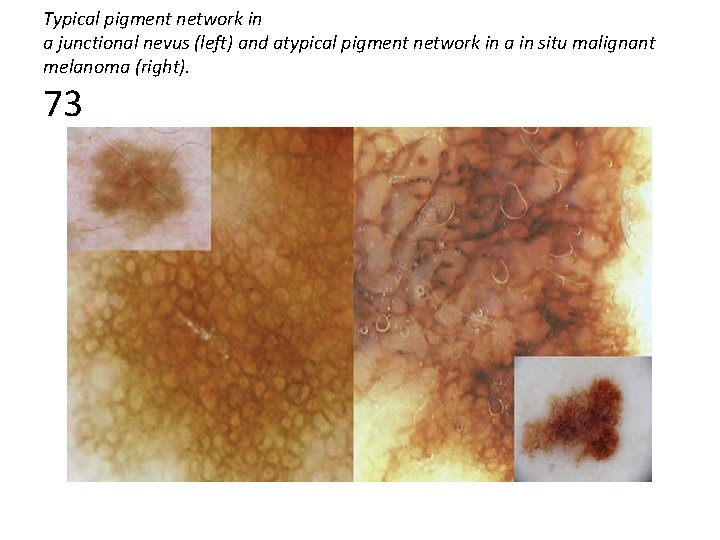
Typical pigment network in a junctional nevus (left) and atypical pigment network in a in situ malignant melanoma (right). 73
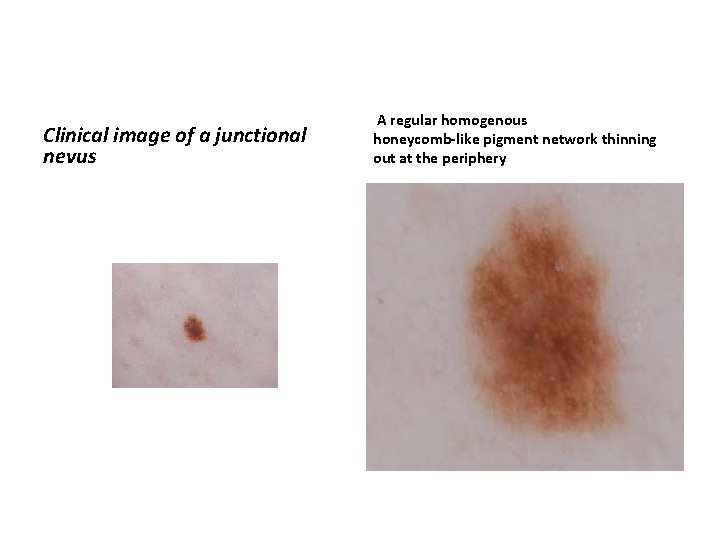
Clinical image of a junctional nevus A regular homogenous honeycomb-like pigment network thinning out at the periphery
The typical network • Regularly meshed is composed of lines that are relatively uniform in width and homogenous in color. • The lines often become gradually thinner and fainter in pigmentation at the lesion’s periphery.
• • The typical network usually corresponds to: Junctional component of a nevus. Darkly pigmented normal skin Dermatofibroma
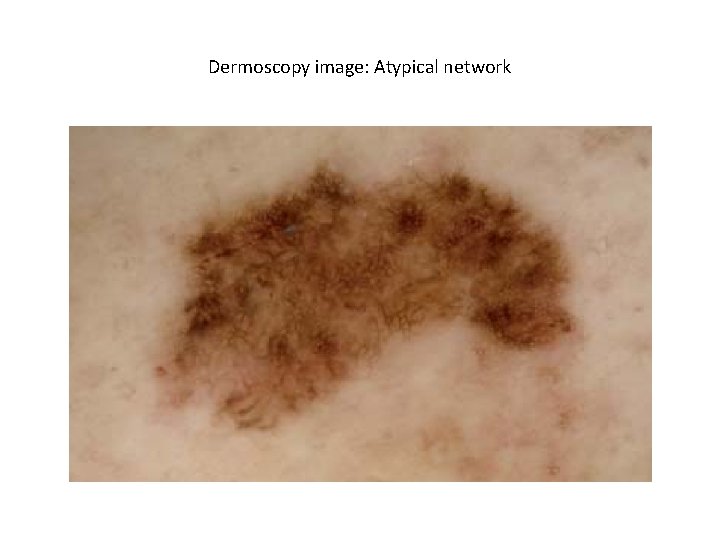
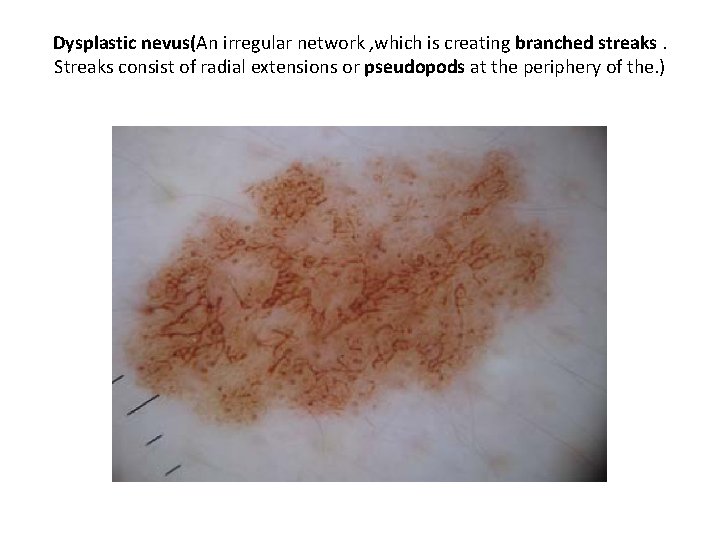
The atypical network • Irregularly meshed ( Lines vary in width and degree of pigmentation ) • Holes that are heterogeneous in area and shape • The network often ends abruptly at the lesion’s periphery. • Appear perturbed and broken up, a finding referred to as “branched streaks”. • The atypical network is often seen in melanoma and dysplastic nevi.
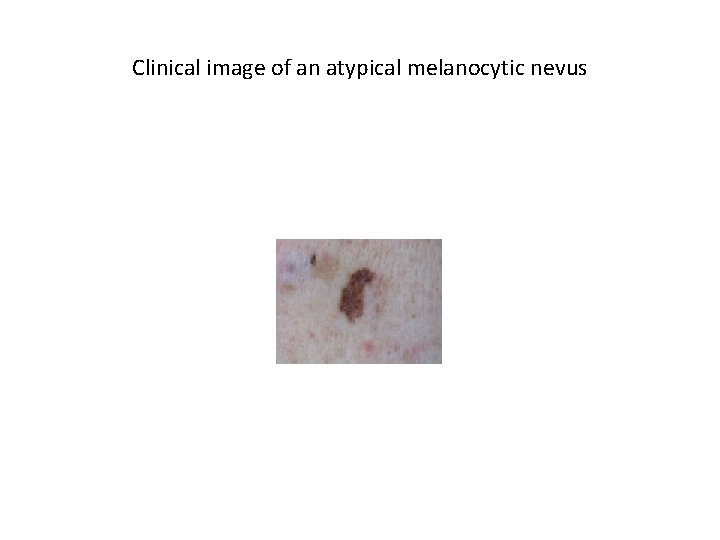
Clinical image of an atypical melanocytic nevus
Dermoscopy image: Atypical network
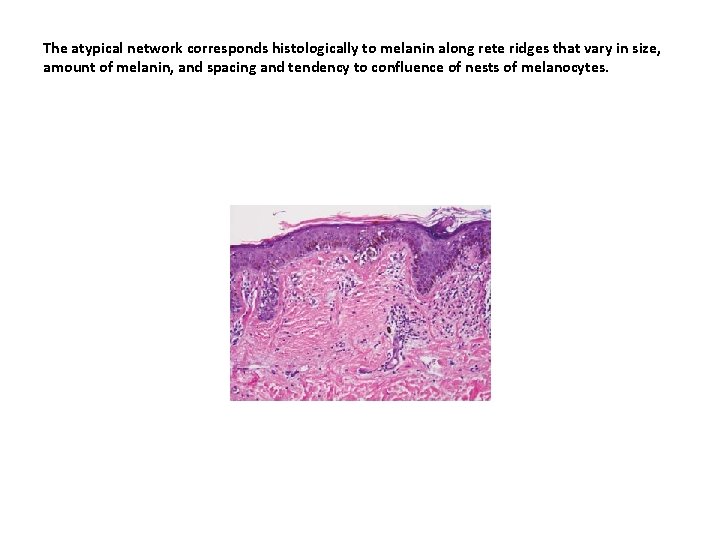
The atypical network corresponds histologically to melanin along rete ridges that vary in size, amount of melanin, and spacing and tendency to confluence of nests of melanocytes.
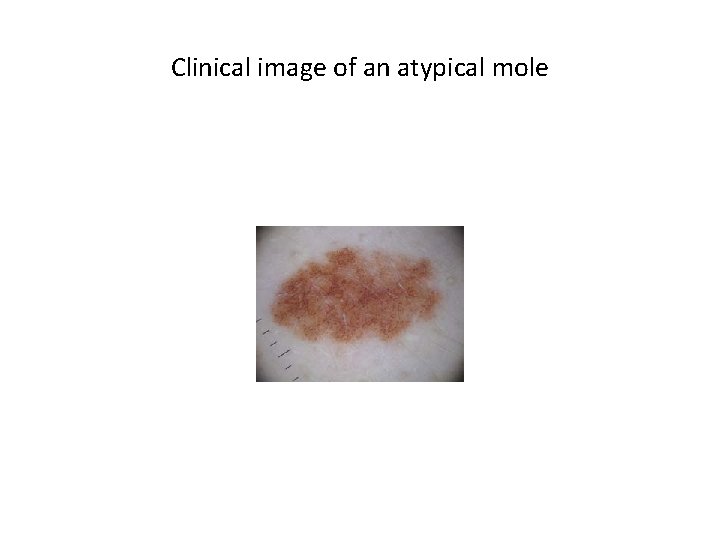
Clinical image of an atypical mole
Dysplastic nevus(An irregular network , which is creating branched streaks. Streaks consist of radial extensions or pseudopods at the periphery of the. )
• The anatomy of the rete ridge pattern on the palms, soles( parallel pigment pattern), and face( pseudonetwork pattern )differs from that of nonglabrous skin.
Structureless Areas • Areas with a size that is at least 10% of the lesion’s surface area. • Devoid of any discernible structures, such as globules, network, or regression structures • They are hypopigmented compared with the rest of the lesion.
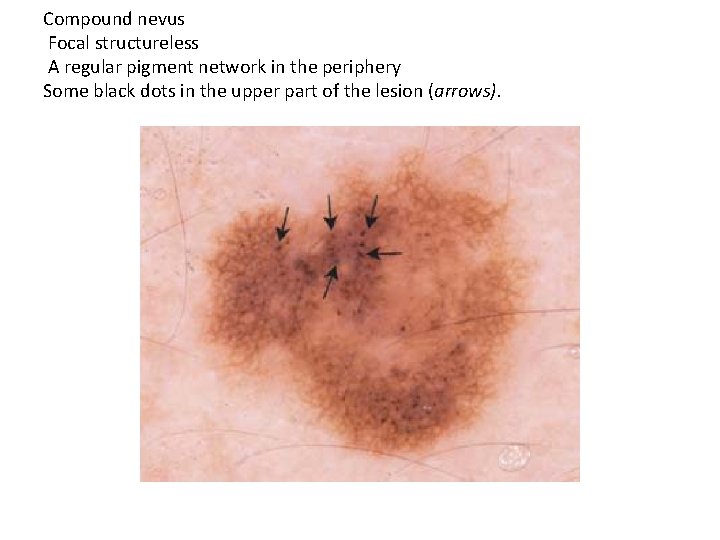
Compound nevus Focal structureless A regular pigment network in the periphery Some black dots in the upper part of the lesion (arrows).
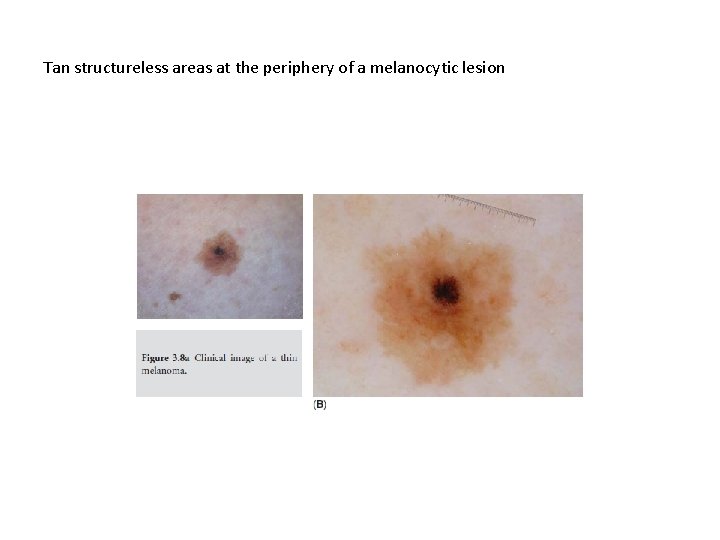
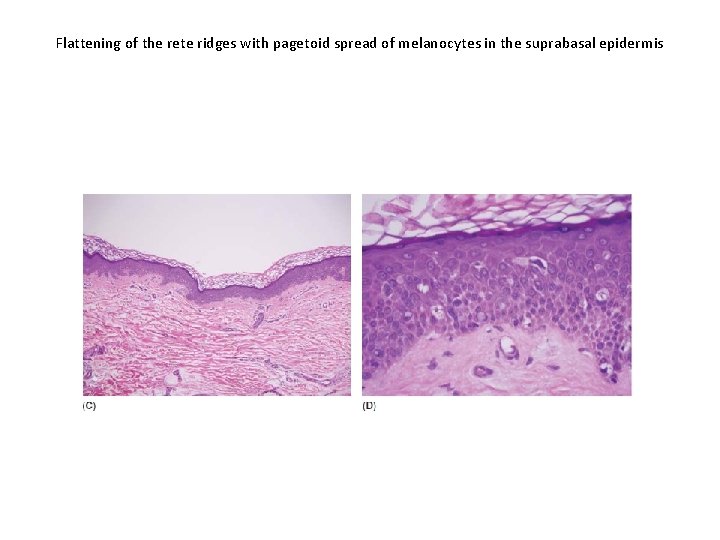
• Focal tan to light brown structureless areas at the periphery of a melanocytic lesion( tend to end abruptly at the edge of a lesion) is commonly associated with melanoma. • Histologically, these areas are characterized by flattening of the DEJ and scattering of atypical melanocytes in suprabasal epidermal layers (i. e. , pagetoid cells).
Tan structureless areas at the periphery of a melanocytic lesion
Flattening of the rete ridges with pagetoid spread of melanocytes in the suprabasal epidermis
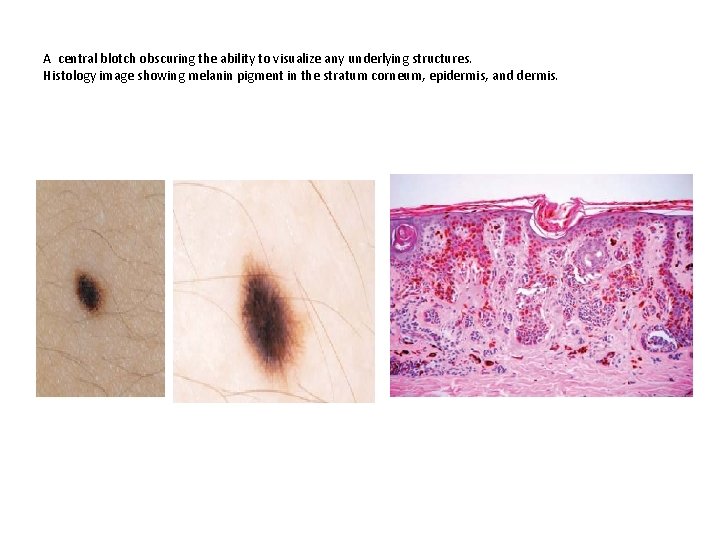
Blotches • An area with a size that is at least 10% of the lesion’s surface area and is heavily pigmented. • In a blotch the melanin pigment is often present throughout the skin, including the SC, epidermis, and the dermis.
Regular blotches Display symmetry Regular borders Homogenous dark hue Located within the center of the lesion A pigment network often surrounds a regular blotch. • Regular blotches are associated with nevi. • • •
A central blotch obscuring the ability to visualize any underlying structures. Histology image showing melanin pigment in the stratum corneum, epidermis, and dermis.
Irregular blotches Asymmetric Irregular contours Located off center Display multiple dark hues (i. e. , heterogenous dark hues). • Irregular blotches are associated with melanoma. • •
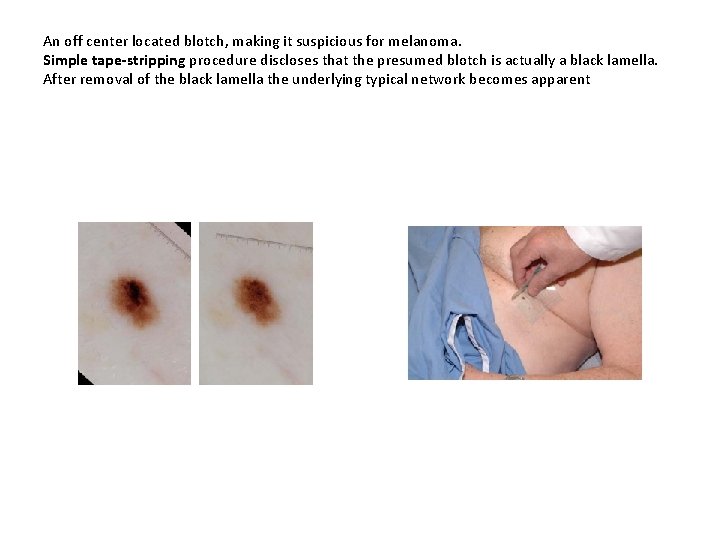
• Occasionally, a blotch-like structure can be seen in activated nevi. • This structure is due to heavy concentrations of melanin in the SC; called a black lamella or pseudoblotch. • It can easily be stripped off using a tape-stripping procedure, thereby revealing underlying structures. • The black lamella will usually reappear 3– 12 months after the tape-stripping procedure.
An off center located blotch, making it suspicious for melanoma. Simple tape-stripping procedure discloses that the presumed blotch is actually a black lamella. After removal of the black lamella the underlying typical network becomes apparent