
Deriving the Instrument Transfer Function from OMI Solar
- Slides: 22
Deriving the Instrument Transfer Function from OMI Solar Observations and Its Implications for Ozone Retrievals Kang Sun, Xiong Liu, Zhaonan Cai, Guanyu Huang, Gonzalo González Abad, and Kelly Chance Harvard-Smithsonian Center for Astrophysics Kai Yang, UMD GSICS Annual Meeting, Mar. 22, 2017 1
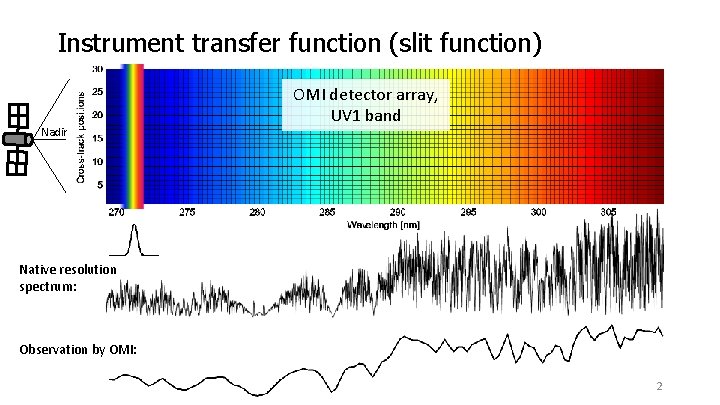
Instrument transfer function (slit function) Nadir OMI detector array, UV 1 band Native resolution spectrum: Observation by OMI: 2
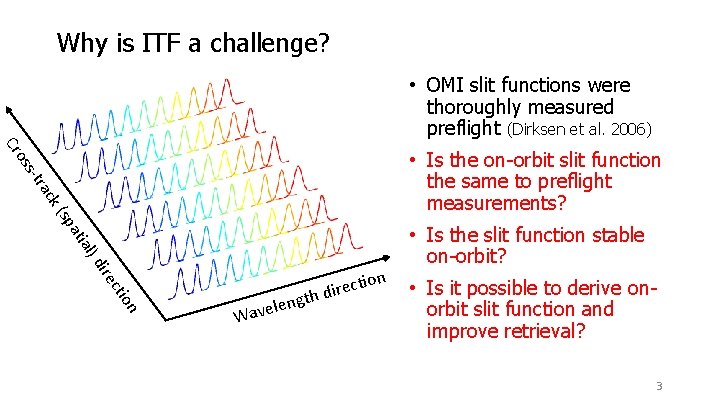
Why is ITF a challenge? • OMI slit functions were thoroughly measured preflight (Dirksen et al. 2006) os Cr a sp k( rac s-t • Is the on-orbit slit function the same to preflight measurements? l) tia e dir on cti on i t c e r h di t g n e avel W • Is the slit function stable on-orbit? • Is it possible to derive onorbit slit function and improve retrieval? 3
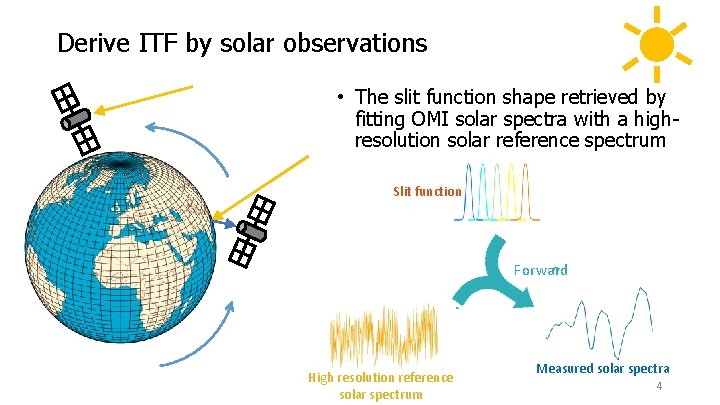
Derive ITF by solar observations • The slit function shape retrieved by fitting OMI solar spectra with a highresolution solar reference spectrum Slit function Inverse Forward High resolution reference solar spectrum Measured solar spectra 4
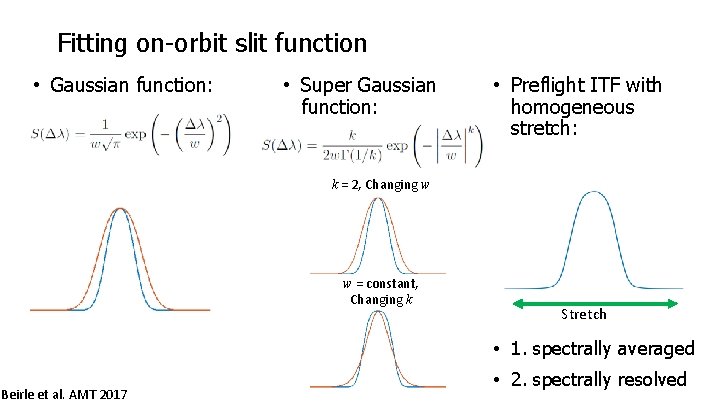
Fitting on-orbit slit function • Gaussian function: • Super Gaussian function: • Preflight ITF with homogeneous stretch: k = 2, Changing w w = constant, Changing k Stretch • 1. spectrally averaged Beirle et al. AMT 2017 • 2. spectrally resolved
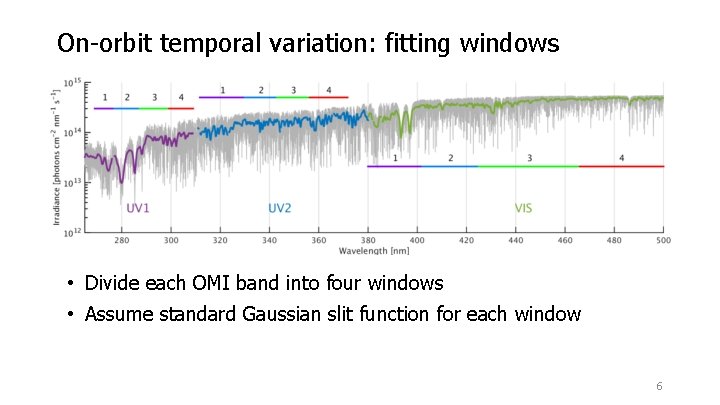
On-orbit temporal variation: fitting windows • Divide each OMI band into four windows • Assume standard Gaussian slit function for each window 6
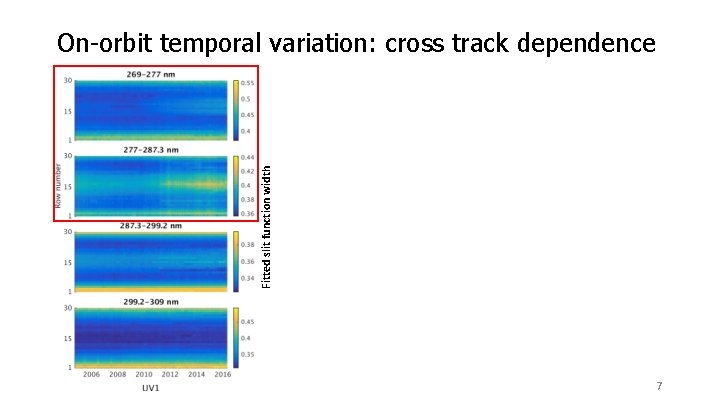
Fitted slit function width On-orbit temporal variation: cross track dependence 7
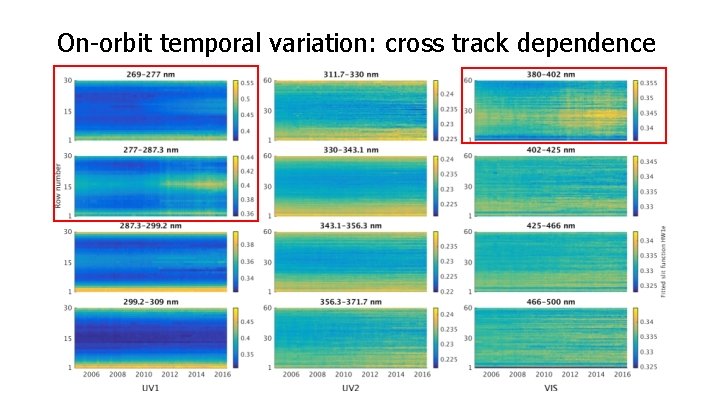
On-orbit temporal variation: cross track dependence 8
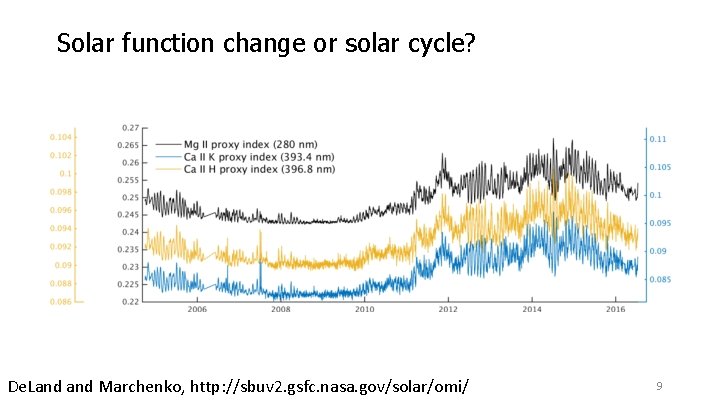
Solar function change or solar cycle? De. Land Marchenko, http: //sbuv 2. gsfc. nasa. gov/solar/omi/ 9
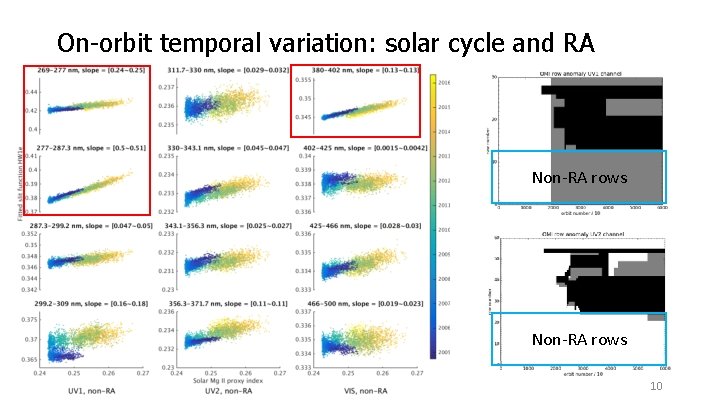
On-orbit temporal variation: solar cycle and RA Non-RA rows 10
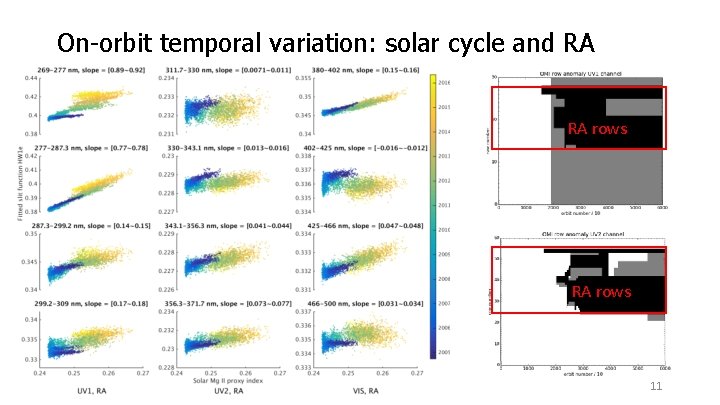
On-orbit temporal variation: solar cycle and RA RA rows 11
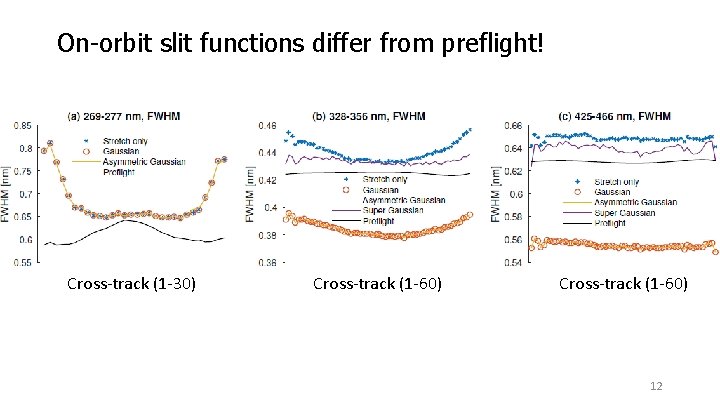
On-orbit slit functions differ from preflight! Cross-track (1 -30) Cross-track (1 -60) 12
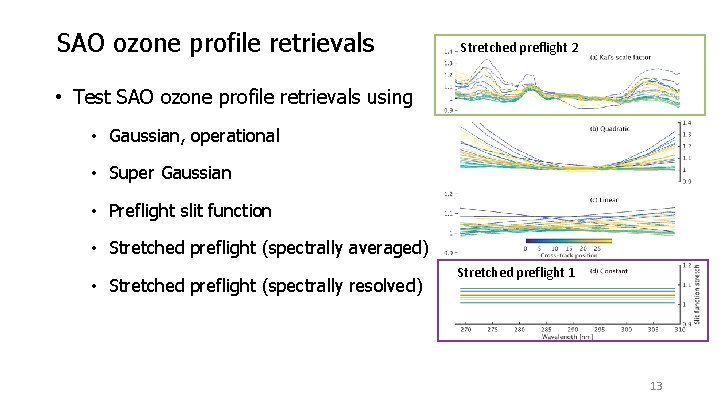
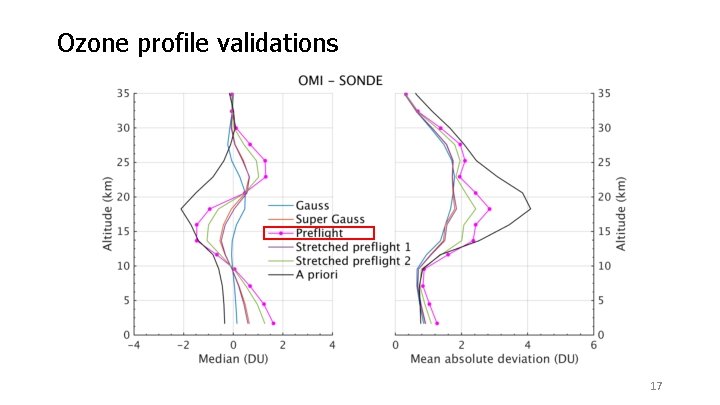
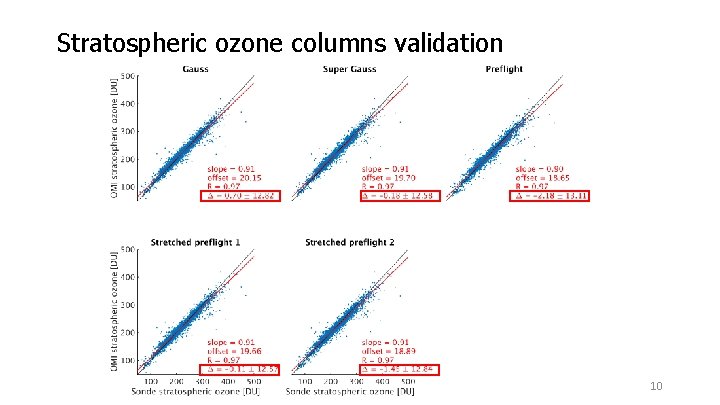
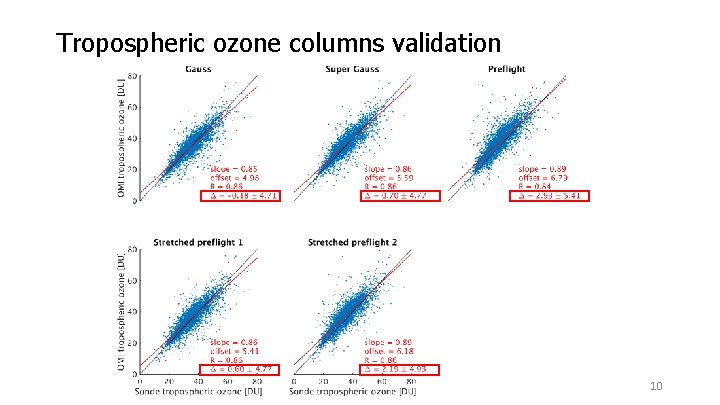
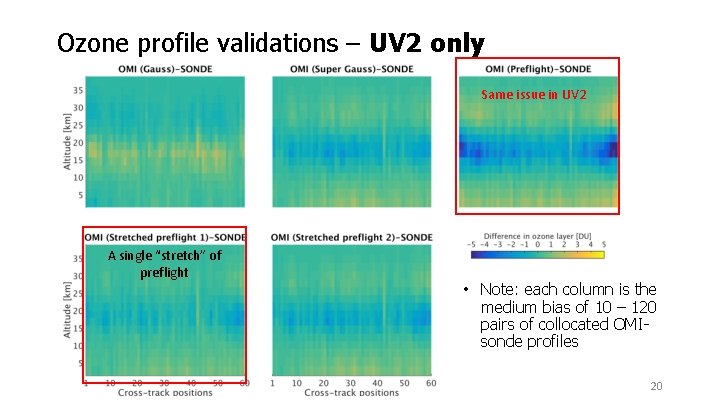
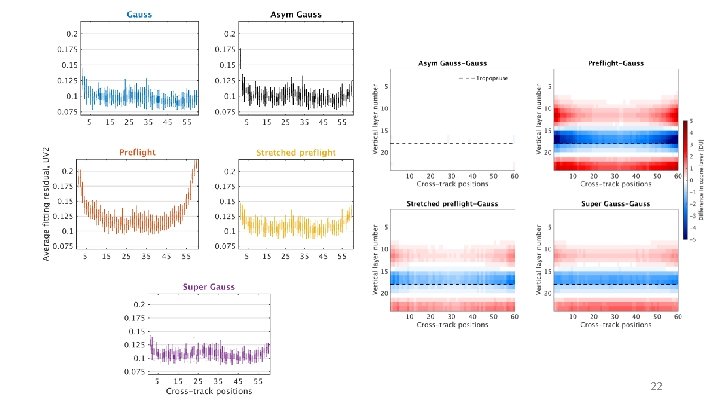
SAO ozone profile retrievals Stretched preflight 2 • Test SAO ozone profile retrievals using • Gaussian, operational • Super Gaussian • Preflight slit function • Stretched preflight (spectrally averaged) • Stretched preflight (spectrally resolved) Stretched preflight 1 13
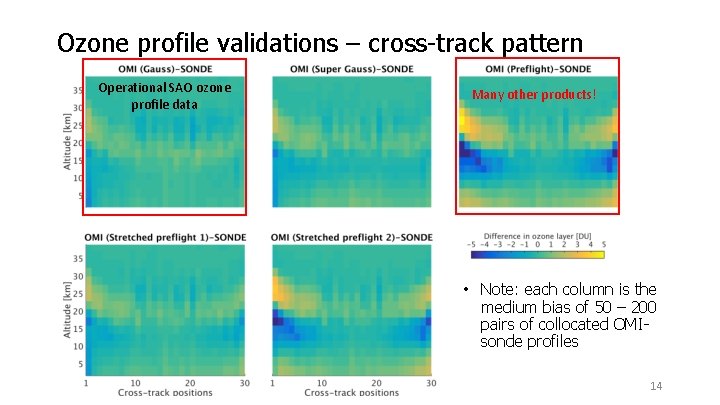
Ozone profile validations – cross-track pattern Operational SAO ozone profile data Many other products! • Note: each column is the medium bias of 50 – 200 pairs of collocated OMIsonde profiles 14
Summary • Derived OMI on-orbit slit functions complicated by solar activities at certain wavelengths • Slit functions of non-RA rows stable over time; RA had impact on slit functions for < 300 nm • On-orbit slit function widths differ from preflight, varying by cross-track positions • Derived slit functions show better cross-track consistency in ozone retrieval 15
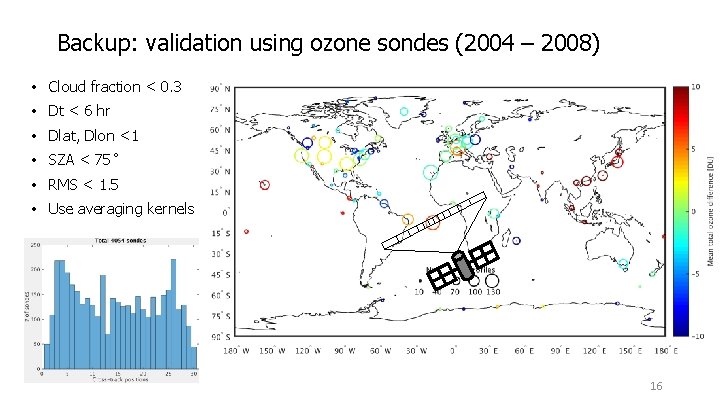
Backup: validation using ozone sondes (2004 – 2008) • Cloud fraction < 0. 3 • Dt < 6 hr • Dlat, Dlon <1 • SZA < 75˚ • RMS < 1. 5 • Use averaging kernels 16
Ozone profile validations 17
Stratospheric ozone columns validation 10
Tropospheric ozone columns validation 10
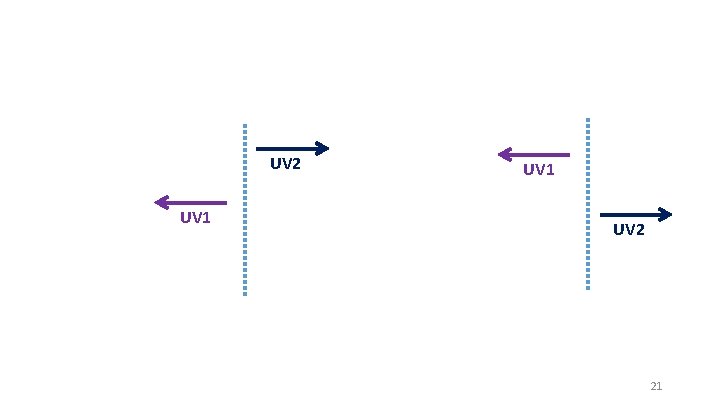
Ozone profile validations – UV 2 only Same issue in UV 2 A single “stretch” of preflight • Note: each column is the medium bias of 10 – 120 pairs of collocated OMIsonde profiles 20
UV 2 UV 1 UV 2 21
22