
DERIVED HORIZONTAL FRAGMENTATION PRESENTED BY MANOJ KUDUDULA PRESENTATION
DERIVED HORIZONTAL FRAGMENTATION PRESENTED BY MANOJ KUDUDULA PRESENTATION ID: 10 University of Houston Clear Lake
TABLE OF CONTENTS 1. DERIVED HORIZONTAL FRAGMENTATION 2. DRAWBACKS 2. 1 Fragmentation used in more applications 2. 2 Fragmentation using better join characteristics 3. CORRECTNESS 3. 1 Completeness 3. 2 Reconstruction 3. 3 Disjointness 4. Vertical Fragmentation
2. Derived Horizontal Fragmentation • A derived horizontal fragmentation is defined on a member relation of a link according to a selection operation specified on its owner • It is important to remember two points – First, the link between the owner and the member relations is defined as an equi-join – Second, an equi-join can be implemented by means of semi -join
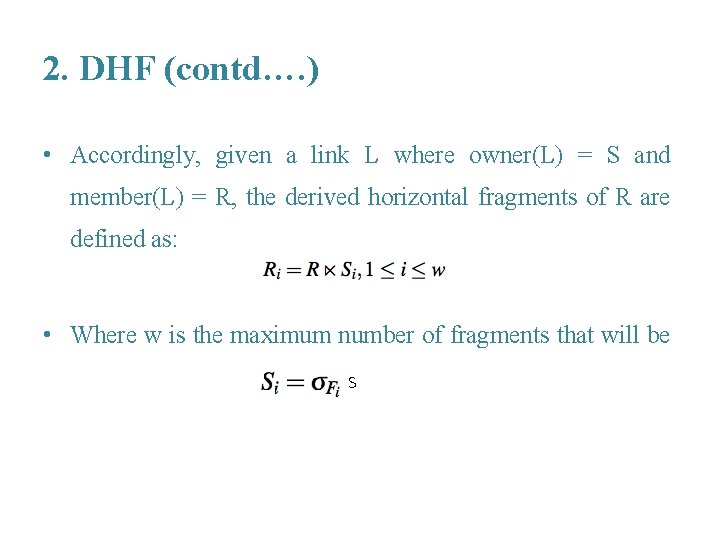
2. DHF (contd…. ) • Accordingly, given a link L where owner(L) = S and member(L) = R, the derived horizontal fragments of R are defined as: • Where w is the maximum number of fragments that will be S
2. DHF(contd…. ) • To carry out a derived horizontal fragmentation, three inputs are needed: – The set of partitions of the owner relation (PAY 1, PAY 2) – The member relation – The set of semi join predicates between the owner and member (EMP. TITLE=PAY. TITLE)
3. Drawbacks • In a database schema if there are two link into a relation R, there could be more than one possible derived horizontal fragmentation of R • The choice of candidate fragmentation is based on two criteria – The fragmentation used in more applications – The fragmentation with better join characteristics
3. 1 The fragmentation used in more Applications • It is quite straight forward if we take into consideration the frequency with which application access some data • The access of the heavy users can minimize the total impact on system performance
3. 2 The Fragmentation with better join characteristics • Consider the last example, the effect of this fragmentation is that the join of the EMP and PAY relations to answer the query is assisted – By performing it on smaller relations – By potentially performing joins in parallel
3. 2 The Fragmentation with better join characteristics (contd…) • The first point is obvious, the fragments of EMP are smaller than EMP itself • Therefore, it will be faster to join any fragment of PAY with any fragment of EMP than to work with the relations themselves • The second point is however, more important and is at the heart of distributed databases • If, besides executing a number of queries at different sites, we can parallelize execution of one join query, the response time or throughput of the system can be expected to be improved.
3. 2 The Fragmentation with better join characteristics (contd…) • Lets now consider ASG, assume that there are two applications – The first application finds the names of engineers who work at certain places, it turns on all three sites and accesses the information about the engineer who work on local projects with higher probability than those of projects at other locations – At each administrative sites where employee records are managed, users would like to access the responsibilities on the projects that these employee work on and learn how they will work on those projects
4. Checking of Correctness • We should now check the fragmentation algorithms discussed so far with respect to three correctness criteria – Completeness – Reconstruction – Disjointness
4. 1 Completeness • The completeness of a primary horizontal fragmentation is based on the selection predicate used • As long as the selection predicates are complete, the resulting fragmentation is guaranteed to be complete as well
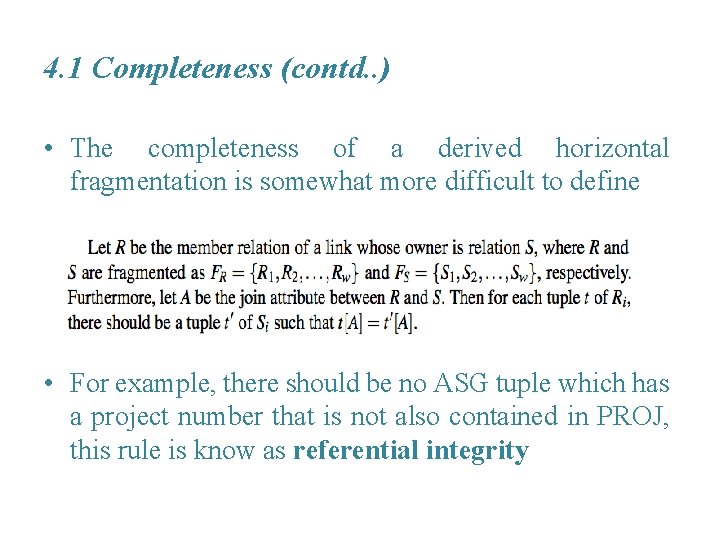
4. 1 Completeness (contd. . ) • The completeness of a derived horizontal fragmentation is somewhat more difficult to define • For example, there should be no ASG tuple which has a project number that is not also contained in PROJ, this rule is know as referential integrity
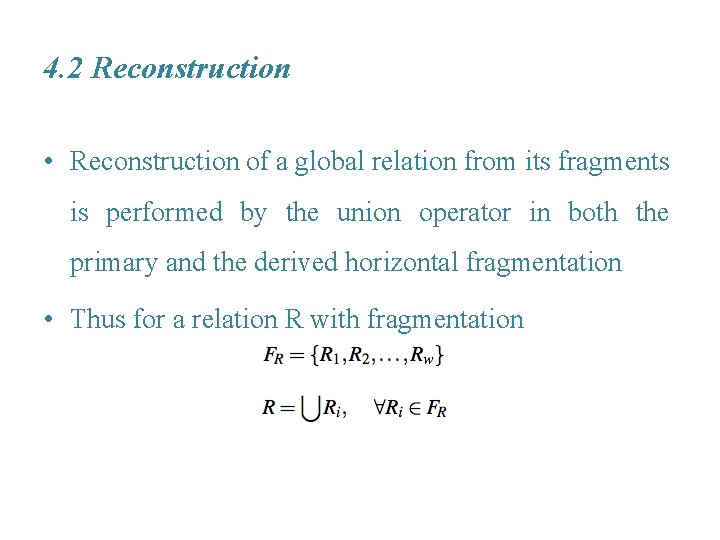
4. 2 Reconstruction • Reconstruction of a global relation from its fragments is performed by the union operator in both the primary and the derived horizontal fragmentation • Thus for a relation R with fragmentation
4. 3 Disjointness • It is easier to establish Disjointness of fragmentation for primary than for derived horizontal fragmentation • In PHF Disjointness is guaranteed as long as the minterm predicates determining the fragmentation are mutually exclusive
Vertical fragmentation • vertical fragmentation of a relation R produces fragments R 1, R 2, . . . , Rr , each of which contains a subset of R’s attributes as well as the primary key of R. • The objective of vertical fragmentation is to partition a relation into a set of smaller relations so that many of the user applications will run on only one fragment
• Vertical fragmentation has been investigated within the context of centralized database systems as well as distributed ones. • Its motivation within the centralized context is as a design tool, which allows the user queries to deal with smaller relations, thus causing a smaller number of page accesses.

Thank you
- Slides: 18