
Derivatives Contingencies Business Segments and Interim Reports Learning
Derivatives, Contingencies, Business Segments, and Interim Reports
Learning Objectives Understand the business and accounting concepts connected with derivatives and hedging activities. Identify the different types of risk faced by a business. Describe the characteristics of the following types of derivatives: swaps, forwards, futures, and options. 2
Learning Objectives Define hedging, and outline the difference between a fair value hedge and a cash flow hedge. Account for a variety of different derivatives and for hedging relationships. CONTINGENCIES Apply the accounting rules for contingent items to the areas of lawsuits and environmental liabilities.
Learning Objectives SEGMENT REPORTING Prepare the necessary supplemental disclosures of financial information by product line and by geographic areas. INTERIM REPORTING Recognize the importance of interim reports, and outline the difficulties encountered when preparing those reports. 4
Types of Risk • • Price risk Credit risk Interest rate risk Exchange rate risk 5
Types of Derivatives • • Swap Forward contract Futures contract Option 6
Types of Derivatives A swap is a contract in which two parties agree to exchange payments in the future based on the movement of some agreedupon price or rate.
Types of Derivatives A forward contract is an agreement between two parties to exchange a specified amount of a commodity, security, or foreign exchange at a specified date in the future with the price or exchange rate being set now.
Types of Derivatives A futures contract is a contract, traded on an exchange, that allows a company to buy a specified quantity of a commodity or a financial security at a specified price on a specified future date.
Types of Derivatives An option is a contract giving the owner the right, but not the obligation, to buy or sell an asset at a specified price any time during a specified period in the future.
Types of Derivatives Call Option: Contract giving the owner the right, but not the obligation, to buy an asset at a specified price. Put Option: Contract giving the owner the right, but not the obligation, to sell an asset at a specified price. An option differs from other derivative instruments because it protects the owner against unfavorable movements in prices or rates while allowing the owner to benefit from favorable movements. 11
Types of Hedging Activities Hedging: Structuring of transactions to reduce risk. • Fair value hedge: A derivative that offsets, at least partially, the change in the fair value of an asset or liability. • Cash flow hedge: A derivative that offsets, at least partially, the variability in cash flows from forecasted transactions that are probable. 12

Accounting for Derivatives Balance sheet: Derivatives should be reported in the balance sheet at their fair value as of the balance sheet date. Income statement: When a derivative is used to hedge risks, the gains and losses on the derivative should be reported in the same income statement in which the income effects on the hedged items are reported.
Accounting for Derivatives • No hedge: All changes in the fair value of derivatives that are not designated as hedges are recognized as gains or losses in the income statement in the period in which the value changes. • Fair value hedge: Changes in the fair value of derivatives designated as fair value hedges are recognized as gains or losses in the period of the value change. 14
Accounting for Derivatives • Cash flow hedge: Changes in the fair value of derivatives designated as cash flow hedges are recognized as part of accumulated other comprehensive income.
Accounting for Derivatives Firms must disclose the gains and losses on derivatives, separated by category: – Fair value hedges – Cash flow hedges – Other • Notional amount: Total face amount of the asset or liability that underlies a derivative contract. 16
Accounting for Derivatives On January 1, 2002, Pratt Company received a two-year $100, 000 variable -rate loan and also entered into an interest rate swap agreement. Jan. 1 Cash Loan Payable 100, 000 17
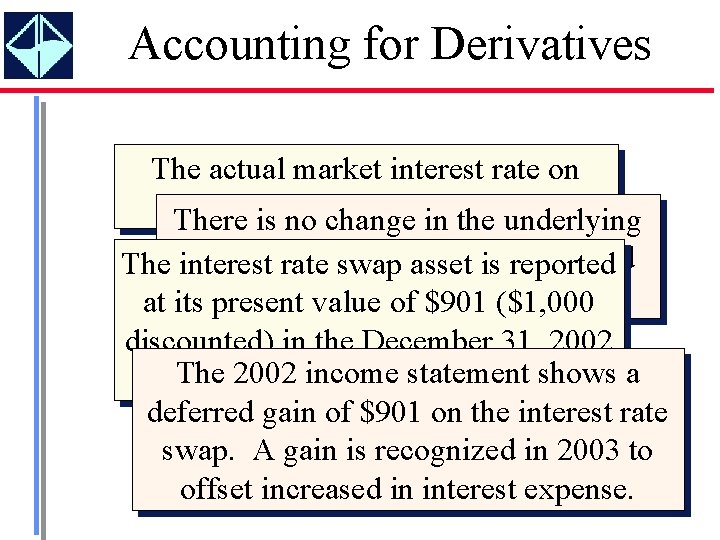
Accounting for Derivatives The actual market interest rate on December 31, 2002 inisthe 11%. There is no change underlying items inrate the swap 2002 balance sheet and The interest asset is reported statement. at its presentincome value of $901 ($1, 000 discounted) in the December 31, 2002 The 2002 incomesheet. statement shows a balance deferred gain of $901 on the interest rate swap. A gain is recognized in 2003 to offset increased in interest expense.
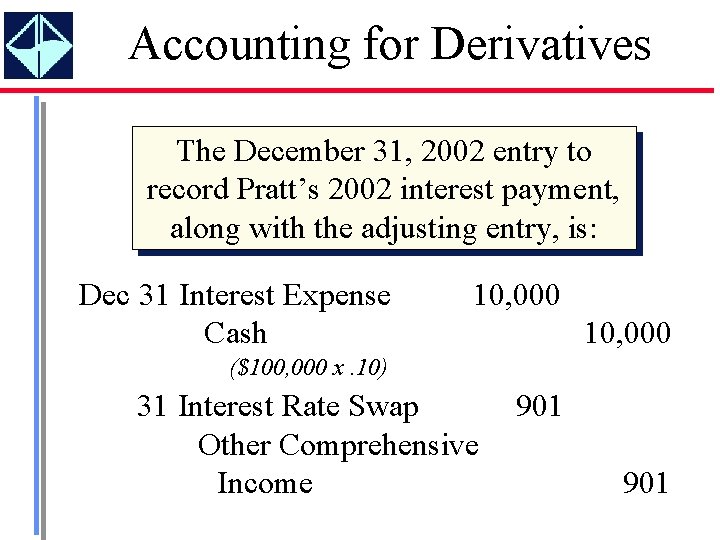
Accounting for Derivatives The December 31, 2002 entry to record Pratt’s 2002 interest payment, along with the adjusting entry, is: Dec 31 Interest Expense Cash 10, 000 ($100, 000 x. 10) 31 Interest Rate Swap Other Comprehensive Income 901
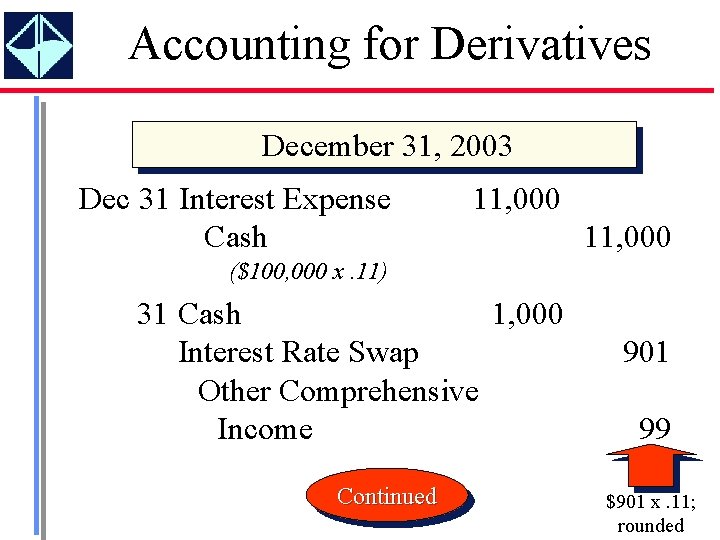
Accounting for Derivatives December 31, 2003 Dec 31 Interest Expense Cash 11, 000 ($100, 000 x. 11) 31 Cash 1, 000 Interest Rate Swap Other Comprehensive Income Continued 901 99 $901 x. 11; rounded
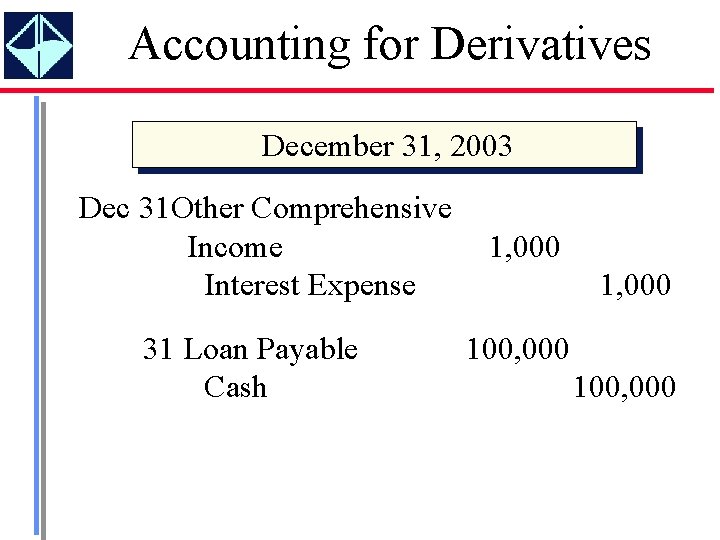
Accounting for Derivatives December 31, 2003 Dec 31 Other Comprehensive Income Interest Expense 31 Loan Payable Cash 1, 000 100, 000
Contingencies FASB Statement No. 5: “. . . an existing condition, situation, or set of circumstances involving uncertainty as to possible gain. . . or loss. . . to an enterprise that will ultimately be resolved when one or more future events occur or fail to occur. ” 22
Contingencies • Contingent losses: Circumstances involving potential losses that will not be resolved until some future event occurs. • Contingent gains: Circumstances involving potential gains that will not be resolved until some future event occurs.
Accounting for Contingencies Contingent Losses Likelihood Probable Accounting Action Recognize a probable liability if the amount can be reasonable estimated. If not estimable, disclose facts in a note. Reasonably Possible Disclose a possibility liability in a note. 24
Accounting for Contingencies Contingent Losses Likelihood Remote Accounting Action No recognition or disclosure unless contingency represents a guarantee. Then, note disclosure is required.
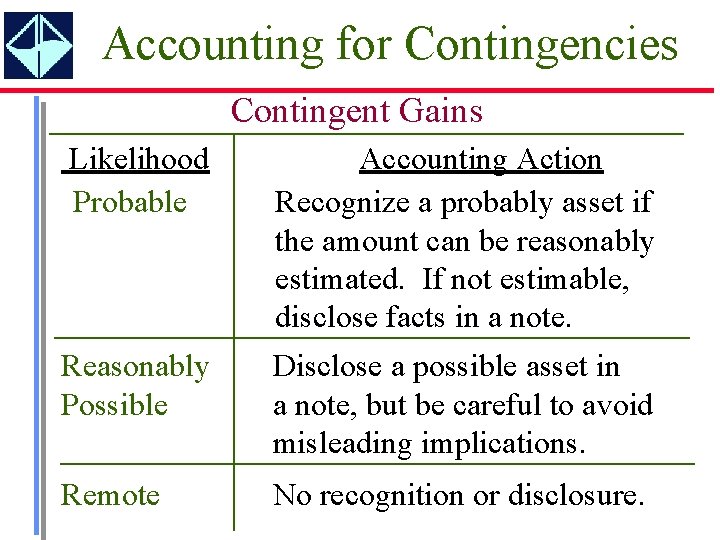
Accounting for Contingencies Contingent Gains Likelihood Probable Accounting Action Recognize a probably asset if the amount can be reasonably estimated. If not estimable, disclose facts in a note. Reasonably Possible Disclose a possible asset in a note, but be careful to avoid misleading implications. Remote No recognition or disclosure.
Accounting for Lawsuits For uninsured risks, a firm must decide when the liability for litigation becomes probable, and thus, a recorded loss. FASB Statement No. 5 identifies several key factors to consider: 27
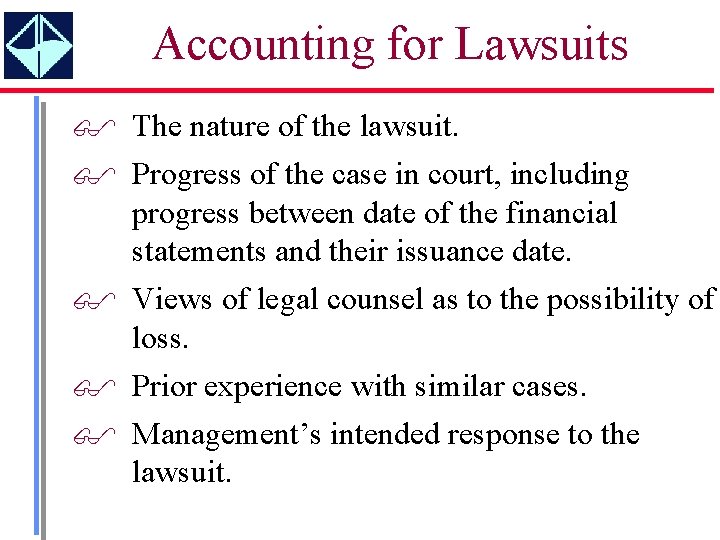
Accounting for Lawsuits $ The nature of the lawsuit. $ Progress of the case in court, including progress between date of the financial statements and their issuance date. $ Views of legal counsel as to the possibility of loss. $ Prior experience with similar cases. $ Management’s intended response to the lawsuit.
Environmental Liabilities • FASB Statement No. 5 does not give specific guidance on disclosure required when a loss contingency cannot be estimated. • Recently, accounting standard setters have issued several statements and Exposure Drafts designed to improve the environmental liability information reported in the financial statements and notes.
Environmental Liabilities • The SEC issued Staff Accounting Bulletin No. 92, its interpretation of GAAP regarding contingent liabilities, with particular applicability to companies with environmental liabilities. 30
Environmental Liabilities • 1996, AICPA issued Statement of Position 96 -1, “Environmental Remediation Liabilities (Including Auditing Guidance). ” • In February 1996, FASB issued a Proposed Statement of Financial Accounting Standards, “Accounting for Certain Liabilities Related to Closure or Removal of Long-Lived Assets. ”
Segment Reporting • FASB Statement No. 14 disclosure requirements: – Revenues, operating profit, and identifiable assets for each significant industry segment. • A segment is significant if its sales, profits, or assets are 10% or more of total company amounts. • A practical limit of 10 segments is suggested, and at least 75% of total company sales must be included in the reported segments. 32
Segment Reporting • FASB Statement No. 14 disclosure requirements: – Revenues from major customers and information about foreign operations and export sales.
FASB Statement No. 131 Disclosure Requirements Total segment operating profit or loss Amounts of certain income statement items such as operating revenues, depreciation, interest revenue, interest expense, tax expense, and significant noncash expenses. Total segment assets. Total capital expenditures. 34
FASB Statement No. 131 Disclosure Requirements Reconciliation of the sum of segment totals to the company total for each of the following items: - Revenues - Operating profit - Assets
FASB Statement No. 131 Disclosure Requirements In addition to these five items, companies must also disclose how operating segments are identified. How large must a segment be for separate disclosure to be required?
FASB Statement No. 131 Disclosure Requirements A segment is reportable if it meets any one of the three criteria as follows: • Revenue test: A segment should be reported if its total revenue is 10% or more of the company’s total revenue. • Profit test: A segment should be reported if the absolute value of its operating profit (or loss) is greater than 10% of the total operating profit for all segments that reported profits • Asset test: A segment should be reported if it contains 10% or more of the combined assets of all operating segments.
Interim Reporting Difficulties with Seasonal Interim Reports 38
Interim Reporting – Seasonal factors – Revenue fluctuations among periods – Fixed costs – Matching of revenues – Adjustments for accrued items – Expense estimates (increased subjectivity) – Extraordinary items – Segment disposal
APB Opinion No. 28 40 • The interim period is an integral part of the annual period. Revenues and expenses for the total period are allocated among interim periods on some reasonable basis (time, sales volume, productive activity).
APB Opinion No. 28 • The interim period is an integral part of the annual period. The same GAAP and reporting practices employed for annual reports are to be used for interim statements, but modification may be necessary for interim reports to better relate to the total results of operations for the period.

The End
- Slides: 42