
DERIVATIVE WORDS AND PRONOUNS Yuli marlina BASIC TERMS

DERIVATIVE WORDS AND PRONOUNS Yuli marlina
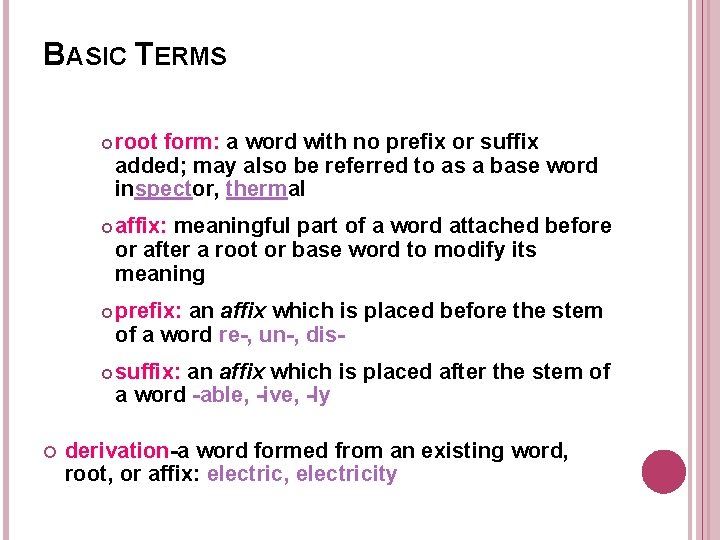
BASIC TERMS root form: a word with no prefix or suffix added; may also be referred to as a base word inspector, thermal affix: meaningful part of a word attached before or after a root or base word to modify its meaning prefix: an affix which is placed before the stem of a word re-, un-, dissuffix: an affix which is placed after the stem of a word -able, -ive, -ly derivation-a word formed from an existing word, root, or affix: electric, electricity
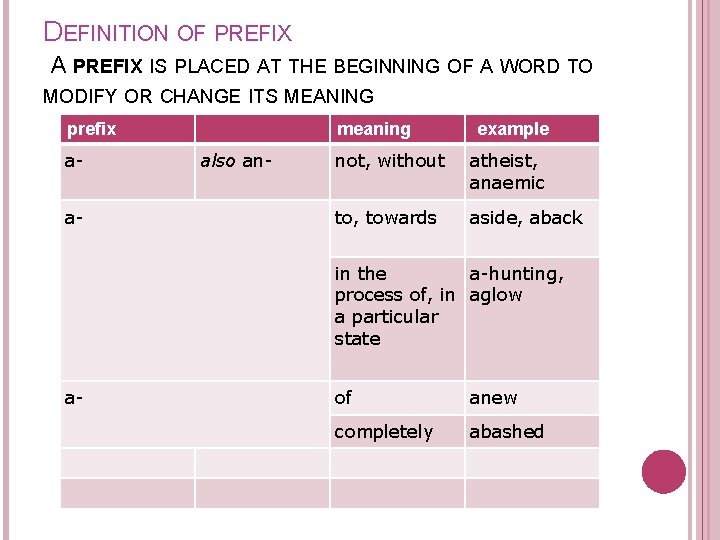
DEFINITION OF PREFIX A PREFIX IS PLACED AT THE BEGINNING OF A WORD TO MODIFY OR CHANGE ITS MEANING prefix aa- also an- meaning example not, without atheist, anaemic to, towards aside, aback in the a-hunting, process of, in aglow a particular state a- of anew completely abashed
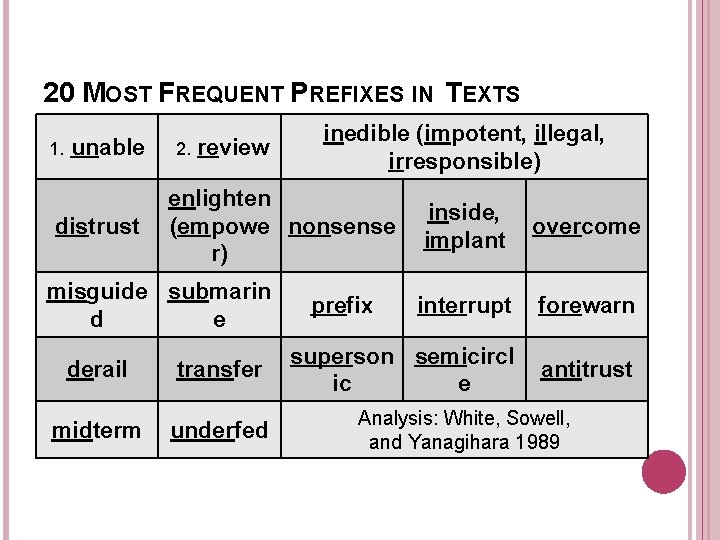
20 MOST FREQUENT PREFIXES IN TEXTS 1. unable distrust 2. review inedible (impotent, illegal, irresponsible) enlighten (empowe nonsense r) misguide submarin d e derail transfer midterm underfed inside, implant overcome interrupt forewarn superson semicircl ic e antitrust prefix Analysis: White, Sowell, and Yanagihara 1989
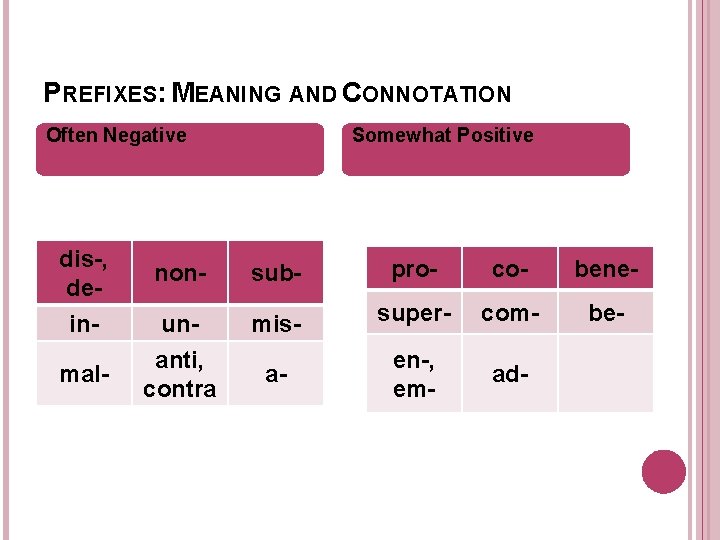
PREFIXES: MEANING AND CONNOTATION Often Negative dis-, deinmal- Somewhat Positive non- sub- pro- co- bene- unanti, contra mis- super- com- be- a- en-, em- ad-
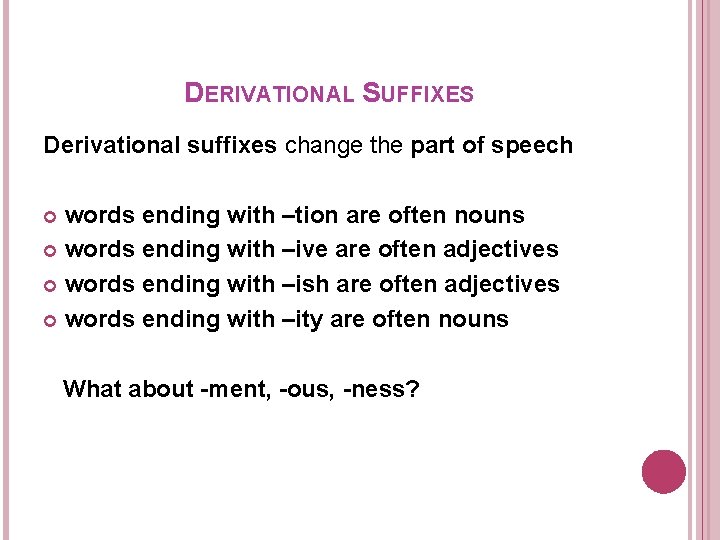
DERIVATIONAL SUFFIXES Derivational suffixes change the part of speech words ending with –tion are often nouns words ending with –ive are often adjectives words ending with –ish are often adjectives words ending with –ity are often nouns What about -ment, -ous, -ness?
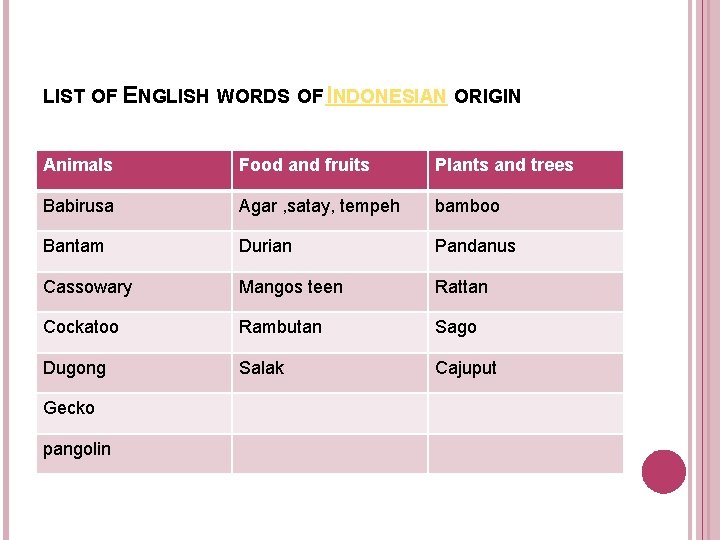
LIST OF ENGLISH WORDS OF INDONESIAN ORIGIN Animals Food and fruits Plants and trees Babirusa Agar , satay, tempeh bamboo Bantam Durian Pandanus Cassowary Mangos teen Rattan Cockatoo Rambutan Sago Dugong Salak Cajuput Gecko pangolin
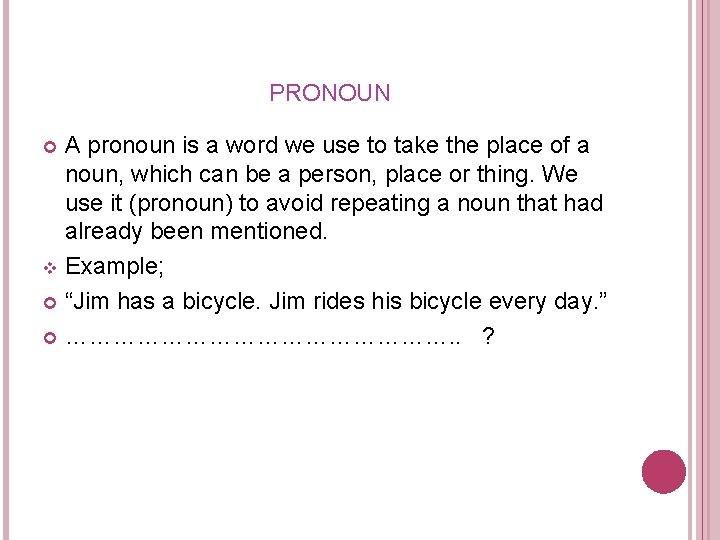
PRONOUN A pronoun is a word we use to take the place of a noun, which can be a person, place or thing. We use it (pronoun) to avoid repeating a noun that had already been mentioned. v Example; “Jim has a bicycle. Jim rides his bicycle every day. ” ……………………. . ?
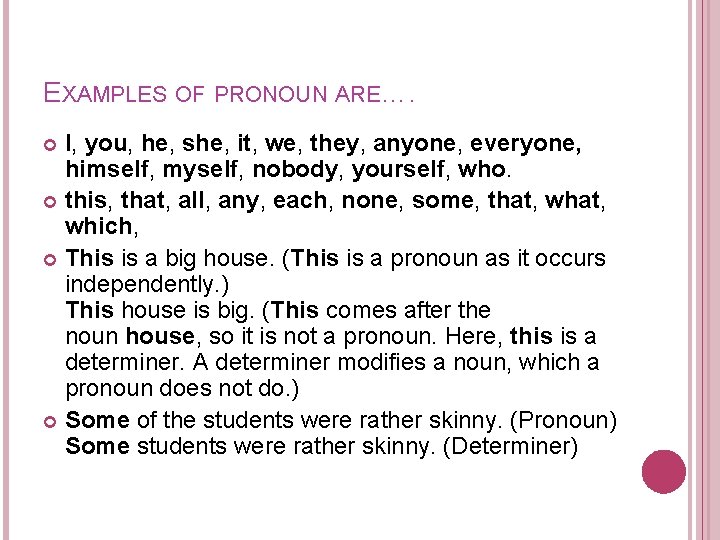
EXAMPLES OF PRONOUN ARE…. I, you, he, she, it, we, they, anyone, everyone, himself, myself, nobody, yourself, who. this, that, all, any, each, none, some, that, what, which, This is a big house. (This is a pronoun as it occurs independently. ) This house is big. (This comes after the noun house, so it is not a pronoun. Here, this is a determiner. A determiner modifies a noun, which a pronoun does not do. ) Some of the students were rather skinny. (Pronoun) Some students were rather skinny. (Determiner)
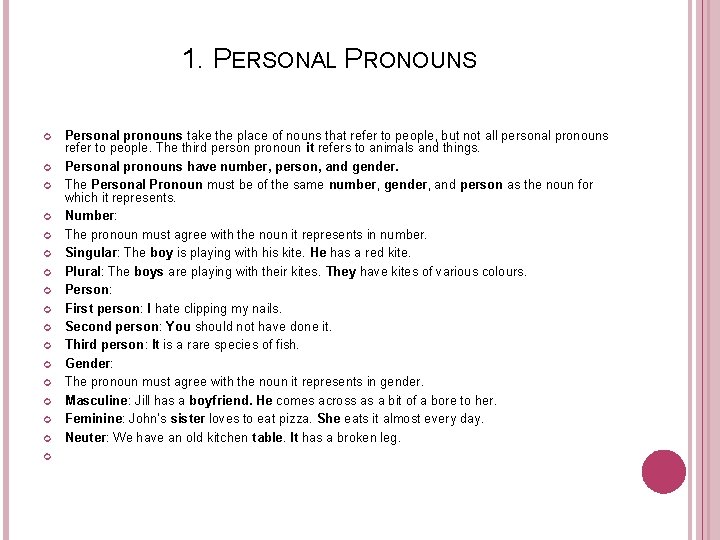
1. PERSONAL PRONOUNS Personal pronouns take the place of nouns that refer to people, but not all personal pronouns refer to people. The third person pronoun it refers to animals and things. Personal pronouns have number, person, and gender. The Personal Pronoun must be of the same number, gender, and person as the noun for which it represents. Number: The pronoun must agree with the noun it represents in number. Singular: The boy is playing with his kite. He has a red kite. Plural: The boys are playing with their kites. They have kites of various colours. Person: First person: I hate clipping my nails. Second person: You should not have done it. Third person: It is a rare species of fish. Gender: The pronoun must agree with the noun it represents in gender. Masculine: Jill has a boyfriend. He comes across as a bit of a bore to her. Feminine: John’s sister loves to eat pizza. She eats it almost every day. Neuter: We have an old kitchen table. It has a broken leg.
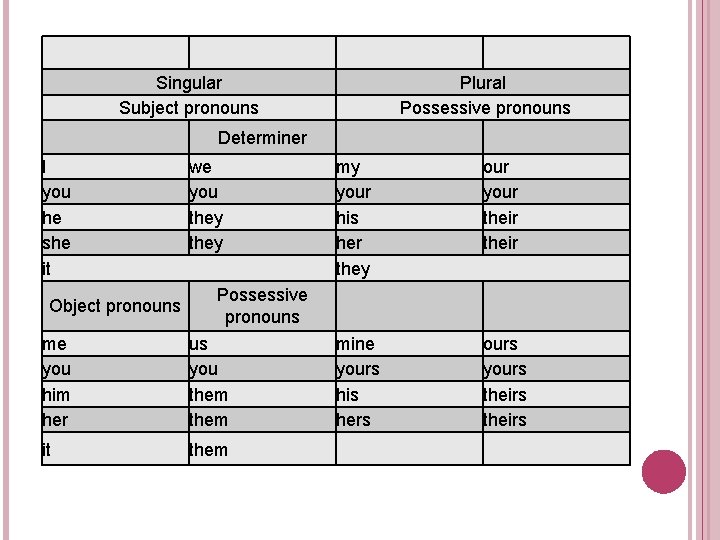
Singular Subject pronouns Plural Possessive pronouns Determiner I you he she it Object pronouns we you they my your his her they our your their mine yours his hers ours yours theirs Possessive pronouns me you him her us you them it them
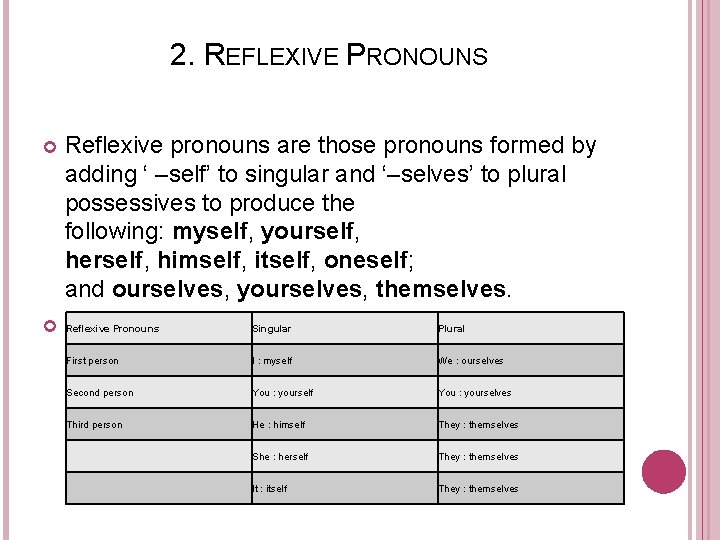
2. REFLEXIVE PRONOUNS Reflexive pronouns are those pronouns formed by adding ‘ –self’ to singular and ‘–selves’ to plural possessives to produce the following: myself, yourself, herself, himself, itself, oneself; and ourselves, yourselves, themselves. Reflexive Pronouns Singular Plural First person I : myself We : ourselves Second person You : yourself You : yourselves Third person He : himself They : themselves She : herself They : themselves It : itself They : themselves
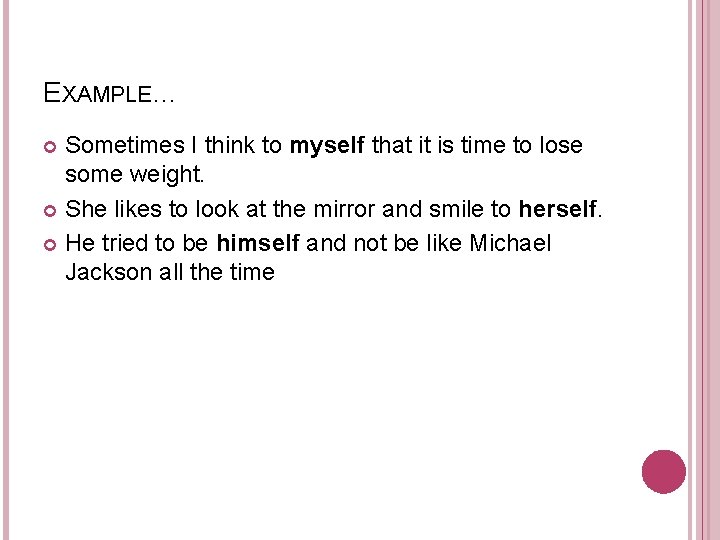
EXAMPLE… Sometimes I think to myself that it is time to lose some weight. She likes to look at the mirror and smile to herself. He tried to be himself and not be like Michael Jackson all the time
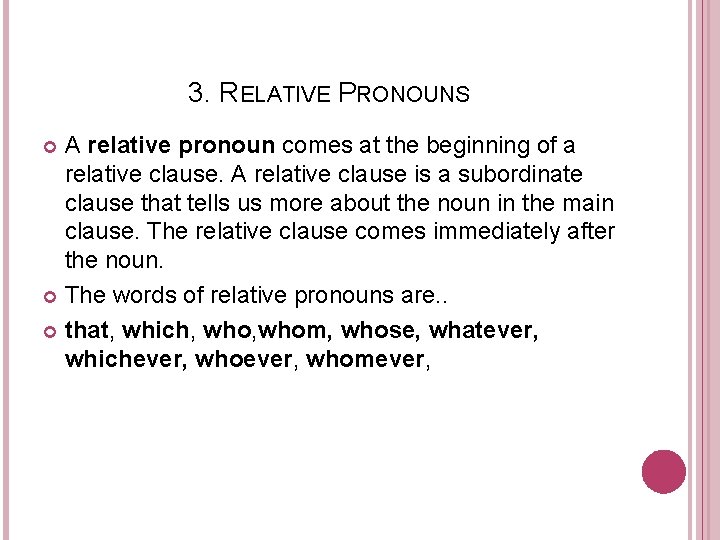
3. RELATIVE PRONOUNS A relative pronoun comes at the beginning of a relative clause. A relative clause is a subordinate clause that tells us more about the noun in the main clause. The relative clause comes immediately after the noun. The words of relative pronouns are. . that, which, whom, whose, whatever, whichever, whomever,
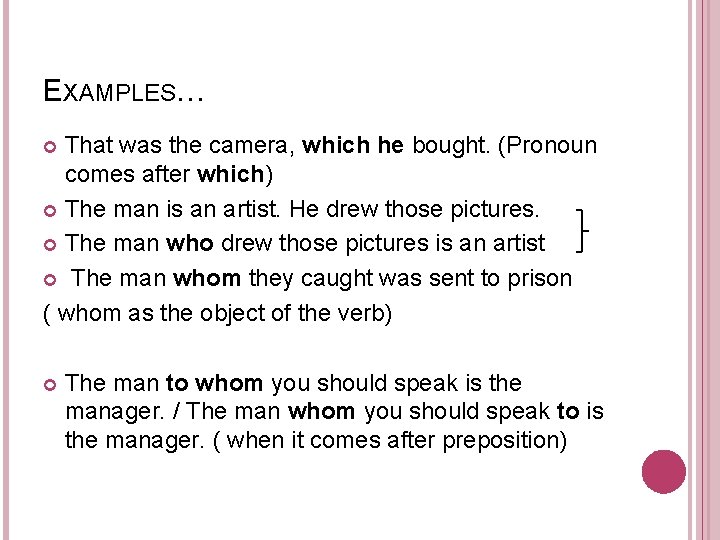
EXAMPLES… That was the camera, which he bought. (Pronoun comes after which) The man is an artist. He drew those pictures. The man who drew those pictures is an artist The man whom they caught was sent to prison ( whom as the object of the verb) The man to whom you should speak is the manager. / The man whom you should speak to is the manager. ( when it comes after preposition)
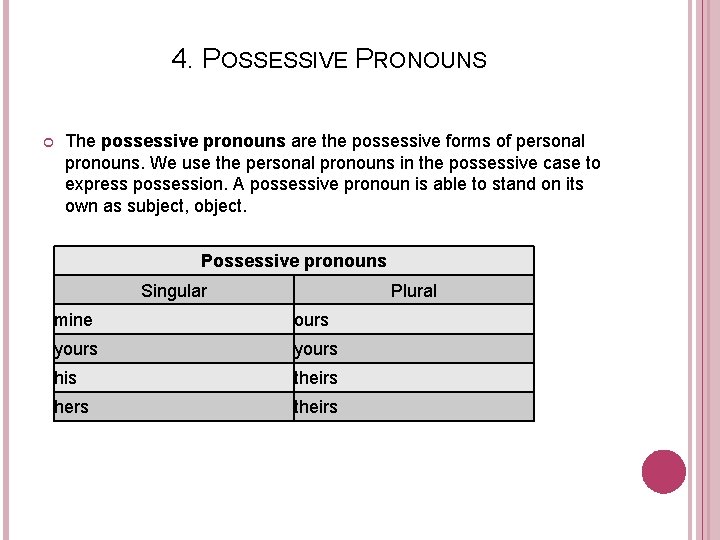
4. POSSESSIVE PRONOUNS The possessive pronouns are the possessive forms of personal pronouns. We use the personal pronouns in the possessive case to express possession. A possessive pronoun is able to stand on its own as subject, object. Possessive pronouns Singular Plural mine ours yours his theirs hers theirs
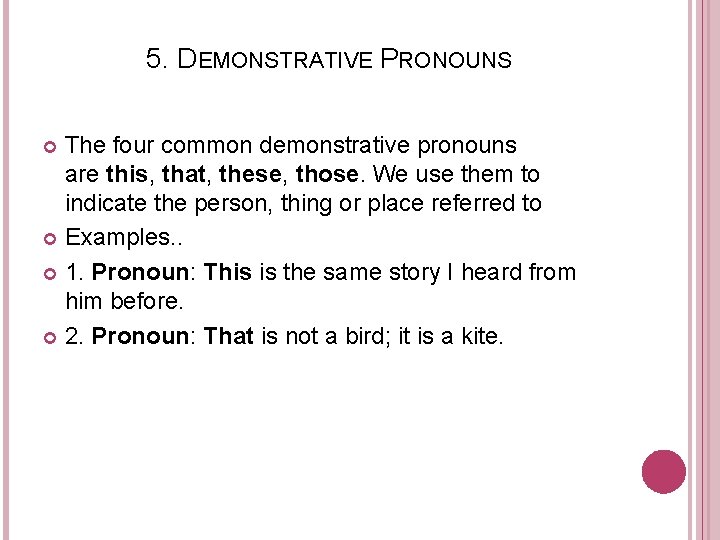
5. DEMONSTRATIVE PRONOUNS The four common demonstrative pronouns are this, that, these, those. We use them to indicate the person, thing or place referred to Examples. . 1. Pronoun: This is the same story I heard from him before. 2. Pronoun: That is not a bird; it is a kite.
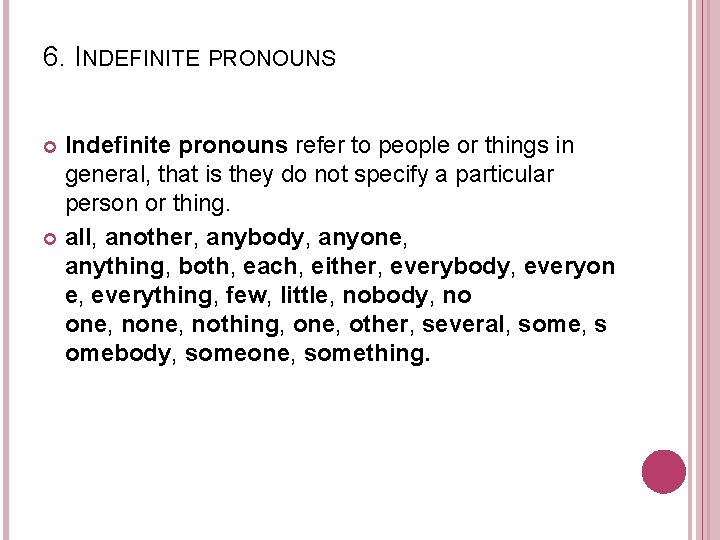
6. INDEFINITE PRONOUNS Indefinite pronouns refer to people or things in general, that is they do not specify a particular person or thing. all, another, anybody, anyone, anything, both, each, either, everybody, everyon e, everything, few, little, nobody, no one, nothing, one, other, several, some, s omebody, someone, something.
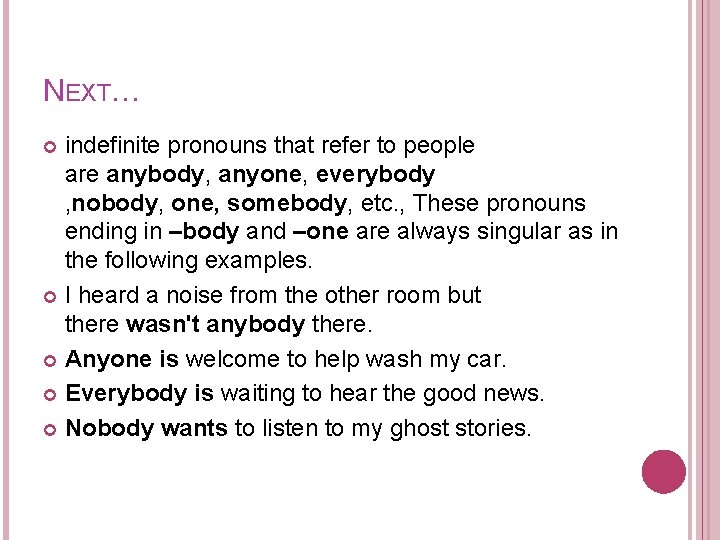
NEXT… indefinite pronouns that refer to people are anybody, anyone, everybody , nobody, one, somebody, etc. , These pronouns ending in –body and –one are always singular as in the following examples. I heard a noise from the other room but there wasn't anybody there. Anyone is welcome to help wash my car. Everybody is waiting to hear the good news. Nobody wants to listen to my ghost stories.
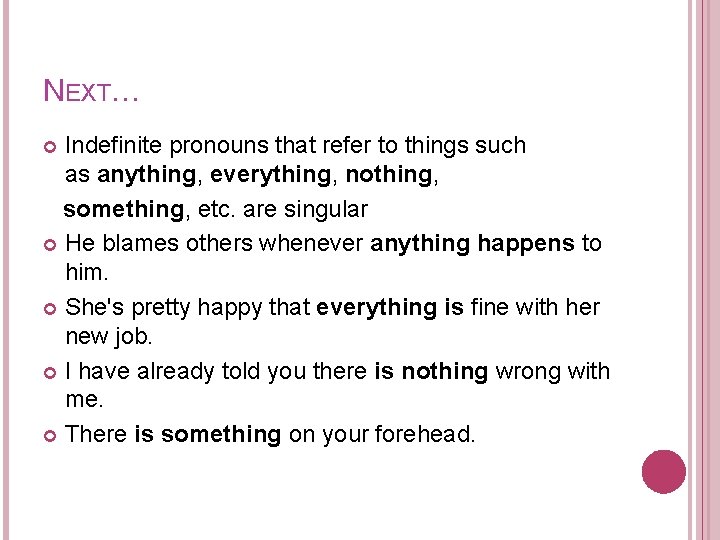
NEXT… Indefinite pronouns that refer to things such as anything, everything, nothing, something, etc. are singular He blames others whenever anything happens to him. She's pretty happy that everything is fine with her new job. I have already told you there is nothing wrong with me. There is something on your forehead.
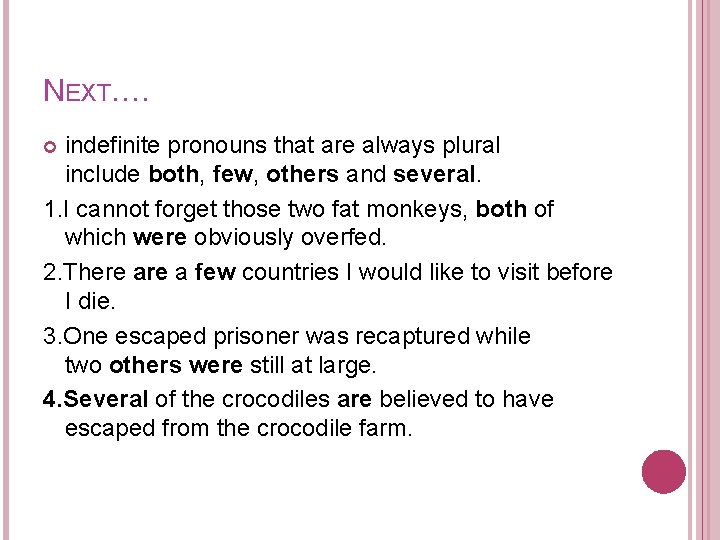
NEXT…. indefinite pronouns that are always plural include both, few, others and several. 1. I cannot forget those two fat monkeys, both of which were obviously overfed. 2. There a few countries I would like to visit before I die. 3. One escaped prisoner was recaptured while two others were still at large. 4. Several of the crocodiles are believed to have escaped from the crocodile farm.
- Slides: 21