
Derivative and properties of functions n Outline Maximum


- Slides: 23
Derivative and properties of functions n Ø Ø Ø Outline Maximum and minimum Fermat’s theorem The closed interval method
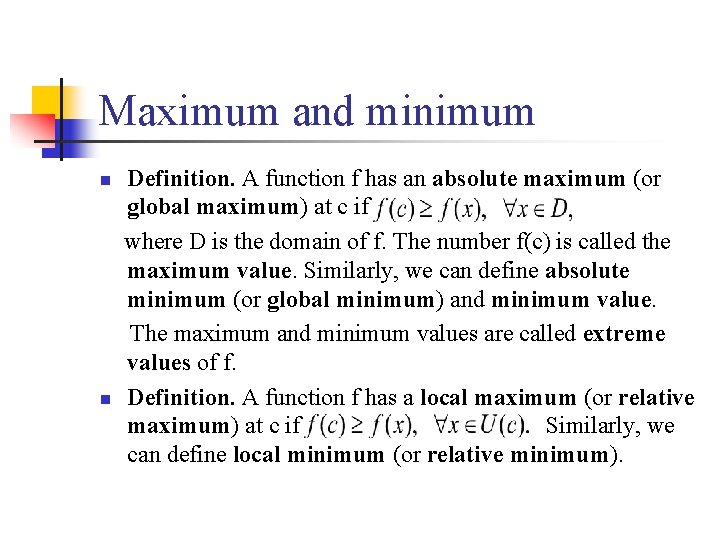
Maximum and minimum n n Definition. A function f has an absolute maximum (or global maximum) at c if where D is the domain of f. The number f(c) is called the maximum value. Similarly, we can define absolute minimum (or global minimum) and minimum value. The maximum and minimum values are called extreme values of f. Definition. A function f has a local maximum (or relative maximum) at c if Similarly, we can define local minimum (or relative minimum).
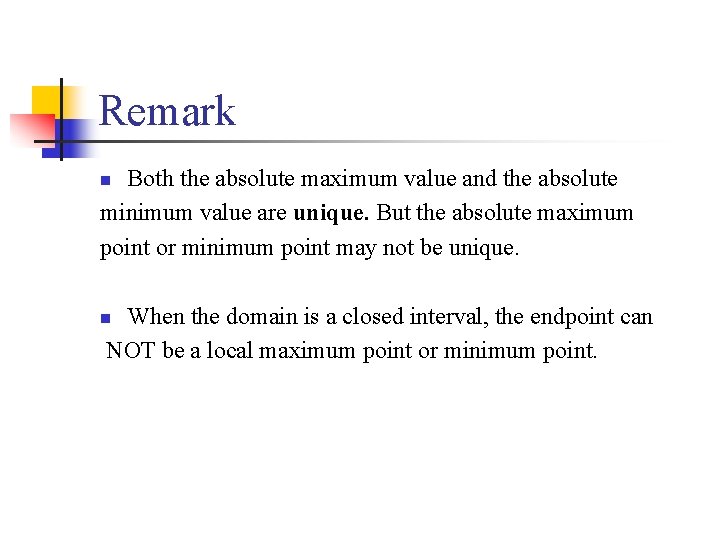
Remark Both the absolute maximum value and the absolute minimum value are unique. But the absolute maximum point or minimum point may not be unique. n When the domain is a closed interval, the endpoint can NOT be a local maximum point or minimum point. n
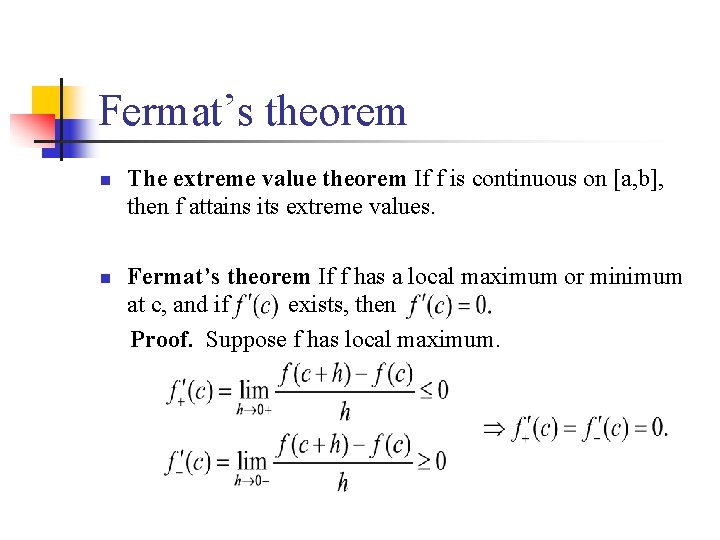
Fermat’s theorem n n The extreme value theorem If f is continuous on [a, b], then f attains its extreme values. Fermat’s theorem If f has a local maximum or minimum at c, and if exists, then Proof. Suppose f has local maximum.
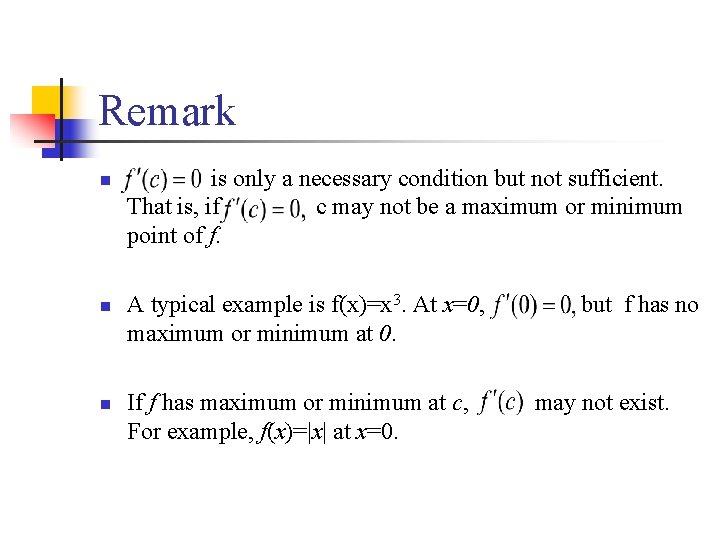
Remark n n n is only a necessary condition but not sufficient. That is, if c may not be a maximum or minimum point of f. A typical example is f(x)=x 3. At x=0, maximum or minimum at 0. If f has maximum or minimum at c, For example, f(x)=|x| at x=0. but f has no may not exist.
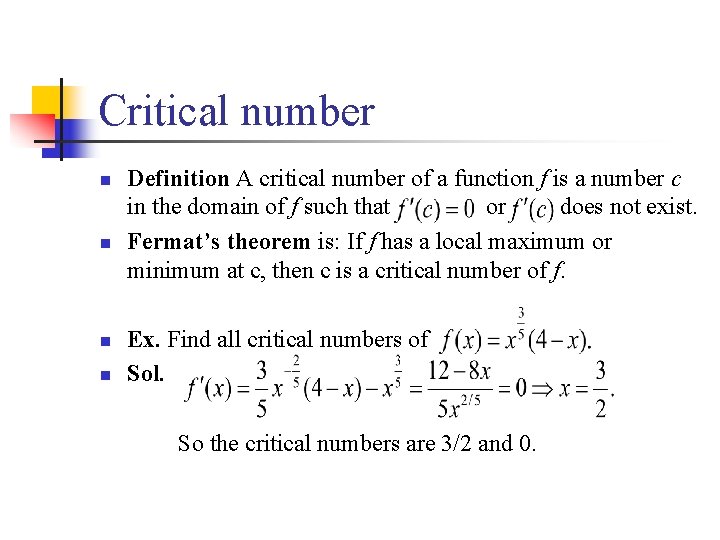
Critical number n n Definition A critical number of a function f is a number c in the domain of f such that or does not exist. Fermat’s theorem is: If f has a local maximum or minimum at c, then c is a critical number of f. Ex. Find all critical numbers of Sol. So the critical numbers are 3/2 and 0.
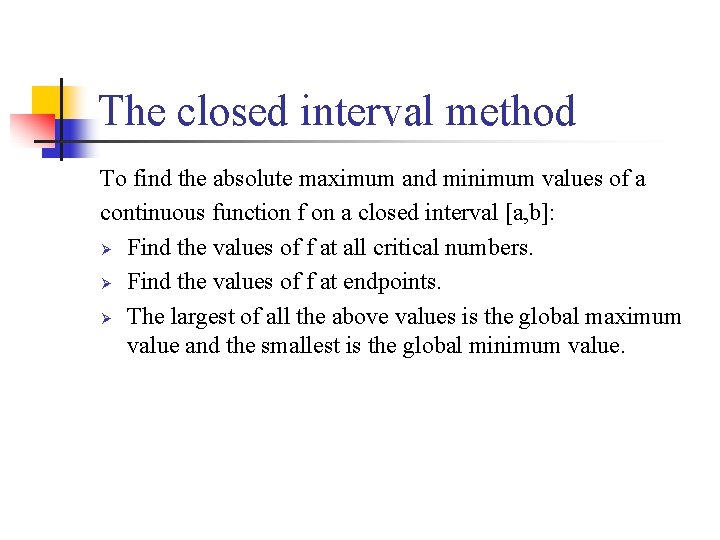
The closed interval method To find the absolute maximum and minimum values of a continuous function f on a closed interval [a, b]: Ø Find the values of f at all critical numbers. Ø Find the values of f at endpoints. Ø The largest of all the above values is the global maximum value and the smallest is the global minimum value.
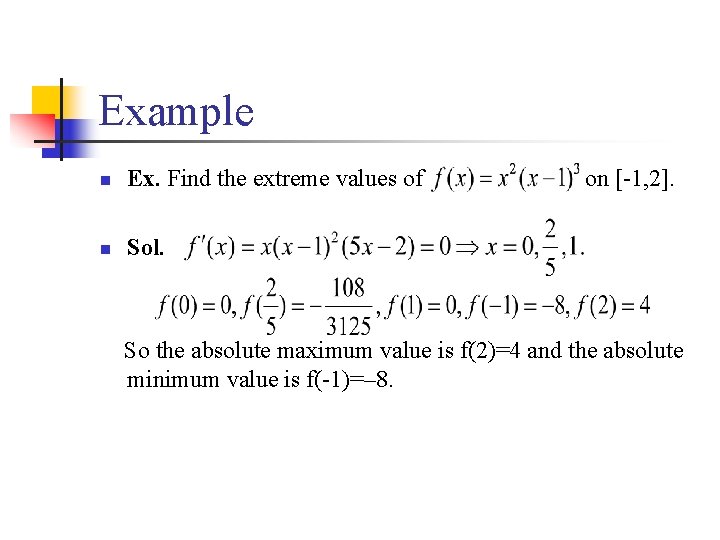
Example n Ex. Find the extreme values of n Sol. on [-1, 2]. So the absolute maximum value is f(2)=4 and the absolute minimum value is f(-1)=– 8.
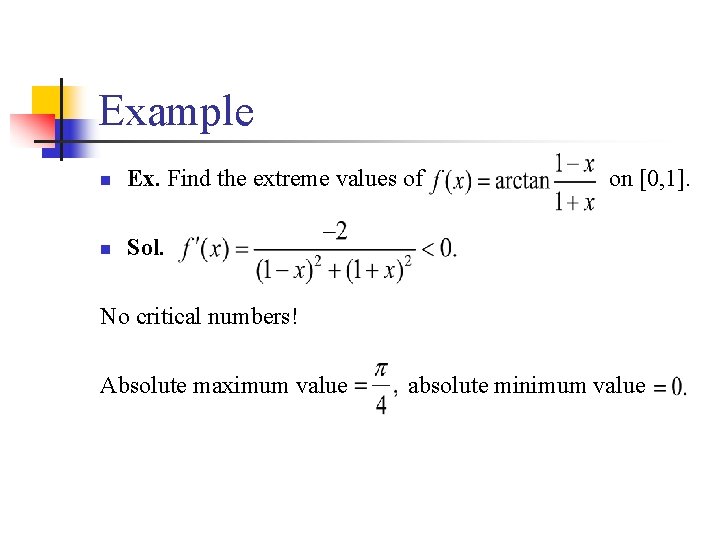
Example n Ex. Find the extreme values of n Sol. on [0, 1]. No critical numbers! Absolute maximum value absolute minimum value
Mean value theorem n Ø Ø Outline Rolle’s theorem Lagrange’s mean value theorem
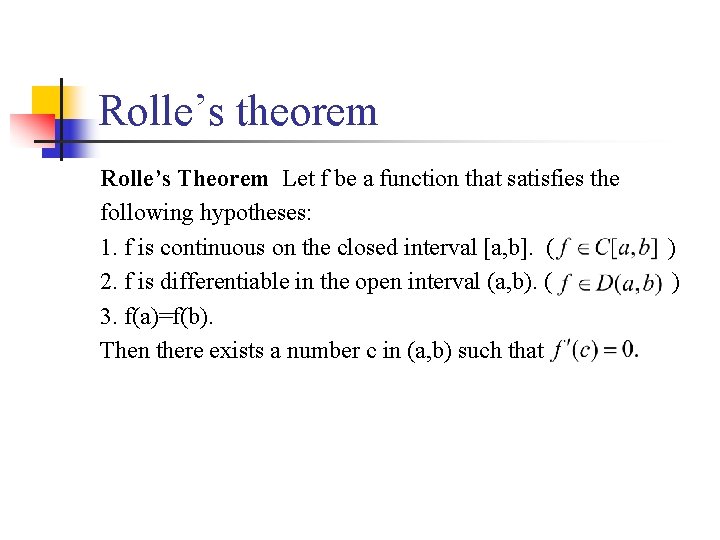
Rolle’s theorem Rolle’s Theorem Let f be a function that satisfies the following hypotheses: 1. f is continuous on the closed interval [a, b]. ( 2. f is differentiable in the open interval (a, b). ( 3. f(a)=f(b). Then there exists a number c in (a, b) such that ) )
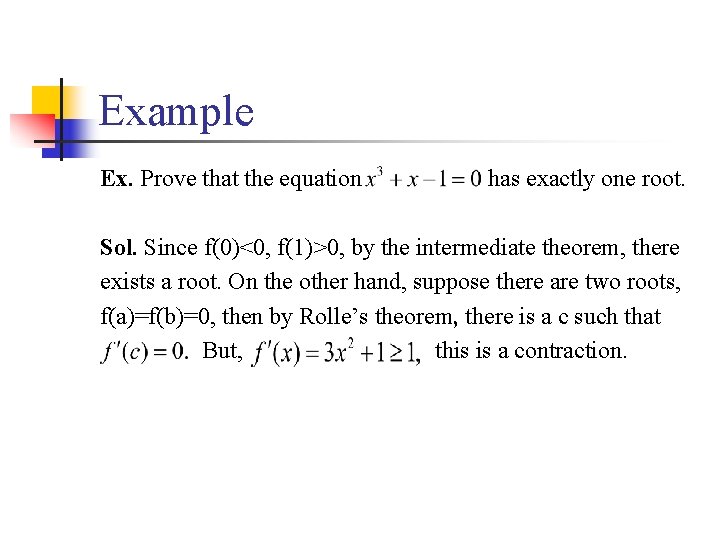
Example Ex. Prove that the equation has exactly one root. Sol. Since f(0)<0, f(1)>0, by the intermediate theorem, there exists a root. On the other hand, suppose there are two roots, f(a)=f(b)=0, then by Rolle’s theorem, there is a c such that But, this is a contraction.
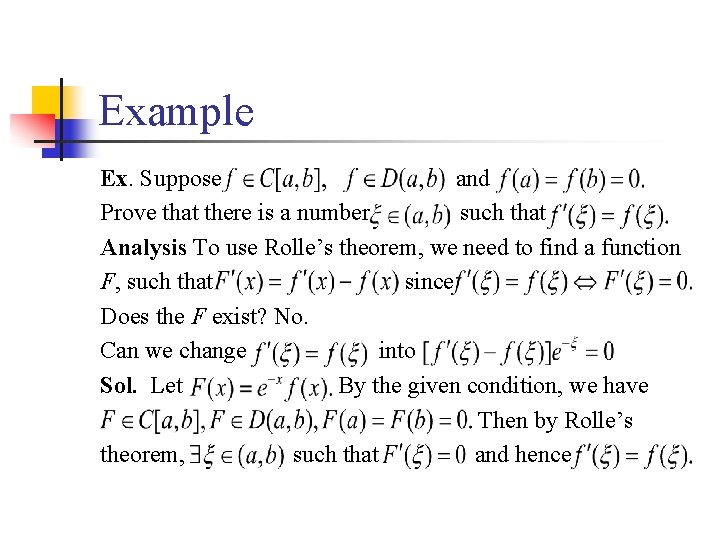
Example Ex. Suppose and Prove that there is a number such that Analysis To use Rolle’s theorem, we need to find a function F, such that since Does the F exist? No. Can we change into Sol. Let By the given condition, we have Then by Rolle’s theorem, such that and hence
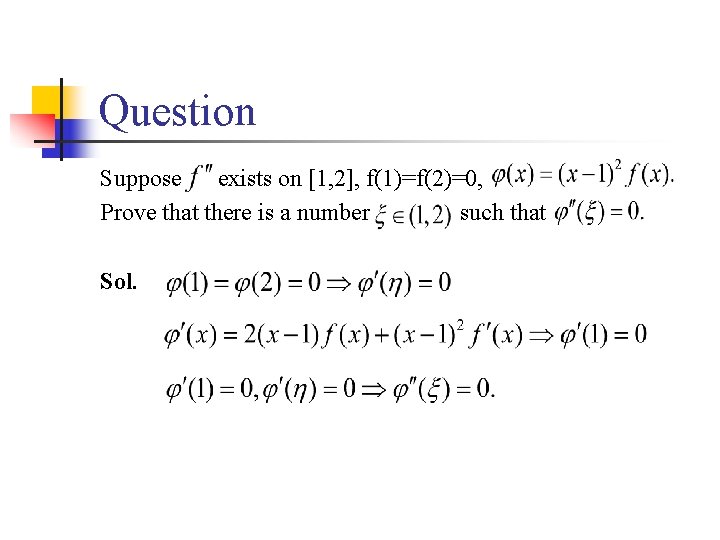
Question Suppose exists on [1, 2], f(1)=f(2)=0, Prove that there is a number such that Sol.
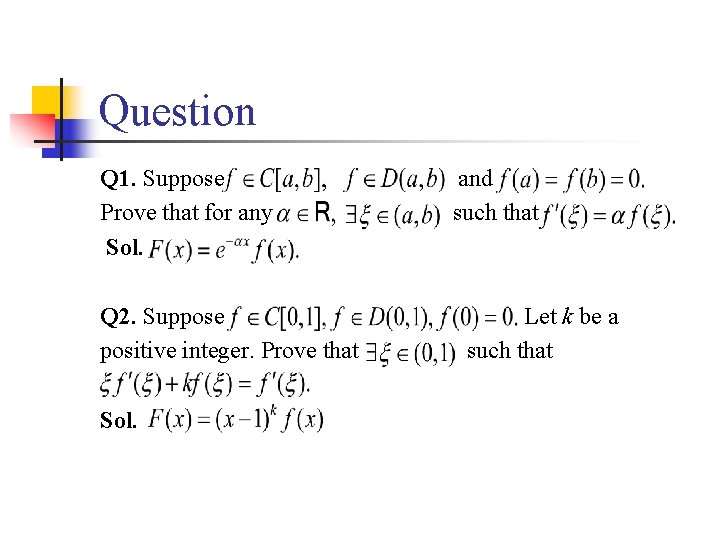
Question Q 1. Suppose Prove that for any Sol. Q 2. Suppose positive integer. Prove that Sol. and such that Let k be a such that
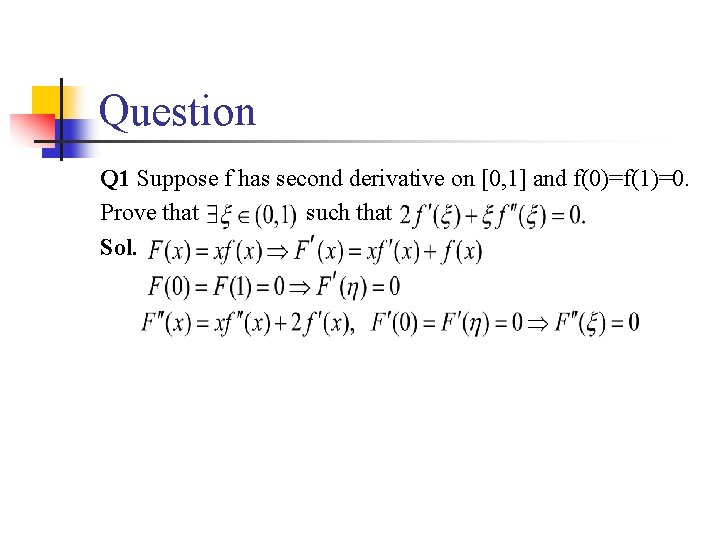
Question Q 1 Suppose f has second derivative on [0, 1] and f(0)=f(1)=0. Prove that such that Sol.
Lagrange’s mean value theorem Theorem Let and number c in (a, b) such that Then there is a Proof. Let Then and F(a)=F(b)=f(a). By Rolle’s theorem, there is a number c in (a, b) such that or,
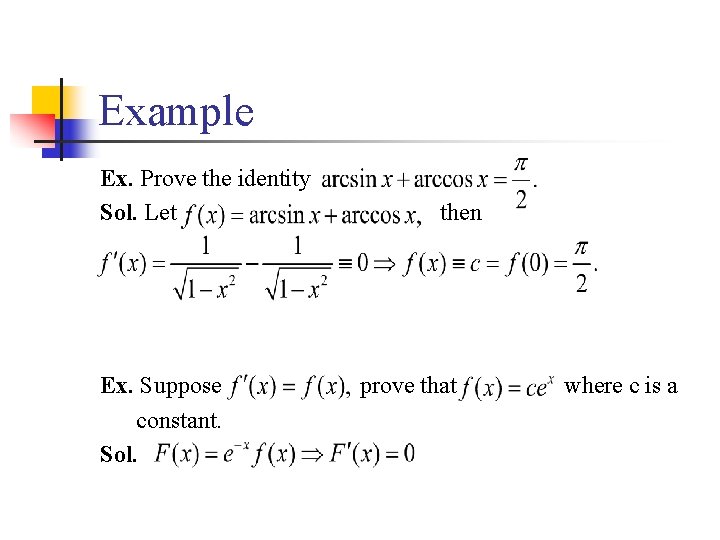
Applications n n Corollary If constant in (a, b). Proof. for all x in an interval (a, b), then f is Corollary If for all x in (a, b), then constant, that is, f(x)=g(x)+c where c is a constant. is
Example Ex. Prove the identity Sol. Let Ex. Suppose constant. Sol. then prove that where c is a
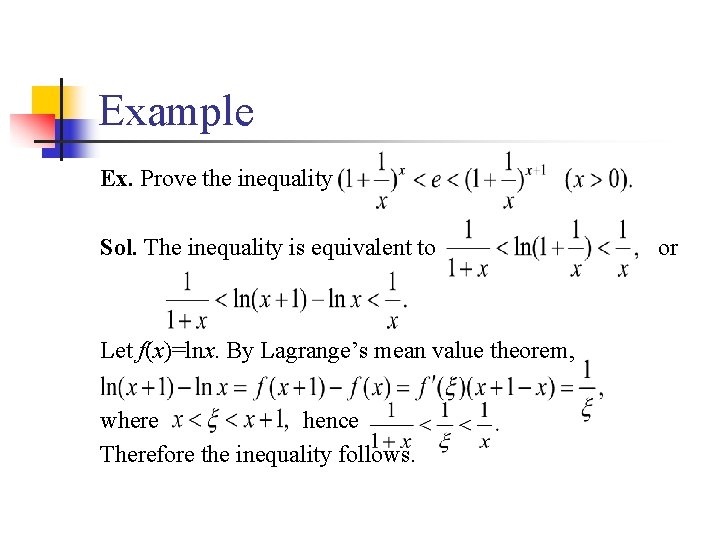
Example Ex. Prove the inequality Sol. The inequality is equivalent to Let f(x)=lnx. By Lagrange’s mean value theorem, where hence Therefore the inequality follows. or
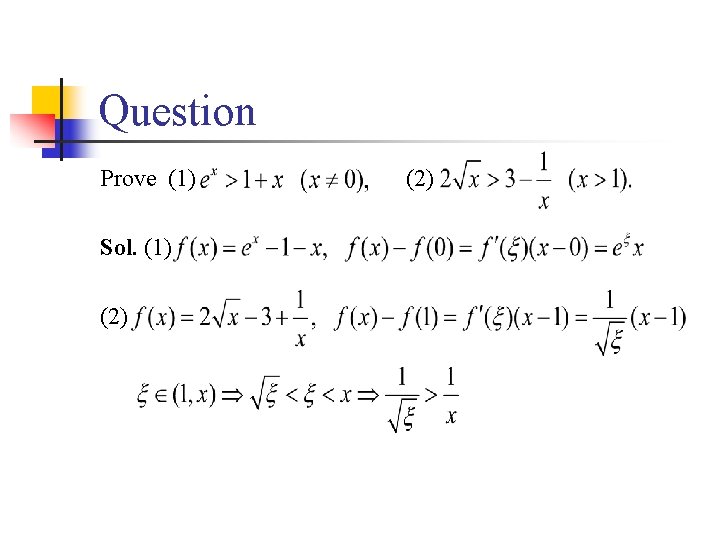
Question Prove (1) Sol. (1) (2)
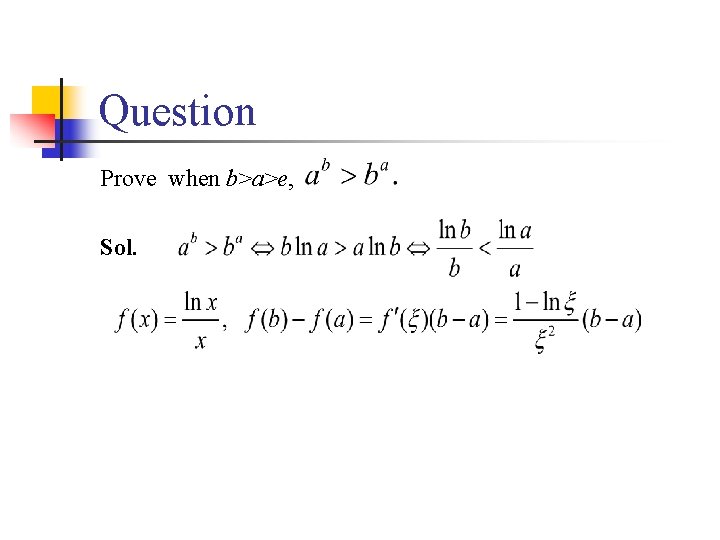
Question Prove when b>a>e, Sol.
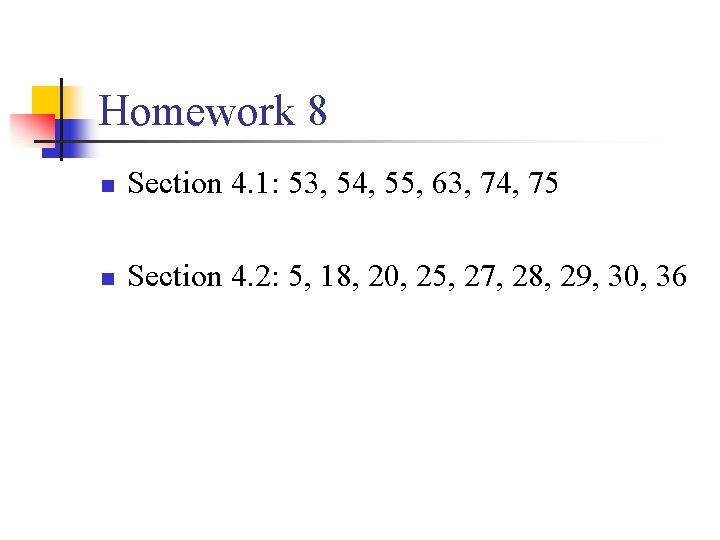
Homework 8 n Section 4. 1: 53, 54, 55, 63, 74, 75 n Section 4. 2: 5, 18, 20, 25, 27, 28, 29, 30, 36