
Derivation of particular types of sentences by means
Derivation of particular types of sentences by means of transformations # 6 -9
Task: Derive the following sentence by means of transformations l Why did Tim choose the job that was not as remunerative as the one the manager suggested? l [Q + tim chose the job [NEG + [the job was remunerative COMP] [the job [the manager suggested the job] was remunerative]] for some reason] l The underlying structure + the application of necessary transformations (step by step) l Focus: NEGATION, QUESTION, RELATIVIZATION, COMPARISON & their combinations
I – Derivation of NEGATIVE sentences l Jill hasn’t seen the film. l [NEG + jill has seen the film] => l [NEG + jill has not seen the film] => l [NEG + jill hasn’t seen the film] => l Jill hasn’t seen the film.
Derivation of NEGATIVE sentences. . . l Jill does not know the answer. l [NEG + jill knows the answer] => l [NEG + jill DO knows the answer] => l [NEG + jill does know the answer] => l [NEG + jill does not know the answer] => l Jill does not know the answer.

NEG – a formal operator – a set of rules for sentence negation: l Add not to Aux l DO-support where necessary ¡ Insert Aux DO ¡ DO the appropriate form of DO & V the appropriate form of V l Aux + NOT the contracted form, where necessary l Delete NEG upon completion

II(a) – Derivation of INTERROGATIVE sentences: YES-NO questions l Can Jack swim? l [Q + jack can swim] => l [Q + can jack swim] => l Can Jack swim? l Did Jack invent the story? l [Q + jack invented the story] => l [Q + jack DO invented the story] => l [Q + jack did invent the story] => l [Q + did jack invent the story] => l Did Jack invent the story?
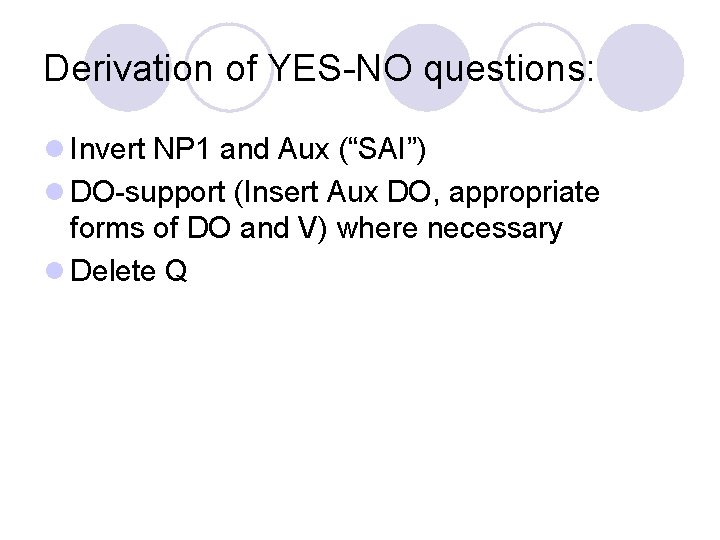
Derivation of YES-NO questions: l Invert NP 1 and Aux (“SAI”) l DO-support (Insert Aux DO, appropriate forms of DO and V) where necessary l Delete Q
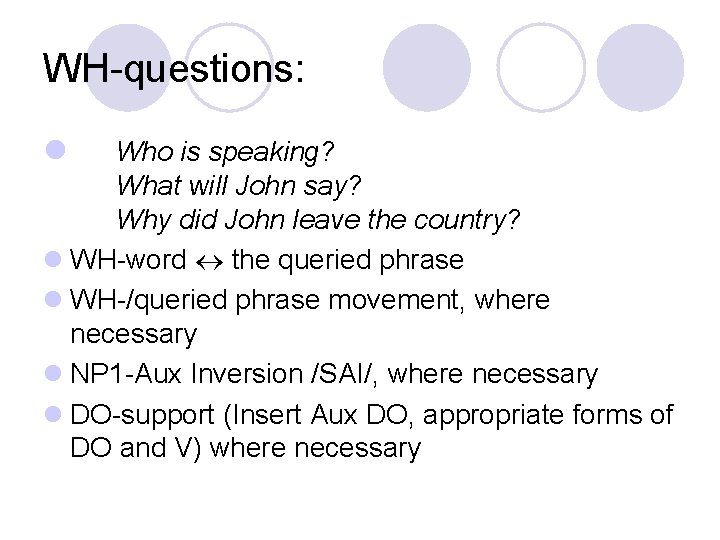
WH-questions: l Who is speaking? What will John say? Why did John leave the country? l WH-word the queried phrase l WH-/queried phrase movement, where necessary l NP 1 -Aux Inversion /SAI/, where necessary l DO-support (Insert Aux DO, appropriate forms of DO and V) where necessary
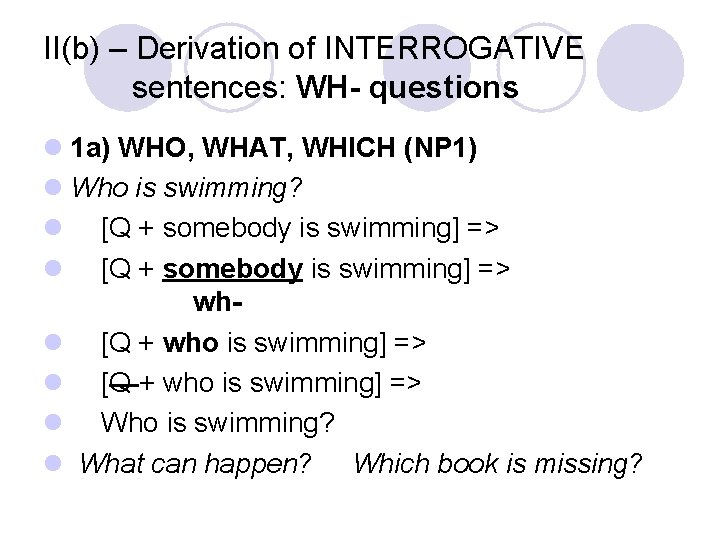
II(b) – Derivation of INTERROGATIVE sentences: WH- questions l 1 a) WHO, WHAT, WHICH (NP 1) l Who is swimming? l [Q + somebody is swimming] => whl [Q + who is swimming] => l Who is swimming? l What can happen? Which book is missing?
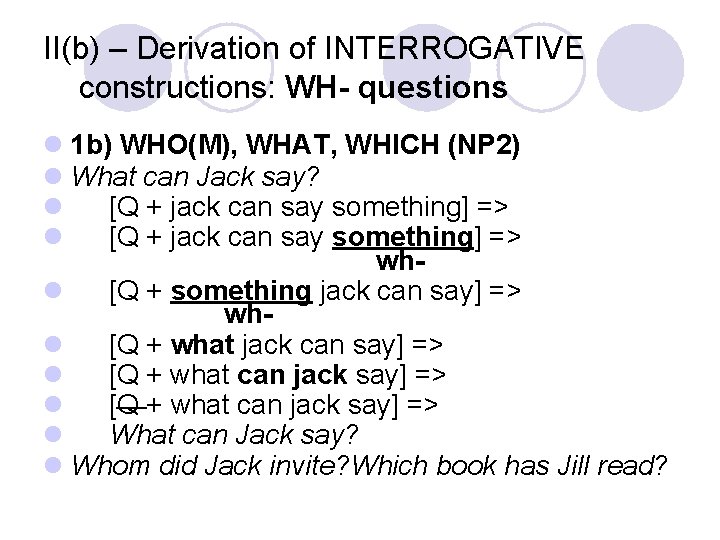
II(b) – Derivation of INTERROGATIVE constructions: WH- questions l 1 b) WHO(M), WHAT, WHICH (NP 2) l What can Jack say? l [Q + jack can say something] => whl [Q + something jack can say] => whl [Q + what jack can say] => l [Q + what can jack say] => l What can Jack say? l Whom did Jack invite? Which book has Jill read?
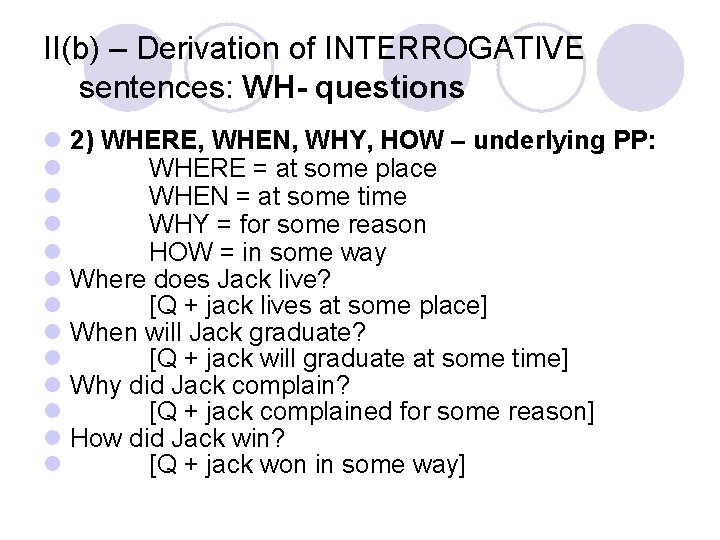
II(b) – Derivation of INTERROGATIVE sentences: WH- questions l 2) WHERE, WHEN, WHY, HOW – underlying PP: l WHERE = at some place l WHEN = at some time l WHY = for some reason l HOW = in some way l Where does Jack live? l [Q + jack lives at some place] l When will Jack graduate? l [Q + jack will graduate at some time] l Why did Jack complain? l [Q + jack complained for some reason] l How did Jack win? l [Q + jack won in some way]
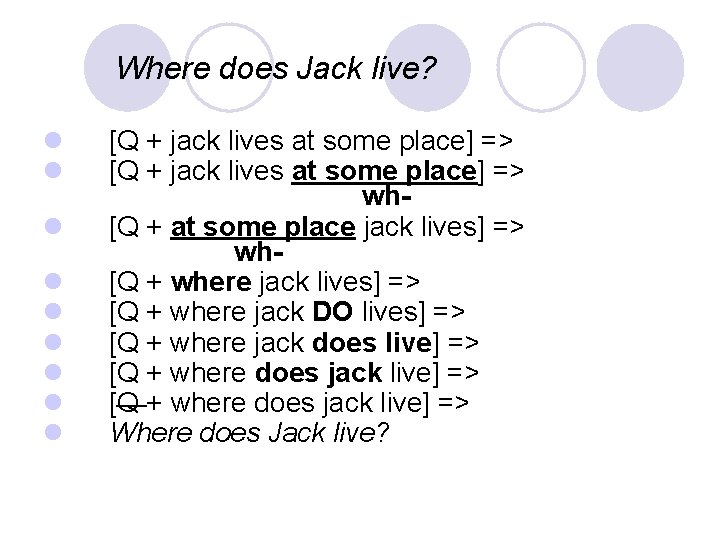
Where does Jack live? l l l l l [Q + jack lives at some place] => wh[Q + at some place jack lives] => wh[Q + where jack lives] => [Q + where jack DO lives] => [Q + where jack does live] => [Q + where does jack live] => Where does Jack live?
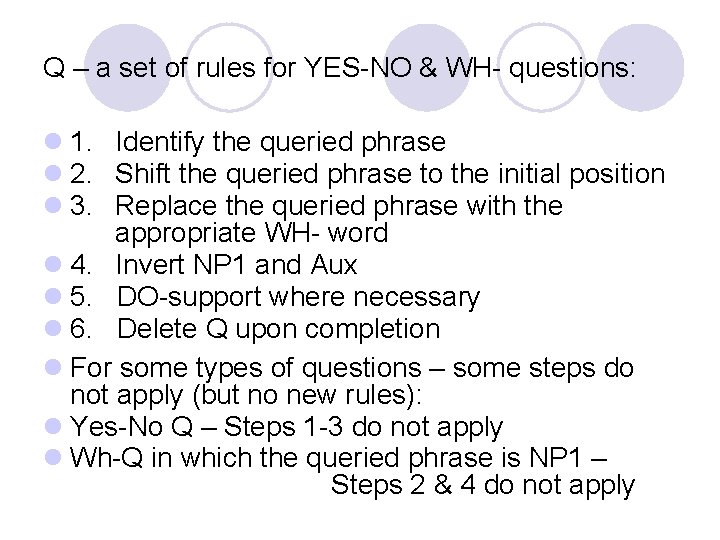
Q – a set of rules for YES-NO & WH- questions: l 1. Identify the queried phrase l 2. Shift the queried phrase to the initial position l 3. Replace the queried phrase with the appropriate WH- word l 4. Invert NP 1 and Aux l 5. DO-support where necessary l 6. Delete Q upon completion l For some types of questions – some steps do not apply (but no new rules): l Yes-No Q – Steps 1 -3 do not apply l Wh-Q in which the queried phrase is NP 1 – Steps 2 & 4 do not apply
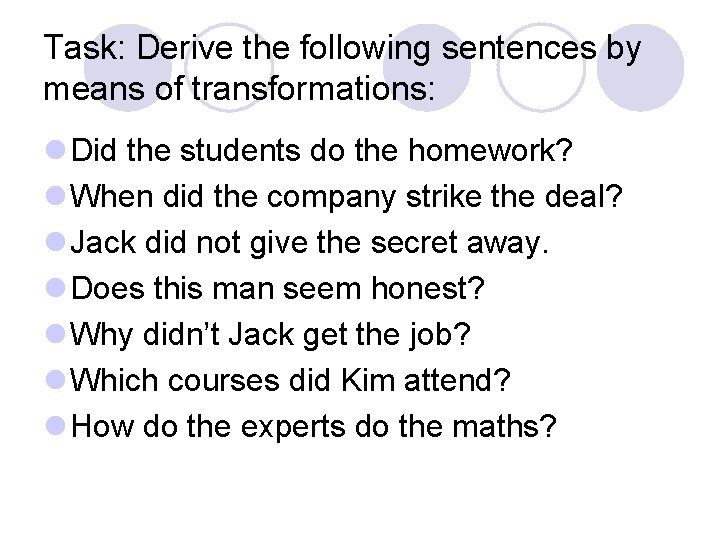
Task: Derive the following sentences by means of transformations: l Did the students do the homework? l When did the company strike the deal? l Jack did not give the secret away. l Does this man seem honest? l Why didn’t Jack get the job? l Which courses did Kim attend? l How do the experts do the maths?
![Did the students do the homework? l [Q + the students did the homework]=>](http://slidetodoc.com/presentation_image_h2/5cf26b255b3675593231b46d52f41bd2/image-15.jpg "Did the students do the homework? l [Q + the students did the homework]=>")
Did the students do the homework? l [Q + the students did the homework]=> l [Q + the students DO did the homework]=> l [Q + the students did do the homework] => l [Q + did the students do the homework]=> l Did the students do the homework?
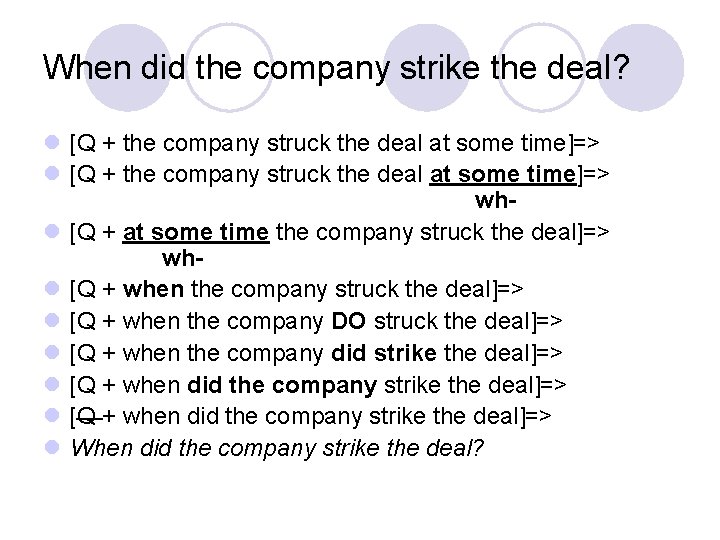
When did the company strike the deal? l [Q + the company struck the deal at some time]=> whl [Q + at some time the company struck the deal]=> whl [Q + when the company struck the deal]=> l [Q + when the company DO struck the deal]=> l [Q + when the company did strike the deal]=> l [Q + when did the company strike the deal]=> l When did the company strike the deal?
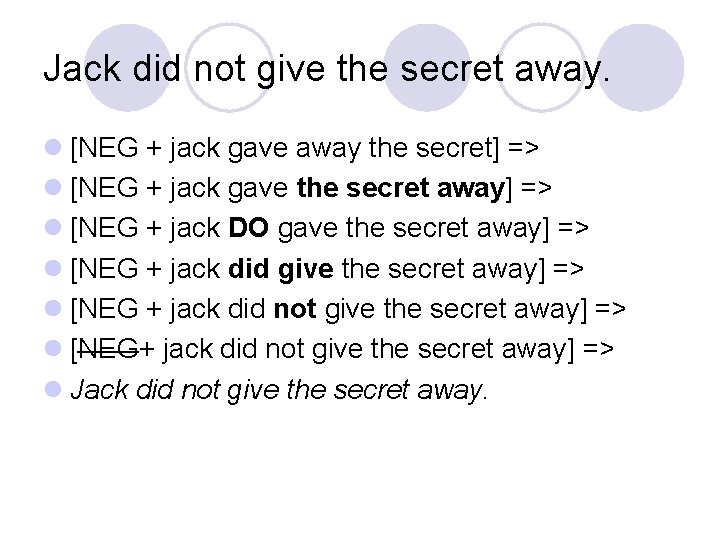
Jack did not give the secret away. l [NEG + jack gave away the secret] => l [NEG + jack gave the secret away] => l [NEG + jack DO gave the secret away] => l [NEG + jack did give the secret away] => l [NEG + jack did not give the secret away] => l [NEG+ jack did not give the secret away] => l Jack did not give the secret away.
![Does this man seem honest? l [Q + this man seems honest]=> l [Q](http://slidetodoc.com/presentation_image_h2/5cf26b255b3675593231b46d52f41bd2/image-18.jpg "Does this man seem honest? l [Q + this man seems honest]=> l [Q")
Does this man seem honest? l [Q + this man seems honest]=> l [Q + this man DO seems honest]=> l [Q + this man does seem honest]=> l [Q + does this man seem honest]=> l Does this man seem honest?
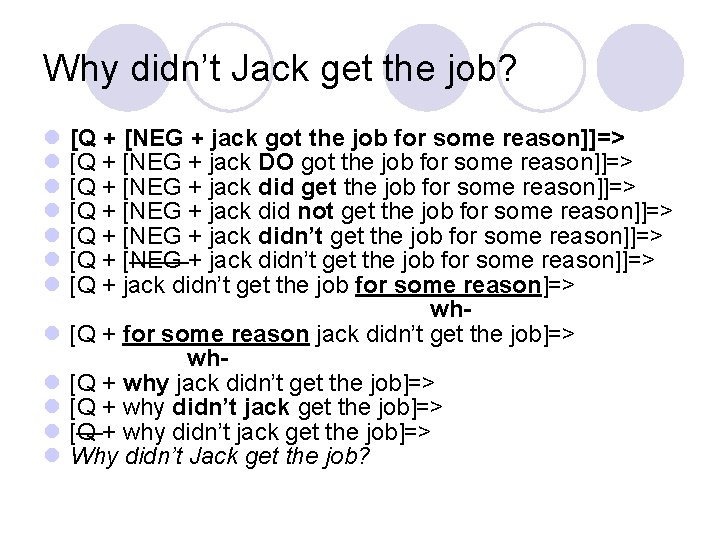
Why didn’t Jack get the job? l l l [Q + [NEG + jack got the job for some reason]]=> [Q + [NEG + jack DO got the job for some reason]]=> [Q + [NEG + jack did get the job for some reason]]=> [Q + [NEG + jack did not get the job for some reason]]=> [Q + [NEG + jack didn’t get the job for some reason]]=> [Q + jack didn’t get the job for some reason]=> wh[Q + for some reason jack didn’t get the job]=> wh[Q + why jack didn’t get the job]=> [Q + why didn’t jack get the job]=> Why didn’t Jack get the job?
![Which courses did Kim attend? l [Q + kim attended some courses]=> whl [Q](http://slidetodoc.com/presentation_image_h2/5cf26b255b3675593231b46d52f41bd2/image-20.jpg "Which courses did Kim attend? l [Q + kim attended some courses]=> whl [Q")
Which courses did Kim attend? l [Q + kim attended some courses]=> whl [Q + some courses kim attended]=> whl [Q + which courses kim attended]=> l [Q + which courses kim DO attended]=> l [Q + which courses kim did attend] l [Q + which courses did kim attend]=> l Which courses did Kim attend?
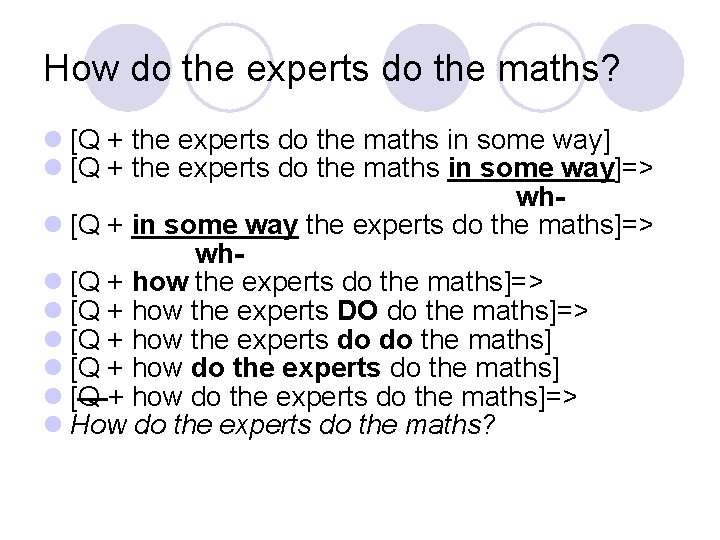
How do the experts do the maths? l [Q + the experts do the maths in some way]=> whl [Q + in some way the experts do the maths]=> whl [Q + how the experts do the maths]=> l [Q + how the experts DO do the maths]=> l [Q + how the experts do do the maths] l [Q + how do the experts do the maths]=> l How do the experts do the maths?
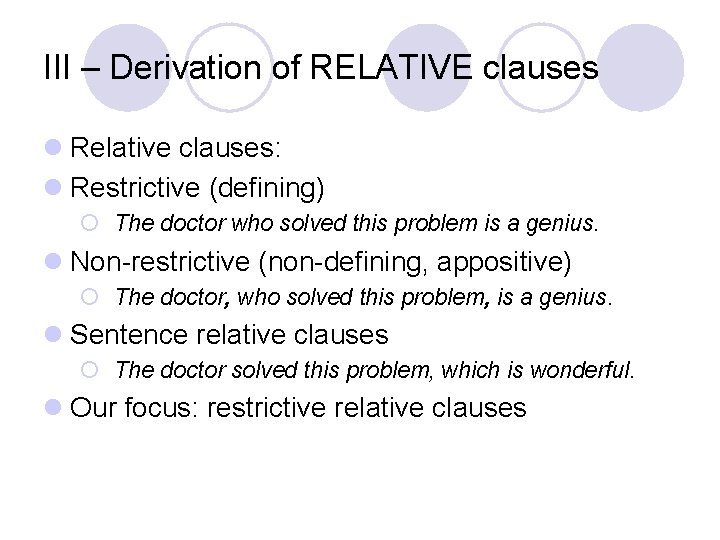
III – Derivation of RELATIVE clauses l Relative clauses: l Restrictive (defining) ¡ The doctor who solved this problem is a genius. l Non-restrictive (non-defining, appositive) ¡ The doctor, who solved this problem, is a genius. l Sentence relative clauses ¡ The doctor solved this problem, which is wonderful. l Our focus: restrictive relative clauses
![Derivation of restrictive RELATIVE clauses [S 1[S 2] S 1] l The problem Mary](http://slidetodoc.com/presentation_image_h2/5cf26b255b3675593231b46d52f41bd2/image-23.jpg "Derivation of restrictive RELATIVE clauses [S 1[S 2] S 1] l The problem Mary")
Derivation of restrictive RELATIVE clauses [S 1[S 2] S 1] l The problem Mary solved is crucial. l [the problem is crucial] & [mary solved the problem] l [the problem [mary solved the problem] is crucial] l Embedding – S 1 & S 2 share the same NP l Embedded sentence restrictive relative clause l Mary solved the problem which is crucial. l [mary solved the problem [the problem is crucial]]
![The problem Mary solved is crucial. l [the problem [mary solved the problem] is](http://slidetodoc.com/presentation_image_h2/5cf26b255b3675593231b46d52f41bd2/image-24.jpg "The problem Mary solved is crucial. l [the problem [mary solved the problem] is")
The problem Mary solved is crucial. l [the problem [mary solved the problem] is crucial] => l which [the problem [mary solved the problem] is crucial] => l [the problem which mary solved is crucial] => l The problem Mary solved is crucial. l If Pron. Rel replaces NP 2 in the embedded sentence, Pron. Rel Deletion – optional
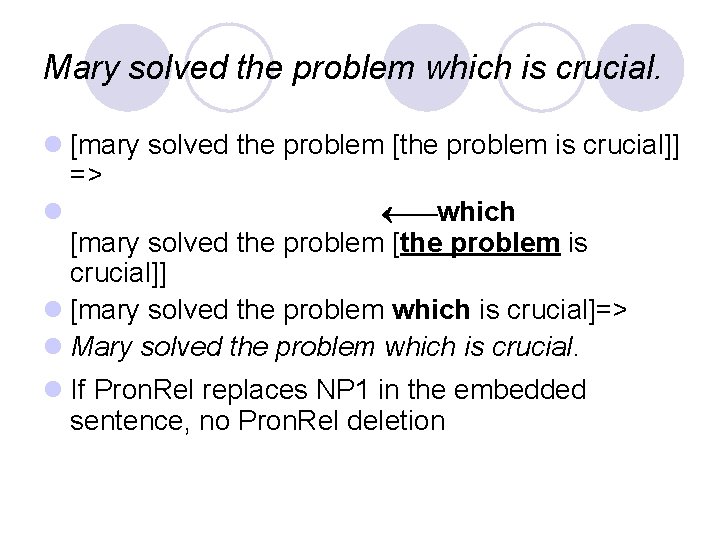
Mary solved the problem which is crucial. l [mary solved the problem [the problem is crucial]] => l which [mary solved the problem [the problem is crucial]] l [mary solved the problem which is crucial]=> l Mary solved the problem which is crucial. l If Pron. Rel replaces NP 1 in the embedded sentence, no Pron. Rel deletion
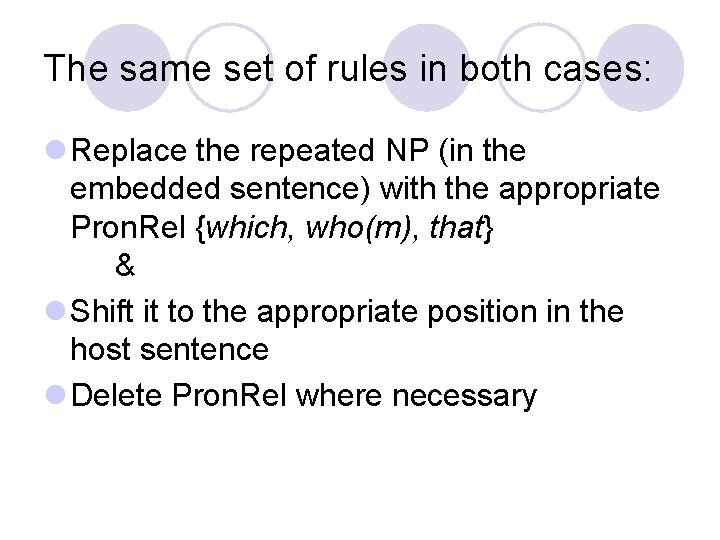
The same set of rules in both cases: l Replace the repeated NP (in the embedded sentence) with the appropriate Pron. Rel {which, who(m), that} & l Shift it to the appropriate position in the host sentence l Delete Pron. Rel where necessary

Recursive embedding (more than 2 kernel sentences): l Mary met the man who wrote the book Tom translated. l [mary met the man [the man wrote the book [tom translated the book]]] l The dog chased the cat that killed the rat that ate the malt that lay in the house that Jack built. l [the dog chased the cat [the cat killed the rat [the rat ate the malt [the malt lay in the house [jack built the house]]]]]
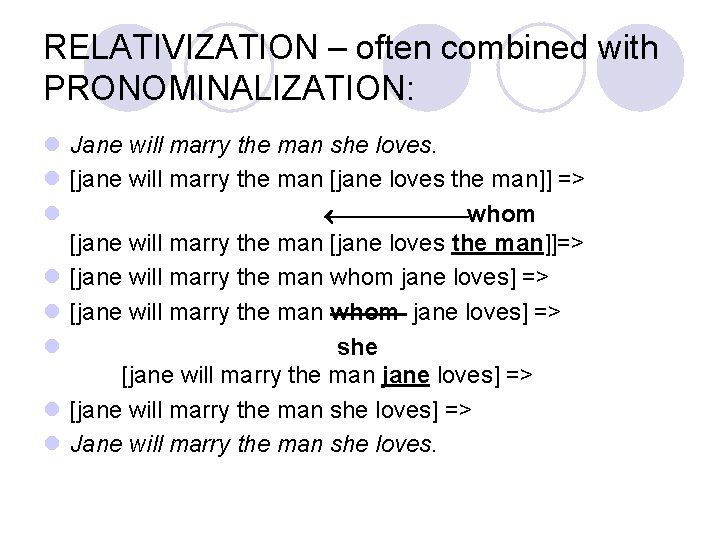
RELATIVIZATION – often combined with PRONOMINALIZATION: l Jane will marry the man she loves. l [jane will marry the man [jane loves the man]] => l whom [jane will marry the man [jane loves the man]]=> l [jane will marry the man whom jane loves] => l she [jane will marry the man jane loves] => l [jane will marry the man she loves] => l Jane will marry the man she loves.
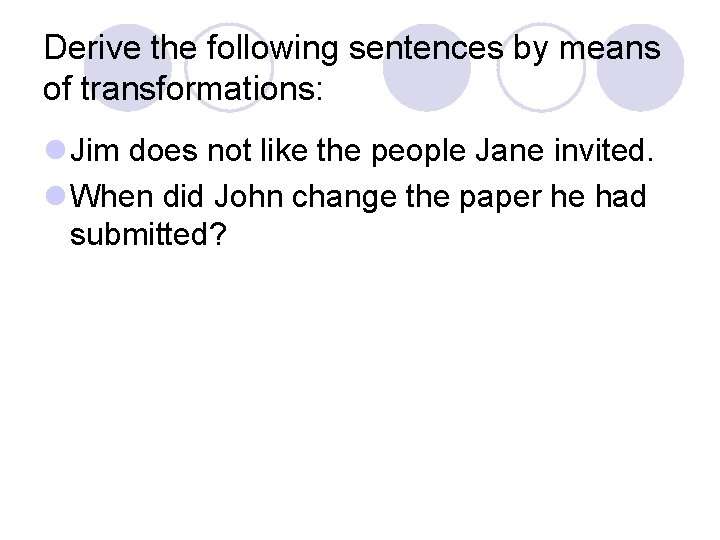
Derive the following sentences by means of transformations: l Jim does not like the people Jane invited. l When did John change the paper he had submitted?
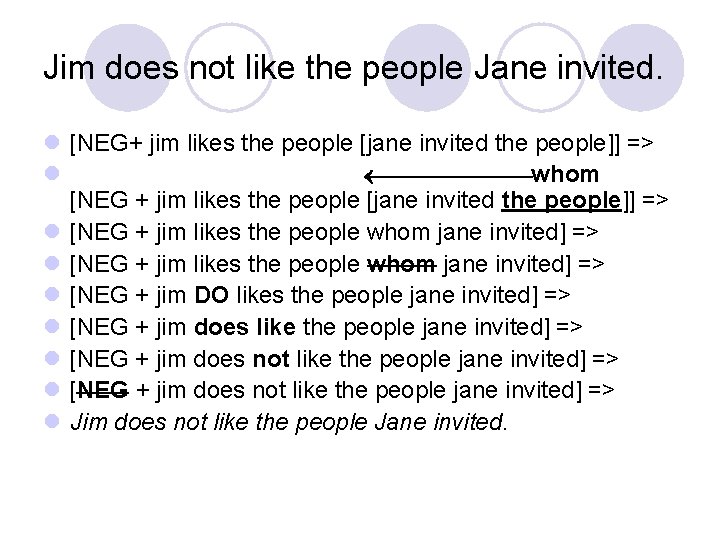
Jim does not like the people Jane invited. l [NEG+ jim likes the people [jane invited the people]] => l whom [NEG + jim likes the people [jane invited the people]] => l [NEG + jim likes the people whom jane invited] => l [NEG + jim DO likes the people jane invited] => l [NEG + jim does like the people jane invited] => l [NEG + jim does not like the people jane invited] => l Jim does not like the people Jane invited.
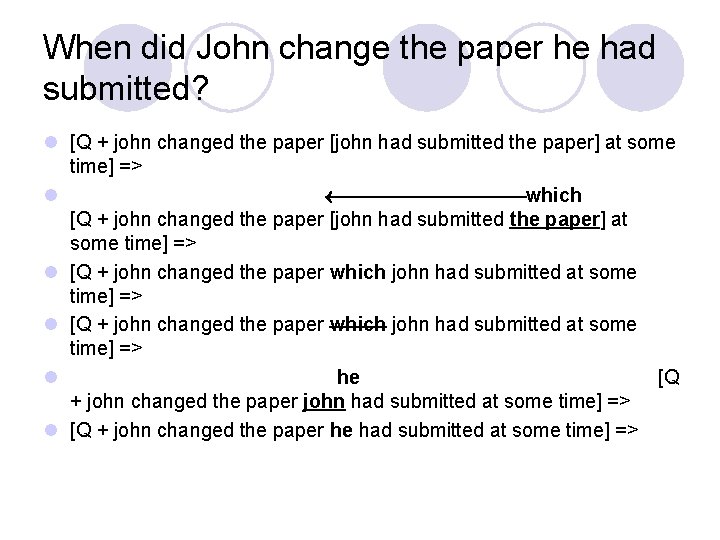
When did John change the paper he had submitted? l [Q + john changed the paper [john had submitted the paper] at some time] => l which [Q + john changed the paper [john had submitted the paper] at some time] => l [Q + john changed the paper which john had submitted at some time] => l he [Q + john changed the paper john had submitted at some time] => l [Q + john changed the paper he had submitted at some time] =>
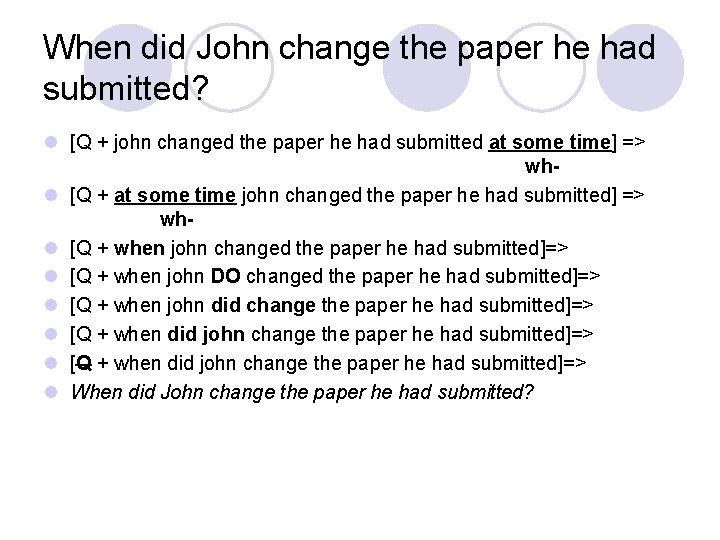
When did John change the paper he had submitted? l [Q + john changed the paper he had submitted at some time] => whl [Q + at some time john changed the paper he had submitted] => whl [Q + when john changed the paper he had submitted]=> l [Q + when john DO changed the paper he had submitted]=> l [Q + when john did change the paper he had submitted]=> l [Q + when did john change the paper he had submitted]=> l When did John change the paper he had submitted?
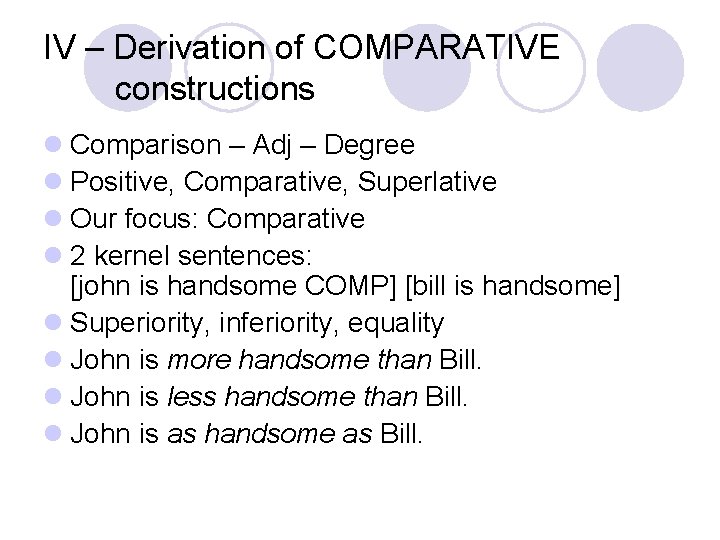
IV – Derivation of COMPARATIVE constructions l Comparison – Adj – Degree l Positive, Comparative, Superlative l Our focus: Comparative l 2 kernel sentences: [john is handsome COMP] [bill is handsome] l Superiority, inferiority, equality l John is more handsome than Bill. l John is less handsome than Bill. l John is as handsome as Bill.
![John is more handsome than Bill. l [[john is handsome COMP] [bill is handsome]]=>](http://slidetodoc.com/presentation_image_h2/5cf26b255b3675593231b46d52f41bd2/image-34.jpg "John is more handsome than Bill. l [[john is handsome COMP] [bill is handsome]]=>")
John is more handsome than Bill. l [[john is handsome COMP] [bill is handsome]]=> l [john is more handsome than bill is handsome]=> l [john is more handsome than bill is]=> l John is more handsome than Bill.
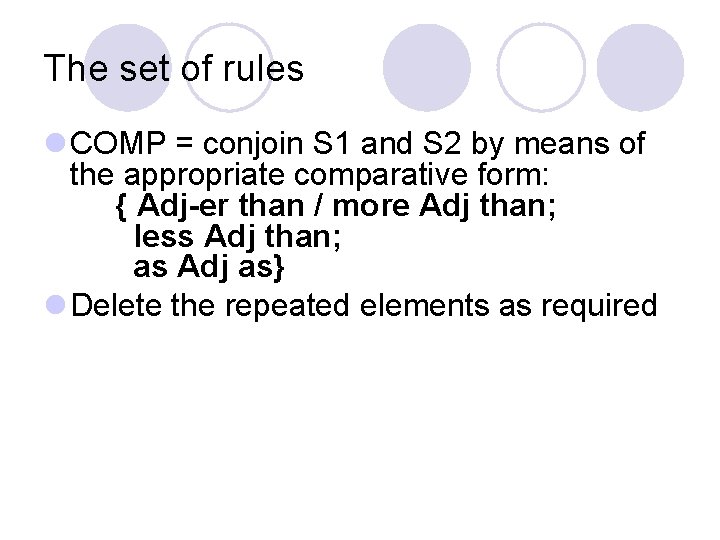
The set of rules l COMP = conjoin S 1 and S 2 by means of the appropriate comparative form: { Adj-er than / more Adj than; less Adj than; as Adj as} l Delete the repeated elements as required
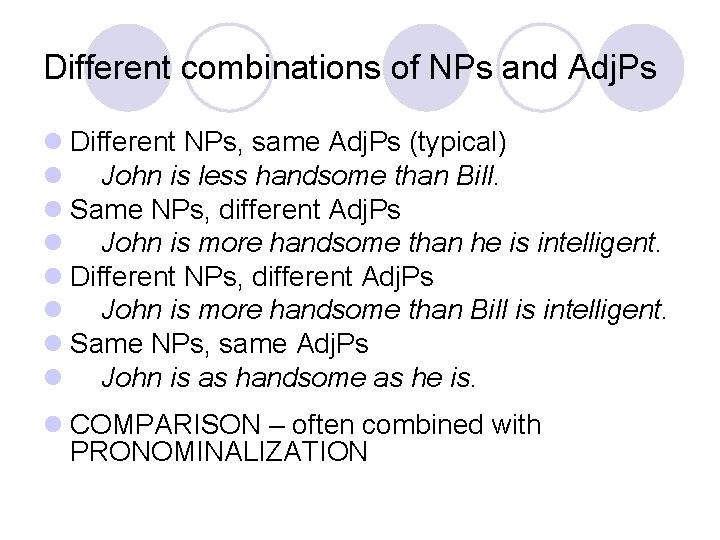
Different combinations of NPs and Adj. Ps l Different NPs, same Adj. Ps (typical) l John is less handsome than Bill. l Same NPs, different Adj. Ps l John is more handsome than he is intelligent. l Different NPs, different Adj. Ps l John is more handsome than Bill is intelligent. l Same NPs, same Adj. Ps l John is as handsome as he is. l COMPARISON – often combined with PRONOMINALIZATION
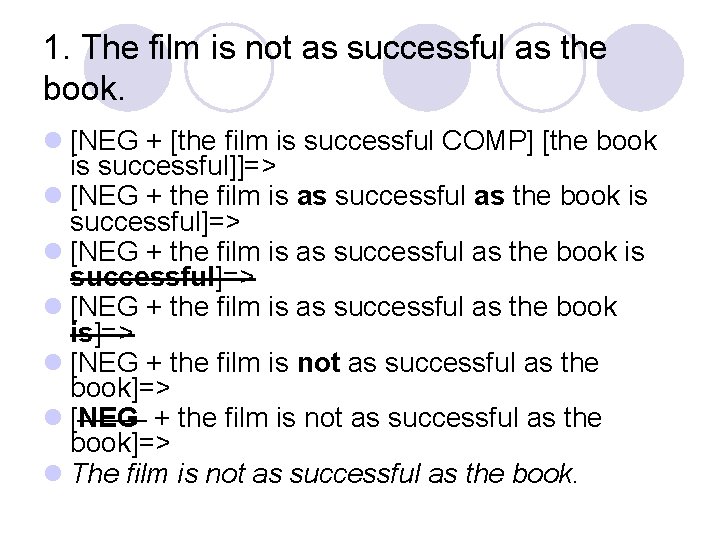
1. The film is not as successful as the book. l [NEG + [the film is successful COMP] [the book is successful]]=> l [NEG + the film is as successful as the book is successful]=> l [NEG + the film is as successful as the book is]=> l [NEG + the film is not as successful as the book]=> l The film is not as successful as the book.
![2. Who is faster than John? l [Q + [somebody is fast COMP] [john](http://slidetodoc.com/presentation_image_h2/5cf26b255b3675593231b46d52f41bd2/image-38.jpg "2. Who is faster than John? l [Q + [somebody is fast COMP] [john")
2. Who is faster than John? l [Q + [somebody is fast COMP] [john is fast]]=> l [Q + somebody is faster than john is fast]=> l [Q + somebody is faster than john is]=> l [Q + somebody is faster than john]=> whl [Q + who is faster than john]=> l Who is faster than John?
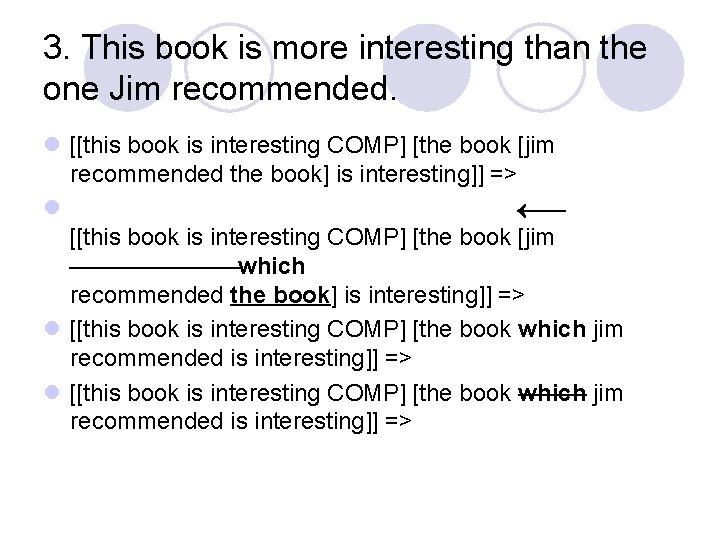
3. This book is more interesting than the one Jim recommended. l [[this book is interesting COMP] [the book [jim recommended the book] is interesting]] => l [[this book is interesting COMP] [the book [jim which recommended the book] is interesting]] => l [[this book is interesting COMP] [the book which jim recommended is interesting]] =>
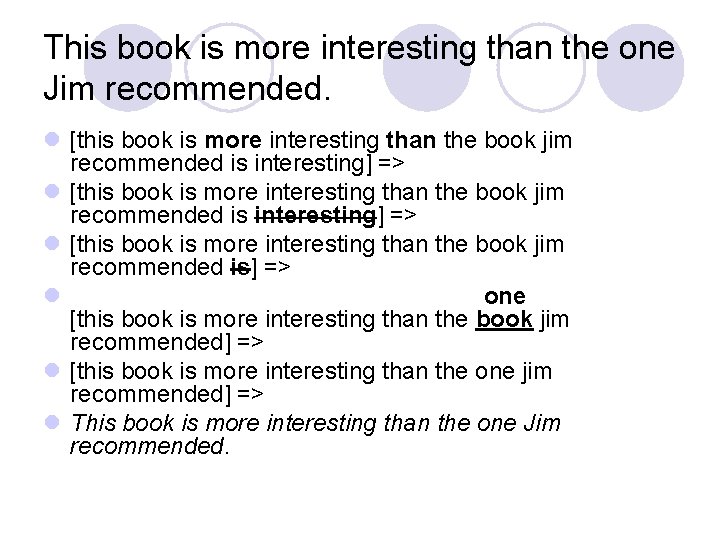
This book is more interesting than the one Jim recommended. l [this book is more interesting than the book jim recommended is interesting] => l [this book is more interesting than the book jim recommended is] => l one [this book is more interesting than the book jim recommended] => l [this book is more interesting than the one jim recommended] => l This book is more interesting than the one Jim recommended.
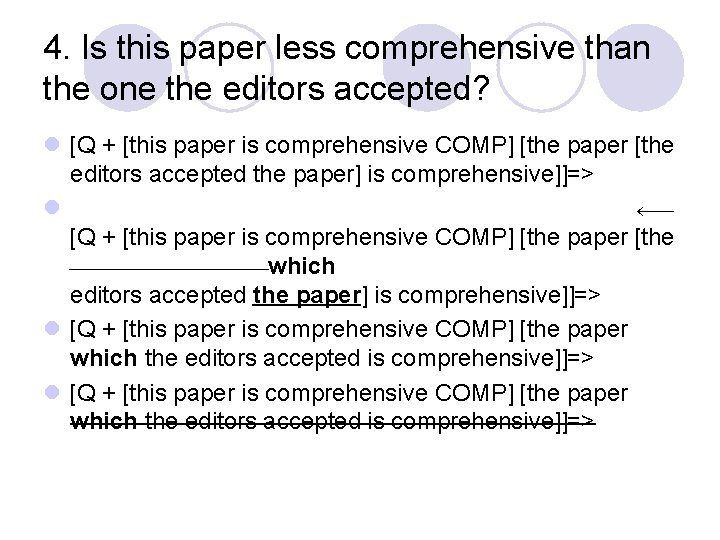
4. Is this paper less comprehensive than the one the editors accepted? l [Q + [this paper is comprehensive COMP] [the paper [the editors accepted the paper] is comprehensive]]=> l [Q + [this paper is comprehensive COMP] [the paper [the which editors accepted the paper] is comprehensive]]=> l [Q + [this paper is comprehensive COMP] [the paper which the editors accepted is comprehensive]]=>
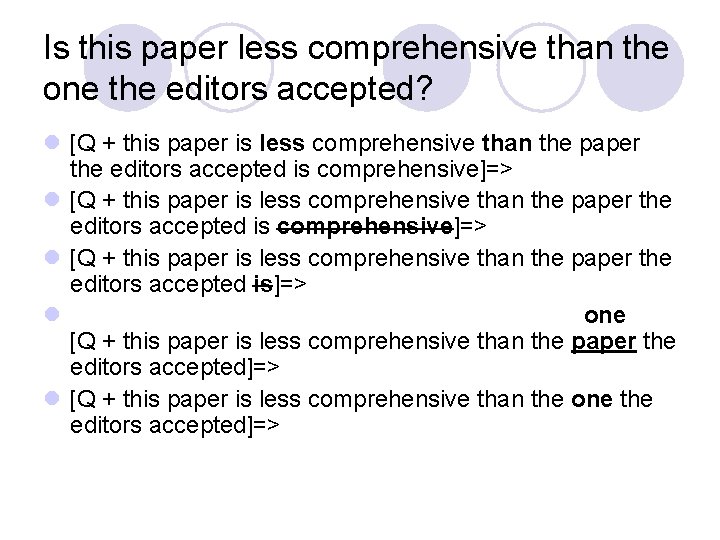
Is this paper less comprehensive than the one the editors accepted? l [Q + this paper is less comprehensive than the paper the editors accepted is comprehensive]=> l [Q + this paper is less comprehensive than the paper the editors accepted is]=> l one [Q + this paper is less comprehensive than the paper the editors accepted]=> l [Q + this paper is less comprehensive than the one the editors accepted]=>

Is this paper less comprehensive than the one the editors accepted? l [Q + is this paper less comprehensive than the one the editors accepted]=> l Is this paper less comprehensive than the one the editors accepted?
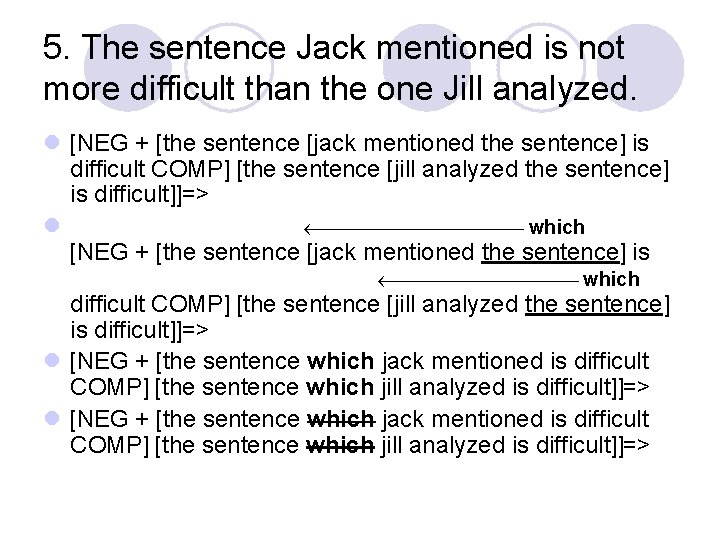
5. The sentence Jack mentioned is not more difficult than the one Jill analyzed. l [NEG + [the sentence [jack mentioned the sentence] is difficult COMP] [the sentence [jill analyzed the sentence] is difficult]]=> l which [NEG + [the sentence [jack mentioned the sentence] is which difficult COMP] [the sentence [jill analyzed the sentence] is difficult]]=> l [NEG + [the sentence which jack mentioned is difficult COMP] [the sentence which jill analyzed is difficult]]=>
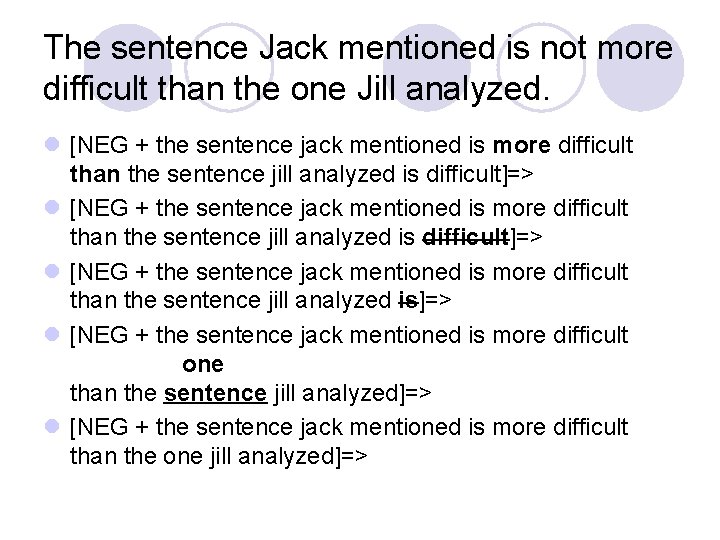
The sentence Jack mentioned is not more difficult than the one Jill analyzed. l [NEG + the sentence jack mentioned is more difficult than the sentence jill analyzed is difficult]=> l [NEG + the sentence jack mentioned is more difficult than the sentence jill analyzed is]=> l [NEG + the sentence jack mentioned is more difficult one than the sentence jill analyzed]=> l [NEG + the sentence jack mentioned is more difficult than the one jill analyzed]=>
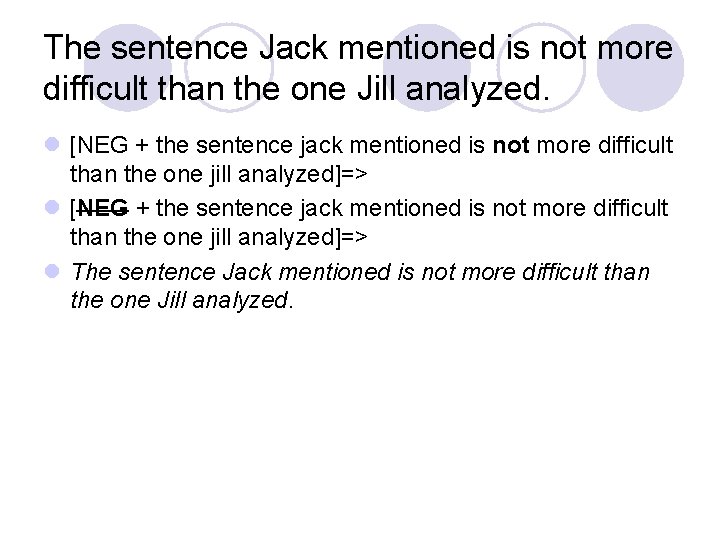
The sentence Jack mentioned is not more difficult than the one Jill analyzed. l [NEG + the sentence jack mentioned is not more difficult than the one jill analyzed]=> l The sentence Jack mentioned is not more difficult than the one Jill analyzed.

6. How did Mary get the book she hadn’t ordered? l [Q + mary got the book [NEG + mary had ordered the book] in some way]=> l [Q + mary got the book [NEG + mary had not ordered the book] in some way]=> l [Q + mary got the book [NEG + mary hadn’t ordered the book] in some way]=> l which [Q + mary got the book [mary hadn’t ordered the book] in some way]=>
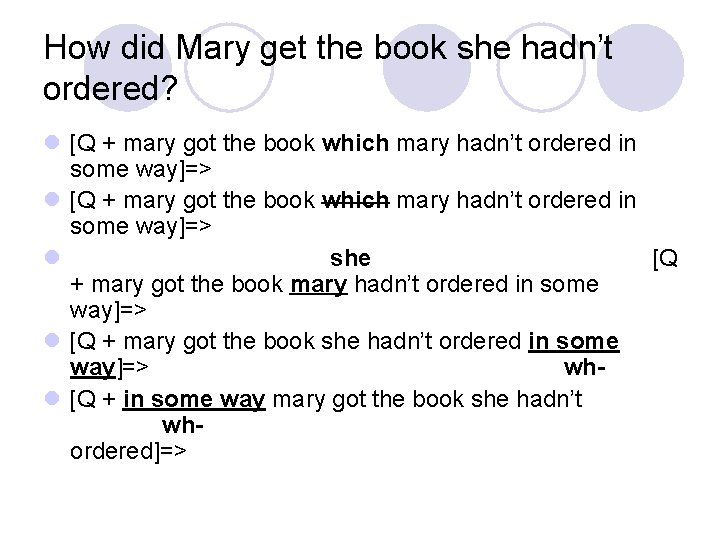
How did Mary get the book she hadn’t ordered? l [Q + mary got the book which mary hadn’t ordered in some way]=> l she [Q + mary got the book mary hadn’t ordered in some way]=> l [Q + mary got the book she hadn’t ordered in some way]=> whl [Q + in some way mary got the book she hadn’t whordered]=>
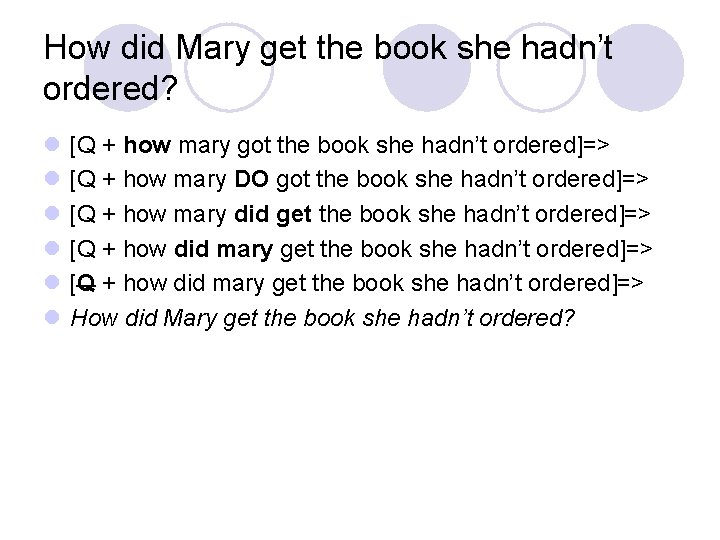
How did Mary get the book she hadn’t ordered? l l l [Q + how mary got the book she hadn’t ordered]=> [Q + how mary DO got the book she hadn’t ordered]=> [Q + how mary did get the book she hadn’t ordered]=> [Q + how did mary get the book she hadn’t ordered]=> How did Mary get the book she hadn’t ordered?

7. Why did Jim choose the job that is less exciting than this one? l [Q + jim chose the job [[the job is exciting COMP] [this job is exciting]] for some reason]=> l [Q + jim chose the job [the job is less exciting than this job is exciting] for some reason]=> l [Q + jim chose the job [the job is less exciting than this job is] for some reason]=> l [Q + jim chose the job [the job is less exciting than this one job] for some reason]=>
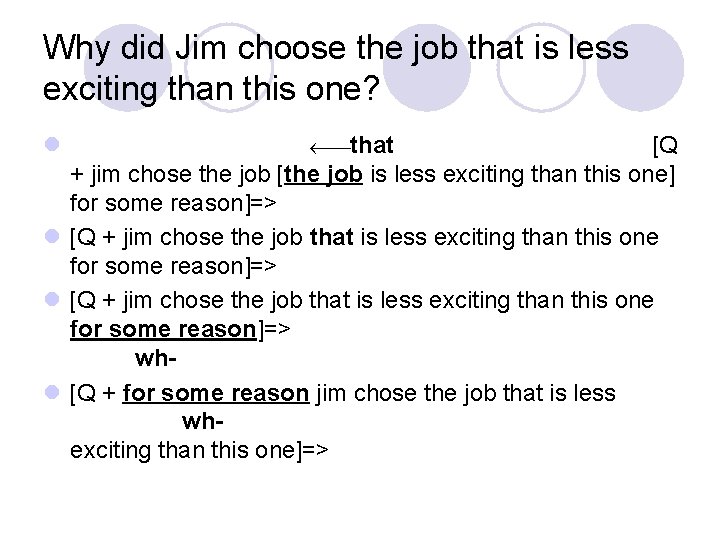
Why did Jim choose the job that is less exciting than this one? l that [Q + jim chose the job [the job is less exciting than this one] for some reason]=> l [Q + jim chose the job that is less exciting than this one for some reason]=> whl [Q + for some reason jim chose the job that is less whexciting than this one]=>
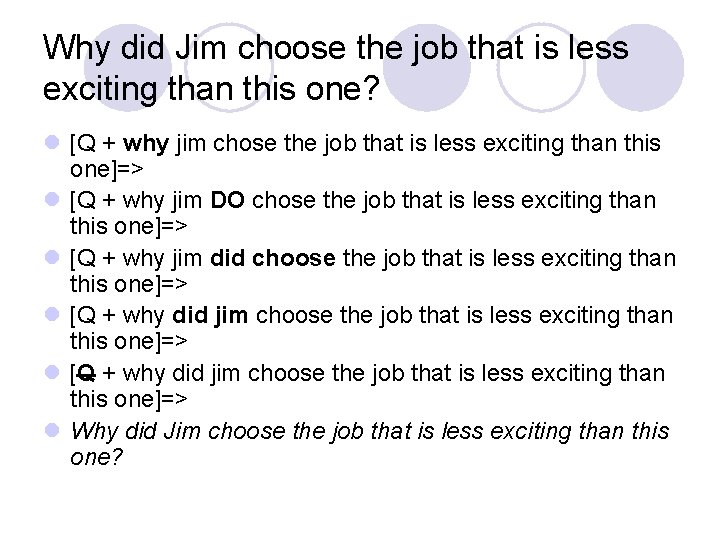
Why did Jim choose the job that is less exciting than this one? l [Q + why jim chose the job that is less exciting than this one]=> l [Q + why jim DO chose the job that is less exciting than this one]=> l [Q + why jim did choose the job that is less exciting than this one]=> l [Q + why did jim choose the job that is less exciting than this one]=> l Why did Jim choose the job that is less exciting than this one?
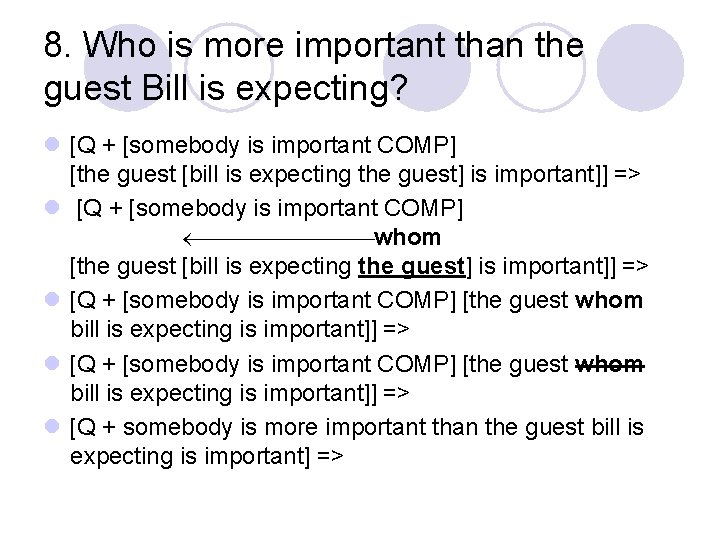
8. Who is more important than the guest Bill is expecting? l [Q + [somebody is important COMP] [the guest [bill is expecting the guest] is important]] => l [Q + [somebody is important COMP] whom [the guest [bill is expecting the guest] is important]] => l [Q + [somebody is important COMP] [the guest whom bill is expecting is important]] => l [Q + somebody is more important than the guest bill is expecting is important] =>
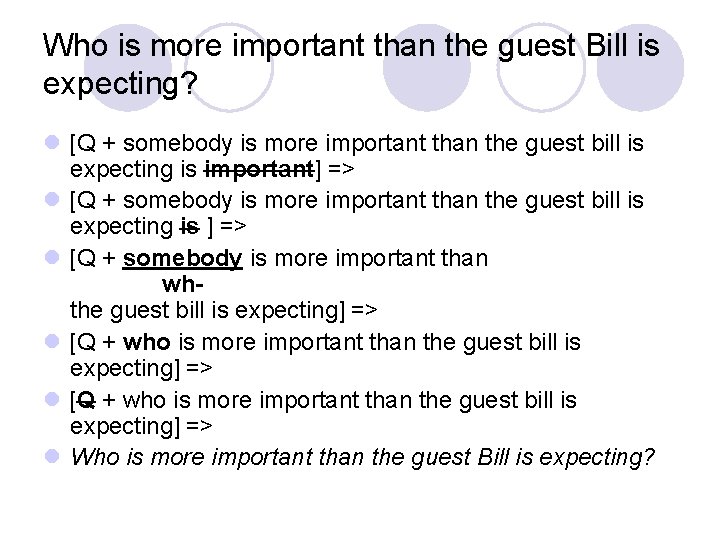
Who is more important than the guest Bill is expecting? l [Q + somebody is more important than the guest bill is expecting is important] => l [Q + somebody is more important than the guest bill is expecting is ] => l [Q + somebody is more important than whthe guest bill is expecting] => l [Q + who is more important than the guest bill is expecting] => l Who is more important than the guest Bill is expecting?
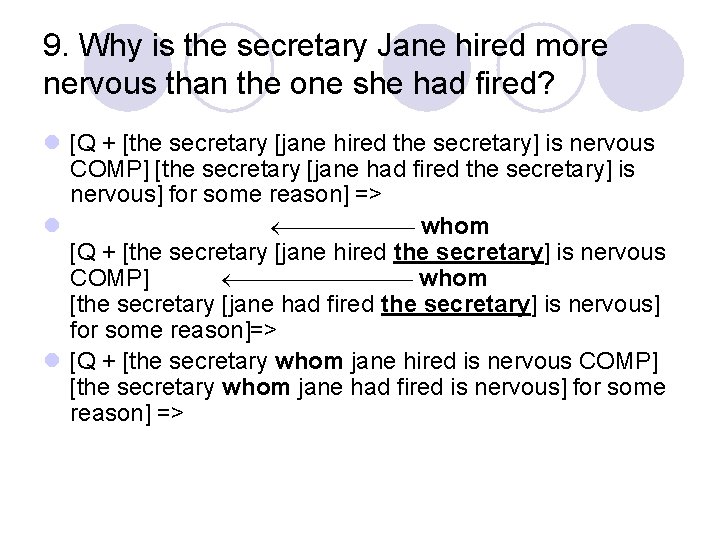
9. Why is the secretary Jane hired more nervous than the one she had fired? l [Q + [the secretary [jane hired the secretary] is nervous COMP] [the secretary [jane had fired the secretary] is nervous] for some reason] => l whom [Q + [the secretary [jane hired the secretary] is nervous COMP] whom [the secretary [jane had fired the secretary] is nervous] for some reason]=> l [Q + [the secretary whom jane hired is nervous COMP] [the secretary whom jane had fired is nervous] for some reason] =>
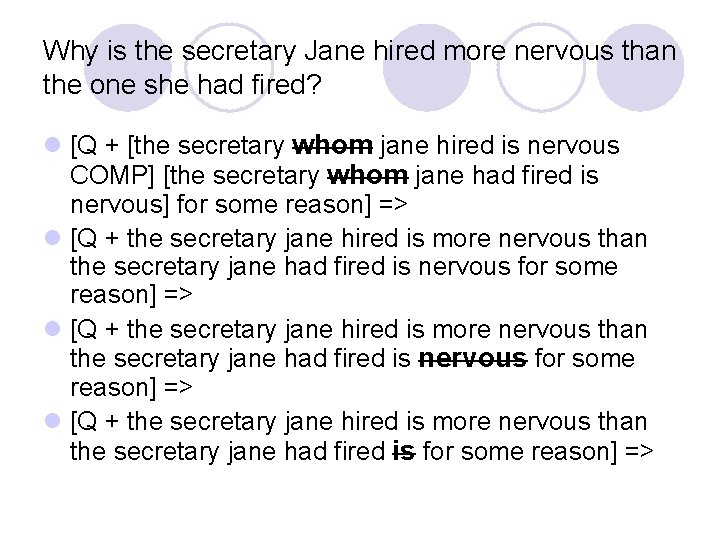
Why is the secretary Jane hired more nervous than the one she had fired? l [Q + [the secretary whom jane hired is nervous COMP] [the secretary whom jane had fired is nervous] for some reason] => l [Q + the secretary jane hired is more nervous than the secretary jane had fired is nervous for some reason] => l [Q + the secretary jane hired is more nervous than the secretary jane had fired is for some reason] =>
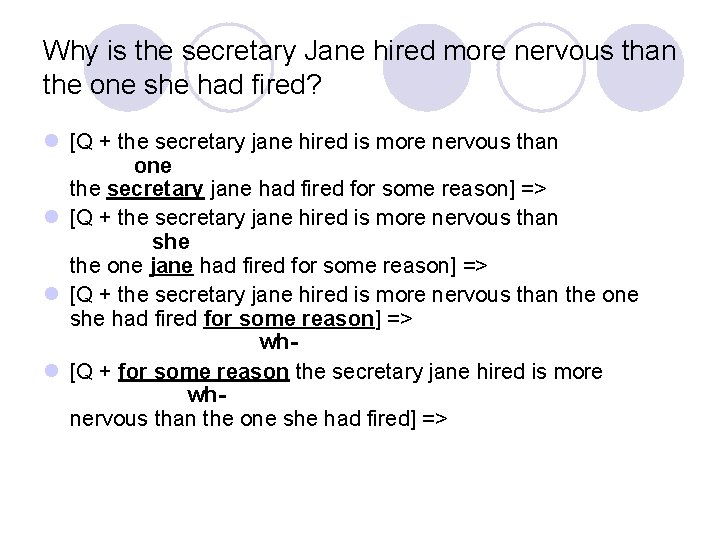
Why is the secretary Jane hired more nervous than the one she had fired? l [Q + the secretary jane hired is more nervous than one the secretary jane had fired for some reason] => l [Q + the secretary jane hired is more nervous than she the one jane had fired for some reason] => l [Q + the secretary jane hired is more nervous than the one she had fired for some reason] => whl [Q + for some reason the secretary jane hired is more whnervous than the one she had fired] =>
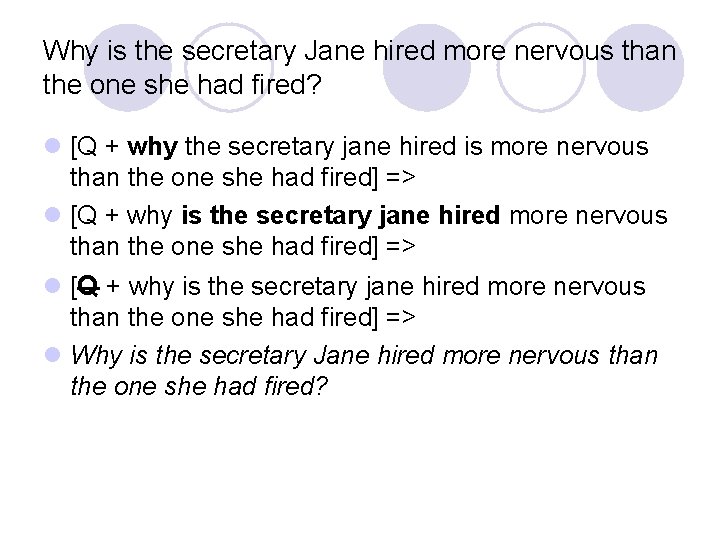
Why is the secretary Jane hired more nervous than the one she had fired? l [Q + why the secretary jane hired is more nervous than the one she had fired] => l [Q + why is the secretary jane hired more nervous than the one she had fired] => l Why is the secretary Jane hired more nervous than the one she had fired?
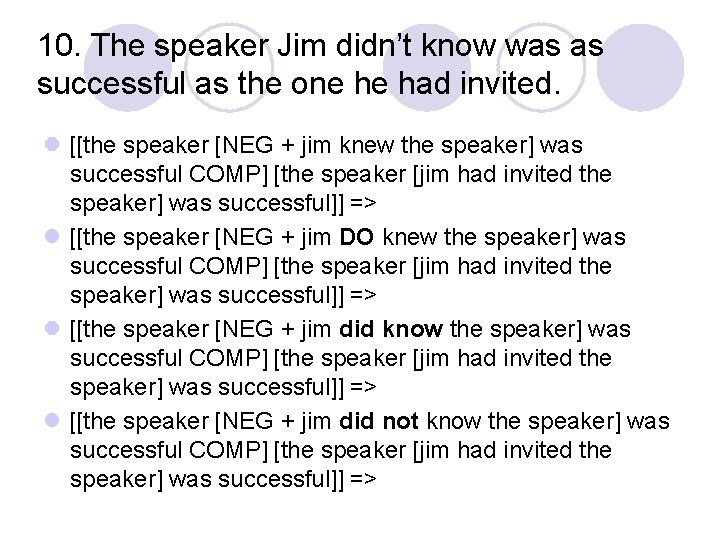
10. The speaker Jim didn’t know was as successful as the one he had invited. l [[the speaker [NEG + jim knew the speaker] was successful COMP] [the speaker [jim had invited the speaker] was successful]] => l [[the speaker [NEG + jim DO knew the speaker] was successful COMP] [the speaker [jim had invited the speaker] was successful]] => l [[the speaker [NEG + jim did know the speaker] was successful COMP] [the speaker [jim had invited the speaker] was successful]] => l [[the speaker [NEG + jim did not know the speaker] was successful COMP] [the speaker [jim had invited the speaker] was successful]] =>
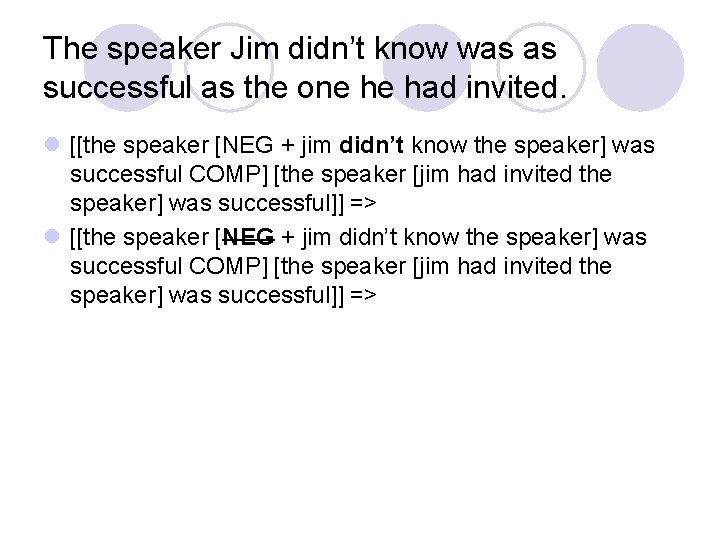
The speaker Jim didn’t know was as successful as the one he had invited. l [[the speaker [NEG + jim didn’t know the speaker] was successful COMP] [the speaker [jim had invited the speaker] was successful]] =>
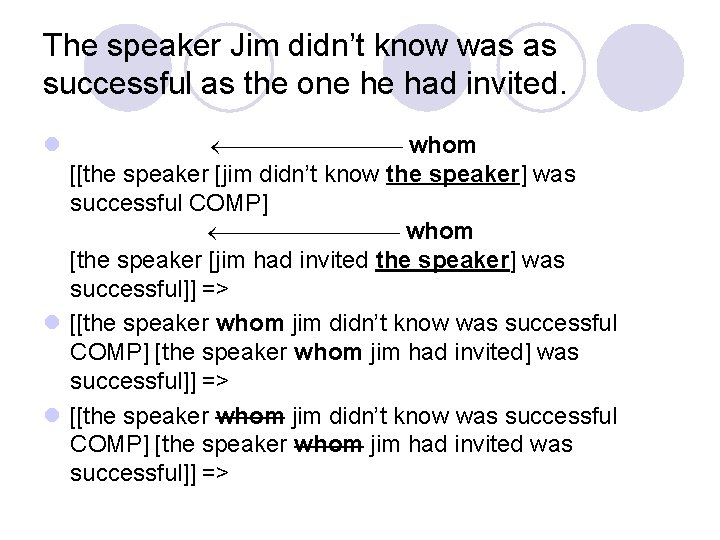
The speaker Jim didn’t know was as successful as the one he had invited. whom [[the speaker [jim didn’t know the speaker] was successful COMP] whom [the speaker [jim had invited the speaker] was successful]] => l [[the speaker whom jim didn’t know was successful COMP] [the speaker whom jim had invited was successful]] => l
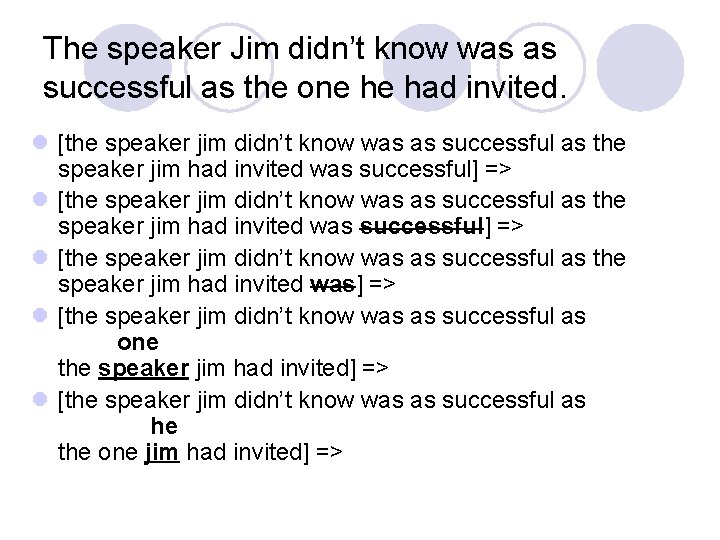
The speaker Jim didn’t know was as successful as the one he had invited. l [the speaker jim didn’t know was as successful as the speaker jim had invited was successful] => l [the speaker jim didn’t know was as successful as the speaker jim had invited was] => l [the speaker jim didn’t know was as successful as one the speaker jim had invited] => l [the speaker jim didn’t know was as successful as he the one jim had invited] =>
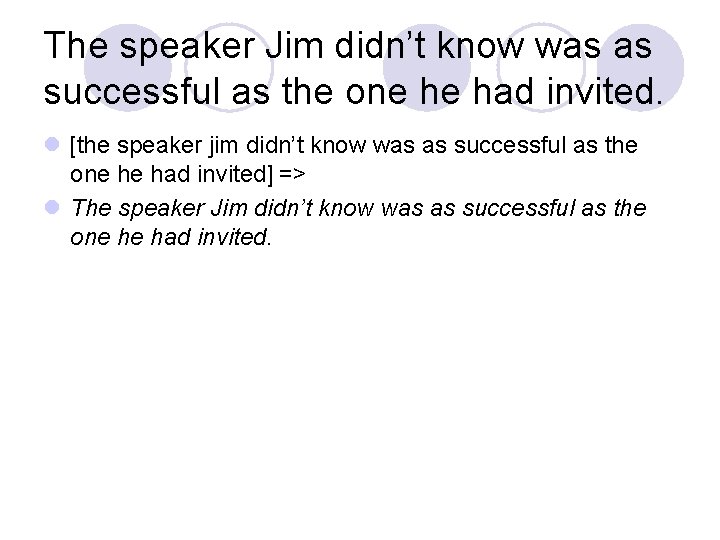
The speaker Jim didn’t know was as successful as the one he had invited. l [the speaker jim didn’t know was as successful as the one he had invited] => l The speaker Jim didn’t know was as successful as the one he had invited.
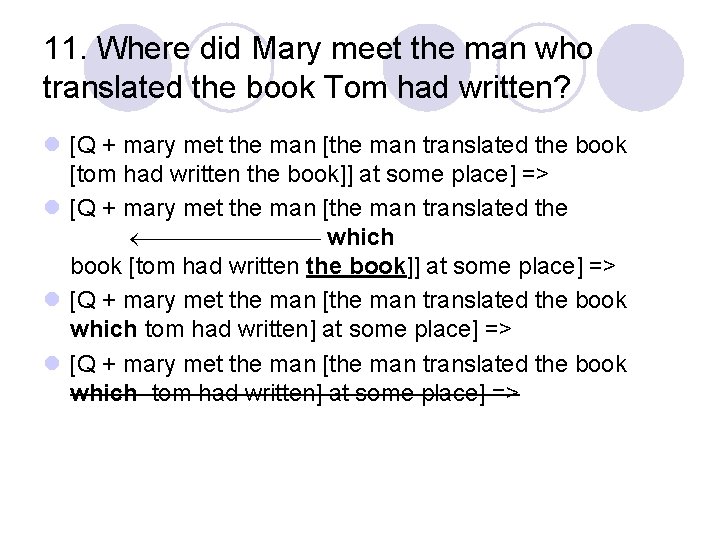
11. Where did Mary meet the man who translated the book Tom had written? l [Q + mary met the man [the man translated the book [tom had written the book]] at some place] => l [Q + mary met the man [the man translated the which book [tom had written the book]] at some place] => l [Q + mary met the man [the man translated the book which tom had written] at some place] =>
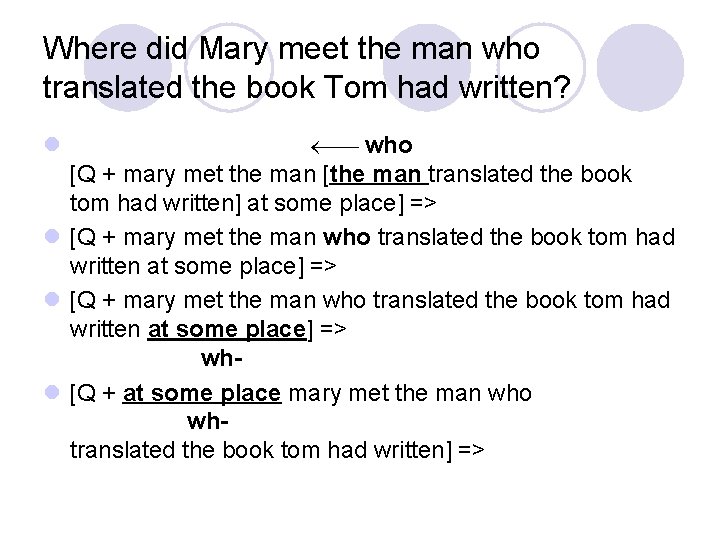
Where did Mary meet the man who translated the book Tom had written? who [Q + mary met the man [the man translated the book tom had written] at some place] => l [Q + mary met the man who translated the book tom had written at some place] => whl [Q + at some place mary met the man who whtranslated the book tom had written] => l
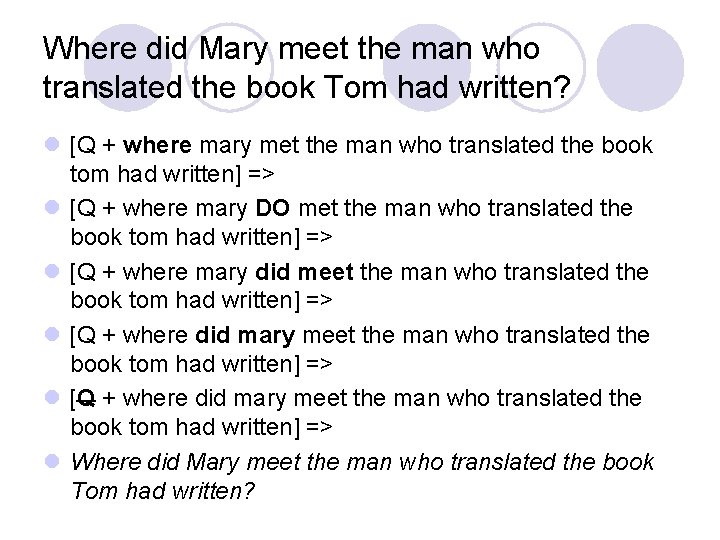
Where did Mary meet the man who translated the book Tom had written? l [Q + where mary met the man who translated the book tom had written] => l [Q + where mary DO met the man who translated the book tom had written] => l [Q + where mary did meet the man who translated the book tom had written] => l [Q + where did mary meet the man who translated the book tom had written] => l Where did Mary meet the man who translated the book Tom had written?
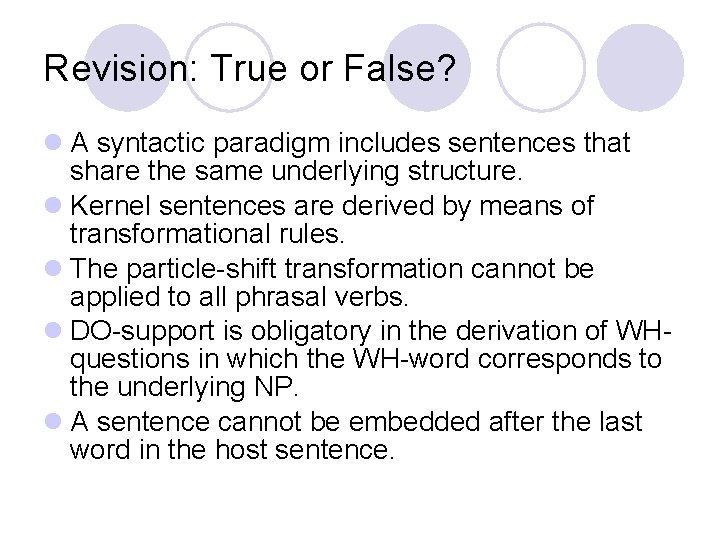
Revision: True or False? l A syntactic paradigm includes sentences that share the same underlying structure. l Kernel sentences are derived by means of transformational rules. l The particle-shift transformation cannot be applied to all phrasal verbs. l DO-support is obligatory in the derivation of WHquestions in which the WH-word corresponds to the underlying NP. l A sentence cannot be embedded after the last word in the host sentence.

True or False? l. Constructional homonyms have the same underlying structure. l. Passivization can be applied to all kernel sentences that contain a monotransitive verb. l. Phrase structure rules are sufficient for the derivation of negative sentences. l. The derivation of relative constructions by means of transformations can accommodate recursive embedding. l. In the comparison transformation, the deletion of all repeated elements is obligatory.
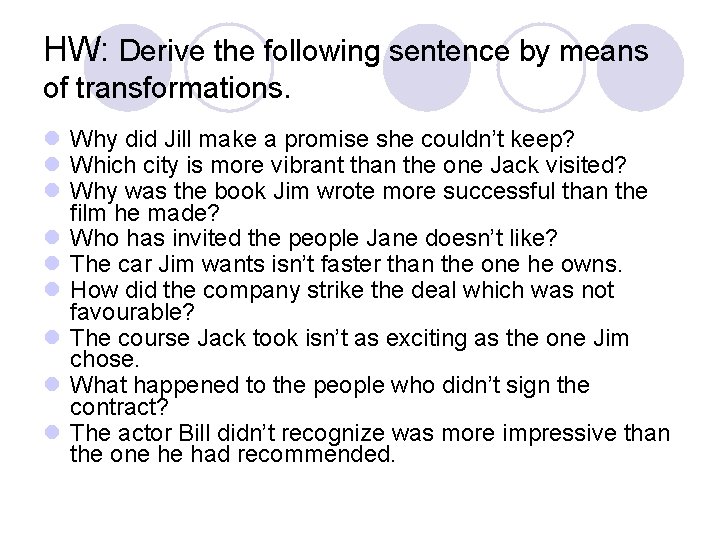
HW: Derive the following sentence by means of transformations. l Why did Jill make a promise she couldn’t keep? l Which city is more vibrant than the one Jack visited? l Why was the book Jim wrote more successful than the film he made? l Who has invited the people Jane doesn’t like? l The car Jim wants isn’t faster than the one he owns. l How did the company strike the deal which was not favourable? l The course Jack took isn’t as exciting as the one Jim chose. l What happened to the people who didn’t sign the contract? l The actor Bill didn’t recognize was more impressive than the one he had recommended.
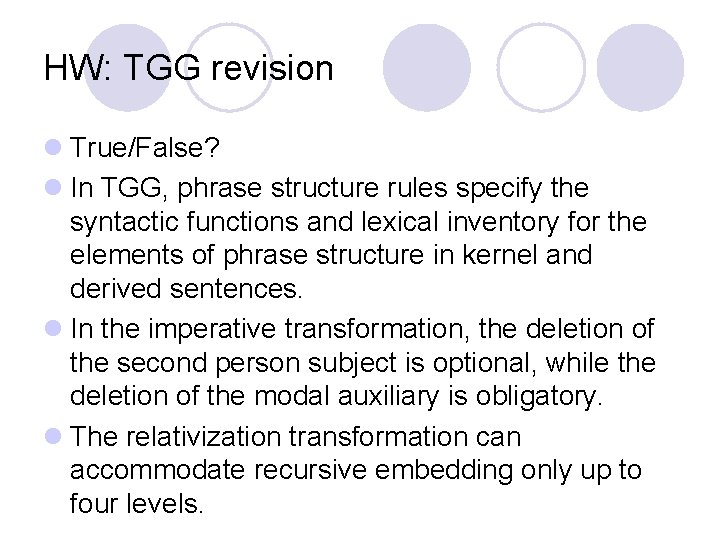
HW: TGG revision l True/False? l In TGG, phrase structure rules specify the syntactic functions and lexical inventory for the elements of phrase structure in kernel and derived sentences. l In the imperative transformation, the deletion of the second person subject is optional, while the deletion of the modal auxiliary is obligatory. l The relativization transformation can accommodate recursive embedding only up to four levels.

HW: TGG revision l State the phrase structure rules and draw the phrase structure tree for the following sentence (2 pts) l The story will seem unlikely to some readers.
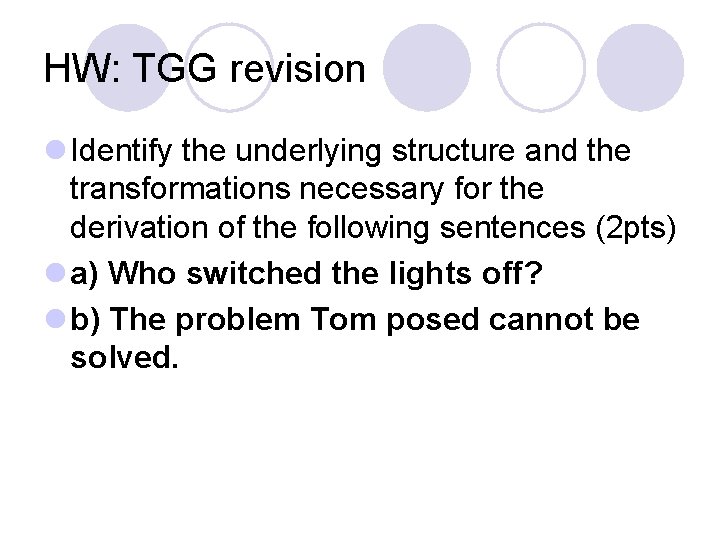
HW: TGG revision l Identify the underlying structure and the transformations necessary for the derivation of the following sentences (2 pts) l a) Who switched the lights off? l b) The problem Tom posed cannot be solved.
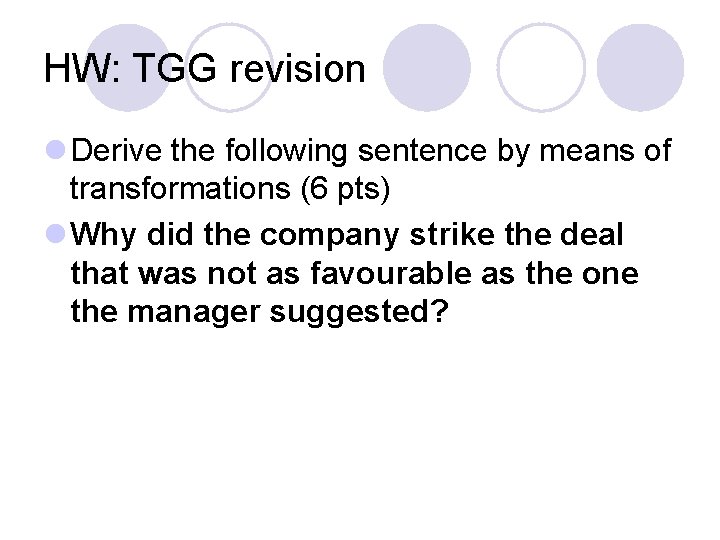
HW: TGG revision l Derive the following sentence by means of transformations (6 pts) l Why did the company strike the deal that was not as favourable as the one the manager suggested?
- Slides: 73