
Der Vorleser 1995 The Reader 1997 A novel

- Slides: 19
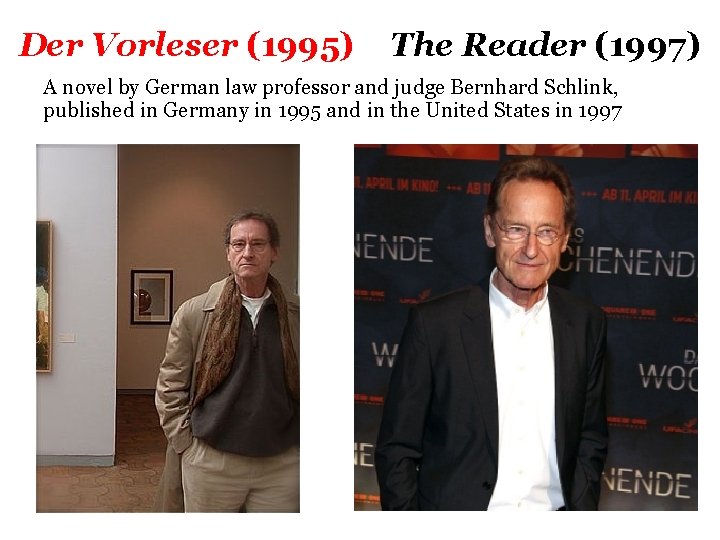
Der Vorleser (1995) The Reader (1997) A novel by German law professor and judge Bernhard Schlink, published in Germany in 1995 and in the United States in 1997
The Reader—Der Vorleser Publication & Translation Review: • What can be gained or lost as a novel— or other artistic work—is translated? • Across time periods? • Across languages? • Across cultures? • What other divides have implications that should be explored as a translated text is created?
With Translated Texts, Consider… • How important but difficult is it to translate word and sentence choices with all their associations, implications, and connotations into a different language. • What aspects of meaning can be lost? • What is supposed to be funny in the text? Is it funny to all readers? • Audit how your cultural lenses might impede your understanding of the text. • What are the implications of translating stylistic features such as imagery, rhythm, sound, or figurative expression? • How important is the fact that texts create meaning within a social or cultural context? Does understanding of a cultural, as well as a linguistic, frame of reference affect the way a work is read and how easy is this to translate? • In which ways does the author of the original text remain the author of the translated work? Does the translator become the author through the linguistic choices they make?
The Reader—Der Vorleser Publication & Translation • The Reader sold 500, 000 copies quickly in Germany. • Ranks 14 th in a list of the 100 favorite books of German readers, the second-highest ranking for any contemporary German novel on the list • Translated into over 25 languages • The New York Times, Richard Bernstein called it “arresting, philosophically elegant, (and) morally complex. ”
Genres Vergangenheitsbewältigung the struggle to come to terms with the past Bildungsroman • Bildung = education • Roman = novel • Bildungsroman = coming of age novel, literally “novel of education” A parable is a didactic story in prose or verse. • A parable is different from a fable because it uses human characters rather than animals.
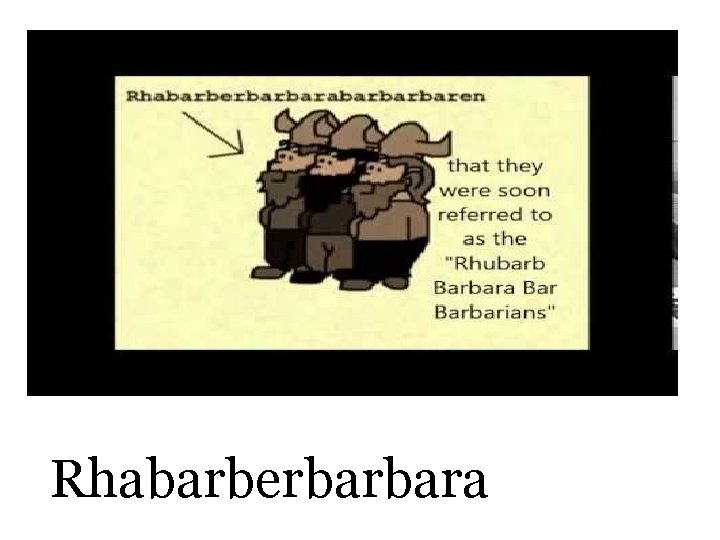
“Rhabarberbarbara” video • German is known for its extra-long compound words. • When Mark Twain complained that some German words were "so long they have a perspective, " he was thinking of words like Freundschaftsbezeigungen (demonstrations of friendship) and Generalstaatsverordnetenversammlungen (general states representatives meetings). • Long German words were in the news in 2013 when many sources reported that Germany had "lost its longest word" because the European Union removed a law from its books called (*ahem*): Rindfleischetikettierungsüberwachungsauf gabenübertragungsgesetz (the law for the delegation of monitoring beef labeling). • But Germany had not in fact lost its longest word, because the process forming these words is an active, productive part of the language, and the potential exists for creating words even longer, if so needed, in the moment. • Here’s an example of how that process works…
Rhabarberbarbara
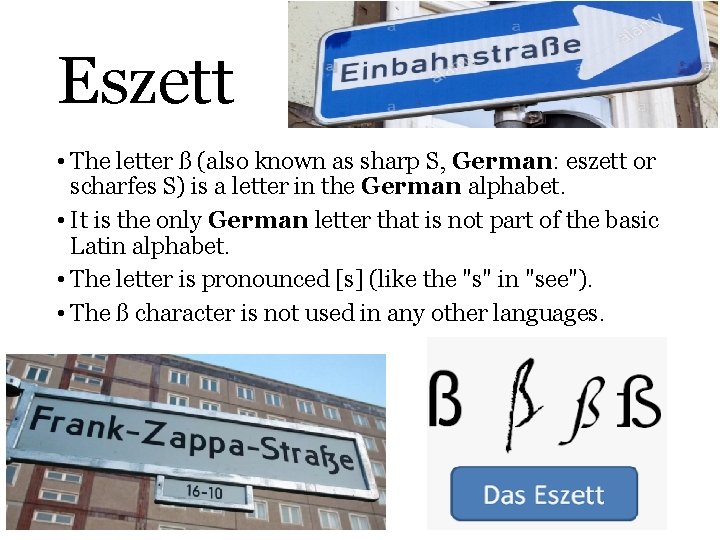
Eszett • The letter ß (also known as sharp S, German: eszett or scharfes S) is a letter in the German alphabet. • It is the only German letter that is not part of the basic Latin alphabet. • The letter is pronounced [s] (like the "s" in "see"). • The ß character is not used in any other languages.
Tripartite Structure • Part I: 1958 • Michael Berg is 15 • Auschwitz liberated 1. 27. 45 • Part II: Six Years Later • Part III: Eighteen Years Later
Historical Context--Acronyms • West Germany • GDR: German Democratic Republic • DDR: Deutsche Demokratische Republik • NAZI = abbreviation for “Nationalsozialismus” • German for “National Socialism” • Do you have any questions about the history or the historical context of this novel?
POV & Chapter 1 • What is the point of view Schlink uses in the novel? Define it and provide an example. • Use adjectives to describe the narrative voice and author’s writing style. • What images stand out to you from your reading homework? • Contrast the sights and sounds outside the narrator’s apartment in Chapter 1 and outside the building described in the flashback later in the chapter. What do the contrasting sights and sounds reveal about the two neighborhoods and the people who live there?
Chapter 2 • How does Schlink use the descriptions of the building, the renovated one and the old building, to introduce the contrast between the present and the past? • List the characteristics of the recurring dream the narrator has about the building. What could the dream signify?
Chapter 1 -5 • Discuss the imagery Schlink uses to introduce the relationship between Frau Hanna Schmitz (she won't have a name until chapter eight) and Michael Berg? • What about Hanna’s characterization makes her sympathetic? What does not? • To what extent are you critical of her? Forgiving?
Part I of The Reader concerns itself with a sexual affair. • How does Schlink depict this relationship and why? • How does Schlink choose diction to describe this affair? • Keep in mind Schlink’s purpose: For example, does the depiction make you uncomfortable? If so, how and why? What could be Schlink’s purpose in making you feel uncomfortable?
Chapter 3 • Comment on Frau Schmitz: what is she like and how do you know? • Consider verbs Schlink associates with her, the description of her building and her apartment, and her actions and words. • What is interesting about the narrator’s memory of her at the end of the chapter?
Chapter 4 • What is so entrancing to the narrator about Frau Schmitz? • Discuss how Schlink conveys the effect Hanna has on Michael. • Consider the narrator’s reflections about her effect on him as well as techniques Schlink uses.
Chapter 5 • The motif of books is introduced in this chapter. Where and how? • Comment on Schlink’s use of the second person in this chapter (you) …see paragraph 3. What is the effect of this choice? What do you think his purpose is?
Chapter 5 • “Desires, memories, fears, passions form labyrinths in which we lose and find and then lose ourselves again”(18). • Discuss Chapter 5 in light of the above quotation. How is the notion of a moral dilemma, and the relationship between thought and behavior presented in this chapter? How is morality like a labyrinth?