
DepthFirst Search A B D E C DepthFirst
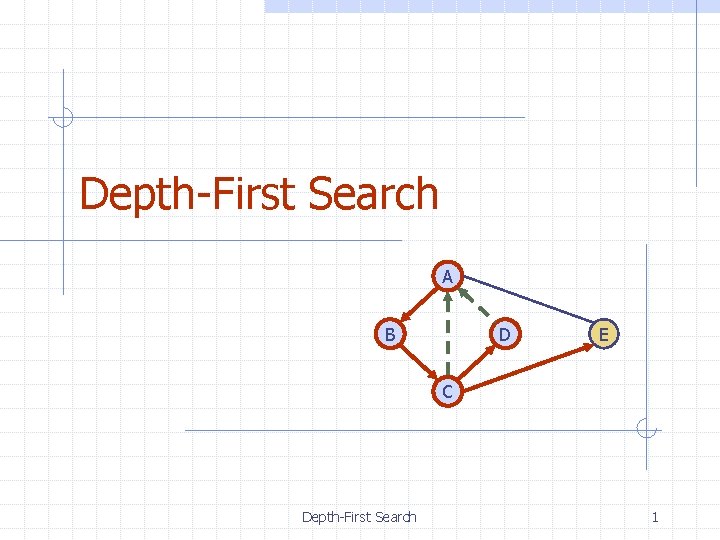
Depth-First Search A B D E C Depth-First Search 1
Outline and Reading Definitions (§ 6. 1) n n n Subgraph Connectivity Spanning trees and forests Depth-first search (§ 6. 3. 1) n n Algorithm Example Properties Analysis Applications of DFS (§ 6. 5) n n Path finding Cycle finding Depth-First Search 2
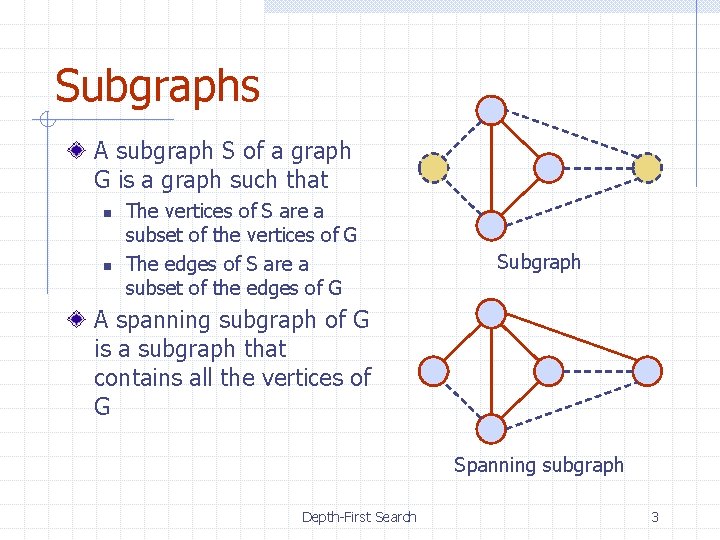
Subgraphs A subgraph S of a graph G is a graph such that n n The vertices of S are a subset of the vertices of G The edges of S are a subset of the edges of G Subgraph A spanning subgraph of G is a subgraph that contains all the vertices of G Spanning subgraph Depth-First Search 3
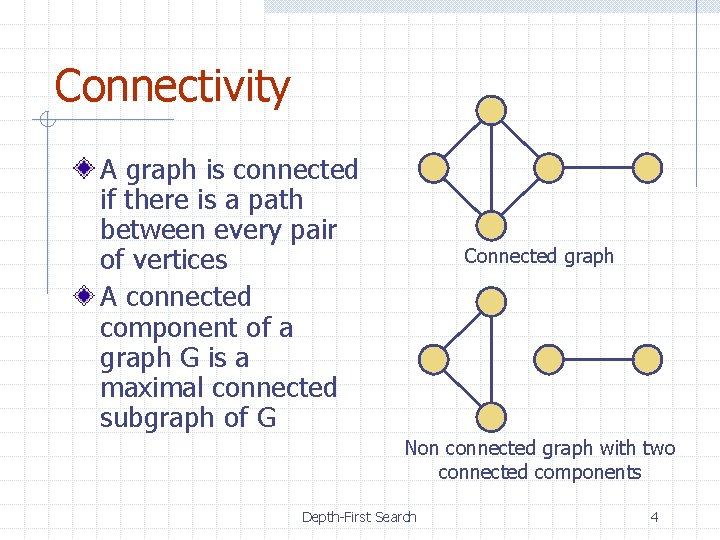
Connectivity A graph is connected if there is a path between every pair of vertices A connected component of a graph G is a maximal connected subgraph of G Connected graph Non connected graph with two connected components Depth-First Search 4
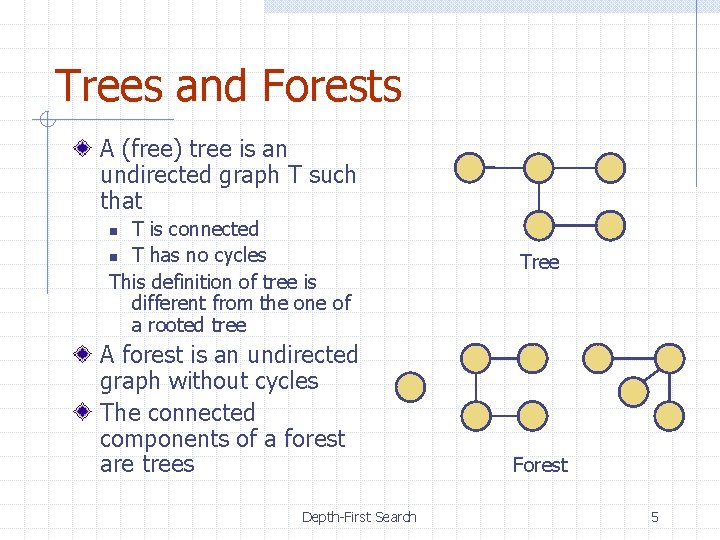
Trees and Forests A (free) tree is an undirected graph T such that T is connected n T has no cycles This definition of tree is different from the one of a rooted tree n A forest is an undirected graph without cycles The connected components of a forest are trees Depth-First Search Tree Forest 5
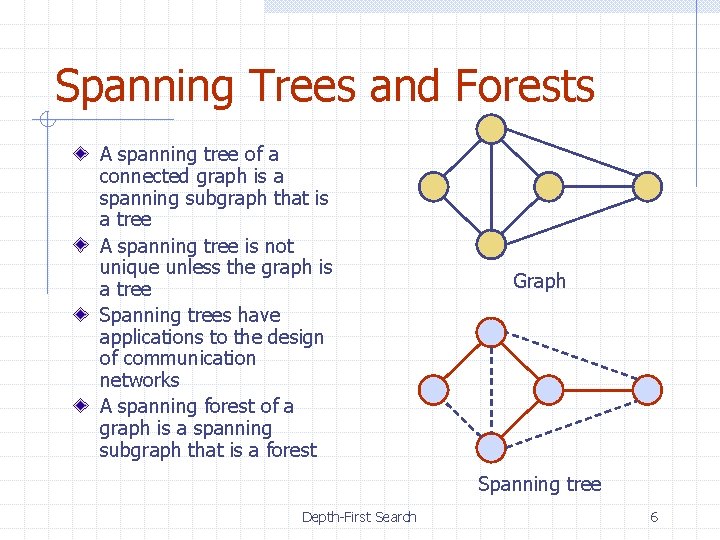
Spanning Trees and Forests A spanning tree of a connected graph is a spanning subgraph that is a tree A spanning tree is not unique unless the graph is a tree Spanning trees have applications to the design of communication networks A spanning forest of a graph is a spanning subgraph that is a forest Graph Spanning tree Depth-First Search 6
Depth-First Search Depth-first search (DFS) is a general technique for traversing a graph A DFS traversal of a graph G n n Visits all the vertices and edges of G Determines whether G is connected Computes the connected components of G Computes a spanning forest of G DFS on a graph with n vertices and m edges takes O(n + m ) time DFS can be further extended to solve other graph problems n n Find and report a path between two given vertices Find a cycle in the graph Depth-first search is to graphs what Euler tour is to binary trees Depth-First Search 7
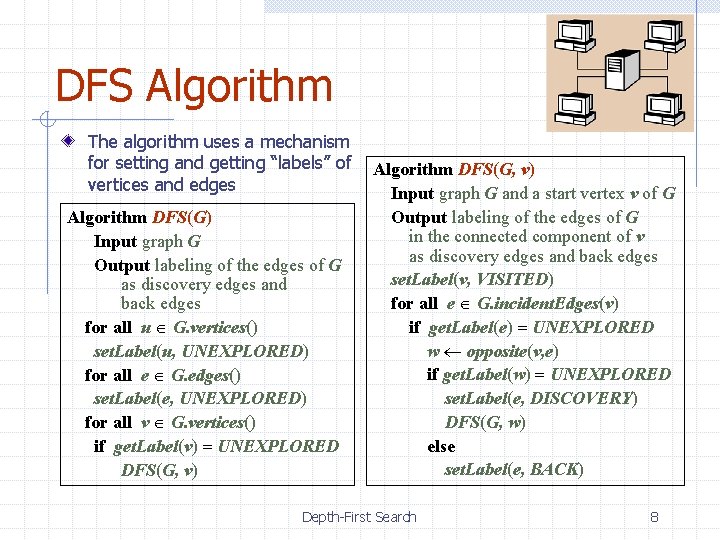
DFS Algorithm The algorithm uses a mechanism for setting and getting “labels” of vertices and edges Algorithm DFS(G) Input graph G Output labeling of the edges of G as discovery edges and back edges for all u G. vertices() set. Label(u, UNEXPLORED) for all e G. edges() set. Label(e, UNEXPLORED) for all v G. vertices() if get. Label(v) = UNEXPLORED DFS(G, v) Algorithm DFS(G, v) Input graph G and a start vertex v of G Output labeling of the edges of G in the connected component of v as discovery edges and back edges set. Label(v, VISITED) for all e G. incident. Edges(v) if get. Label(e) = UNEXPLORED w opposite(v, e) if get. Label(w) = UNEXPLORED set. Label(e, DISCOVERY) DFS(G, w) else set. Label(e, BACK) Depth-First Search 8
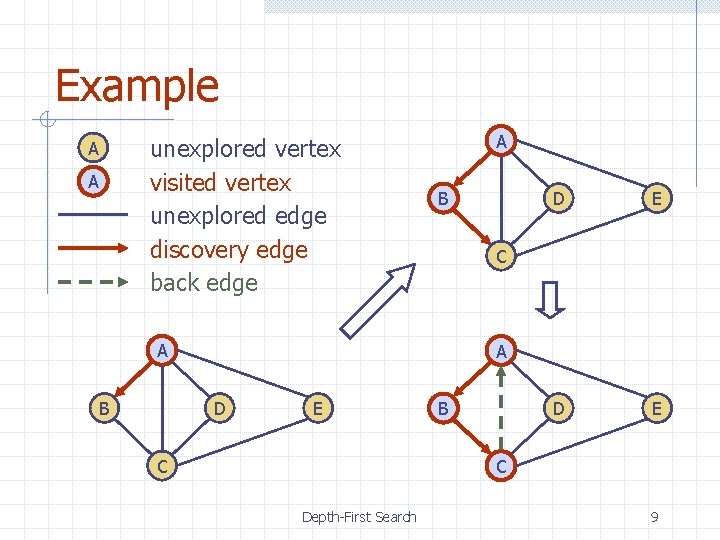
Example unexplored vertex visited vertex unexplored edge discovery edge back edge A A A B E D E C A B D A D E C B C Depth-First Search 9
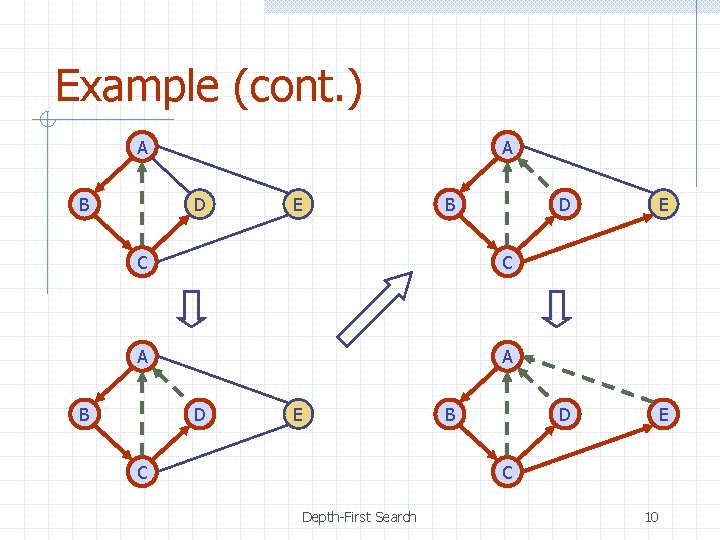
Example (cont. ) A B A D E B C C A A B D E C Depth-First Search 10
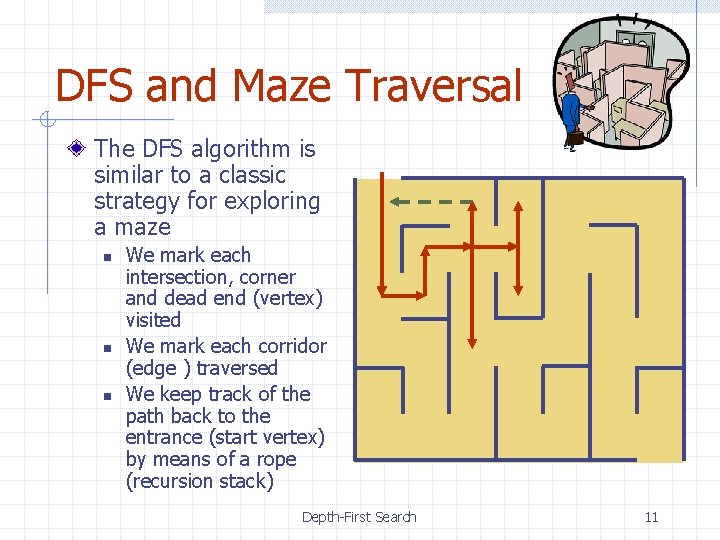
DFS and Maze Traversal The DFS algorithm is similar to a classic strategy for exploring a maze n n n We mark each intersection, corner and dead end (vertex) visited We mark each corridor (edge ) traversed We keep track of the path back to the entrance (start vertex) by means of a rope (recursion stack) Depth-First Search 11
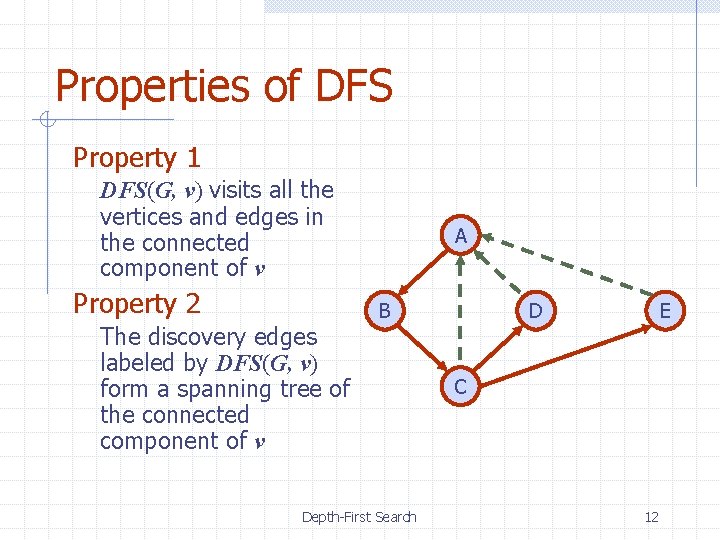
Properties of DFS Property 1 DFS(G, v) visits all the vertices and edges in the connected component of v Property 2 The discovery edges labeled by DFS(G, v) form a spanning tree of the connected component of v A B Depth-First Search D E C 12
Analysis of DFS Setting/getting a vertex/edge label takes O(1) time Each vertex is labeled twice n n once as UNEXPLORED once as VISITED Each edge is labeled twice n n once as UNEXPLORED once as DISCOVERY or BACK Method incident. Edges is called once for each vertex DFS runs in O(n + m) time provided the graph is represented by the adjacency list structure n Recall that Sv deg(v) = 2 m Depth-First Search 13
Path Finding We can specialize the DFS algorithm to find a path between two given vertices u and z using the template method pattern We call DFS(G, u) with u as the start vertex We use a stack S to keep track of the path between the start vertex and the current vertex As soon as destination vertex z is encountered, we return the path as the contents of the stack Algorithm path. DFS(G, v, z) set. Label(v, VISITED) S. push(v) if v = z return S. elements() for all e G. incident. Edges(v) if get. Label(e) = UNEXPLORED w opposite(v, e) if get. Label(w) = UNEXPLORED set. Label(e, DISCOVERY) S. push(e) path. DFS(G, w, z) S. pop(e) else set. Label(e, BACK) S. pop(v) Depth-First Search 14
Cycle Finding We can specialize the DFS algorithm to find a simple cycle using the template method pattern We use a stack S to keep track of the path between the start vertex and the current vertex As soon as a back edge (v, w) is encountered, we return the cycle as the portion of the stack from the top to vertex w Algorithm cycle. DFS(G, v, z) set. Label(v, VISITED) S. push(v) for all e G. incident. Edges(v) if get. Label(e) = UNEXPLORED w opposite(v, e) S. push(e) if get. Label(w) = UNEXPLORED set. Label(e, DISCOVERY) path. DFS(G, w, z) S. pop(e) else T new empty stack repeat o S. pop() T. push(o) until o = w return T. elements() S. pop(v) Depth-First Search 15
- Slides: 15