
Depth of position interaction determination in GEMbased multilayer
Depth of position interaction determination in GEM-based multilayer PET detectors. • Detection and localization of high energy photons making use of an appropriate converter sheet in front of the GEM device used for charge amplification and localization • To compensate for the low conversion efficiency of a single element, multi-layer structures will be made, with stacks of converter-GEM modules.
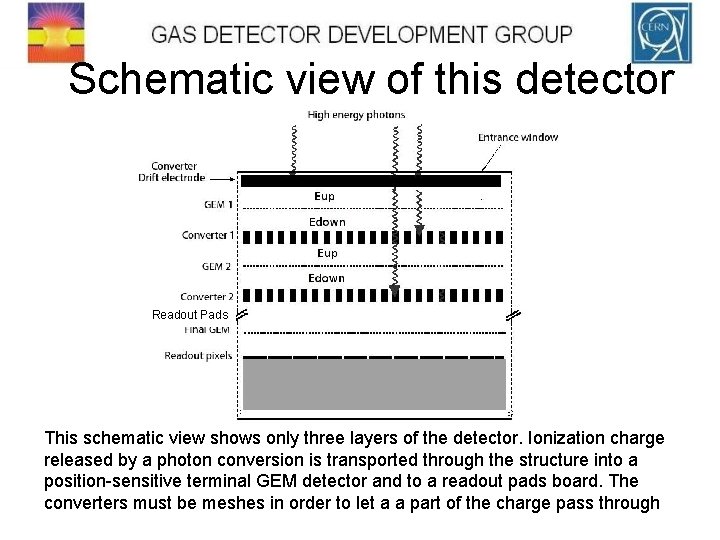
Schematic view of this detector Readout Pads This schematic view shows only three layers of the detector. Ionization charge released by a photon conversion is transported through the structure into a position-sensitive terminal GEM detector and to a readout pads board. The converters must be meshes in order to let a a part of the charge pass through
Limitations • Two fundamental limitations hinder the use of this technology, when confronted to classic crystal-based detectors : – In a multi-layer GEM-converted stack, one has to ensure that the charge transported to the final multiplier does not depend on the conversion depth. – The thickness of each layer, typically several mm, adds an (unknown) delay to the final charge collection, implying a poor time resolution; for ten layers: several hundred ns
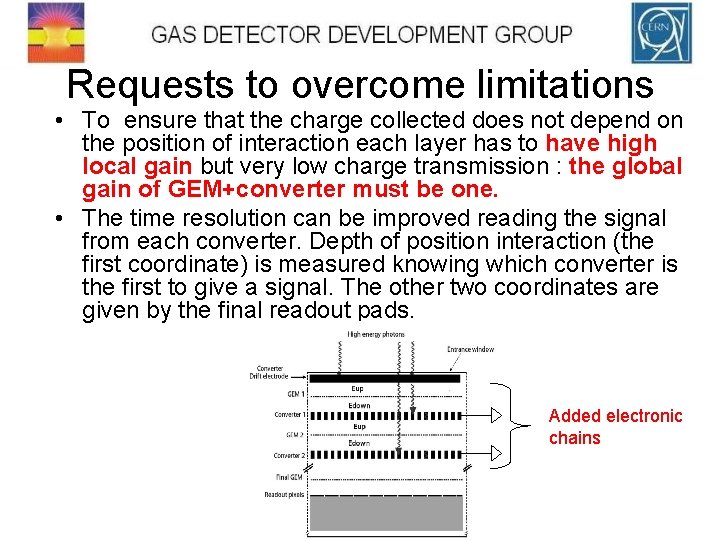
Requests to overcome limitations • To ensure that the charge collected does not depend on the position of interaction each layer has to have high local gain but very low charge transmission : the global gain of GEM+converter must be one. • The time resolution can be improved reading the signal from each converter. Depth of position interaction (the first coordinate) is measured knowing which converter is the first to give a signal. The other two coordinates are given by the final readout pads. Added electronic chains
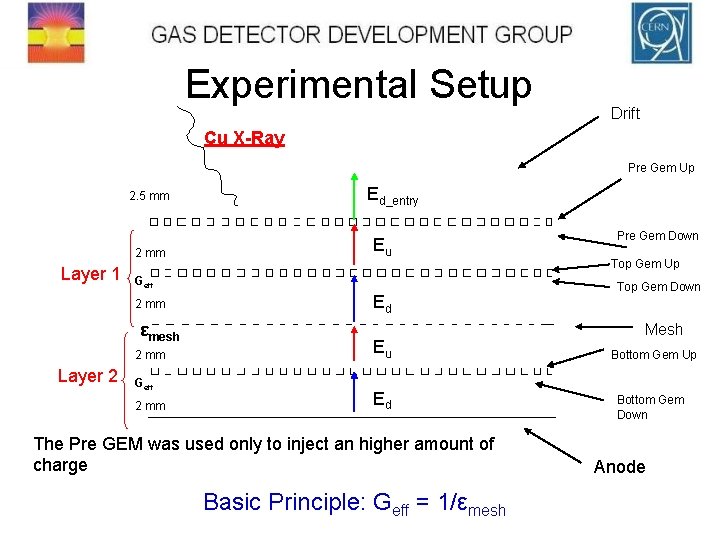
Experimental Setup Drift Cu X-Ray Pre Gem Up 2. 5 mm 2 mm Layer 1 Eu Geff 2 mm εmesh 2 mm Layer 2 Ed_entry Geff 2 mm Ed Eu Ed The Pre GEM was used only to inject an higher amount of charge Basic Principle: Geff = 1/εmesh Pre Gem Down Top Gem Up Top Gem Down Mesh Bottom Gem Up Bottom Gem Down Anode
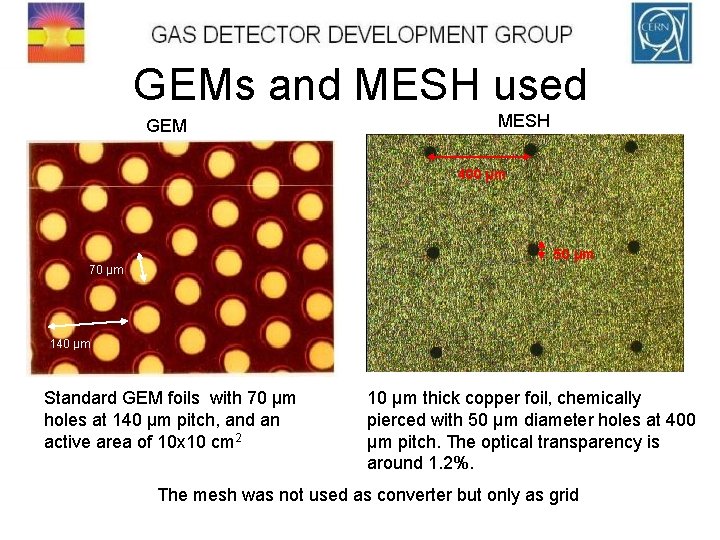
GEMs and MESH used GEM MESH 400 μm 50 μm 70 μm 140 μm Standard GEM foils with 70 µm holes at 140 µm pitch, and an active area of 10 x 10 cm 2 10 µm thick copper foil, chemically pierced with 50 µm diameter holes at 400 µm pitch. The optical transparency is around 1. 2%. The mesh was not used as converter but only as grid
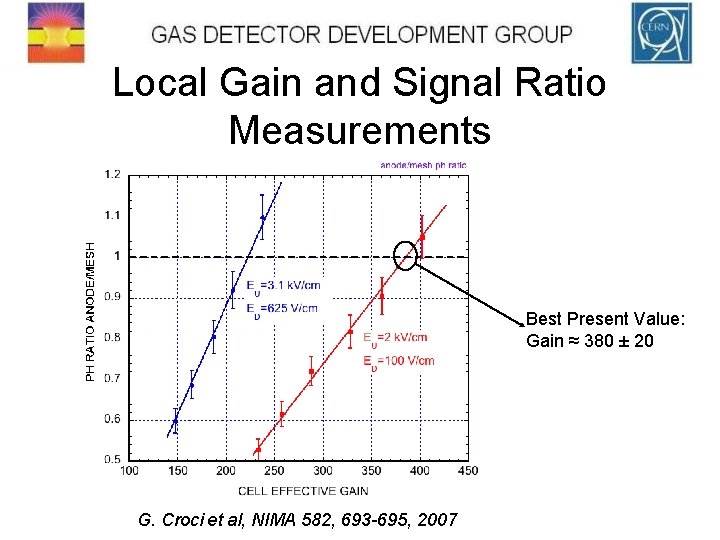
Local Gain and Signal Ratio Measurements Best Present Value: Gain ≈ 380 ± 20 G. Croci et al, NIMA 582, 693 -695, 2007
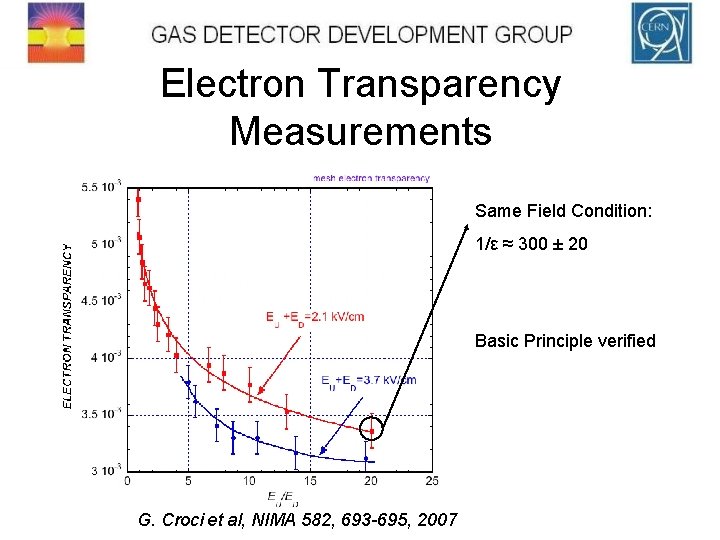
Electron Transparency Measurements Same Field Condition: 1/ε ≈ 300 ± 20 Basic Principle verified G. Croci et al, NIMA 582, 693 -695, 2007
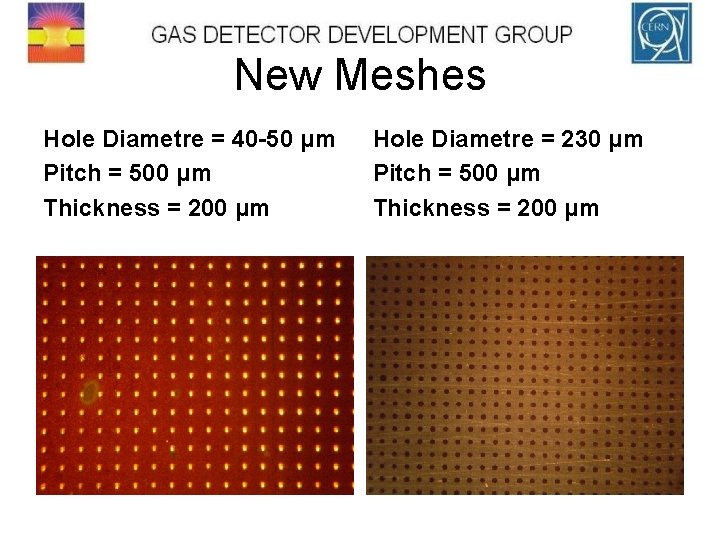
New Meshes Hole Diametre = 40 -50 μm Pitch = 500 μm Thickness = 200 μm Hole Diametre = 230 μm Pitch = 500 μm Thickness = 200 μm
- Slides: 9