
Depth of Knowledge Social Studies Civic Literacy Teacher
- Slides: 22
Depth of Knowledge Social Studies Civic Literacy Teacher Network
Depth of Knowledge Guiding Questions…. § What is Depth of Knowledge? § How does Depth of Knowledge impact instruction and assessment?
Depth of Knowledge is… One step in the alignment process
DOK (cont. ) n No Child Left Behind (NCLB) requires assessments to “measure the depth and breadth of the state academic content standards for a given grade level” (U. S. Department of Education, 2003, p. 12)
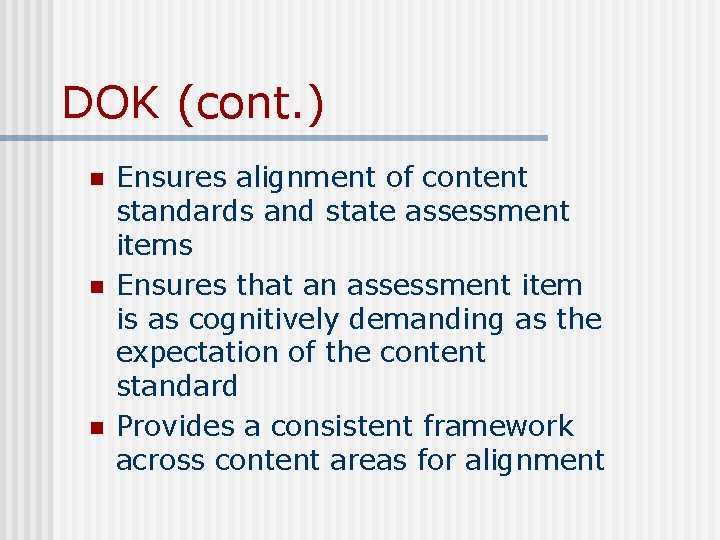
DOK (cont. ) n n n Ensures alignment of content standards and state assessment items Ensures that an assessment item is as cognitively demanding as the expectation of the content standard Provides a consistent framework across content areas for alignment
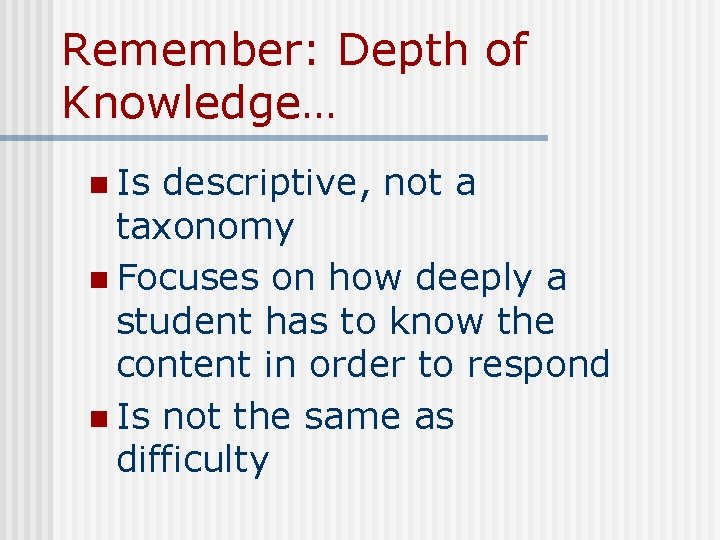
Remember: Depth of Knowledge… n Is descriptive, not a taxonomy n Focuses on how deeply a student has to know the content in order to respond n Is not the same as difficulty
DOK (cont. ) n Assigning Depth-of. Knowledge to content standards and assessment items is an essential requirement of alignment analysis n Four levels of Depth of Knowledge were used for our analysis:
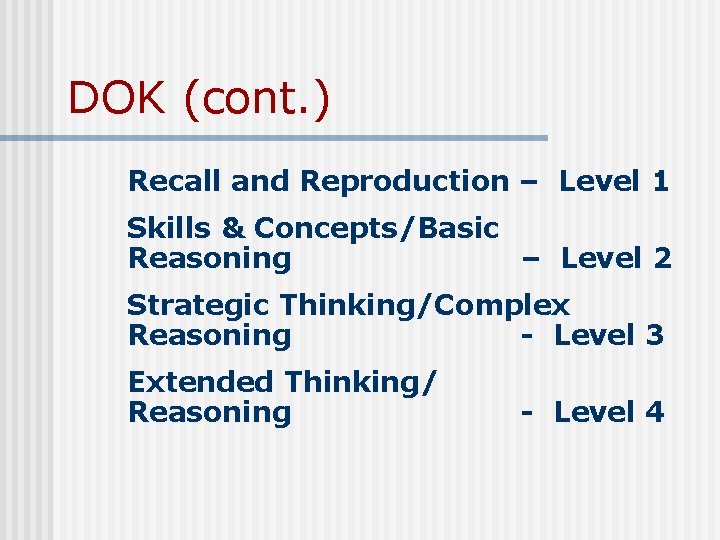
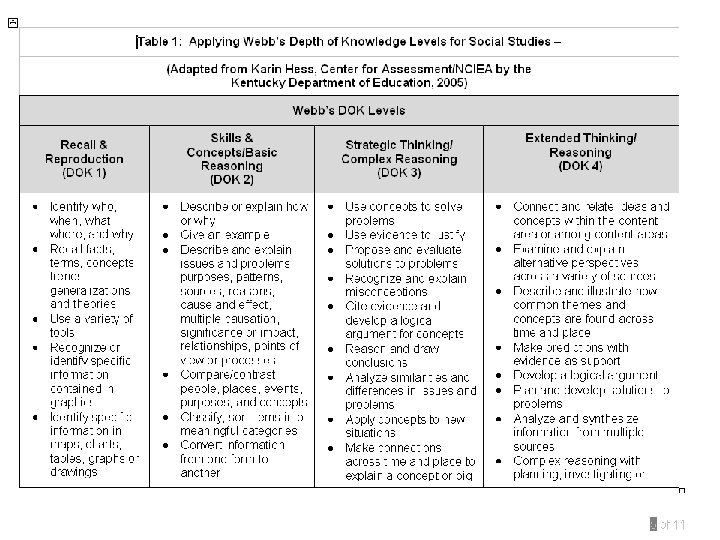
DOK (cont. ) Recall and Reproduction – Level 1 Skills & Concepts/Basic Reasoning – Level 2 Strategic Thinking/Complex Reasoning - Level 3 Extended Thinking/ Reasoning - Level 4
Recall and Reproduction (DOK 1) n. Focus on specific facts, definitions, details, or using routine procedures
Recall and Reproduction (DOK 1): Examples n Recall facts, terms, concepts n Recognize or identify specific information in charts, maps, tables, graphs, and drawings
Skills and Concepts/ Basic Reasoning (DOK 2) n Requires basic application of skills and concepts, decision-making approaches n Requires deeper knowledge than just giving a definition such as explaining how or why
Skills and Concepts/ Basic Reasoning (DOK 2): Examples n Describe or give an example n Compare/contrast people, places, events, purposes, and concepts
Strategic Thinking/ Complex Reasoning (DOK 3) n Requires deep understanding as exhibited through planning, using evidence, and more demanding cognitive reasoning
Strategic Thinking/ Complex Reasoning (DOK 3): Examples n Analyze similarities in differences in issues and problems n Explain, generalize or connect historical events or ideas, using supporting evidence from a text or source
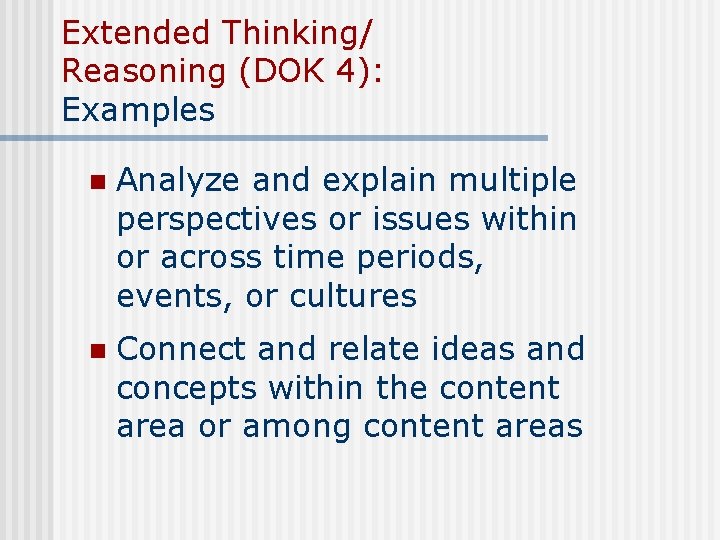
Extended Thinking/ Reasoning (DOK 4) n Requires complex reasoning, planning, and thinking generally over extended periods of time for the investigation or to complete the multiple steps of the assessment item
Extended Thinking/ Reasoning (DOK 4) • Extended time period is not a distinguishing factor if the required work is only repetitive and does not require applying significant conceptual understanding and higher-order thinking
Extended Thinking/ Reasoning (DOK 4): Examples n Analyze and explain multiple perspectives or issues within or across time periods, events, or cultures n Connect and relate ideas and concepts within the content area or among content areas
Practice Depth of Knowledge!!!
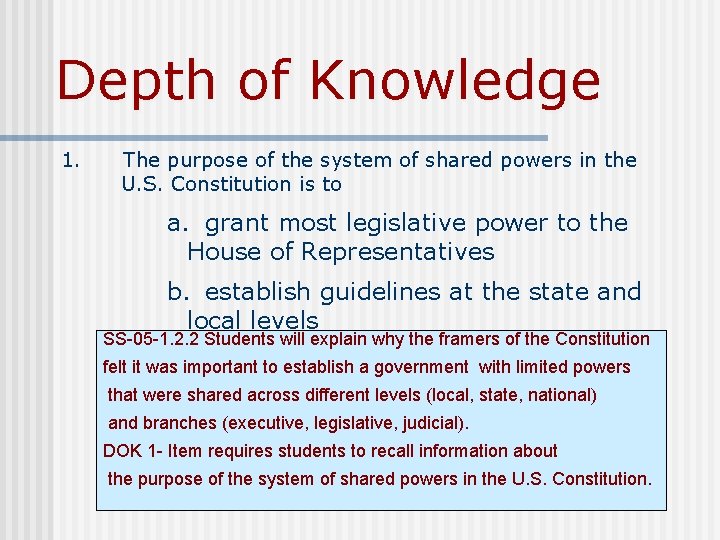
Depth of Knowledge 1. The purpose of the system of shared powers in the U. S. Constitution is to a. grant most legislative power to the House of Representatives b. establish guidelines at the state and local levels SS-05 -1. 2. 2 Students will explain why the framers of the Constitution c. important balance the interests power of felt it was to establish a governmentand with limited powers largeacross and different small levels states that were shared (local, state, national) and branches (executive, legislative, judicial). d. prevent any one branch of the DOK 1 - Item requires students to recall information about government from gaining too much the purpose of the system of shared powers in the U. S. Constitution. power.
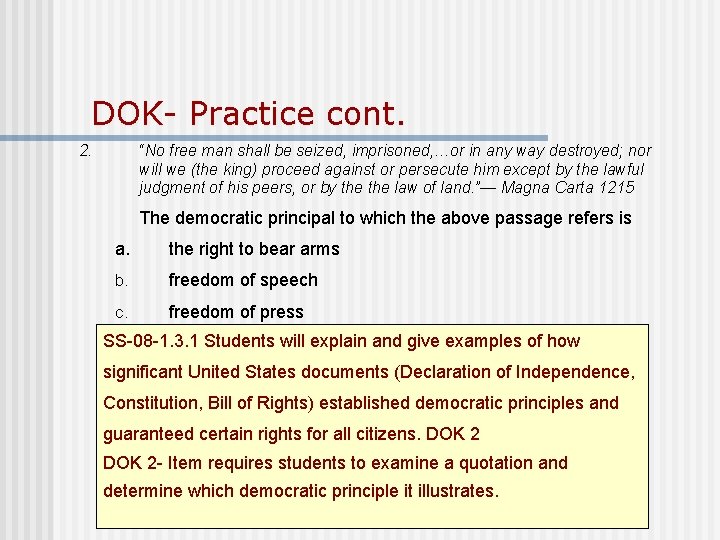
DOK- Practice cont. 2. “No free man shall be seized, imprisoned, …or in any way destroyed; nor will we (the king) proceed against or persecute him except by the lawful judgment of his peers, or by the law of land. ”— Magna Carta 1215 The democratic principal to which the above passage refers is a. the right to bear arms b. freedom of speech c. freedom of press SS-08 -1. 3. 1 Students will by explain d. the right to a trial jury and give examples of how significant United States documents (Declaration of Independence, Constitution, Bill of Rights) established democratic principles and guaranteed certain rights for all citizens. DOK 2 - Item requires students to examine a quotation and determine which democratic principle it illustrates.
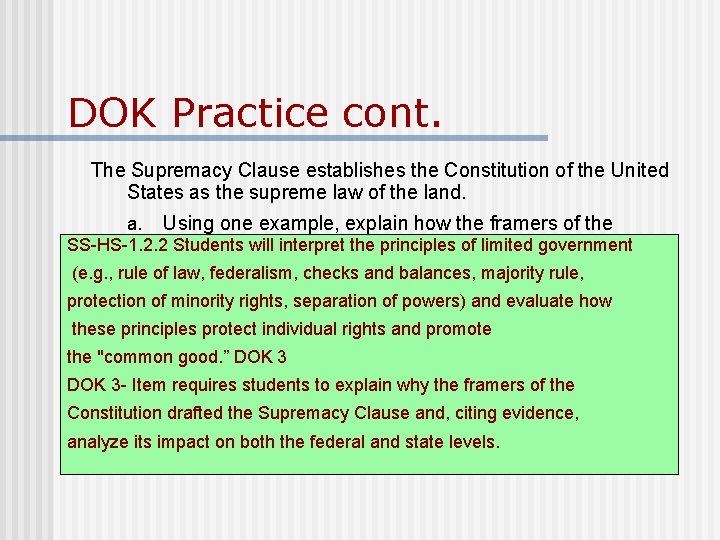
DOK Practice cont. The Supremacy Clause establishes the Constitution of the United States as the supreme law of the land. a. Using one example, explain how the framers of the SS-HS-1. 2. 2 Constitution Students willanticipated interpret the some principles of limited government of the problems associated the Supremacy (e. g. , rule ofwith law, federalism, when checksthey and drafted balances, majority rule, Clause. b. of. Citing evidence from at least one example, analyze protection minority rights, separation of powers) and evaluate how the impact of the Supremacy Clause of the Constitution on the workings of government at both the federal and state the "common good. ” DOK 3 level. these principles protect individual rights and promote DOK 3 - Item requires students to explain why the framers of the Constitution drafted the Supremacy Clause and, citing evidence, analyze its impact on both the federal and state levels.